
Labour analgesia 30 mark Question for anaesthesia MD Exam
labour analgesia 30 marks anaesthesia MD exam question answer 2024
Labour Analgesia — 30-Mark Model Answer (Anaesthesia MD Examination)
Introduction
1. Physiology and Pathways of Labour Pain (5 marks)
First Stage of Labour
- Pain is visceral in origin - from uterine contractions, cervical dilation, and lower uterine segment distension.
- Afferent impulses travel via the uterine and cervical plexuses through sympathetic nerves, entering the spinal cord at T10-L1.
- Character: crampy, poorly localised, referred to the umbilicus, lower abdomen, and lumbar region.
Second Stage of Labour
- Pain becomes somatic as the presenting part descends and distends the vagina, perineum, and pelvic floor.
- Afferent impulses travel via the pudendal nerve (S2-S4) and posterior cutaneous nerve of the thigh.
- Sensory block must extend from T10 to S4 to cover both stages.
Physiological Consequences of Untreated Labour Pain
| System | Effect |
|---|---|
| Respiratory | Minute ventilation increases up to 300%; PaCO2 may fall below 20 mmHg, causing fetal hypoxia between contractions |
| Cardiovascular | Cardiac output rises 45% above third-trimester values per contraction; surges to 80% above baseline immediately postpartum |
| Neuroendocrine | Catecholamine surge causes uterine vasoconstriction, reduced uteroplacental perfusion, fetal acidosis |
| Uterine | Extreme hyperventilation reduces uterine blood flow and promotes fetal acidosis |
2. Non-Pharmacological Methods (3 marks)
- Breathing techniques - Lamaze, Bradley method, LeBoyer technique
- Continuous labour support - doula or partner presence; Cochrane review of 26 trials (n=15,858) showed shorter labour, more spontaneous vaginal deliveries, less pharmacological analgesia
- Hydrotherapy (water immersion / warm bath)
- TENS (Transcutaneous Electrical Nerve Stimulation) - stimulates Aβ fibres, activates gate control mechanism
- Acupuncture/acupressure - Cochrane review of 28 RCTs (n=3,960): acupuncture minimally reduces labour pain and increases maternal satisfaction; acupressure showed no clear benefit over sham
- Massage - Cochrane review of 10 RCTs: reduces pain in first stage; increases sense of control
- Hypnosis - Cochrane review of 9 trials (n=2,954): reduced systemic analgesia use; no clear difference in neuraxial use
- Intradermal sterile water injections, aromatherapy, biofeedback
3. Pharmacological Methods
3a. Systemic Analgesics (4 marks)
Opioids
| Drug | Route | Dose | Notes |
|---|---|---|---|
| Meperidine (Pethidine) | IV / IM | 50 mg IV; 50–100 mg IM | Historically most used; active metabolite normeperidine half-life 13–23h (3x longer in fetus); lower Apgar scores; now rarely used |
| Morphine | IM | Latent labour | Significant sedation; active metabolite M6G prolonged in neonate |
| Fentanyl | IV PCA | 25–50 mcg bolus | Short-acting; better side effect profile; can cause transient FHR changes |
| Remifentanil | IV PCA | 20–40 mcg bolus | Ultra-short-acting; most suitable systemic opioid for PCA; risk of maternal apnoea - 1:1 nurse monitoring mandatory |
| Nalbuphine | IV/IM/SC | 10–20 mg q4-6h | Mixed agonist-antagonist; analgesic potency similar to morphine |
| Butorphanol | IV/IM | 1–2 mg | 5x more potent than morphine; 40x more than meperidine |
Non-opioid Systemic Agents
- Nitrous oxide (Entonox - 50% N2O + 50% O2) - self-administered via facemask at onset of contraction; rapid onset/offset; minimal uterine effects; provides mild-moderate analgesia; safe for fetus; widely used in the UK
- Low-dose ketamine (10–15 mg IV) - excellent analgesia in 2–5 min without loss of consciousness; most useful just prior to delivery or as adjuvant to regional; doses >1 mg/kg cause hypertonic uterine contractions
- Midazolam (≤2 mg IV) - anxiolytic adjunct to neuraxial blockade; chronic diazepam use associated with fetal depression
- NSAIDs - avoid in labour (premature closure of ductus arteriosus)
3b. Regional (Neuraxial) Techniques (12 marks)
"Using a local anaesthetic-opioid mixture for lumbar epidural analgesia during labor significantly reduces drug requirements when compared with using either agent alone." - Morgan & Mikhail, 7e
I. Epidural Analgesia
- Patient positioned sitting or left lateral; sterile technique
- Identify L3-L4 or L2-L3 interspace; loss of resistance technique (saline or air) for epidural space identification
- Test dose - 3 mL of 1.5% lidocaine + epinephrine 1:200,000; wait 5 minutes
- Tachycardia (+20-30 bpm) = intravascular placement
- Rapid dense motor/sensory block = intrathecal placement
- If test dose negative: administer 10-15 mL of LA-opioid mixture in 5 mL increments
- Place supine with left uterine displacement; monitor BP every 1-2 min for 15 min
- Bupivacaine 0.0625–0.1% + fentanyl 2 mcg/mL
- Ropivacaine 0.1% + fentanyl 2 mcg/mL (less motor block, safer cardiac profile than bupivacaine)
- Bupivacaine 0.125% + sufentanil 0.5–1 mcg/mL
- First stage: T10–L1
- Second stage: T10–S4
| Mode | Description | Advantage |
|---|---|---|
| Continuous Epidural Infusion (CEI) | Steady infusion | Stable block level |
| PCEA (Patient-Controlled Epidural Analgesia) | Patient self-delivers bolus | Reduced LA consumption, less motor block |
| PIEB (Programmed Intermittent Epidural Bolus) | Automated boluses at intervals | Better spread, less breakthrough pain; meta-analysis of 27 studies (n=3,133) showed reduced breakthrough pain, improved maternal satisfaction, decreased motor block |
| PCEA + PIEB | Combined | Best overall control |
II. Combined Spinal-Epidural (CSE) Analgesia
- Epidural needle placed in epidural space as standard
- Spinal needle (25G Whitacre or Sprotte pencil-point) passed through epidural needle until dural puncture confirmed by CSF
- Intrathecal injection of opioid ± low-dose LA
- Spinal needle withdrawn; epidural catheter threaded and secured
- Fentanyl 15–25 mcg (opioid alone - no motor block; "walking epidural")
- Sufentanil 5–7.5 mcg
- Bupivacaine 2.5 mg + fentanyl 15 mcg (excellent initial analgesia)
- Faster onset (2–5 minutes vs 20 min for epidural)
- Dense analgesia; particularly useful for advanced labour
- Low-dose intrathecal component preserves ambulation ("walking epidural")
- Epidural catheter allows top-up for prolonged labour or operative delivery
III. Spinal (Intrathecal) Analgesia
- Single-shot intrathecal opioid ± LA
- Provides rapid but time-limited analgesia (1.5–3 hours)
- "Saddle block" - hyperbaric tetracaine 3–4 mg or bupivacaine 2.5–5 mg + fentanyl 12.5–25 mcg for second stage/operative vaginal delivery
- Continuous spinal analgesia via intrathecal catheter: used after accidental dural puncture; provides excellent analgesia and utilises the wet tap
IV. Other Regional Techniques
- Blocks S2-S4 (pudendal nerve), covering perineum/vaginal outlet
- Technique: transvaginal injection beneath ischial spine through sacrospinous ligament, using Koback needle/Iowa trumpet guide; 10 mL of 1% lidocaine or 2% chloroprocaine per side
- Useful for second stage and perineal repair
- Complications: intravascular injection, retroperitoneal haematoma, retropsoas/subgluteal abscess
- Injections at 4 o'clock and 10 o'clock lateral to cervix
- Controls first-stage pain only
- No longer used for viable fetuses - high rate of transient fetal bradycardia (uterine artery proximity, direct fetal drug absorption); risk of injecting into fetal head
- Still used for intrauterine fetal demise, D&C, D&E procedures
4. Complications of Neuraxial Analgesia (4 marks)
| Complication | Incidence | Management |
|---|---|---|
| Hypotension (systolic <100 mmHg or >20% drop) | Most common | Phenylephrine 40–120 mcg IV bolus (first choice); ephedrine if bradycardia; left uterine displacement; IV fluid bolus; supplemental O2 |
| Inadvertent intravascular injection | Epidural catheter misplacement 5–15% | Epinephrine test dose; slow incremental dosing ≤5 mL; stop injection at first CNS signs (tinnitus, metallic taste, circumoral numbness) |
| Total spinal / High spinal | Inadvertent intrathecal injection | ABCDE resuscitation; RSI and intubation; vasopressors; left lateral tilt |
| Post-dural Puncture Headache (PDPH) | 0.5–2.5% | Conservative (caffeine, hydration, analgesics); epidural blood patch (gold standard) if not settling in 24-48h |
| Epidural haematoma | Rare | Avoid in coagulopathy; urgent MRI; neurosurgical decompression |
| Epidural abscess | Rare | Strict asepsis; IV antibiotics; surgical drainage |
| Fever/pyrexia | Epidural-associated fever | Acetaminophen; fever workup to exclude sepsis; neonatal sepsis workup if fever ≥38°C |
| Pruritus | Opioid-related | Naloxone 40–80 mcg IV (small doses); nalbuphine; ondansetron |
| Urinary retention | Common | Bladder catheterisation if needed |
| Motor block | LA dose-dependent | Use dilute LA solutions; PCEA/PIEB |
| Fetal bradycardia | CSE - transient | Usually resolves; repositioning; tocolysis (terbutaline) if persistent; prepare for emergency LSCS |
5. Effect on Labour and the Neonate (2 marks)
- Labour progress: Dilute LA-opioid combinations do NOT prolong labour or increase operative (caesarean or instrumental) delivery rates - this is a Class A evidence finding (Morgan & Mikhail, 7e)
- Fetus/Neonate: Neuraxial analgesia is vastly superior to systemic opioids for fetal safety; systemic opioids (especially meperidine/morphine) cross placenta and cause neonatal respiratory depression, lower Apgar scores, and neurobehavioural depression; neuraxial drugs - being highly dilute - have minimal neonatal effects
- Maternal catecholamines: Effective analgesia reduces catecholamines, improving uteroplacental perfusion
6. Contraindications to Neuraxial Analgesia
| Absolute | Relative |
|---|---|
| Patient refusal | Systemic infection/sepsis |
| Coagulopathy (INR >1.5, platelets <80,000) | Pre-existing neurological disease |
| Infection at injection site | Severe aortic/mitral stenosis |
| Hypovolaemic shock | Pharmacological anticoagulation |
| Raised intracranial pressure (mass effect) | Platelet 80,000-100,000 (individualised) |
| Inadequate expertise/resources | Uncorrected hypovolaemia |
Summary Table
| Technique | Level Blocked | Onset | Duration | Best For |
|---|---|---|---|---|
| Epidural (continuous) | T10–S4 | 20 min | Indefinite | Full labour + LSCS conversion |
| CSE | T10–S4 | 2–5 min | Indefinite (epidural) | Severe early pain; near delivery |
| Single-shot spinal | Saddle (S2–S5) | 3–5 min | 1.5–3 h | Second stage, instrumental delivery |
| Pudendal nerve block | S2–S4 | 5–10 min | 1–2 h | Perineal pain, second stage |
| IV Remifentanil PCA | Systemic | Immediate | Continuous | Neuraxial refused/contraindicated |
| Entonox (N2O/O2) | Systemic | 30–60 sec | Minutes | Mild-moderate, bridging |
Conclusion
- Miller's Anesthesia, 2-Volume Set, 10th Edition (Elsevier, 2023)
- Morgan & Mikhail's Clinical Anesthesiology, 7th Edition (McGraw Hill, 2022)
- Barash, Cullen & Stoelting's Clinical Anesthesia, 9th Edition
Anaesthesia for awake craniotomy
awake craniotomy anaesthesia technique asleep awake asleep dexmedetomidine 2024
Anaesthesia for Awake Craniotomy — Comprehensive MD Exam Answer
1. Introduction and Rationale
2. Indications
| Indication | Rationale |
|---|---|
| Tumours adjacent to eloquent cortex (primary motor/sensory, speech/language areas) | Allows real-time motor or speech mapping for safe maximal resection |
| Epilepsy surgery (temporal lobe epilepsy, cortical dysplasia) | Electrocorticography (ECoG), seizure focus localisation |
| Tumours near mesial temporal structures | Short-term memory mapping; Wada test alternatives |
| Arteriovenous malformations (AVMs) near eloquent cortex | Functional mapping before occlusion |
| Deep brain stimulation (DBS) electrode placement | Microelectrode recording and clinical response assessment |
| Stereotactic biopsy of eloquent regions | Neurological monitoring |
3. Presurgical Evaluation
Preoperative Neurological Workup
- Wada test (intracarotid sodium amobarbital test) - selective hemisphere anaesthesia to lateralise speech dominance and test bilateral memory representation
- Video-telemetry with EEG electrode placement - for epilepsy surgery, to record and localise ictal events
- Functional MRI (fMRI) / PET scan - non-invasive cortical mapping
- Neuropsychological baseline assessment - establishes cognitive/language function for intraoperative comparison
Patient Selection Criteria
- Motivated, cooperative, psychologically prepared patient
- Able to follow commands and communicate during testing
- No severe anxiety, claustrophobia, or panic disorder
- No obstructive sleep apnoea (high sedation risk with prone/lateral positions)
- No significant language barrier
- No uncontrolled cough, nausea, or movement disorders
- Severe anxiety or inability to cooperate (relative)
- Morbid obesity (airway management challenges with inaccessible airway)
- Obstructive sleep apnoea
- Uncontrolled cough or movement disorder
- Severe nausea or GERD
- Raised intracranial pressure with risk of herniation
- Children (generally not suitable; poor cooperation)
- Patients unable to understand the procedure
- Detailed explanation of all phases (most important - reduces anxiety and intraoperative failure)
- Psychological rehearsal ("walk-through") of the awake testing phase
- Consider anxiolytic premedication carefully - avoid benzodiazepines if ECoG-based seizure focus localisation is planned (anticonvulsant effect masks EEG activity)
- Anti-emetics (ondansetron, dexamethasone) - routine, especially if opioids are planned
- Anticonvulsants: continue or reduce by half depending on whether intraoperative EEG activation is needed
- NPO as per standard guidelines; IV access, arterial line
4. Anaesthetic Techniques
Technique 1: Monitored Anaesthesia Care (MAC) / Sedation Throughout ("Awake-Awake-Awake")
- Patient is sedated at a light-to-moderate level throughout
- Spontaneous ventilation maintained with unprotected airway
- Titrated sedation reduced during mapping phase
- Best for cooperative patients with good tolerance
Technique 2: Asleep-Awake-Asleep (AAA) with Supraglottic Airway (LMA)
- Most widely practiced technique
- Three distinct phases:
| Phase | Technique |
|---|---|
| Phase 1 - Asleep | GA induced; LMA inserted; controlled or spontaneous ventilation; craniotomy performed under GA |
| Phase 2 - Awake | Anaesthesia stopped; LMA removed when patient responsive; cortical mapping performed |
| Phase 3 - Asleep | LMA reinserted; anaesthesia resumed; tumour resection and wound closure |
- During the awake phase, the patient communicates with the neuropsychologist/surgeon
- LMA is preferred over ETT for easier removal and less stimulation
Technique 3: Asleep-Awake-Asleep with Endotracheal Tube (ETT)
- Customised ETTs with local anaesthetic installation in glottis/trachea allow awake extubation without cough
- Used when airway concerns preclude LMA
- More stimulating; technically demanding
- Reported but less commonly used than LMA technique
5. Scalp Nerve Block - The Cornerstone
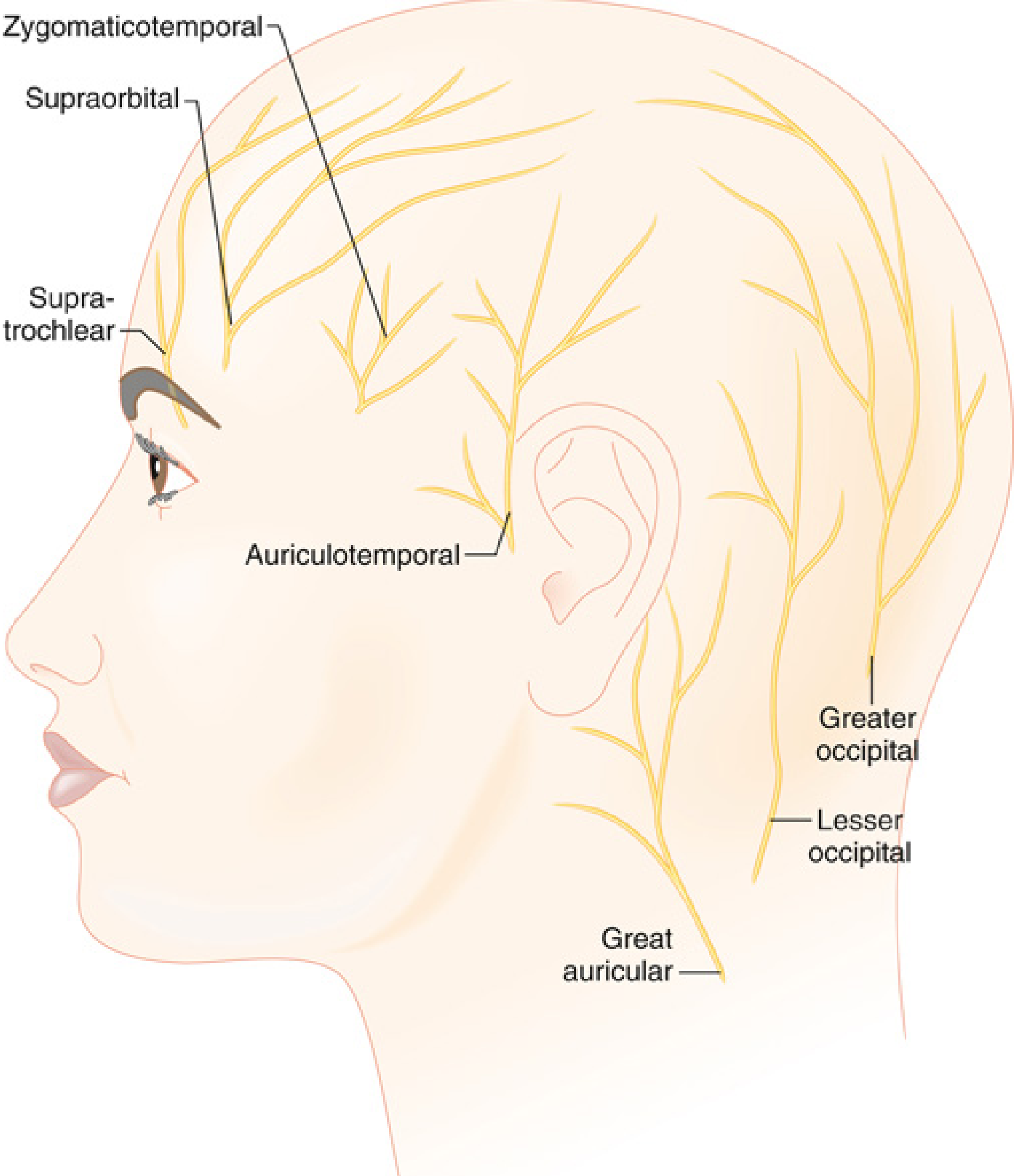
| Nerve | Origin | Area covered |
|---|---|---|
| Supratrochlear | V1 (ophthalmic) | Forehead medially |
| Supraorbital | V1 (ophthalmic) | Forehead laterally, anterior scalp |
| Zygomaticotemporal | V2 (maxillary) | Temporal region anteriorly |
| Auriculotemporal | V3 (mandibular) | Temporal region, lateral scalp |
| Lesser occipital | C2 | Posterior lateral scalp |
| Greater occipital (Great auricular) | C2-C3 | Posterior scalp, occiput |
- Unilateral (ipsilateral to craniotomy) or bilateral depending on incision
- Local anaesthetic: ropivacaine 0.5-0.75% or bupivacaine 0.25-0.5% with or without adrenaline
- Maximum dose calculations mandatory - volumes can be substantial when combined with surgeon's pin-site infiltration and dural infiltration
- Surgeon supplements with local infiltration of pin sites, skin incision, and dura (especially subtemporal dura - most painful area)
- The anesthesiologist must track cumulative LA dose to prevent toxicity
6. Sedation and Drug Regimens
- Minimise patient discomfort during painful phases (positioning, pinning, craniotomy)
- Ensure patient responsiveness and cooperation during mapping
- Minimal respiratory depression - airway inaccessible in pin fixation
- Minimal suppression of EEG activity (if ECoG planned)
- Rapid offset to allow prompt awakening for testing
Drug Options
A. Propofol-Based Regimens
- Propofol infusion (50-150 mcg/kg/min) - most widely used; rapid offset; excellent titrability
- Often combined with remifentanil (0.02-0.05 mcg/kg/min) for analgesia during painful phases
- Or combined with dexmedetomidine (0.2 mcg/kg/h)
- Critical limitation: Propofol must be discontinued at least 15 minutes before EEG/ECoG recording - it leaves a residual high-frequency, high-amplitude beta activity footprint that can obscure seizure activity
- Propofol + remifentanil: synergistic respiratory depression - great caution in pin-fixed patient
B. Dexmedetomidine-Based Regimens
- Dexmedetomidine (α2-adrenergic agonist): loading dose 0.5-1 mcg/kg over 10-20 min, then infusion 0.2-0.7 mcg/kg/h
- Key advantages:
- Sedation AND analgesia with minimal respiratory depression - safest agent for spontaneous ventilation
- Cooperative, arousable sedation - patients respond to verbal commands
- Does not suppress EEG - can be maintained during ECoG recording (0.1-0.5 mcg/kg/h during testing)
- Anxiolytic without full amnesia - patients remain cooperative
- Disadvantage: Bradycardia, hypotension; slower onset; occasional delays in arousal; less analgesic than opioid combinations
- Comparative study (Barash, 9e): propofol-remifentanil vs dexmedetomidine - similar sedation and mapping efficacy but lower rates of respiratory depression with dexmedetomidine
- Functional testing has been successfully performed with dexmedetomidine 0.1-0.2 mcg/kg/h during neurocognitive testing
C. Remifentanil Alone or Combinations
- Remifentanil infusion: excellent analgesia with rapid offset (context-sensitive half-life ~3 min); risk of respiratory depression and chest wall rigidity; requires vigilant monitoring
- Combination options:
- Propofol + remifentanil (most commonly used for MAC)
- Dexmedetomidine + remifentanil (excellent; minimal respiratory depression)
- Propofol + fentanyl + dexmedetomidine
D. Drugs to Avoid
| Drug | Reason |
|---|---|
| Benzodiazepines | Suppress EEG activity; interfere with seizure localisation; anticonvulsant; prolonged effect |
| Ketamine (high dose) | Psychomimetic effects; uncooperative patient; risk during mapping |
| Barbiturates (except therapeutic) | Suppress EEG; risk of apnoea |
| Nitrous oxide | Increases ICP; emesis; limited added benefit |
7. Monitoring
| Monitor | Rationale |
|---|---|
| Standard ASA monitors (SpO2, ECG, NIBP) | Baseline safety monitoring |
| Capnography (ETCO2) | Essential - breath-by-breath confirmation of airway patency and respiratory drive; detects apnoea before SpO2 falls, especially with deep sedation |
| Arterial line | Beat-to-beat BP monitoring; blood sampling; required when vasoactive drugs used |
| EEG/ECoG | Seizure focus localisation in epilepsy surgery |
| Neuropsychological testing | Continuous speech, motor, sensory assessment during cortical stimulation |
| Temperature | Procedures are lengthy; hypothermia possible |
| Urinary catheter | For long procedures |
| Peripheral nerve stimulator | If neuromuscular blockade used in AAA technique |
8. Intraoperative Phases and Management
Phase 1: Positioning and Pin Fixation
- Most painful phase (pericranium)
- Adequate scalp block before pin application
- Bolus sedation/analgesia at time of pinning
- Patient positioning critical: maximise neck extension and atlanto-occipital positioning before final head holder lockdown - this widens the airway and allows more latitude for sedation
- Visual access to patient's face must be maintained throughout - for speech testing (naming objects) and detecting motor responses during mapping
- Temperature management, pressure-area padding
Phase 2: Skin Incision and Craniotomy
- Moderately to deeply sedated
- Scalp block analgesia covering the incision
- Surgeon infiltrates incision line additionally
- Monitoring SpO2 and ETCO2 continuously
Phase 3: Dural Opening
- Subtemporal dura traction is particularly painful - ensure adequate dural infiltration with LA
- Commence reducing sedation in preparation for awake phase
- If LMA-based AAA: commence waking patient; remove LMA when responsive
Phase 4: Awake Cortical Mapping (Critical Phase)
- Patient fully awake and cooperative
- Electrocorticography (ECoG): cortical surface EEG to localise seizure foci
- If no spontaneous activity: provocative agents used
- Methohexital 0.3 mg/kg - safe, effective seizure activation agent
- Etomidate 0.05-0.1 mg/kg - alternative
- Alfentanil bolus 30-50 mcg/kg; Remifentanil 2.5 mcg/kg - under GA
- Hyperventilation - helps activate foci
- Direct cortical stimulation mapping: bipolar stimulator applied to brain surface
- Motor mapping: observe for movement in contralateral limbs/face
- Speech mapping: naming task (patient asked to name images) - speech arrest or errors indicate language cortex
- Sensory mapping: patient reports tingling/paraesthesia
- Dexmedetomidine can be maintained at low rates (0.1-0.2 mcg/kg/h) during mapping without interfering with testing
Phase 5: Tumour Resection and Closure
- Sedation resumed; LMA reinserted if AAA technique
- Anaesthesia for closure
9. Complications and Management
| Complication | Incidence | Management |
|---|---|---|
| Intraoperative seizures | ~3-10% | Cold saline irrigation of cortex (first line); cease stimulation; propofol 0.5-1 mg/kg IV increments (wait briefly to see if self-limiting before giving propofol - propofol suppresses EEG); if refractory: benzodiazepines as last resort |
| Airway obstruction / Apnoea | ~1-5% | Jaw thrust; nasopharyngeal airway; reduce/stop propofol/remifentanil; emergency LMA/ETT - severely hindered by pin-fixed head; prevention critical |
| Respiratory depression | Common with propofol + opioids | Verbal stimulation; reduce sedation; supplemental O2; ETCO2 monitoring |
| Uncooperative / agitated patient | ~5% | Reassurance; repositioning; small propofol bolus; abort to GA if necessary |
| Nausea and vomiting | Common with opioids | Prophylactic ondansetron + dexamethasone; avoid/minimise opioids |
| Uncontrolled pain | Inadequate scalp block | Supplemental LA by surgeon; small ketamine boluses; fentanyl bolus |
| Intractable brain oedema | Rare | Mannitol, hyperventilation, head-up position, steroids; may require GA conversion |
| Haemodynamic instability | Dexmedetomidine bradycardia; catecholamine surges | Atropine for bradycardia; ephedrine/phenylephrine for hypotension |
| Conversion to GA | ~2-8% | Pre-planned emergency GA plan; video laryngoscope available; RSI with appropriate head position strategies |
| Post-dural puncture headache | N/A for craniotomy | N/A |
| Postoperative neurological deficit | From resection | PACU or ICU monitoring; post-op neurological assessment |
10. Postoperative Management
- PACU or ICU observation (neurological observations every 15-30 min initially)
- Multimodal analgesia: paracetamol, NSAIDs (cautiously), scalp infiltration of long-acting LA
- Nausea prophylaxis continued
- Anticonvulsant medication maintained/resumed
- Monitoring for: delayed seizures, neurological deterioration, haematoma (headache, reduced GCS), raised ICP, pneumocephalus
- Steroids (dexamethasone) to reduce cerebral oedema
- VTE prophylaxis when appropriate
11. Summary Comparison - Anaesthetic Approaches
| Technique | Airway | Sedation | Best For |
|---|---|---|---|
| MAC throughout | Unprotected, spontaneous | Propofol ± remifentanil ± dex | Cooperative patient; short procedures |
| AAA - LMA | LMA Phase 1&3; unprotected Phase 2 | Propofol ± remifentanil ± dex | Most cases; flexible |
| AAA - ETT | ETT Phase 1; unprotected Phase 2; ETT Phase 3 | GA then emergence | High aspiration risk; obese patients |
| Dex + remifentanil MAC | Unprotected | Dex + remifentanil | ECoG-based procedures; respiratory risk |
Key Examination Points
- The essential element is the scalp nerve block - sedation cannot compensate for inadequate local anaesthesia
- Six nerves of the scalp must be blocked: supratrochlear, supraorbital, zygomaticotemporal, auriculotemporal, lesser occipital, greater occipital
- Propofol must be stopped ≥15 min before ECoG - residual beta activity obscures seizure focus
- Dexmedetomidine advantage: sedation + analgesia with minimal respiratory depression; can be maintained during mapping at 0.1-0.2 mcg/kg/h
- Capnography is essential - airway is all but inaccessible with head in pin fixation
- Avoid benzodiazepines as premedication if ECoG is planned
- Seizures during mapping - cold saline first; then propofol 0.5-1 mg/kg; wait before giving propofol in case self-limiting
- Conversion to GA is pre-planned - video laryngoscope must be immediately available
- Miller's Anesthesia, 2-Volume Set, 10th Edition (Chapter 53: Awake Craniotomy and Seizure Surgery)
- Barash, Cullen & Stoelting's Clinical Anesthesia, 9th Edition (Chapter: Awake Craniotomy)
- Morgan & Mikhail's Clinical Anesthesiology, 7th Edition
Brain Death And Organ Harvesting 30 mark Question
brain death criteria diagnosis organ harvesting anaesthesia management 2024 guidelines
https://www.transplant.bc.ca/Documents/Health%20Professional…
Brain Death and Organ Harvesting — 30-Mark Model Answer (Anaesthesia MD Examination)
1. Definition and Historical Context
- First codified by the Harvard Ad Hoc Committee in 1968, following the world's first cardiac transplant by Dr Christiaan Barnard in 1967
- Incorporated into the Uniform Determination of Death Act (USA) and legally recognised in most countries
- The legal time of death is the moment the apnoea test confirms PaCO2 criteria are met in the absence of any respiratory effort
- Equivalent terms: death by neurological criteria (DNC), brain stem death (BSD - UK terminology)
2. Causes of Brain Death
| Category | Examples |
|---|---|
| Traumatic | Severe traumatic brain injury (TBI) - most common |
| Vascular | Aneurysmal subarachnoid haemorrhage (aSAH), massive intracerebral haemorrhage, ischaemic stroke with herniation |
| Anoxic-ischaemic | Cardiac arrest with prolonged resuscitation |
| Infective/Inflammatory | Fulminant meningitis/encephalitis |
| Metabolic | Fulminant hepatic failure with cerebral oedema |
| Mass lesions | Large tumour with uncontrollable herniation |
3. Prerequisites Before Brain Death Testing (5 marks)
A. Establish Irreversible Cause of Coma
- Known, structural, irreversible catastrophic neurological injury
- Neuroimaging (CT/MRI) explains the coma
- Patient has received aggressive treatment (osmotherapy, ICP management, surgery) and further treatment is futile
B. Exclude Confounding Conditions
| Confounder | Requirement |
|---|---|
| Hypothermia | Core temperature must be ≥36°C |
| Drug intoxication | Sedatives, hypnotics, opioids, anaesthetic agents must be excluded; toxicology screen if uncertain; wait appropriate elimination time (usually 5 half-lives) |
| Neuromuscular blocking agents | Confirm complete reversal using train-of-four peripheral nerve stimulator (4/4 twitches) |
| Metabolic disturbances | Correct severe electrolyte abnormalities, acid-base disturbances, hypoglycaemia |
| Severe cardiovascular instability | Systolic BP must be ≥100 mmHg before testing |
| Pharmacological paralysis | No residual neuromuscular blockade |
C. Qualified Examiners
- Two independent doctors (in most countries) - neither involved in transplant team
- Senior physicians (consultant/attending) qualified in neurology, neurosurgery, or intensive care
- Two separate examinations, separated by an appropriate observation period (institution-dependent)
4. Clinical Examination for Brain Death (8 marks)
A. Level of Consciousness
- Unresponsive to all stimuli
- No purposeful motor response to painful stimulation (deep pressure on condyles of TMJ, supraorbital notch, nail beds, sternal rub)
- Motor responses from spinally-mediated reflexes (Lazarus sign - arms rising and meeting midline) may still occur and are not incompatible with brain death, but require explanation
- Decerebrate or decorticate posturing IS incompatible with brain death
B. Brainstem Reflexes - All Must Be Absent Bilaterally
| Reflex | Cranial Nerve | Test | Brain Death Finding |
|---|---|---|---|
| Pupillary light reflex | CN II, III | Bright light to each eye | Fixed, dilated pupils (4-9mm); no constriction bilaterally |
| Corneal reflex | CN V, VII | Cotton/suction catheter touches cornea | No blink bilaterally |
| Oculocephalic reflex (Doll's eye) | CN III, VI, VIII | Rapid head turning (contraindicated if C-spine injury) | Eyes remain fixed (no conjugate movement) |
| Oculovestibular reflex (Caloric) | CN VIII, III, VI | Head at 30°; 50 mL ice water instilled in each ear; wait 5 min between sides; observe 1 min | No eye deviation toward irrigated side bilaterally |
| Gag reflex | CN IX, X | Stimulate posterior oropharynx | Absent gag |
| Cough reflex | CN X | Suction catheter passed to carina | Absent cough |
| Grimace to pain | CN V, VII | Noxious stimulation to face | No grimacing |
- Nystagmus or spontaneous eye movements
- Conjugate eye deviation
- Pinpoint pupils (suggests opioid effect)
- Decerebrate/decorticate posturing
- Grimacing to pain
C. Apnoea Test
- Systolic BP ≥100 mmHg (vasopressors if needed)
- PaO2 ≥200 mmHg (pre-oxygenate with 100% O2 for 10 minutes)
- Normalise PaCO2 to baseline (35-45 mmHg) by adjusting ventilator
- Obtain baseline ABG confirming normocapnia and adequate oxygenation
- Disconnect from ventilator
- Deliver 100% O2 via catheter at carina level (6 L/min) - apnoeic oxygenation maintains SpO2
- Observe for any respiratory effort (chest/abdominal excursion, gasping) for 8-10 minutes
- Obtain ABG at end of observation period
- No respiratory effort is observed AND
- PaCO2 ≥60 mmHg OR a rise of ≥20 mmHg from a normal baseline PaCO2
- SpO2 falls below 85-90% (despite apnoeic oxygenation)
- Severe haemodynamic instability (hypotension, severe arrhythmia)
- In these cases, proceed to ancillary/confirmatory tests
5. Ancillary (Confirmatory) Tests
- Clinical exam cannot be completed (e.g., severe facial trauma, severe lung disease preventing apnoea test)
- Confounders cannot be fully excluded
- Legal or institutional requirements
- Religious/cultural objections to clinical criteria alone
| Test | Finding in Brain Death | Notes |
|---|---|---|
| EEG | Electrocerebral silence (isoelectric - no potentials >2 mV over 30 min recording, ≥8 electrodes) | Can be falsely isoelectric with hypothermia, drug overdose; does NOT confirm brainstem death alone |
| Cerebral angiography (4-vessel) | Absent intracranial blood flow | Gold standard; invasive |
| CT Angiography (CTA) | Absent intracranial circulation | Non-invasive; preferred in many centres |
| Radionuclide Scintigraphy (HMPAO-SPECT) | No cerebral perfusion ("hollow skull sign") | Useful when CTA unavailable |
| Transcranial Doppler (TCD) | Reverberant flow/systolic spikes only; no net flow | Non-invasive; operator-dependent; technical pitfalls |
| Brainstem Auditory Evoked Potentials (BAEPs) | Absent waves III-V | Tests brainstem conduction |
| Somatosensory Evoked Potentials | Absent cortical N20 | Supplements EEG |
6. Communication with Family
- Family should not be surprised by brain death - they should have been counselled about the prognosis from the time of severe brain injury
- Announcement: "Your loved one has died but is being supported by machines"
- Organ donation discussion occurs separately from the brain death declaration - by organ procurement organisation (OPO) personnel, not the treating team
- In the USA: federal law requires physician to contact the OPO
- Cultural/religious sensitivity mandatory - some faiths (Orthodox Jewish, Japanese tradition) may not accept brain death criteria
- Family refusal remains a major cause of lost donor potential
7. Types of Organ Donation
A. Donation After Brain Death (DBD)
- Heart-beating donor
- Optimal organ quality (warm ischaemia avoided)
- Allows time for full evaluation and multiple organ procurement
- Accounts for ~70% of deceased donors (USA)
B. Donation After Circulatory (Cardiac) Death (DCD)
- Non-heart-beating donor
- Maastricht Classification:
| Category | Description | Type |
|---|---|---|
| I | Dead on arrival | Uncontrolled |
| II | Unsuccessful resuscitation | Uncontrolled |
| III | Imminent cardiac arrest (planned withdrawal of life support) | Controlled |
| IV | Cardiac arrest in brain-dead donor | Controlled |
- Controlled DCD (Cat III) most common: life support withdrawn in OT; organ procurement begins after 5-minute "no-touch" period of confirmed cardiac arrest
- Warm ischaemia time is longer in uncontrolled DCD - reduces organ quality
- DCD accounted for 30.2% of deceased donors in USA in 2021 (Miller's Anesthesia, 10e)
8. Pathophysiology Following Brain Death - "The Catecholamine Storm" (4 marks)
Phase 1: Autonomic Storm (Cushing Response/Catecholamine Surge)
- As intracranial pressure rises and herniation occurs, brainstem ischaemia triggers an intense sympathetic discharge
- Plasma catecholamines rise 10-100x above baseline
- Cardiovascular effects: severe hypertension, tachycardia, arrhythmias, myocardial ischaemia, reversible left ventricular dysfunction (catecholamine cardiomyopathy)
Phase 2: Post-Herniation Cardiovascular Collapse
- Loss of sympathetic tone → systemic vasodilation, increased venous capacitance, relative hypovolaemia
- Exacerbated by prior osmotherapy (mannitol), diuresis, and inadequate fluid resuscitation
- Progressive hypotension requiring vasopressors
Phase 3: Hypothalamic-Pituitary Axis Disruption
| Derangement | Mechanism | Clinical Effect |
|---|---|---|
| Central diabetes insipidus (DI) | Loss of ADH (vasopressin) | Massive polyuria, hypernatraemia, hyperosmolaemia |
| Thyroid hormone deficiency | Loss of TSH | Reduced cardiac contractility, metabolic suppression |
| Adrenocortical failure | Loss of ACTH/cortisol | Haemodynamic instability, electrolyte disturbances |
| Insulin deficiency/resistance | Loss of hypothalamic regulation | Hyperglycaemia |
Phase 4: Systemic Consequences
- Hypothermia - loss of hypothalamic temperature regulation
- Coagulopathy - DIC from thromboplastin release from injured brain
- Pulmonary oedema - neurogenic (sympathetic storm) + aspiration risk
- Anaemia - from haemorrhage, haemodilution
- Infection - ICU-acquired, aspiration pneumonia
9. ICU Management of the Brain-Dead Organ Donor (5 marks)
The "Rule of 100s" (Trauma Surgery guideline)
- Systolic BP >100 mmHg
- Urine output >100 mL/h
- PaO2 >100 mmHg
A. Haemodynamic Goals
| Parameter | Target |
|---|---|
| Mean Arterial Pressure (MAP) | ≥60-70 mmHg |
| Systolic BP | >100 mmHg |
| CVP | 6-10 mmHg (4-8 for lung-optimised protocol) |
| Heart rate | 60-100/min |
| Cardiac index | >2.4 L/min/m² |
| Mixed venous O2 saturation | >60% |
- Vasopressors: Noradrenaline (norepinephrine) first choice; vasopressin has dual benefit (vasopressor + treats DI); avoid high-dose dopamine
- Fluid resuscitation: balanced crystalloids; albumin; avoid synthetic starches
- Inotropes (dopamine, dobutamine) if cardiogenic dysfunction
B. Respiratory Goals (Critical for Lung Donation)
| Parameter | Target |
|---|---|
| SpO2 | >95% |
| PaO2 | >100 mmHg |
| PaCO2 | 35-45 mmHg |
| TV | 6-8 mL/kg (lung-protective) |
| PEEP | 5-8 cm H2O |
| FiO2 | Minimum to achieve target SpO2 |
- Frequent suctioning; HOB 30-45°; avoid ventilator-associated pneumonia
- Lung-protective ventilation critical for lung procurement
C. T4 Hormonal Resuscitation Protocol
| Drug | Dose | Purpose |
|---|---|---|
| Methylprednisolone | 15 mg/kg IV bolus | Anti-inflammatory; adrenal replacement; improves lung function |
| Tri-iodothyronine (T3) or Thyroxine (T4) | T3: 4 mcg bolus then 3 mcg/h; or T4: 20 mcg bolus then 10 mcg/h | Restores cardiac contractility; reverses metabolic suppression |
| Vasopressin (ADH) | 0.5-2.4 U/h infusion | Treats DI; vasopressor; reduces noradrenaline requirements |
| Insulin | Titrated to glucose 6-10 mmol/L | Glycaemic control; reduces ischaemia-reperfusion injury |
D. Specific Organ Targets
| System | Management |
|---|---|
| Kidneys | Adequate MAP and urine output (>1 mL/kg/h); avoid nephrotoxins; optimise fluid balance |
| Heart | Treat arrhythmias; maintain sinus rhythm; avoid high-dose inotropes; echocardiography to assess function |
| Liver | Normalise glucose; avoid hepatotoxic drugs; maintain adequate perfusion |
| Lungs | Lung-protective ventilation; apnoeic oxygenation trials; bronchoscopy if secretions |
| Pancreas | Glycaemic control; maintain perfusion |
| Corneas/Skin | Clock starts on BD declaration - can retrieve up to 24h later |
E. Diabetes Insipidus Management
- Urine output >3-4 mL/kg/h + rising serum Na+ + low urine osmolality (hypotonic)
- Vasopressin (desmopressin DDAVP 0.5-2 mcg IV q6h, or vasopressin infusion)
- Replace fluid losses with 0.45% NaCl or 5% dextrose
- Target sodium: 130-155 mmol/L
10. Anaesthesia for Organ Procurement (Harvesting) in the Operating Theatre (6 marks)
Role of the Anaesthesiologist
- Verify the brain death certificates
- Confirm family consent is in order
- Confirm no absolute contraindications to donation (e.g., active HIV, active malignancy)
- Continue ICU-level haemodynamic support
- Manage spinal reflexes and haemodynamic responses to surgical stimulation
Why Anaesthesia is Required Despite Brain Death?
- Spinal cord reflexes remain intact and may cause gross movements (Lazarus reflex, limb movements) during surgical stimulation, which is distressing to the surgical team
- Haemodynamic reflexes - surgical stimulation can cause spinal-sympathetic reflex responses: hypertension and tachycardia (without pain perception), which can worsen catecholamine-mediated organ injury
- Volatile agents may provide ischaemic preconditioning - theoretical benefit for organ protection
- Muscle relaxants provide optimal surgical conditions
"Neuromuscular blockade required to inhibit spinal motor reflexes... volatile anaesthetics due to theoretical advantage of ischaemic preconditioning... brain death may cause haemodynamic response to noxious stimuli; hypertension should be avoided." (BC Transplant Anaesthesia Guidelines, 2024)
Monitoring in OT
| Monitor | Rationale |
|---|---|
| Standard ASA monitoring | ECG, SpO2, ETCO2, NIBP |
| Arterial line | Beat-to-beat BP; ABGs; rapid responses to instability |
| Central venous catheter | CVP monitoring; vasopressor/inotrope delivery |
| Urinary catheter | Hourly urine output |
| Temperature | Hypothermia prevention |
| Peripheral nerve stimulator | Confirm NMB |
| Hourly ABG, electrolytes, glucose, lactate | Organ protection |
Anaesthetic Technique
- Neuromuscular blockade (NMB): suxamethonium/rocuronium; maintain throughout
- Volatile anaesthetic (isoflurane/sevoflurane): 0.5-1 MAC - suppresses spinal motor reflexes; ischaemic preconditioning
- Opioids (fentanyl): to attenuate haemodynamic responses to incision - not for analgesia (brain dead) but to reduce reflex hypertension
- Continue vasopressors and inotropes as per ICU management
- Ventilation: lung-protective strategy as per ICU
| Parameter | Target |
|---|---|
| MAP | >60 mmHg |
| Systolic BP | >100 mmHg |
| Heart rate | 60-100/min |
| CVP | 6-10 mmHg initially; reduced to 4-6 mmHg after heart/lung procurement; raised to 10-12 mmHg for kidney procurement |
| Urine output | >1 mL/kg/h |
| Temperature | >35°C |
- Continue vasopressin infusion for DI
- Insulin to maintain glucose 6-10 mmol/L
- Methylprednisolone if not already given
- NAC (N-acetylcysteine) 30 mg/kg 1 hour before procurement; 300 mg via portal vein before cross-clamp - shown to improve graft survival
- Prophylactic broad-spectrum antibiotics (cephalosporin)
- Heparin IV bolus (300-400 units/kg) before aortic cross-clamping - to prevent vascular thrombosis during cold flush
Surgical Sequence (Multi-organ Procurement)
- Midline incision - suprasternal notch to pubis
- Thoracic dissection - heart, lungs mobilised
- Abdominal dissection - liver, pancreas, kidneys, bowel
- Heparin given before cross-clamping
- Aortic cross-clamp (supradiaphragmatic) + cold perfusion with preservation solution begins
- At cross-clamp: all vasopressors ceased; ventilator stopped
- Cardioplegia for heart
- Sequential organ removal in order of ischaemia tolerance:
- Heart (most sensitive - 4h cold ischaemia)
- Lungs (6h cold ischaemia)
- Liver (12-24h)
- Pancreas (12-24h)
- Kidneys (24-36h)
- Intestines (8-12h)
- Corneas, skin, bones - post-cardiac death
11. Donation After Circulatory Death (DCD) - Anaesthetic Implications
- Life support withdrawn in OT (Maastricht III) - comfort care drugs (morphine, midazolam) given to relieve any distress
- No-touch period of 2-5 minutes after cardiac arrest (permanent cardiac arrest confirmed)
- Rapid organ retrieval begins immediately after no-touch period
- Warm ischaemia time is the critical variable - shorter warm ischaemia = better organ outcomes
- Ex-vivo machine perfusion (normothermic or hypothermic) increasingly used to recondition DCD organs
12. Ethical and Legal Considerations
| Issue | Principle |
|---|---|
| Dead donor rule | Organs must not be retrieved until death is declared; death must not be caused by organ procurement |
| Consent | Informed consent from next-of-kin; donor card/advance directive |
| Separation of teams | Brain death declaration team ≠ transplant team |
| Non-maleficence | Comfort care not withheld for organ-preservation purposes in DCD |
| Justice | Equitable organ allocation (UNOS/OPTN in USA; NOTTO in India) |
| Cultural/religious sensitivity | Orthodox Judaism, some Asian cultures may reject brain death criteria; requires cultural intermediaries |
| Medicolegal | In medicolegal cases, permission from appropriate authority required before procurement |
13. Summary - Key Examination Points
- Harvard criteria 1968 - first formalised brain death; 25 assessments required
- Three absolute requirements for brain death: deep coma (known irreversible cause) + all brainstem reflexes absent + apnoea test positive (PaCO2 ≥60 mmHg or rise ≥20 mmHg, no respiratory effort)
- Five confounders to exclude before testing: hypothermia, drugs, NMB, metabolic, hypotension
- Ancillary tests (EEG, CTA, SPECT, TCD) - not routinely required; used when clinical exam incomplete
- Catecholamine storm → haemodynamic collapse → hypothalamic-pituitary failure → DI, hypothyroidism, adrenal failure
- T4 protocol: methylprednisolone + T3/T4 + vasopressin + insulin
- Anaesthesia in OT: NMB + volatile agent + opioids = suppress spinal reflexes + haemodynamic responses; NOT for consciousness (brain dead)
- CVP strategy: low (4-8) during heart/lung harvesting; raise (10-12) for kidney procurement
- Dead donor rule and separation of teams are non-negotiable ethical principles
- DCD donors now account for 30% of deceased donors in the USA; Maastricht classification
- Miller's Anesthesia, 2-Volume Set, 10th Edition
- Bradley & Daroff's Neurology in Clinical Practice, 8th Edition
- Plum & Posner's Diagnosis and Treatment of Stupor and Coma, 5th Edition
- Mulholland & Greenfield's Surgery: Scientific Principles and Practice, 7th Edition
- BC Transplant - Anesthesia for Donors following Death by Neurological Criteria (2024)
- NOTTO (National Organ & Tissue Transplant Organisation) India - OT Guidelines
Shivering 10 marks question
postoperative shivering anaesthesia causes pathophysiology treatment meperidine clonidine grading
https://pmc.ncbi.nlm.nih.gov/articles/PMC5931188
Shivering in Anaesthesia — 10-Mark Model Answer (Anaesthesia MD Examination)
1. Definition
2. Physiology of Normal Thermoregulation
- Peripheral thermoreceptors (skin - warm and cold receptors)
- Central thermoreceptors (hypothalamus, spinal cord, deep abdominal structures)
- Behavioural thermoregulation (moving, dressing, seeking warmth)
- Peripheral vasoconstriction (reduces heat loss by ~25%)
- Shivering (increases heat production by 2-5 times above basal metabolic rate)
- Non-shivering thermogenesis (brown fat activation - mainly in neonates)
3. Causes of Perioperative Shivering
A. Thermoregulatory (Primary) - Most Common
| Phase | Mechanism | Time |
|---|---|---|
| Phase 1 - Redistribution | Anaesthesia causes peripheral vasodilation → core heat redistributes to periphery → rapid core temperature drop of 1-1.5°C | First 30-60 min |
| Phase 2 - Linear heat loss | Heat loss exceeds heat production (radiation, convection, evaporation, conduction) | Next 2-3 hours |
| Phase 3 - Plateau | Vasoconstriction at lower threshold limits further heat loss | After 3-4 hours |
- Cold operating room environment (standard OT: 20-22°C)
- Cold IV fluids and blood products
- Exposed body cavities (laparotomy, thoracotomy)
- Cold anaesthetic gases (unhumidified)
- Regional anaesthesia (sympathetic block → vasodilation, impaired thermosensation in blocked area)
- Extremes of age (elderly, neonates - impaired thermoregulation)
- Prolonged surgery
- Thin body habitus / low BMI
B. Non-Thermoregulatory (Secondary) Mechanisms
- Cortical disinhibition - anaesthetic agents suppress spinal cord interneurons that normally inhibit reflex muscular activity; on emergence, these reflexes are briefly disinhibited
- Altered pain modulation - especially relevant to epidural/spinal analgesia
- Pyrogen-mediated - inflammatory cytokines (fever shivering)
- Reduced serotonin, noradrenaline, and opioid neurotransmission during anaesthetic recovery - explains why drugs acting on these pathways (meperidine, clonidine, tramadol) are effective
- Neuraxial anaesthesia-specific: cold LA solutions injected into epidural/subarachnoid space → thermoreceptors in spinal cord stimulated; false signal of peripheral cooling despite normal core temperature
4. Grading / Classification of Shivering
| Grade | Description |
|---|---|
| 0 | None |
| 1 | Mild - localised to neck, thorax only; detected only by palpation |
| 2 | Moderate - gross muscle movement limited to one extremity |
| 3 | Severe - gross movement involving more than one extremity or trunk |
| Grade | Description |
|---|---|
| 0 | No shivering |
| 1 | Piloerection/peripheral vasoconstriction only; no visible muscular activity |
| 2 | Visible muscular activity in one muscle group only |
| 3 | Visible muscular activity in more than one muscle group |
| 4 | Whole body violent shivering |
5. Consequences of Shivering
| System | Effect |
|---|---|
| Metabolic | Oxygen consumption increases 200-500% (up to 5x basal); can dislodge skin grafts |
| Cardiovascular | Cardiac output increases; HR and BP increase; catecholamine release - risk of myocardial ischaemia in coronary artery disease |
| Neurological | Raised intracranial pressure (ICP); raised intraocular pressure (IOP) - hazardous post-ophthalmic or neurosurgery |
| Haemostasis | Worsens coagulopathy (hypothermia-induced) |
| Wound | Impairs wound healing; increases infection risk |
| Respiratory | Increased CO2 production; hypoxaemia if demand exceeds supply |
| Surgical | Dislodges surgical dressings, grafts, drains |
| Patient comfort | Distress, pain at incision site, worsens PONV |
| PACU | Prolongs PACU stay; increases costs |
6. Prevention of Perioperative Shivering
A. Passive Warming
- Warm blankets; cotton or thermal covers
- Increase ambient OT temperature (especially in paediatrics and burns)
- Minimise exposed surface area
B. Active Warming (Most Effective)
- Forced-air warming blankets (Bair Hugger) - gold standard; most effective convective warming; 30 min pre-warming before induction ("pre-warming") significantly reduces redistribution hypothermia
- Underbody water mattresses - convection heating; highly effective
- Warmed IV fluids - fluid warmers for all large-volume IV fluids and blood products
- Warm humidified anaesthetic gases - reduces respiratory heat loss
- Warm skin preparation solutions - avoid cold antiseptic pooling on skin
C. Pharmacological Prevention
- Meperidine (Pethidine) 0.5-1 mg/kg IV - most studied; highly effective
- Dexmedetomidine - α2-agonist; pre-operative infusion reduces shivering
- Ondansetron 8 mg IV - via 5-HT3 blockade
- Intrathecal/epidural additives - sufentanil, clonidine added to neuraxial solutions reduce post-spinal shivering
7. Treatment of Established Shivering
A. Non-Pharmacological
- Supplemental oxygen (high-flow face mask) - counteract increased O2 demand
- Active external warming: warm blankets, forced-air warmer
- Temperature monitoring; treat underlying hypothermia
B. Pharmacological Treatment
| Drug | Dose | Mechanism | Notes |
|---|---|---|---|
| Meperidine (Pethidine) | 25-50 mg IV (0.35-0.5 mg/kg) | κ (kappa) opioid agonist + serotonin/noradrenaline reuptake inhibition; specific anti-shivering effect beyond mere sedation | Gold standard; most effective single agent; reduces shiver threshold; onset ~2-3 min |
| Clonidine | 75-150 mcg IV | Central α2-adrenergic agonist; reduces thermoregulatory threshold | Effective; causes sedation, hypotension, bradycardia |
| Tramadol | 1-2 mg/kg IV | Weak opioid + serotonin/noradrenaline reuptake inhibitor | Effective; less respiratory depression than meperidine; nausea common |
| Dexmedetomidine | 0.5-1 mcg/kg IV over 10 min | α2-agonist | Effective; useful in ICU setting; bradycardia risk |
| Ketamine | 0.5-0.75 mg/kg IV | NMDA antagonist + opioid-like shivering threshold reduction | Comparable to meperidine; psychomimetic effects |
| Ondansetron | 8 mg IV | 5-HT3 antagonist | Less potent; useful when opioids contraindicated |
| Magnesium sulphate | 30-50 mg/kg IV | NMDA antagonist; vasodilation; calcium antagonism | Modest efficacy; useful adjunct |
| Physostigmine | 0.04 mg/kg IV | Cholinesterase inhibitor | Historical; rarely used |
| Nefopam | 20 mg IV | Non-opioid; serotonin/dopamine reuptake inhibitor | Effective; not widely available in all centres |
8. Special Situations
| Situation | Consideration |
|---|---|
| Post-spinal/epidural shivering | Very common (cold LA, loss of thermosensation); clonidine in spinal mix reduces incidence; treat with IV meperidine |
| Elderly patients | Shivering paradoxically less common (impaired thermoregulatory response); but consequences more severe (cardiovascular) |
| Neonates/infants | Non-shivering thermogenesis predominates; prone to rapid hypothermia; aggressive warming essential |
| Cardiac surgery | Rewarming phase on CPB commonly causes shivering; increases O2 demand when most vulnerable |
| Neurosurgery | Raised ICP from shivering; treat aggressively |
| Ophthalmic surgery | Raised IOP; shivering during recovery can dislodge repair |
| Skin grafting | Shivering dislodges grafts; prevent with aggressive warming |
| Fever (non-hypothermic shivering) | Treat underlying cause; antipyretics |
9. Summary Algorithm
Shivering detected in PACU
        ↓
Supplemental O2 → Warm blankets/forced-air warming
        ↓
Core temperature <36°C?
   YES → Aggressive active rewarming + Meperidine 25 mg IV
   NO  → Non-thermoregulatory cause → Meperidine 25 mg IV / Clonidine 75 mcg IV
        ↓
Monitor: SpO2, BP, HR, Temperature
        ↓
If refractory: repeat dose or switch agent (tramadol/clonidine/dexmedetomidine)
Key Examination Points (10 marks)
- Definition - involuntary oscillatory muscle contractions; primary (thermoregulatory) + secondary (non-thermoregulatory) mechanisms
- Incidence - 40-65% after GA; 30-55% after neuraxial anaesthesia
- Three phases of intraoperative heat loss - redistribution (most rapid), linear, plateau
- Consequences - O2 consumption up to 500%; raised ICP/IOP; cardiovascular stress; worsens coagulopathy
- Grading - 0-4 (Crossley scale) or BSAS 0-3
- Prevention - pre-warming + forced-air warming + warmed IV fluids = most effective
- Meperidine 25-50 mg IV = gold standard treatment; works via κ-opioid receptors
- Clonidine, tramadol, dexmedetomidine, ketamine - effective alternatives
- Non-thermoregulatory shivering occurs even in normothermic patients - explains epidural shivering
- Supplemental O2 mandatory during shivering to compensate 200-500% increase in O2 consumption
- Morgan & Mikhail's Clinical Anesthesiology, 7th Edition
- Barash, Cullen & Stoelting's Clinical Anesthesia, 9th Edition
- Miller's Anesthesia, 2-Volume Set, 10th Edition
Cerebral Blood flow 10 mark question
Cerebral Blood Flow (CBF) — 10-Mark Model Answer (Anaesthesia MD Examination)
1. Normal Values and Basic Physiology
| Parameter | Value |
|---|---|
| Overall CBF | 50 mL/100 g/min (at PaCO2 = 40 mmHg) |
| Grey matter CBF | ~80 mL/100 g/min (metabolically active) |
| White matter CBF | ~20 mL/100 g/min |
| Total CBF (adult) | 750 mL/min = 15-20% of cardiac output |
| Normal CPP | 80-100 mmHg |
| Normal ICP | <10 mmHg |
| CBF (mL/100 g/min) | Consequence |
|---|---|
| >50 | Normal |
| 20-25 | EEG slowing (neurological impairment) |
| <20 | Isoelectric (flat) EEG |
| <10 | Irreversible brain damage / infarction |
2. CBF = CPP / CVR (Cerebrovascular Resistance)
CPP = MAP − ICP (or MAP − CVP if CVP > ICP)
- Normal CPP: 80-100 mmHg
- CPP <50 mmHg → EEG slowing
- CPP 25-40 mmHg → flat EEG
- CPP <25 mmHg → irreversible damage
3. Regulation of Cerebral Blood Flow
A. Cerebral Autoregulation (Pressure Autoregulation) ★★★
- Normal autoregulatory range: MAP 60-160 mmHg
- Outside this range, CBF becomes pressure-passive (directly proportional to MAP)
- Below 60 mmHg: vasodilation maxed out → CBF falls → ischaemia
- Above 160 mmHg: vasoconstriction maxed out → CBF rises → cerebral oedema, haemorrhage, BBB disruption
- Onset: rapid (10-60 seconds)
- Myogenic - vascular smooth muscle contracts in response to stretch (Bayliss effect)
- Metabolic - metabolites (CO2, H+, adenosine, K+) from active neurons cause local vasodilation
- Neurogenic - sympathetic/parasympathetic innervation modulates tone
- Chronic hypertension shifts the entire curve to the RIGHT (both upper and lower limits shift right) - protective at high pressures but vulnerable to ischaemia at "normal" MAP
- Long-term antihypertensive therapy can partially restore the curve to normal
- Severe head injury/TBI
- Stroke/ischaemia
- Volatile anaesthetics (dose-dependent impairment)
- Severe hypercapnia, hypoxia, sustained seizures
- Prematurity (absent autoregulation in preterm neonates)
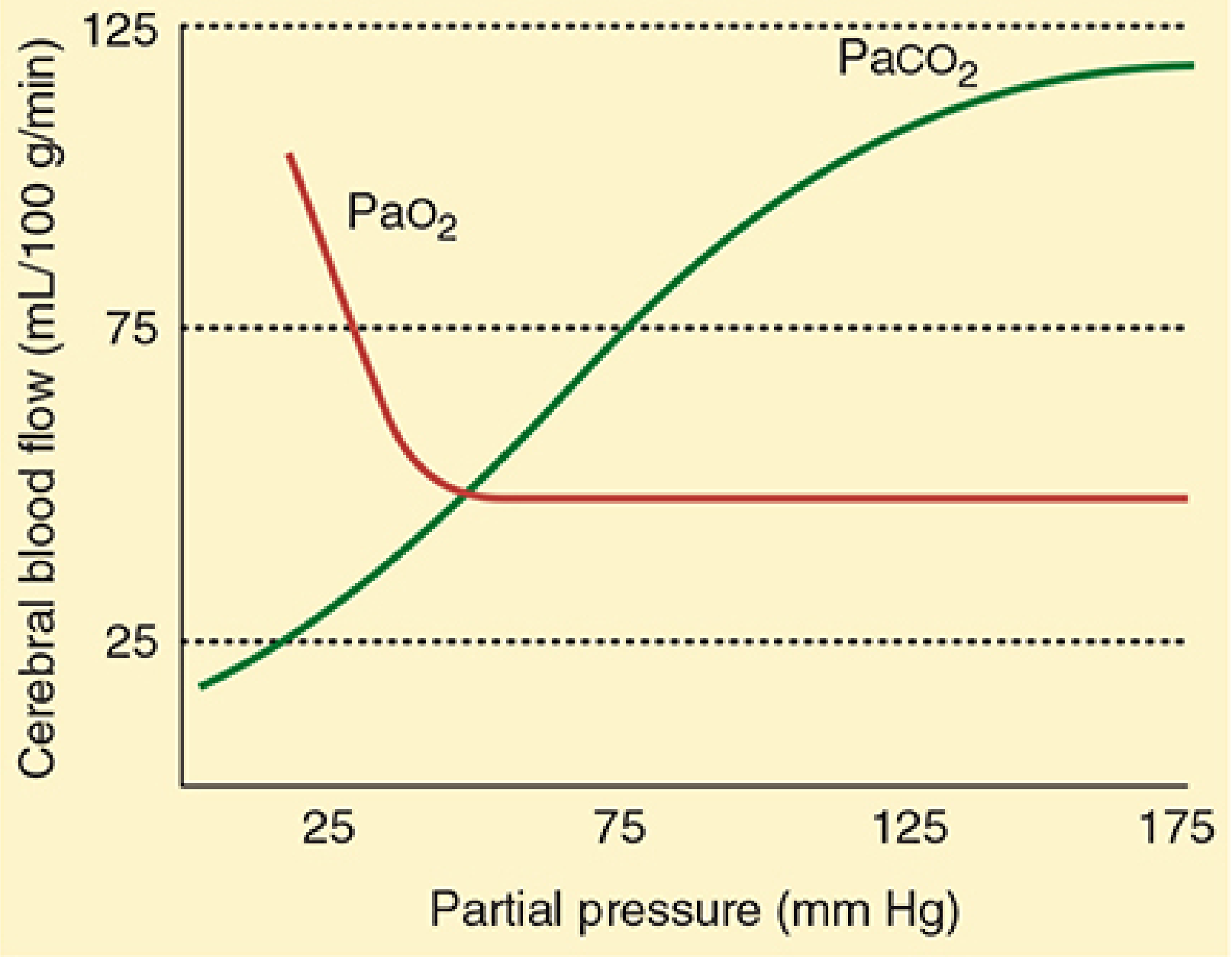
B. CO2 Reactivity (Chemical Regulation) ★★★
CBF is directly proportional to PaCO2 between 20 and 80 mmHg
| PaCO2 | Effect on CBF | Vessel |
|---|---|---|
| Hypercapnia (↑PaCO2) | Vasodilation → ↑CBF | Cerebral arterioles dilate |
| Hypocapnia (↓PaCO2) | Vasoconstriction → ↓CBF | Cerebral arterioles constrict |
| PaCO2 <20 mmHg | Severe ↓CBF → EEG changes even in normals | Over-vasoconstriction |
| PaCO2 >80 mmHg | Plateau effect | Maximum vasodilation |
- Acute metabolic acidosis has little effect on CBF (H+ cannot cross BBB)
- After 24-48h, CSF HCO3- adapts to compensate → the effect of chronic hypocapnia/hypercapnia is diminished (tachyphylaxis to hyperventilation)
- Hyperventilation (PaCO2 to 30-35 mmHg) → reduces CBF by ~25-30% → reduces ICP acutely (used in herniation as temporising measure; NOT for prolonged use)
- Permissive normocapnia preferred in elective neurosurgery
C. Oxygen Tension (PaO2)
- Hyperoxia: minimal decrease in CBF (~10%)
- Normoxia (PaO2 >60 mmHg): CBF essentially unchanged
- Moderate hypoxia (PaO2 50-60 mmHg): mild ↑ in CBF begins
- Severe hypoxia (PaO2 <50 mmHg): marked ↑↑ in CBF (see graph above - steep rise at low PaO2)
D. Metabolic Coupling / Neurovascular Coupling
- Local metabolites accumulate (CO2, H+, K+, adenosine, nitric oxide)
- Local cerebrovascular resistance falls
- Regional CBF increases to match demand
- Regional CBF increases during motor/visual/cognitive activity (basis of fMRI)
- Grey matter (metabolically active) has 4x higher CBF than white matter
E. Temperature
| Temperature | Effect on CBF/CMRO2 |
|---|---|
| Hypothermia | ↓ CBF + ↓ CMRO2 (Q10 ≈ 2 per 10°C) |
| At 27°C | CMRO2 ~50% of normal |
| At 20°C | EEG isoelectric |
| Hyperthermia | ↑ CBF + ↑ CMRO2; above 42°C → neuronal injury |
F. Other Factors
| Factor | Effect on CBF |
|---|---|
| Blood viscosity (haematocrit) | ↓ Hct → ↓ viscosity → ↑ CBF (but ↓ O2 capacity); optimal Hct ~30% for cerebral O2 delivery |
| Sympathetic stimulation | Vasoconstriction → ↓ CBF (protective during hypertension) |
| Nitric oxide | Vasodilator; mediates neurovascular coupling |
| ICP | ↑ ICP → ↓ CPP → ↓ CBF |
4. Effects of Anaesthetic Agents on CBF
A. Volatile Anaesthetics
- Direct cerebral vasodilation (↑ CBF)
- Decrease CMRO2 → via flow-metabolism coupling → ↓ CBF (indirect)
| Agent | CBF Effect | CMRO2 Effect | Notes |
|---|---|---|---|
| Halothane | ↑↑↑ CBF significantly | ↓ CMRO2 | Most cerebral vasodilation; rarely used |
| Isoflurane | ↑ CBF at >1 MAC (minimal at <1 MAC) | ↓↓ CMRO2 (can produce isoelectric EEG) | Can suppress EEG at clinical doses |
| Sevoflurane | Minimal ↑ CBF at ≤1 MAC | ↓ CMRO2 similar to isoflurane | Preferred for neuroanesthesia; preserves autoregulation up to 1 MAC |
| Desflurane | Minimal ↑ CBF at ≤1.5 MAC | ↓ CMRO2 | Similar to isoflurane; unique EEG reversal at high MAC |
B. IV Anaesthetic Agents
| Agent | CBF | CMRO2 | ICP | Notes |
|---|---|---|---|---|
| Propofol | ↓↓ | ↓↓ | ↓↓ | Maintains coupling; ideal for neuroanaesthesia; reduces ICP |
| Thiopentone | ↓↓ | ↓↓↓ | ↓↓ | Can produce isoelectric EEG; excellent neuroprotection |
| Ketamine | ↑↑ | ↑ | ↑↑ | Contraindicated in raised ICP; cerebral vasodilator |
| Etomidate | ↓ | ↓↓ | ↓ | Reduces CBF and CMRO2; useful in haemodynamically unstable |
| Benzodiazepines | ↓ | ↓ | ↓ | Modest reduction; maintain coupling |
| Opioids | Minimal effect | Minimal | ↓ slightly | Indirect effect via CO2 reduction when respiration reduced |
| Nitrous oxide | ↑ (cerebral vasodilator) | ↑ slightly | ↑ | Avoid or combine with agents that ↓ CBF in neurosurgery |
| Dexmedetomidine | ↓ | ↓ | ↓ | Maintains coupling; useful adjunct in neuroanaesthesia |
5. Clinical Applications in Anaesthesia
| Situation | Principle | Management |
|---|---|---|
| Raised ICP | Reduce CBF; reduce CMRO2 | Moderate hyperventilation (PaCO2 30-35 mmHg); propofol/thiopentone TIVA; avoid ketamine and N2O; head-up 30°; mannitol |
| Neurosurgery | Maintain CPP; slack brain | MAP 60-80 mmHg; normocapnia; avoid volatile agents at >1 MAC; TIVA preferred |
| Carotid endarterectomy | Ensure adequate ipsilateral CBF | Avoid hypotension; monitor EEG/TCD/NIRS; permissive mild hypertension |
| Cardiac surgery/CPB | CBF dependent on pump flow + PaCO2 | Alpha-stat vs pH-stat management; hypothermia neuroprotection |
| Traumatic brain injury | Avoid secondary insults | CPP ≥60 mmHg; normocapnia (avoid hyperventilation); normoxia; normothermia |
| Cerebral vasospasm (SAH) | Increase CBF to ischaemic areas | "Triple H" (now: euvolaemia + hypertension); nimodipine; TCD monitoring |
6. Monitoring of CBF
| Method | Principle | Notes |
|---|---|---|
| Transcranial Doppler (TCD) | Doppler shift in MCA velocity | Non-invasive; surrogate for CBF; normal MCA velocity ~55 cm/s; vasospasm >120 cm/s; Lindegaard ratio distinguishes vasospasm from hyperaemia |
| NIRS (Near-infrared spectroscopy) | Regional cerebral O2 saturation | Reflects venous saturation; non-invasive; reflects adequacy of O2 delivery |
| Brain tissue pO2 (Licox) | Clark electrode bolt in white matter | Normal 20-50 mmHg; <20 mmHg = intervention; <10 mmHg = ischaemia |
| Thermal diffusion flowmetry | Local quantitative CBF | Invasive; continuous; placed in at-risk tissue |
| Jugular venous O2 saturation (SjvO2) | Retrograde jugular bulb catheter | Normal 55-75%; <50% = ischaemia; >75% = hyperaemia or infarction |
| EEG/BIS | Cortical electrical activity | Indirect - reflects adequacy of global CBF |
| CT perfusion / PET | Quantitative regional CBF | Gold standard in research; not for continuous monitoring |
7. Blood-Brain Barrier (BBB)
- Tight junctions between cerebral endothelial cells; minimal pores
- Allows: lipid-soluble substances (O2, CO2, most anaesthetics, glucose via transport)
- Blocks: ions, proteins, large molecules (mannitol, antibiotics)
- Water moves freely (osmotic gradient exploited by mannitol)
- BBB disruption by: severe hypertension (MAP >150-160 mmHg), trauma, ischaemia, tumours, infection, marked hypercapnia, hypoxia, seizures
Summary Table - Key CBF Numbers
| Parameter | Value to Remember |
|---|---|
| Normal CBF | 50 mL/100 g/min |
| Total brain blood flow | 750 mL/min (15-20% CO) |
| Autoregulation range (MAP) | 60-160 mmHg |
| CBF change per mmHg PaCO2 | 1-2 mL/100 g/min |
| EEG slowing threshold | CBF <20-25 mL/100 g/min |
| EEG isoelectric threshold | CBF <20 mL/100 g/min |
| Irreversible damage | CBF <10 mL/100 g/min |
| CBF change per °C | 5-7% |
| Normal MCA velocity (TCD) | ~55 cm/s |
| Vasospasm (TCD) | >120 cm/s |
- Morgan & Mikhail's Clinical Anesthesiology, 7th Edition (Chapter 26)
- Miller's Anesthesia, 2-Volume Set, 10th Edition (Chapters 53, 80)
- Barash, Cullen & Stoelting's Clinical Anesthesia, 9th Edition (Chapter 18)
- Plum & Posner's Diagnosis and Treatment of Stupor and Coma, 5th Edition
Massive Blood Transfusion and Blood Components 30 marks Question for MD anaesthesia exam
massive blood transfusion protocol 1:1:1 ratio damage control resuscitation complications 2024
Massive Blood Transfusion and Blood Components — 30-Mark Model Answer (Anaesthesia MD Examination)
1. Definitions
Massive Blood Transfusion (MBT)
- Transfusion of ≥10 units of packed red blood cells (PRBCs) within 24 hours (most widely used)
- Transfusion of ≥4 units PRBCs in 1 hour with ongoing haemorrhage requiring continuation
- Replacement of the entire blood volume within 24 hours (adult ~5L = ~10 units PRBCs)
- Some definitions: ≥20 units PRBCs/24h; or ≥50% total blood volume in 3 hours
Haemorrhagic Shock Classification (Basis for MBT Decision)
| Class | Blood Loss (mL) | Blood Loss (%) | HR | BP | RR | Consciousness |
|---|---|---|---|---|---|---|
| I | <750 | <15% | <100 | Normal | 14-20 | Normal |
| II | 750-1500 | 15-30% | 100-120 | Normal/↓PP | 20-30 | Anxious |
| III | 1500-2000 | 30-40% | 120-140 | ↓ | 30-40 | Confused |
| IV | >2000 | >40% | >140 | ↓↓ | >35 | Obtunded/Unconscious |
2. Indications for Activating a Massive Transfusion Protocol (MTP)
- Penetrating mechanism: 1 point
- SBP ≤90 mmHg on arrival: 1 point
- HR ≥120/min on arrival: 1 point
- FAST positive: 1 point
- ABC score ≥2
- Persistent haemodynamic instability despite initial resuscitation
- Active bleeding requiring urgent surgery or angioembolisation
- Blood transfusion already begun in emergency department
- Estimated blood loss >1500 mL or ongoing surgical bleeding not controlled
3. Blood Components - Composition and Properties (10 marks)
A. Packed Red Blood Cells (PRBCs)
| Property | Details |
|---|---|
| Preparation | Centrifugation of whole blood; buffy coat removed |
| Volume | 250-350 mL per unit |
| Haematocrit | 55-80% |
| Storage | 1-6°C in additive solution (SAGM: saline, adenine, glucose, mannitol) |
| Shelf life | 42 days |
| Expected rise per unit (adult) | Hb rises ~1 g/dL; Hct rises ~3% per unit |
| ABO/Rh compatibility | Required for non-emergency; O-negative for emergency before crossmatch |
| Transfusion trigger (elective) | Hb <7 g/dL in stable patients; Hb <8 g/dL in cardiac surgery/elderly |
| Emergency (uncrossmatched) | O-negative (females of childbearing age); O-positive (males, older females) |
- ↓ 2,3-DPG → left shift of O2-Hb dissociation curve → reduced O2 delivery
- ↑ K+ (haemolysis) → risk of hyperkalaemia with MBT
- ↑ Hydrogen ions (metabolic acidosis)
- ↓ Platelet and coagulation factor activity
- Microaggregate formation
- ↓ ATP → impaired RBC deformability
- ↑ Free haemoglobin (pro-inflammatory)
B. Fresh Frozen Plasma (FFP)
| Property | Details |
|---|---|
| Preparation | Plasma separated and frozen within 8h of collection |
| Volume | 200-300 mL per unit |
| Contents | All clotting factors including labile V and VIII; fibrinogen (~2 g/L); albumin; immunoglobulins |
| Storage | Frozen: −18°C; shelf life 1 year. Thawed: 4°C; must be used within 5 days |
| Thawing time | 20-30 min (a critical bottleneck in MBT) - pre-thawed plasma reduces delays |
| ABO compatibility | Recommended (not always essential) |
| Dose | 10-15 mL/kg per transfusion |
| Indications | Coagulopathy (INR >1.5) + active bleeding; MTP 1:1:1 protocol; FFP deficiency states; warfarin reversal (if PCC unavailable) |
| Expected effect | Increases all clotting factors by ~10% per 10-15 mL/kg |
| Does NOT correct | Factor XIII, vWF (use cryoprecipitate); thrombocytopaenia (use platelets) |
C. Platelets
| Property | Details |
|---|---|
| Preparation | Pooled from 4-6 whole blood donations (random donor) OR single donor apheresis |
| Volume | 50-60 mL per single unit; 200-300 mL per pool/apheresis unit |
| Storage | 20-24°C with agitation; shelf life only 5 DAYS (most temperature and time sensitive) |
| ABO/Rh compatibility | Preferred; Rh-negative for females of childbearing age |
| Dose | 1 pool (4-6 units) raises platelet count by ~30,000-50,000/µL |
| Transfusion trigger | Platelets <50,000/µL + active bleeding; <100,000/µL in neurosurgery/ophthalmic; <10,000/µL prophylaxis |
| In MBT | Empiric 1:1:1 ratio with PRBCs and FFP |
D. Cryoprecipitate
| Property | Details |
|---|---|
| Preparation | Precipitate formed when FFP is thawed at 1-6°C; collected by centrifugation |
| Volume | 10-20 mL per unit (concentrated) |
| Contents | Fibrinogen (250 mg/bag), Factor VIII (80-120 IU), von Willebrand factor, Factor XIII, fibronectin |
| Storage | Frozen −18°C for 1 year; once thawed must be used within 6h |
| Dose | 1 unit/5 kg body weight (~8-10 units for adult); raises fibrinogen by ~50-100 mg/dL |
| Indications | Fibrinogen <1.5 g/L with bleeding; haemophilia A (no factor VIII concentrate available); vWD; hypofibrinogenaemia in MBT; DIC |
| Target fibrinogen | >1.5-2 g/L in active bleeding |
E. Whole Blood
| Property | Details |
|---|---|
| Contents | RBCs + plasma + platelets + all clotting factors in physiological proportions |
| Advantage | True "balanced" resuscitation; superior to reconstituted 1:1:1 |
| Limitations | Short shelf life for platelets (5 days); limited supply; complex storage and compatibility issues |
| Current use | Military trauma (NATO experience); some civilian trauma centres; fresh warm whole blood in austere settings |
| Note | "Fresh whole blood, arguably the optimal replacement, has not been available in the United States since the early 1980s." - Schwartz's, 11e |
F. Prothrombin Complex Concentrate (PCC)
| Property | Details |
|---|---|
| Contents | 4-factor PCC: Factors II, VII, IX, X + Proteins C and S |
| Dose | 25-50 IU/kg (INR-guided) |
| Advantages | Immediate availability (no thaw); small volume; targets specific deficiencies |
| Indications | Warfarin reversal; factor deficiency states; MBT adjunct |
G. Fibrinogen Concentrate (Haemocomplettan/RiaSTAP)
- Lyophilised fibrinogen; immediate reconstitution; no blood group compatibility
- Dose: 3-4 g to raise fibrinogen by ~1 g/L (based on ROTEM/TEG guidance)
- Increasingly replacing cryoprecipitate in many protocols
H. Recombinant Activated Factor VII (rFVIIa - NovoSeven)
- Rescue agent for refractory life-threatening haemorrhage unresponsive to standard measures
- Mechanism: activates Factor X on platelet surface; bypasses intrinsic pathway
- Requires: pH >7.2, Temperature >35°C, Fibrinogen >0.5 g/L, Platelets >50,000/µL to work
- Dose: 90-120 mcg/kg; expensive; thrombotic risk
4. Trauma-Induced Coagulopathy (TIC) / Acute Coagulopathy of Trauma (4 marks)
Acidosis + Hypothermia + Coagulopathy = Death
- Activated Protein C (APC) pathway - tissue hypoperfusion activates endothelial thrombomodulin → thrombin-thrombomodulin complex → activates protein C → inhibits factors Va and VIIIa → reduced thrombin generation
- Hyperfibrinolysis - APC inhibits PAI-1 → increased tPA activity → clot breakdown
- Endothelial glycocalyx shedding - shed proteoglycans (syndecan-1) = "auto-heparinisation"
- Platelet exhaustion - widespread ADP release from injured tissues renders platelets unresponsive to further stimulation
- Dilution - large-volume crystalloid resuscitation dilutes clotting factors and platelets
- Hypothermia - reduces enzyme activity of coagulation cascade; impairs platelet function
- Acidosis - reduces thrombin generation; reduces factor activity
- TEG (Thromboelastography) and ROTEM (Rotational Thromboelastometry) assess global haemostasis:
- Rate of clot formation (R-time / CT)
- Clot strength (MA / MCF)
- Fibrinolysis (LY30 / ML)
- Guide specific factor/platelet/fibrinogen replacement - reduces total blood product use vs empiric 1:1:1 approach
5. Damage Control Resuscitation (DCR) and MTP (6 marks)
The "Bloody Vicious Cycle"
| Principle | Detail |
|---|---|
| 1. Permissive hypotension | Target SBP 80-90 mmHg (MAP 50-65 mmHg) until surgical haemostasis; avoids clot dislodgement, reduces dilution; NOT in TBI (maintain CPP) |
| 2. Haemostatic resuscitation | Use blood products not crystalloid as primary resuscitation fluid |
| 3. Damage control surgery | Brief, life-saving surgery only; pack and close; re-look 24-48h once physiology restored |
| 4. 1:1:1 ratio | Empiric FFP:Platelets:PRBCs in equal ratios to reconstitute "whole blood" |
| 5. Minimise crystalloid | Large-volume crystalloid worsens dilutional coagulopathy, hypothermia, oedema |
| 6. Early TXA | Within 3 hours of injury |
The 1:1:1 Ratio - Evidence
- 1:1:1 (FFP:Platelets:PRBCs) vs 1:1:2
- 1:1:1 achieved haemostasis more rapidly and fewer deaths from exsanguination at 24 hours
- No difference in 30-day mortality but haemostatic benefit was clear
- Confirmed 1:1:1 beneficial in most massively bleeding patients
- Earlier plasma delivery reduced mortality
Typical MTP Structure (Cooler-Based):
| Cooler | Contents |
|---|---|
| Pack 1 (immediately) | 6 units PRBCs + 6 units FFP + 1 apheresis platelet |
| Pack 2 (on request) | 6 units PRBCs + 6 units FFP + 1 apheresis platelet + cryoprecipitate |
| Pack 3 | Same; add TXA, calcium, consider PCC |
- After every 6-10 units of blood products: ABG + electrolytes + glucose + lactate
- CBC, PT/INR, APTT, fibrinogen level
- TEG/ROTEM at intervals - guides goal-directed therapy
Transfusion Targets During MBT:
| Parameter | Target |
|---|---|
| Hb | >8 g/dL (active haemorrhage); >7 g/dL (stable) |
| INR | <1.5 |
| APTT | <1.5 x normal |
| Fibrinogen | >1.5-2 g/L |
| Platelets | >50,000/µL (>100,000 in TBI/neuro) |
| Base deficit | <6 mEq/L |
| pH | >7.2 |
| Temperature | >35°C |
| Ionised calcium | >1.1 mmol/L |
6. Tranexamic Acid (TXA) - Key Evidence
- Mechanism: Competitive inhibitor of plasminogen; antifibrinolytic
- CRASH-2 Trial (Lancet 2010): 20,000+ trauma patients; TXA 1 g IV over 10 min, then 1 g over 8 hours; significantly reduced all-cause mortality (14.5% vs 16.0%; p=0.0035); greatest benefit when given within 1 hour of injury
- Critical time window: Benefit greatest <1h; significant if <3h; mortality INCREASES if given after 3 hours (pro-thrombotic risk)
- Dose: 1 g IV bolus over 10 min within 3 hours of injury/surgery; repeat 1 g if still bleeding
- Now standard of care in MBT for trauma; also used in obstetric haemorrhage (WOMAN Trial), cardiac surgery
7. Complications of Massive Blood Transfusion (8 marks)
A. Metabolic Complications
| Complication | Mechanism | Management |
|---|---|---|
| Hypothermia | Cold blood products (stored at 4°C); most dangerous complication in MBT | Blood/fluid warmers; forced-air warming; warm OT; target core temp >35°C |
| Hypocalcaemia | Citrate (anticoagulant preservative) chelates ionised calcium; liver cannot metabolise citrate at rates >1 unit/5 min | Calcium gluconate/chloride IV empirically (10 mL 10% calcium gluconate per 4 units PRBCs); monitor iCa+ every 4-6 units |
| Hyperkalaemia | K+ leaches from RBCs during storage (up to 50 mmol/L in old blood); life-threatening arrhythmias | Use fresher blood when possible; monitor K+; treat arrhythmias |
| Metabolic acidosis | Citrate + lactate from stored blood; tissue hypoperfusion; haemolysis | Correct coagulopathy; improve perfusion; avoid excessive crystalloid |
| Metabolic alkalosis | Late complication: citrate metabolised to bicarbonate when perfusion restored | Usually self-limiting |
| Hypomagnesaemia | Chelation by citrate | Monitor; supplement if needed |
| Hypoglycaemia (neonates) | Loss of glucose from stored blood; impaired gluconeogenesis | Monitor glucose in neonates and infants |
B. Haematological Complications
| Complication | Mechanism | Management |
|---|---|---|
| Dilutional coagulopathy | Loss of clotting factors + platelets with haemorrhage; dilution with stored PRBCs (no factors/platelets) | 1:1:1 protocol; TEG/ROTEM-guided factor replacement |
| Disseminated Intravascular Coagulation (DIC) | Consumption of factors + platelets; fibrinolysis; TIC | Treat underlying cause; haemostatic resuscitation; cryoprecipitate; tranexamic acid |
| Dilutional thrombocytopaenia | Platelets have 5-day shelf life; not present in PRBCs | Empiric platelet transfusion; target >50,000/µL |
| Haemolytic transfusion reaction (acute) | ABO incompatibility (usually clerical error) | STOP transfusion; IV fluids; furosemide; notify blood bank; sample for investigation |
| Febrile non-haemolytic reaction | Antibodies to donor WBC antigens/cytokines | Paracetamol; slow or stop transfusion |
| Microaggregate formation | Stored blood forms fibrin/platelet/WBC clumps | Leukodepleted blood; 40-micron filter; 170-micron filter standard |
C. Immune-Mediated Complications
| Complication | Mechanism | Features | Management |
|---|---|---|---|
| TRALI (Transfusion-Related Acute Lung Injury) | Donor anti-HLA or anti-HNA antibodies activate recipient neutrophils; capillary leak | New-onset ALI/ARDS within 6h of transfusion; bilateral pulmonary infiltrates; PaO2/FiO2 <300; NOT fluid overload | Stop transfusion; supportive care; mechanical ventilation; diuretics unhelpful; usually resolves in 48-96h |
| TACO (Transfusion-Associated Circulatory Overload) | Hydrostatic pulmonary oedema from volume overload | Dyspnoea, hypertension, tachycardia within 6h; bilateral infiltrates; elevated BNP | Stop/slow transfusion; diuretics (furosemide); O2; upright position |
| Transfusion-related immunomodulation (TRIM) | Allogeneic blood suppresses recipient immune system | Increased infection risk, cancer recurrence, impaired wound healing | Minimise allogeneic transfusion; consider autologous/cell salvage |
| Allergic/anaphylactic | IgE-mediated reaction to plasma proteins | Urticaria to anaphylaxis | Stop transfusion; antihistamines; adrenaline if anaphylaxis |
| GvHD (Graft vs Host Disease) | Viable donor T-lymphocytes attack recipient | Rash, diarrhoea, hepatitis, pancytopaenia; high mortality | Prevention: irradiated blood for immunocompromised patients |
D. Infectious Complications
- HIV: 1 in 2 million units
- Hepatitis C: 1 in 1.9 million units
- Hepatitis B: 1 in 300,000 units
- Bacterial contamination (platelets highest risk due to room temperature storage): septic shock
- CMV, malaria, prions (vCJD)
E. Other Complications
| Complication | Notes |
|---|---|
| Air embolism | Rapid pressure infusion; use air-in-line alarms |
| Microemboli / ARDS | Microaggregates in stored blood; use 40-micron filters; leukodepleted blood |
| Citrate toxicity | Liver failure patients; neonates (impaired citrate metabolism) |
| Hypothermia | MOST DANGEROUS in MBT - directly impairs coagulation enzymes |
8. Alternatives to Allogenic Blood Transfusion
| Strategy | Details |
|---|---|
| Preoperative autologous donation (PAD) | Patient donates own blood 4-6 weeks pre-op |
| Intraoperative cell salvage (ICS/autotransfusion) | Collects, washes, concentrates shed blood for re-infusion; contraindicated in malignancy, infection, bowel contamination |
| Acute normovolemic haemodilution (ANH) | Pre-op blood removal + simultaneous colloid/crystalloid; blood returned after surgical haemostasis |
| Erythropoietin | Pre-op stimulation of erythropoiesis; 3-4 weeks before surgery |
| Iron therapy | Pre-op correction of iron-deficiency anaemia |
| Restrictive transfusion strategy | Hb trigger 7 g/dL (TRICC trial); reduces allogenic exposure |
| Surgical haemostasis | Bipolar, harmonic scalpel, argon beam, topical haemostats |
| Permissive hypotension | DCR as above |
9. Summary - Anaesthetist's Checklist for MBT
| Action | Detail |
|---|---|
| Activate MTP | Alert blood bank; prepare coolers |
| Large bore access | 2x 14G IV; consider IO; CVC; arterial line |
| Blood warmers | Level 1, Ranger - all blood products at 37-40°C |
| Empiric calcium | 10 mL 10% calcium gluconate per 4 units PRBCs |
| TXA | 1 g IV within 3 hours |
| 1:1:1 ratio | FFP:Platelets:PRBCs from start |
| Target hypothermia | Warm OT, warming blankets, warm fluids |
| Avoid crystalloid | Minimal saline/lactated Ringer's |
| Monitor | ABG, iCa, K+, TEG/ROTEM, fibrinogen every 6-10 units |
| Goal-directed therapy | Transition from empiric 1:1:1 to TEG-guided when possible |
| Terminate MTP | When haemostasis achieved; active bleeding stopped |
Key Examination Points
- Definition of MBT: ≥10 units PRBCs in 24h (most common definition)
- Lethal triad: Hypothermia + Acidosis + Coagulopathy
- 1:1:1 ratio (DCR): FFP : Platelets : PRBCs - PROPPR trial evidence
- TXA: Within 3 hours; CRASH-2 trial; Class I evidence; do NOT give after 3 hours
- Blood components: Know composition, storage, volumes, shelf life
- Hypocalcaemia: Most immediately correctable metabolic complication - calcium for every 4 units
- Hypothermia: Most dangerous - impairs ALL coagulation enzymes
- TRALI vs TACO: Permeability vs hydrostatic oedema; both within 6h of transfusion
- TEG/ROTEM: Goal-directed haemostatic resuscitation; reduces unnecessary blood product use
- Acute haemolytic reaction: Stop transfusion immediately; ABO incompatibility; potentially fatal
- Miller's Anesthesia, 2-Volume Set, 10th Edition (Chapters 45, 46, 62)
- Morgan & Mikhail's Clinical Anesthesiology, 7th Edition (Chapter 39)
- Schwartz's Principles of Surgery, 11th Edition (Chapter 4, 5)
- Mulholland & Greenfield's Surgery, 7th Edition (Chapter 19)
- Sabiston Textbook of Surgery, 21st Edition (Chapter 10)
- CRASH-2 Trial Collaborators, Lancet 2010; PROPPR Trial, JAMA 2015