
Spleen injury
Reading File
Spleen injury (splenic trauma) is one of the most common solid organ injuries in abdominal trauma. It ranges from minor capsular tears to complete shattered spleen, and management ranges from observation to splenectomy depending on hemodynamic stability and injury grade.
Searching sources...
Finding Sources
Finding Sources
Searching PubMed
"spleen injury" AND "management"
Reading File
Reading File
Finding Sources
Reading File
Reading File
Reading File
Finding Sources
Reading File
Reading File
I now have comprehensive information from multiple authoritative surgical textbooks. Let me compile the full answer.
Loading Image
Here is a detailed, textbook-based overview of splenic injury:
Splenic Injury
Overview
The spleen is the most commonly injured intra-abdominal organ in blunt abdominal trauma, followed by the liver. It should be suspected in any left upper quadrant (LUQ) injury, deceleration mechanism, or fractured lower left ribs. Iatrogenic injury during LUQ surgery (particularly with adhesions) also remains a frequent cause.
- Bailey and Love's Short Practice of Surgery, 28th Ed.
AAST Organ Injury Scale (2018 Revision)
CT is the gold standard for grading splenic injury in hemodynamically stable patients. The 2018 revision incorporated vascular findings (arterial blush, pseudoaneurysm) to guide angioembolization decisions.
| Grade | Injury Description |
|---|---|
| I | Subcapsular hematoma <10% surface area; capsular tear, <1 cm parenchymal depth |
| II | Subcapsular hematoma 10-50% surface area; intraparenchymal hematoma <5 cm; laceration 1-3 cm depth, not involving trabecular vessels |
| III | Subcapsular hematoma >50% or expanding; ruptured subcapsular or parenchymal hematoma; intraparenchymal hematoma ≥5 cm or expanding; laceration >3 cm depth or involving trabecular vessels |
| IV | Laceration involving segmental or hilar vessels, major devascularization (>25% of spleen) |
| V | Shattered spleen; hilar vascular injury with devascularized spleen |
Advance one grade for multiple injuries, up to grade III.
- Mulholland & Greenfield's Surgery, 7th Ed.; Current Surgical Therapy, 14th Ed.; Sabiston Textbook of Surgery
CT Imaging
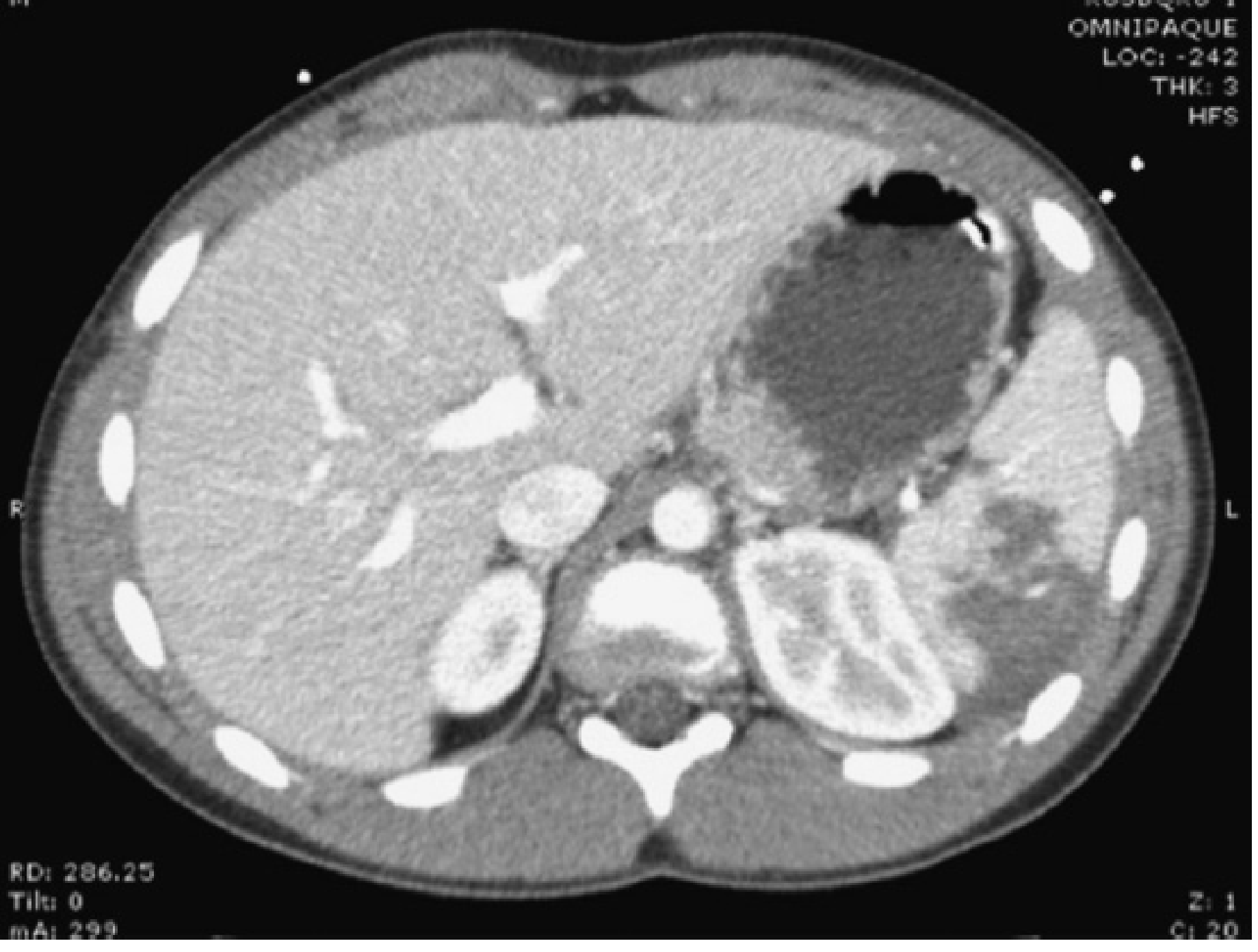
CT image of a high-grade spleen injury - Mulholland & Greenfield's Surgery
CT reliably identifies splenic injuries by demonstrating disruption of normal architecture, free fluid, and a "vascular blush" (contrast extravasation indicating active bleeding). Multidetector CT has a negative predictive value as high as 99.63% for significant blunt abdominal injuries.
Initial Assessment
- FAST ultrasound: Rapid, bedside screening. Sensitivity 73-88%, specificity 98-100%. Detects free fluid (minimum ~200 mL needed). Positive FAST + hemodynamic instability = emergent laparotomy. Positive FAST + stability = proceed to CT.
- CT abdomen with IV contrast: Definitive assessment, grades injury, identifies vascular blush or pseudoaneurysm.
- Current Surgical Therapy, 14th Ed.
Management
Nonoperative Management (NOM)
NOM is now the standard approach for >85% of blunt splenic injuries, enabled by advances in CT and angioembolization.
Criteria for NOM (Box I criteria):
- Hemodynamic stability (SBP >90, HR <130)
- CT documentation and classification of injury
- No other intra-abdominal or retroperitoneal injury mandating surgery
- Transfusion requirement <2 units pRBCs in 24 hours
Additional contraindications/cautions: Portal hypertension (relative contraindication due to elevated splenic parenchymal pressures); irreversible coagulopathy; requirement for urgent anticoagulation (e.g., artificial heart valve, blunt carotid injury).
Age >55 is associated with higher NOM failure rates, but does not alone preclude the attempt.
NOM monitoring:
- Serial clinical exams, vital signs, and hematocrit
- ICU monitoring for high-grade (III-V) injuries
- Most failures occur within the first few days; delayed bleeding (from subcapsular hematoma or pseudoaneurysm) can occur days to weeks later
- Follow-up CT at 2-3 days for grade III-V injuries to detect pseudoaneurysm or hematoma progression
Success rates: ~90% overall at high-volume centers; failure rates of just 5% achievable for grades III-V with angioembolization adjunct.
- Current Surgical Therapy, 14th Ed.; Sabiston Textbook of Surgery
Splenic Angioembolization
A key adjunct that has dramatically expanded the scope of NOM.
Indications:
- Active contrast extravasation (vascular blush) on CT
- Pseudoaneurysm on CT
- High-grade injuries (III-V) - even without overt contrast findings, angiography within 24-96 hours is recommended by many centers
Technique options:
- Proximal splenic artery embolization: Coil occlusion distal to the dorsal pancreatic artery - reduces perfusion pressure while preserving some splenic function via collateral flow
- Distal/selective embolization: Targets specific bleeding vessels; higher risk of splenic necrosis
Complications of embolization: Splenic necrosis, pancreatic necrosis, access site complications. Recent literature suggests a more conservative approach may achieve similar success rates without these risks.
- Mulholland & Greenfield's Surgery, 7th Ed.; Sabiston Textbook of Surgery; Fischer's Mastery of Surgery, 8th Ed.
Operative Management
Indications for surgery:
- Hemodynamic instability at presentation
- Failed NOM (progressive hemorrhage, peritonitis, increasing transfusion requirement)
- Associated hollow viscus injury requiring laparotomy
- Severe grades (IV-V) with instability
Splenectomy technique (open):
- Midline incision for full peritoneal access
- Retract spleen posteromedially; divide splenocolic ligament (white line of Toldt) and continue superiorly
- Create blunt plane posterior to spleen and behind pancreatic tail to deliver spleen into wound
- Ligate and divide short gastric vessels (avoiding gastric greater curve)
- Clamp and ligate hilar vessels, carefully avoiding pancreatic tail
- Drain only if pancreatic tail injury suspected
Splenic salvage (splenorrhaphy, partial splenectomy, topical hemostatic agents): Described but limited utility in the modern era given highly effective NOM and endovascular options.
- Sabiston Textbook of Surgery
Post-splenectomy Vaccinations (OPSI Prevention)
Overwhelming post-splenectomy infection (OPSI) carries 30-70% mortality and 0.5-2% incidence. Vaccinate against encapsulated organisms:
- Streptococcus pneumoniae
- Neisseria meningitidis
- Haemophilus influenzae type b
These should also be given prophylactically to patients with severe injuries undergoing NOM, in case of eventual failure requiring splenectomy.
- Mulholland & Greenfield's Surgery, 7th Ed.; Sabiston Textbook of Surgery
Special Situations
Pediatric Splenic Injury
NOM is the default approach even for grade IV injuries in hemodynamically stable children. Activity restriction follows a "grade + 2 weeks" rule (e.g., grade 4 = 6 weeks restricted activity). At surgery, splenic salvage is more aggressively attempted to preserve immunological function.
- Schwartz's Principles of Surgery, 11th Ed.
Malarial Spleen
Rupture of a malaria-enlarged spleen can occur after trivial injury with delayed presentation. Embolization is attempted if available; splenectomy before perisplenic hematoma ruptures is recommended. Early ligation of splenic vessels along the superior pancreatic border is advised before disturbing the hematoma.
- Bailey and Love's Short Practice of Surgery, 28th Ed.
Summary Table
| Scenario | Management |
|---|---|
| Grade I-II, hemodynamically stable | NOM (observation) |
| Grade III-V, hemodynamically stable | NOM + angiography ± embolization |
| Any grade, hemodynamically unstable | Emergency laparotomy + splenectomy |
| NOM failure | Operative intervention |
| All splenectomy patients | Vaccinate against pneumococcus, meningococcus, H. influenzae |
This is a shared conversation. Sign in to Orris to start your own chat.