
AI in health care
AI in healthcare 2025 2026 latest developments clinical applications
"artificial intelligence"[MeSH Terms] AND "delivery of health care"[MeSH Terms]
AI in Healthcare: A Current Overview
1. Clinical Documentation - AI Scribes
2. Large Language Models (LLMs) in Clinical Practice
3. Medical Imaging & Diagnostics
- Radiology: AI tools detect lung nodules, fractures, intracranial hemorrhage, and breast cancer on mammography with performance rivaling radiologists in controlled studies.
- Pathology: Digital pathology AI can classify tumors and predict molecular subtypes from histology slides.
- Ophthalmology: FDA-cleared AI (e.g., IDx-DR) autonomously screens for diabetic retinopathy without a specialist.
- GE HealthCare (June 2026) is actively expanding AI-enabled nuclear medicine workflows at the SNMMI Annual Meeting, integrating AI with PET imaging and theranostics.
4. Chronic Disease Management & Chatbots
5. Nursing & Patient Outcomes
6. Drug Discovery & Development
- AlphaFold (DeepMind) has predicted structures for virtually every known protein, transforming target identification.
- AI-designed molecules have entered clinical trials (e.g., Insilico Medicine's INS018_055 for IPF is in Phase II).
- IQVIA and other CROs are embedding "Healthcare-grade AI" into clinical trial design, patient recruitment, and pharmacovigilance.
7. Administrative AI
- Revenue cycle management: AI automates prior authorizations, coding, and claim denials. A KLAS 2026 report notes that while AI-driven clinical decision support is increasingly discussed, only ~40% of deep adopters are actively using archived data for AI-driven analytics in real production workflows.
- Scheduling & triage: NLP tools route patient messages and prioritize callbacks.
Key Challenges
| Challenge | Detail |
|---|---|
| Bias & equity | Models trained on non-representative data can perform worse for minority populations |
| Hallucinations | LLMs generate plausible but incorrect clinical information |
| Regulatory | FDA 510(k)/De Novo pathways for AI/ML-based SaMD (Software as Medical Device) are evolving |
| Privacy | HIPAA compliance, data governance, and de-identification requirements |
| Workflow integration | EHR interoperability and clinician adoption remain practical barriers |
| Accountability | Liability when AI contributes to a diagnostic or treatment error |
Bottom Line
Make a presentation on “hypersensitivity pneumonitis” for young budding pulmologists
"hypersensitivity pneumonitis"[MeSH Terms] AND diagnosis
"hypersensitivity pneumonitis" AND "guidelines"
ls /home/daytona/workspace/ 2>/dev/null && echo "---" && node -e "require('pptxgenjs'); console.log('pptxgenjs ok')"
mkdir -p /home/daytona/workspace/hp-presentation
~/hp-presentation/build.js
const pptxgen = require("pptxgenjs");
const { execSync } = require("child_process");

// ── Fetch images ──────────────────────────────────────────────────────────────
const imageUrls = [
  "https://cdn.orris.care/cdss_images/4cbf3e40cfeca1d676b99941ed523c302ddaa0049dbd1ed7f4f9efaae5e4e567.png", // Diagnostic flowchart
  "https://cdn.orris.care/cdss_images/3d8594fc54984e5ddfa52b10416171ab5e1f193f1af29fcf8d096368096b40d2.png", // Management flowchart
];

let imgDiag = null, imgMgmt = null;
try {
  const result = JSON.parse(
    execSync(
      `node /home/daytona/skills/shared/scripts/fetch_images.js "${imageUrls[0]}" "${imageUrls[1]}"`,
      { timeout: 30000 }
    ).toString()
  );
  if (result[0] && !result[0].error) imgDiag = result[0].base64;
  if (result[1] && !result[1].error) imgMgmt = result[1].base64;
} catch (e) {
  console.warn("Image fetch failed:", e.message);
}

// ── Color palette ─────────────────────────────────────────────────────────────
const C = {
  navy:    "0A1628",  // dominant dark
  teal:    "0D7377",  // accent / section bar
  sky:     "14BDCC",  // light accent
  white:   "FFFFFF",
  offwhite:"F0F4F8",
  slate:   "2D4059",
  amber:   "F5A623",  // warning / highlight
  red:     "C0392B",
  green:   "1E8449",
  gray:    "6B7C93",
  lightgray:"D6DCE5",
};

// ── Helpers ───────────────────────────────────────────────────────────────────
function titleSlide(pres, title, subtitle) {
  const s = pres.addSlide();
  // full dark background
  s.addShape(pres.ShapeType.rect, { x: 0, y: 0, w: 10, h: 5.625, fill: { color: C.navy } });
  // teal accent bar
  s.addShape(pres.ShapeType.rect, { x: 0, y: 3.6, w: 10, h: 0.18, fill: { color: C.teal } });
  // glow circle
  s.addShape(pres.ShapeType.ellipse, { x: 7.2, y: -1.0, w: 4.5, h: 4.5,
    fill: { color: C.teal, transparency: 80 }, line: { color: C.teal, transparency: 80 } });
  s.addText(title, {
    x: 0.6, y: 1.1, w: 8.8, h: 1.8,
    fontSize: 38, bold: true, color: C.white, fontFace: "Calibri",
    align: "left", valign: "middle", margin: 0,
  });
  s.addText(subtitle, {
    x: 0.6, y: 3.0, w: 7.5, h: 0.5,
    fontSize: 16, color: C.sky, fontFace: "Calibri", align: "left", margin: 0,
  });
  s.addText("Murray & Nadel's Respiratory Medicine | Robbins Pathology | Grainger & Allison's Radiology", {
    x: 0.6, y: 5.1, w: 8.8, h: 0.35,
    fontSize: 9, color: C.gray, fontFace: "Calibri", align: "left", margin: 0,
  });
  return s;
}

function sectionDivider(pres, title, subtitle) {
  const s = pres.addSlide();
  s.addShape(pres.ShapeType.rect, { x: 0, y: 0, w: 10, h: 5.625, fill: { color: C.slate } });
  s.addShape(pres.ShapeType.rect, { x: 0, y: 0, w: 0.18, h: 5.625, fill: { color: C.teal } });
  s.addShape(pres.ShapeType.ellipse, { x: 6.5, y: 2.5, w: 5, h: 5,
    fill: { color: C.teal, transparency: 88 }, line: { color: C.teal, transparency: 88 } });
  s.addText(title, {
    x: 0.55, y: 1.6, w: 8.5, h: 1.5,
    fontSize: 34, bold: true, color: C.white, fontFace: "Calibri", align: "left", margin: 0,
  });
  if (subtitle) {
    s.addText(subtitle, {
      x: 0.55, y: 3.1, w: 7.5, h: 0.55,
      fontSize: 15, color: C.sky, fontFace: "Calibri", align: "left", margin: 0,
    });
  }
  return s;
}

function contentSlide(pres, heading, bullets, opts = {}) {
  const s = pres.addSlide();
  // off-white bg
  s.addShape(pres.ShapeType.rect, { x: 0, y: 0, w: 10, h: 5.625, fill: { color: C.offwhite } });
  // heading bar
  s.addShape(pres.ShapeType.rect, { x: 0, y: 0, w: 10, h: 1.05, fill: { color: C.navy } });
  s.addShape(pres.ShapeType.rect, { x: 0, y: 1.05, w: 10, h: 0.07, fill: { color: C.teal } });
  s.addText(heading, {
    x: 0.35, y: 0.05, w: 9.4, h: 0.95,
    fontSize: 22, bold: true, color: C.white, fontFace: "Calibri",
    align: "left", valign: "middle", margin: 0,
  });
  // bullet content
  const items = bullets.map((b, i) => {
    if (b.type === "header") {
      return [
        { text: b.text, options: { bold: true, color: C.teal, fontSize: b.fontSize || 14, breakLine: true } }
      ];
    }
    if (b.type === "bullet2") {
      return [
        { text: "    \u2013 " + b.text, options: { color: C.slate, fontSize: 11.5, breakLine: true } }
      ];
    }
    // default bullet
    return [
      { text: "\u25CF  " + b.text, options: { color: C.navy, fontSize: b.fontSize || 13, bold: b.bold || false, breakLine: true } }
    ];
  });
  const flat = items.flat();
  // remove last breakLine
  if (flat.length > 0) flat[flat.length - 1].options.breakLine = false;
  s.addText(flat, {
    x: opts.x || 0.35, y: opts.y || 1.25,
    w: opts.w || 9.3, h: opts.h || 4.1,
    fontFace: "Calibri", valign: "top", margin: 6,
  });
  // optional footnote
  if (opts.footnote) {
    s.addText(opts.footnote, {
      x: 0.35, y: 5.3, w: 9.3, h: 0.28,
      fontSize: 8, color: C.gray, fontFace: "Calibri", align: "left", margin: 0,
    });
  }
  return s;
}

function twoColSlide(pres, heading, leftBullets, rightBullets, opts = {}) {
  const s = pres.addSlide();
  s.addShape(pres.ShapeType.rect, { x: 0, y: 0, w: 10, h: 5.625, fill: { color: C.offwhite } });
  s.addShape(pres.ShapeType.rect, { x: 0, y: 0, w: 10, h: 1.05, fill: { color: C.navy } });
  s.addShape(pres.ShapeType.rect, { x: 0, y: 1.05, w: 10, h: 0.07, fill: { color: C.teal } });
  // divider
  s.addShape(pres.ShapeType.line, { x: 5.1, y: 1.2, w: 0, h: 4.2, line: { color: C.lightgray, width: 1.5 } });
  s.addText(heading, {
    x: 0.35, y: 0.05, w: 9.4, h: 0.95,
    fontSize: 22, bold: true, color: C.white, fontFace: "Calibri", align: "left", valign: "middle", margin: 0,
  });
  // left
  if (opts.leftTitle) {
    s.addText(opts.leftTitle, { x: 0.35, y: 1.18, w: 4.5, h: 0.35, fontSize: 13, bold: true, color: C.teal, fontFace: "Calibri", margin: 0 });
  }
  const leftItems = leftBullets.map(b => ({
    text: "\u25CF  " + b, options: { color: C.navy, fontSize: 12.5, breakLine: true }
  }));
  if (leftItems.length) leftItems[leftItems.length - 1].options.breakLine = false;
  s.addText(leftItems, { x: 0.35, y: opts.leftTitle ? 1.58 : 1.25, w: 4.6, h: 3.8, fontFace: "Calibri", valign: "top", margin: 4 });
  // right
  if (opts.rightTitle) {
    s.addText(opts.rightTitle, { x: 5.25, y: 1.18, w: 4.5, h: 0.35, fontSize: 13, bold: true, color: C.teal, fontFace: "Calibri", margin: 0 });
  }
  const rightItems = rightBullets.map(b => ({
    text: "\u25CF  " + b, options: { color: C.navy, fontSize: 12.5, breakLine: true }
  }));
  if (rightItems.length) rightItems[rightItems.length - 1].options.breakLine = false;
  s.addText(rightItems, { x: 5.25, y: opts.rightTitle ? 1.58 : 1.25, w: 4.45, h: 3.8, fontFace: "Calibri", valign: "top", margin: 4 });
  return s;
}

function imageSlide(pres, heading, imageData, caption, opts = {}) {
  const s = pres.addSlide();
  s.addShape(pres.ShapeType.rect, { x: 0, y: 0, w: 10, h: 5.625, fill: { color: C.offwhite } });
  s.addShape(pres.ShapeType.rect, { x: 0, y: 0, w: 10, h: 1.05, fill: { color: C.navy } });
  s.addShape(pres.ShapeType.rect, { x: 0, y: 1.05, w: 10, h: 0.07, fill: { color: C.teal } });
  s.addText(heading, {
    x: 0.35, y: 0.05, w: 9.4, h: 0.95,
    fontSize: 22, bold: true, color: C.white, fontFace: "Calibri", align: "left", valign: "middle", margin: 0,
  });
  if (imageData) {
    s.addImage({ data: imageData, x: opts.ix || 0.4, y: opts.iy || 1.18, w: opts.iw || 9.2, h: opts.ih || 3.9 });
  }
  if (caption) {
    s.addText(caption, {
      x: 0.35, y: opts.cy || 5.2, w: 9.3, h: 0.38,
      fontSize: 8.5, color: C.gray, fontFace: "Calibri", italic: true, align: "center", margin: 0,
    });
  }
  return s;
}

function tableSlide(pres, heading, rows, colWidths, headerColor) {
  const s = pres.addSlide();
  s.addShape(pres.ShapeType.rect, { x: 0, y: 0, w: 10, h: 5.625, fill: { color: C.offwhite } });
  s.addShape(pres.ShapeType.rect, { x: 0, y: 0, w: 10, h: 1.05, fill: { color: C.navy } });
  s.addShape(pres.ShapeType.rect, { x: 0, y: 1.05, w: 10, h: 0.07, fill: { color: C.teal } });
  s.addText(heading, {
    x: 0.35, y: 0.05, w: 9.4, h: 0.95,
    fontSize: 22, bold: true, color: C.white, fontFace: "Calibri", align: "left", valign: "middle", margin: 0,
  });
  s.addTable(rows, {
    x: 0.3, y: 1.22, w: 9.4, h: 4.15,
    colW: colWidths,
    fontFace: "Calibri", fontSize: 11.5,
    border: { pt: 0.5, color: C.lightgray },
    fill: { color: C.white },
  });
  return s;
}

// ═══════════════════════════════════════════════════════════════
// BUILD PRESENTATION
// ═══════════════════════════════════════════════════════════════
const pres = new pptxgen();
pres.layout = "LAYOUT_16x9";
pres.title = "Hypersensitivity Pneumonitis";
pres.author = "Pulmonology Education";

// ── SLIDE 1: Title ────────────────────────────────────────────
titleSlide(pres,
  "Hypersensitivity\nPneumonitis",
  "A Comprehensive Guide for Budding Pulmonologists  |  2026"
);

// ── SLIDE 2: Section – Overview ───────────────────────────────
sectionDivider(pres, "01  Overview & Classification", "What is HP and how do we classify it?");

// ── SLIDE 3: Definition ───────────────────────────────────────
contentSlide(pres, "What is Hypersensitivity Pneumonitis?", [
  { type: "bullet", text: "Complex inflammatory and/or fibrotic interstitial lung disease (ILD) in susceptible individuals" },
  { type: "bullet", text: "Caused by immunologically mediated reaction to inhaled organic or low-molecular-weight antigens" },
  { type: "bullet", text: "Also called Extrinsic Allergic Alveolitis (EAA)" },
  { type: "bullet", text: "Exposures: occupational, avocational, residential, or environmental settings" },
  { type: "bullet", text: "Overlap with other ILDs makes diagnosis and management challenging" },
  { type: "bullet", text: "High index of suspicion required — always consider HP in any ILD workup" },
  { type: "header", text: "KEY CONCEPT" },
  { type: "bullet", text: "HP is diagnosed by integration of clinical + radiologic + histopathologic findings in Multidisciplinary Discussion (MDD)" },
], { footnote: "Murray & Nadel's Textbook of Respiratory Medicine, Chapter 91" });

// ── SLIDE 4: Classification ───────────────────────────────────
twoColSlide(pres,
  "Current Classification: Nonfibrotic vs Fibrotic HP",
  [
    "Nonfibrotic HP (= Acute/Subacute HP)",
    "Predominantly inflammatory pattern",
    "Reversible with antigen avoidance",
    "Ground-glass opacity, centrilobular nodules on HRCT",
    "Better prognosis",
    "Responds to corticosteroids",
    "Cluster analysis shows majority of HP fits this two-cluster model",
  ],
  [
    "Fibrotic HP (= Chronic HP)",
    "Irreversible fibrosis present",
    "May mimic UIP or NSIP pattern on HRCT",
    "Higher mortality rate",
    "Antigen identification may be impossible in up to 50% of cases",
    "Can progress even after antigen removal",
    "May require antifibrotics or transplant evaluation",
  ],
  { leftTitle: "NONFIBROTIC (Inflammatory)", rightTitle: "FIBROTIC (Chronic)" }
);

// ── SLIDE 5: Section – Etiology ───────────────────────────────
sectionDivider(pres, "02  Etiology & Antigens", "Know your triggers — >200 sources implicated");

// ── SLIDE 6: Antigen Table ────────────────────────────────────
const hdrStyle = { bold: true, color: C.white, fill: { color: C.slate }, align: "center" };
tableSlide(pres,
  "Common Causes of Hypersensitivity Pneumonitis",
  [
    [
      { text: "Disease Name", options: hdrStyle },
      { text: "Source of Antigen", options: hdrStyle },
      { text: "Antigen", options: hdrStyle },
    ],
    [{ text: "Farmer's Lung" }, { text: "Moldy hay / grain (thermophilic actinomycetes)" }, { text: "Saccharopolyspora rectivirgula" }],
    [{ text: "Bird Breeder's Lung" }, { text: "Pigeons, doves, parakeets (feathers, droppings)" }, { text: "Avian proteins, IgA" }],
    [{ text: "Hot Tub Lung" }, { text: "Contaminated hot tubs / saunas" }, { text: "Mycobacterium avium complex (MAC)" }],
    [{ text: "Humidifier Lung" }, { text: "Contaminated water in humidifiers, HVAC" }, { text: "Fungi, bacteria, protozoa" }],
    [{ text: "Cheese Washer's Lung" }, { text: "Moldy cheese rinds" }, { text: "Penicillium casei" }],
    [{ text: "Metalworking Fluid HP" }, { text: "Contaminated metalworking fluids" }, { text: "MAC, fungi" }],
    [{ text: "Chemical HP" }, { text: "Auto-painting, spray foam insulation" }, { text: "Isocyanates (TDI, MDI)" }],
    [{ text: "Summer-type HP (Japan)" }, { text: "Seasonal, humid environments" }, { text: "Trichosporon species" }],
  ],
  [2.5, 4.0, 2.9],
  C.slate
);

// ── SLIDE 7: Section – Immunopathogenesis ─────────────────────
sectionDivider(pres, "03  Immunopathogenesis", "Type III and IV hypersensitivity — a dual mechanism");

// ── SLIDE 8: Pathogenesis ─────────────────────────────────────
twoColSlide(pres,
  "Immunopathogenesis: Dual Mechanism",
  [
    "Type III (Immune Complex-mediated)",
    "Inhaled antigens → serum IgG precipitins formed",
    "Antigen-antibody immune complexes deposit in alveolar walls",
    "Complement activation → acute inflammation",
    "Occurs within hours of exposure",
    "Explains acute febrile illness pattern",
  ],
  [
    "Type IV (Cell-mediated / Delayed)",
    "T-lymphocyte sensitization to inhaled antigens",
    "CD4+ and CD8+ T cells infiltrate lung",
    "BAL shows markedly elevated CD8+ (low CD4:CD8 ratio)",
    "Granuloma formation — epithelioid macrophages + giant cells",
    "Explains chronic progressive fibrotic disease",
  ],
  { leftTitle: "TYPE III — Immune Complex", rightTitle: "TYPE IV — Cell-Mediated" }
);

// ── SLIDE 9: Histopathology ───────────────────────────────────
contentSlide(pres, "Histopathology", [
  { type: "header", text: "CLASSIC TRIAD (nonfibrotic HP)" },
  { type: "bullet", text: "1.  Peribronchiolar mononuclear cell infiltrate (lymphocytes predominate)" },
  { type: "bullet", text: "2.  Poorly formed (noncohesive) noncaseating granulomas — 2/3 of cases, peribronchiolar" },
  { type: "bullet", text: "3.  Cellular bronchiolitis" },
  { type: "header", text: "GRANULOMA FEATURES" },
  { type: "bullet", text: "Epithelioid macrophages + multinucleated giant cells" },
  { type: "bullet", text: "Giant cells may contain cholesterol clefts (Schaumann bodies)" },
  { type: "bullet", text: "Bronchiolocentric distribution — key to distinguishing from sarcoid" },
  { type: "header", text: "FIBROTIC HP" },
  { type: "bullet", text: "Bilateral upper-lobe-dominant interstitial fibrosis (UIP pattern in advanced cases)" },
  { type: "bullet", text: "May overlap with NSIP or UIP — bronchiolocentric accentuation helpful clue" },
], { footnote: "Murray & Nadel's Respiratory Medicine; Robbins & Kumar Basic Pathology" });

// ── SLIDE 10: Section – Diagnosis ────────────────────────────
sectionDivider(pres, "04  Clinical Features & Diagnosis", "Recognize the syndrome, find the antigen");

// ── SLIDE 11: Clinical Features ───────────────────────────────
twoColSlide(pres,
  "Clinical Presentations",
  [
    "Nonfibrotic / Acute HP",
    "Onset 4–8 hours after antigen exposure",
    "Fever, chills, myalgia",
    "Cough and dyspnea",
    "No eosinophilia; wheeze uncommon",
    "Resolves days after antigen removal",
    "Temporal relationship to exposure is diagnostic clue",
  ],
  [
    "Fibrotic / Chronic HP",
    "Insidious onset — weeks to months",
    "Progressive dyspnea, dry cough",
    "Malaise, weight loss",
    "Bibasilar crackles on auscultation",
    "Clubbing (in ~50% of fibrotic cases)",
    "Irreversible if antigen not removed early",
    "May progress even with antigen avoidance",
  ],
  { leftTitle: "NONFIBROTIC (Acute/Subacute)", rightTitle: "FIBROTIC (Chronic)" }
);

// ── SLIDE 12: HRCT Findings ───────────────────────────────────
contentSlide(pres, "HRCT Findings", [
  { type: "header", text: "NONFIBROTIC / SUBACUTE HP" },
  { type: "bullet", text: "Centrilobular poorly-defined nodules (~5 mm) — mid/lower zones" },
  { type: "bullet", text: "Ground-glass opacity (GGO) — especially with ongoing exposure" },
  { type: "bullet", text: "Mosaic attenuation + air trapping on expiratory CT (lobular air trapping = coexisting bronchiolitis)" },
  { type: "bullet", text: "Thin-walled cysts (3–25 mm) in subacute phase" },
  { type: "header", text: "FIBROTIC / CHRONIC HP" },
  { type: "bullet", text: "Intralobular and interlobular septal thickening" },
  { type: "bullet", text: "Traction bronchiectasis, honeycombing" },
  { type: "bullet", text: "Mid-zone or upper-lobe predominance (vs lower-zone in IPF)" },
  { type: "header", text: "HP vs IPF on HRCT — Features Favoring HP" },
  { type: "bullet", text: "Upper/mid-zone predominance, GGO, centrilobular nodules, bronchocentric distribution, air trapping" },
], { footnote: "Grainger & Allison's Diagnostic Radiology; Semin Roentgenol 2026 PMID:41513513" });

// ── SLIDE 13: Diagnostic Flowchart ───────────────────────────
if (imgDiag) {
  imageSlide(pres,
    "Diagnostic Approach to HP",
    imgDiag,
    "Fig 91.2 — Approach to HP diagnosis: exposure assessment → HRCT pattern → diagnostic certainty → MDD. (Murray & Nadel's Respiratory Medicine)",
    { iy: 1.18, ih: 3.9, cy: 5.18 }
  );
} else {
  contentSlide(pres, "Diagnostic Approach to HP", [
    { type: "header", text: "STEP 1 — Exposure Assessment" },
    { type: "bullet", text: "Comprehensive occupational, residential & avocational history" },
    { type: "bullet", text: "Consider referral to occupational medicine / industrial hygienist" },
    { type: "header", text: "STEP 2 — HRCT Pattern" },
    { type: "bullet", text: "Nonfibrotic (typical HP pattern) vs fibrotic (UIP-like/NSIP-like)" },
    { type: "bullet", text: "Air trapping on expiratory HRCT is a key clue" },
    { type: "header", text: "STEP 3 — Diagnostic Certainty" },
    { type: "bullet", text: "Confident diagnosis → exposure + typical HRCT + known antigen" },
    { type: "bullet", text: "Working diagnosis → BAL ± transbronchial biopsy considered" },
    { type: "bullet", text: "Surgical lung biopsy when diagnosis remains uncertain after MDD" },
  ]);
}

// ── SLIDE 14: Diagnostic Tests ────────────────────────────────
contentSlide(pres, "Investigations in HP", [
  { type: "header", text: "PULMONARY FUNCTION TESTS" },
  { type: "bullet", text: "Predominantly restrictive pattern (reduced TLC, FVC, compliance)" },
  { type: "bullet", text: "Reduced DLCO — important marker of severity and prognosis" },
  { type: "bullet", text: "Airflow obstruction may be present in smokers / chronic forms" },
  { type: "header", text: "SEROLOGY — Serum Precipitins / Specific IgG" },
  { type: "bullet", text: "Neither sensitive nor specific — high false-positive rate in exposed, asymptomatic individuals" },
  { type: "bullet", text: "92% of bird breeder HP had positive antibodies BUT so did 87% of asymptomatic controls" },
  { type: "bullet", text: "Can wane over time with reduced exposure" },
  { type: "header", text: "BAL" },
  { type: "bullet", text: "Lymphocytosis (>30%) with low CD4:CD8 ratio (<1) — classic finding" },
  { type: "bullet", text: "Most sensitive test but not diagnostic alone" },
  { type: "header", text: "BIOPSY" },
  { type: "bullet", text: "Transbronchial biopsy may suffice for nonfibrotic HP" },
  { type: "bullet", text: "Surgical lung biopsy (VATS) for indeterminate cases" },
], { footnote: "Murray & Nadel's Respiratory Medicine, Chapter 91" });

// ── SLIDE 15: Prognostic Factors ──────────────────────────────
tableSlide(pres,
  "Prognostic Indicators of Mortality in HP",
  [
    [
      { text: "Domain", options: { bold: true, color: C.white, fill: { color: C.slate }, align: "center" } },
      { text: "Adverse Prognostic Factors", options: { bold: true, color: C.white, fill: { color: C.slate }, align: "center" } },
    ],
    [{ text: "Demographics" }, { text: "Male sex, older age" }],
    [{ text: "Physical Exam" }, { text: "Auscultatory crackles" }],
    [{ text: "Lung Function" }, { text: "Low FVC%, low DLCO%" }],
    [{ text: "HRCT" }, { text: "Increased fibrosis, honeycombing, traction bronchiectasis, mosaic attenuation, increased PA:Ao ratio" }],
    [{ text: "Histology" }, { text: "Increased fibrosis, fibroblast foci" }],
    [{ text: "Genetics" }, { text: "MUC5B rs35705950 SNP, shorter telomere length (<10th percentile)" }],
    [{ text: "Composite" }, { text: "Abnormal ILD-GAP index" }],
    [{ text: "Other" }, { text: "No identified antigen, smoking, acute exacerbation, pulmonary hypertension" }],
  ],
  [2.8, 6.6],
  C.slate
);

// ── SLIDE 16: Section – Management ───────────────────────────
sectionDivider(pres, "05  Management", "Antigen avoidance is the cornerstone of treatment");

// ── SLIDE 17: Management Overview ────────────────────────────
contentSlide(pres, "Management: Key Pillars", [
  { type: "header", text: "1.  ANTIGEN AVOIDANCE (Most Important)" },
  { type: "bullet", text: "Complete removal from exposure environment is first-line treatment" },
  { type: "bullet", text: "Even partial reduction of exposure may slow progression" },
  { type: "bullet", text: "Environmental remediation (HEPA filtration, dehumidification) where relocation is not possible" },
  { type: "bullet", text: "Occupational counselling — may require change of occupation" },
  { type: "header", text: "2.  PHARMACOLOGIC THERAPY" },
  { type: "bullet", text: "Initiated when clinically significant disease progression despite antigen avoidance" },
  { type: "bullet", text: "Systemic corticosteroids (Prednisone) — initial treatment, tapering schedule" },
  { type: "bullet", text: "Corticosteroid-sparing agents: Azathioprine (AZA), Mycophenolate mofetil (MMF)" },
  { type: "bullet", text: "Antifibrotic therapy (Nintedanib) — emerging role in fibrotic HP progression" },
  { type: "header", text: "3.  SUPPORTIVE CARE" },
  { type: "bullet", text: "Supplemental O2, pulmonary rehabilitation, smoking cessation, vaccinations" },
], { footnote: "Murray & Nadel's Respiratory Medicine, Chapter 91 | German S2k Guideline 2025 (PMID:39870058)" });

// ── SLIDE 18: Management Flowchart ───────────────────────────
if (imgMgmt) {
  imageSlide(pres,
    "Management Algorithm for HP",
    imgMgmt,
    "Fig 91.6 — HP management approach: antigen avoidance → steroid response assessment → corticosteroid-sparing / antifibrotic agents → lung transplant evaluation. (Murray & Nadel's Respiratory Medicine)",
    { iy: 1.18, ih: 3.9, cy: 5.18 }
  );
} else {
  contentSlide(pres, "Management Algorithm", [
    { type: "bullet", text: "Antigen avoidance → monitor for response at 6–12 weeks" },
    { type: "bullet", text: "Ongoing symptoms/progression → add systemic steroids" },
    { type: "bullet", text: "Steroid response? → Taper and monitor" },
    { type: "bullet", text: "No response / steroid-dependent → AZA or MMF" },
    { type: "bullet", text: "Fibrotic HP progression → consider nintedanib" },
    { type: "bullet", text: "End-stage disease → lung transplant evaluation" },
  ]);
}

// ── SLIDE 19: Lung Transplant ─────────────────────────────────
contentSlide(pres, "Advanced Disease & Lung Transplantation", [
  { type: "header", text: "WHEN TO CONSIDER TRANSPLANT EVALUATION" },
  { type: "bullet", text: "Continued disease progression despite antigen avoidance + pharmacotherapy" },
  { type: "bullet", text: "FVC <50% predicted or DLCO <40% predicted" },
  { type: "bullet", text: "Resting or exertional hypoxemia" },
  { type: "bullet", text: "6MWT distance <250 m or >50 m decline in 12 months" },
  { type: "header", text: "OUTCOMES" },
  { type: "bullet", text: "HP mortality increases with age — age-adjusted mortality rose from 0.1 → 0.7 per million (1988–2016)" },
  { type: "bullet", text: "Average annual percentage increase in mortality: 5.6%" },
  { type: "bullet", text: "Fibrotic HP: 56–68% of HP cases; prevalence 0.9–1.7 per 100,000" },
  { type: "bullet", text: "Acute exacerbations of fibrotic HP carry high mortality — early recognition essential" },
  { type: "header", text: "PREVENTION" },
  { type: "bullet", text: "Occupational health monitoring, protective equipment, engineering controls" },
  { type: "bullet", text: "Outbreak investigation when occupational cluster is identified" },
], { footnote: "Murray & Nadel's Respiratory Medicine, Chapter 91" });

// ── SLIDE 20: Section – Differentials ────────────────────────
sectionDivider(pres, "06  Differential Diagnosis", "HP mimics — don't be fooled");

// ── SLIDE 21: Differentials ───────────────────────────────────
twoColSlide(pres,
  "Differential Diagnosis",
  [
    "Idiopathic Pulmonary Fibrosis (IPF)",
    "Lower-lobe honeycomb dominant UIP",
    "No causative antigen",
    "No GGO, no air trapping",
    "MUC5B SNP association similar",
    "Sarcoidosis",
    "Well-formed granulomas (vs HP: poorly-formed)",
    "Lymphangitic distribution on HRCT",
    "Bilateral hilar adenopathy",
  ],
  [
    "NSIP (Nonspecific Interstitial Pneumonia)",
    "Bilateral symmetric GGO with basal predominance",
    "May occur in CTD — check ANA, anti-Scl70",
    "RB-ILD / DIP",
    "Smoking history key differentiator",
    "Centrilobular GGO similar to HP",
    "Acute Eosinophilic Pneumonia",
    "Peripheral eosinophilia present (unlike HP)",
    "Responds rapidly to steroids",
  ],
  { leftTitle: "KEY DIFFERENTIALS — LEFT", rightTitle: "KEY DIFFERENTIALS — RIGHT" }
);

// ── SLIDE 22: Mnemonics / Pearls ──────────────────────────────
contentSlide(pres, "Clinical Pearls for the Pulmonologist", [
  { type: "header", text: "DIAGNOSIS PEARLS" },
  { type: "bullet", text: "Always take a detailed exposure history — occupational, home, hobbies (birds, hot tubs, farming)" },
  { type: "bullet", text: "Air trapping on expiratory HRCT + GGO = HP until proven otherwise" },
  { type: "bullet", text: "BAL lymphocytosis with CD4:CD8 < 1 strongly suggests HP" },
  { type: "bullet", text: "Positive serum precipitins = exposure, NOT disease — must correlate clinically" },
  { type: "bullet", text: "In 50% of chronic HP — no antigen ever found" },
  { type: "header", text: "MANAGEMENT PEARLS" },
  { type: "bullet", text: "Antigen removal FIRST — steroids are adjunctive, not primary" },
  { type: "bullet", text: "Fibrotic HP progresses like IPF — consider antifibrotics if rapid decline" },
  { type: "bullet", text: "Refer early for lung transplant in deteriorating fibrotic HP" },
  { type: "bullet", text: "MUC5B SNP and telomere shortening = poor prognosis markers" },
  { type: "header", text: "DO NOT MISS" },
  { type: "bullet", text: "Acute exacerbation of fibrotic HP = medical emergency — high mortality" },
], { footnote: "Murray & Nadel's Respiratory Medicine; German S2k Guideline 2025; Am J Respir Crit Care Med 2025" });

// ── SLIDE 23: Key References ──────────────────────────────────
contentSlide(pres, "Key References", [
  { type: "bullet", text: "Murray & Nadel's Textbook of Respiratory Medicine, 7th Ed. — Chapter 91 (Johannson & Fernandez Perez)" },
  { type: "bullet", text: "Robbins & Kumar Basic Pathology, 11th Ed. — Chapter 11" },
  { type: "bullet", text: "Grainger & Allison's Diagnostic Radiology — Chapter 9" },
  { type: "bullet", text: "Koschel D et al. Diagnosis and Treatment of HP: S2k Guideline (German Respiratory Society). Respiration 2025. PMID: 39870058" },
  { type: "bullet", text: "Ryerson CJ et al. Outcomes of Atypical Fibrotic HP Pattern on CT. Am J Respir Crit Care Med 2025. PMID: 40505139" },
  { type: "bullet", text: "Sellers T et al. HP: Imaging Findings and Patterns. Semin Roentgenol 2026. PMID: 41513513" },
  { type: "bullet", text: "Carroll MB et al. Update on Interstitial Pneumonias. Clin Chest Med 2024. PMID: 38816097" },
  { type: "header", text: "INTERNATIONAL GUIDELINES" },
  { type: "bullet", text: "ATS/JRS/ALAT Clinical Practice Guidelines for HP Diagnosis (2020) — Raghu G et al. Am J Respir Crit Care Med" },
  { type: "bullet", text: "Fernandez Perez ER et al. Diagnosis and Evaluation of HP. CHEST Guideline 2021" },
], { footnote: "Prepared for: Pulmonology Residency Education | July 2026" });

// ── SLIDE 24: Closing ─────────────────────────────────────────
const closing = pres.addSlide();
closing.addShape(pres.ShapeType.rect, { x: 0, y: 0, w: 10, h: 5.625, fill: { color: C.navy } });
closing.addShape(pres.ShapeType.rect, { x: 0, y: 2.5, w: 10, h: 0.12, fill: { color: C.teal } });
closing.addShape(pres.ShapeType.ellipse, { x: -1, y: 3.5, w: 5, h: 5,
  fill: { color: C.teal, transparency: 88 }, line: { color: C.teal, transparency: 88 } });
closing.addText("Key Take-Home Message", {
  x: 1.0, y: 0.7, w: 8, h: 0.6,
  fontSize: 18, color: C.sky, fontFace: "Calibri", align: "center", bold: true, margin: 0,
});
closing.addText([
  { text: "Hypersensitivity Pneumonitis is a clinician's diagnosis.\n", options: { bold: true, color: C.white, fontSize: 22, breakLine: true } },
  { text: "Ask about the environment. Find the antigen. Remove it early.\n", options: { color: C.sky, fontSize: 17, breakLine: true } },
  { text: "When fibrosis sets in, act fast — the window is narrow.", options: { color: C.lightgray, fontSize: 15 } },
], {
  x: 0.8, y: 2.8, w: 8.4, h: 2.3,
  fontFace: "Calibri", align: "center", valign: "middle", margin: 0,
});
closing.addText("Based on Murray & Nadel's Respiratory Medicine | Robbins Pathology | Current Guidelines 2025–2026", {
  x: 0.5, y: 5.28, w: 9, h: 0.28,
  fontSize: 8, color: C.gray, fontFace: "Calibri", align: "center", margin: 0,
});

// ── WRITE FILE ────────────────────────────────────────────────
const outPath = "/home/daytona/workspace/hp-presentation/Hypersensitivity_Pneumonitis.pptx";
pres.writeFile({ fileName: outPath }).then(() => {
  console.log("SUCCESS:", outPath);
}).catch(e => {
  console.error("ERROR:", e.message);
  process.exit(1);
});
cd /home/daytona/workspace/hp-presentation && node build.js 2>&1
ls -lh /home/daytona/workspace/hp-presentation/Hypersensitivity_Pneumonitis.pptx
Hypersensitivity Pneumonitis
Presentation · PPTX
What's Inside (24 Slides)
| # | Slide | Content |
|---|---|---|
| 1 | Title | Bold opening slide with accent design |
| 2 | Section divider | Overview & Classification |
| 3 | Definition | HP as a complex ILD, extrinsic allergic alveolitis, MDD cornerstone |
| 4 | Classification | Two-column: Nonfibrotic (acute) vs Fibrotic (chronic) HP |
| 5 | Section divider | Etiology & Antigens |
| 6 | Antigen Table | 9 named diseases — Farmer's Lung, Bird Breeder's, Hot Tub Lung, Metalworker's, Isocyanates, etc. |
| 7 | Section divider | Immunopathogenesis |
| 8 | Pathogenesis | Two-column: Type III immune complex vs Type IV cell-mediated |
| 9 | Histopathology | Classic triad, granuloma features, Schaumann bodies, fibrotic changes |
| 10 | Section divider | Clinical Features & Diagnosis |
| 11 | Clinical Presentations | Nonfibrotic vs fibrotic side-by-side |
| 12 | HRCT Findings | Centrilobular nodules, GGO, air trapping, traction bronchiectasis, HP vs IPF clues |
| 13 | Diagnostic Flowchart | Embedded Murray & Nadel Fig 91.2 flowchart image |
| 14 | Investigations | PFTs, serology limitations, BAL CD4:CD8 ratio, biopsy indications |
| 15 | Prognostic Factors Table | 8 domains from Murray & Nadel Table 91.1 (demographics → genetics) |
| 16 | Section divider | Management |
| 17 | Management Pillars | Antigen avoidance → steroids → steroid-sparing → antifibrotics |
| 18 | Management Algorithm | Embedded Murray & Nadel Fig 91.6 flowchart image |
| 19 | Advanced Disease | Transplant indications, mortality trends, acute exacerbation |
| 20 | Section divider | Differential Diagnosis |
| 21 | Differentials | IPF, Sarcoidosis, NSIP, RB-ILD, AEP — with distinguishing features |
| 22 | Clinical Pearls | Diagnosis + management pearls + "do not miss" |
| 23 | References | Murray & Nadel, Robbins, Radiology text, 2025-2026 guidelines (PMIDs included) |
| 24 | Closing | Take-home message slide |
Create a 1-page cheat sheet / quick reference guide on HP diagnosis criteria
"hypersensitivity pneumonitis" AND "diagnostic criteria"
~/hp-presentation/hp_cheatsheet.py
#!/usr/bin/env python3
"""
HP Diagnosis Criteria – 1-Page Cheat Sheet
Uses ReportLab for precise, dense, colour-coded layout.
"""
from reportlab.lib.pagesizes import A4
from reportlab.lib.units import mm
from reportlab.lib import colors
from reportlab.platypus import (
SimpleDocTemplate, Table, TableStyle, Paragraph, Spacer, HRFlowable
)
from reportlab.lib.styles import ParagraphStyle
from reportlab.lib.enums import TA_LEFT, TA_CENTER
from reportlab.pdfbase import pdfmetrics
from reportlab.pdfbase.ttfonts import TTFont
# ── Colours ───────────────────────────────────────────────────────────────────
NAVY = colors.HexColor("#0A1628")
TEAL = colors.HexColor("#0D7377")
SKY = colors.HexColor("#14BDCC")
AMBER = colors.HexColor("#E67E22")
RED = colors.HexColor("#C0392B")
GREEN = colors.HexColor("#1E8449")
WHITE = colors.white
OFFWHT = colors.HexColor("#F5F8FA")
LGRAY = colors.HexColor("#D6DCE5")
DGRAY = colors.HexColor("#4A5568")
SLATE = colors.HexColor("#2D4059")
YELLOW = colors.HexColor("#FFF3CD")
YELBORD = colors.HexColor("#F5A623")
# ── Styles ────────────────────────────────────────────────────────────────────
def S(name, **kw):
defaults = dict(fontName="Helvetica", fontSize=7.5, leading=10,
textColor=NAVY, spaceAfter=0, spaceBefore=0)
defaults.update(kw)
return ParagraphStyle(name, **defaults)
TITLE = S("title", fontName="Helvetica-Bold", fontSize=16, leading=20,
textColor=WHITE, alignment=TA_CENTER, spaceAfter=0)
SHEAD = S("shead", fontName="Helvetica-Bold", fontSize=7.8, leading=10,
textColor=WHITE, alignment=TA_CENTER)
LABEL = S("label", fontName="Helvetica-Bold", fontSize=7, leading=9,
textColor=NAVY)
BODY = S("body", fontName="Helvetica", fontSize=7, leading=9.5,
textColor=NAVY)
BODY_WH = S("body_wh", fontName="Helvetica", fontSize=7, leading=9.5,
textColor=WHITE)
BOLD_WH = S("bold_wh", fontName="Helvetica-Bold", fontSize=7, leading=9.5,
textColor=WHITE)
SMALL = S("small", fontName="Helvetica", fontSize=5.8, leading=7.5,
textColor=DGRAY)
SMALL_C = S("small_c", fontName="Helvetica", fontSize=5.8, leading=7.5,
textColor=DGRAY, alignment=TA_CENTER)
FOOT = S("foot", fontName="Helvetica-Oblique", fontSize=5.5, leading=7,
textColor=DGRAY, alignment=TA_CENTER)
ALERT = S("alert", fontName="Helvetica-Bold", fontSize=7.2, leading=9.5,
textColor=colors.HexColor("#7D3C00"))
# helper: cell with a Paragraph
def P(text, style=None):
if style is None: style = BODY
return Paragraph(text, style)
def PB(text, col=None):
c = col or NAVY
st = S("pb", fontName="Helvetica-Bold", fontSize=7, leading=9.5, textColor=c)
return Paragraph(text, st)
def bullet(text, indent=0, bold_start=None):
prefix = " " * (indent * 4) + "• "
if bold_start:
return P(f"{prefix}<b>{bold_start}</b> {text}")
return P(prefix + text)
W = A4[0] # page width = 210 mm
H = A4[1]
OUT = "/home/daytona/workspace/hp-presentation/HP_Diagnosis_Cheatsheet.pdf"
doc = SimpleDocTemplate(
OUT,
pagesize=A4,
topMargin=6*mm,
bottomMargin=5*mm,
leftMargin=7*mm,
rightMargin=7*mm,
)
PW = doc.width # usable width
# ═══════════════════════════════════════════════════════════════
# HEADER ROW
# ═══════════════════════════════════════════════════════════════
header_data = [[
P("<b><font size=15 color='#FFFFFF'>Hypersensitivity Pneumonitis</font></b> "
"<font size=9 color='#14BDCC'> — Diagnosis Quick Reference</font>",
S("hdr", fontName="Helvetica-Bold", fontSize=15, leading=18, textColor=WHITE)),
P("<font color='#14BDCC'><b>ATS/JRS/ALAT 2020 · Murray & Nadel 7e · S2k Guideline 2025</b></font>",
S("hdr2", fontName="Helvetica", fontSize=7, leading=9, textColor=WHITE,
alignment=TA_CENTER)),
P("<font color='#AAAAAA'>Pulmonology Quick Ref | July 2026</font>",
S("hdr3", fontName="Helvetica-Oblique", fontSize=6.5, leading=8,
textColor=DGRAY, alignment=TA_CENTER)),
]]
header_tbl = Table(header_data, colWidths=[PW*0.55, PW*0.28, PW*0.17])
header_tbl.setStyle(TableStyle([
("BACKGROUND", (0,0), (-1,-1), NAVY),
("ROWBACKGROUNDS", (0,0), (-1,-1), [NAVY]),
("VALIGN", (0,0), (-1,-1), "MIDDLE"),
("LEFTPADDING", (0,0), (-1,-1), 6),
("RIGHTPADDING", (0,0), (-1,-1), 4),
("TOPPADDING", (0,0), (-1,-1), 5),
("BOTTOMPADDING",(0,0), (-1,-1), 5),
]))
# ═══════════════════════════════════════════════════════════════
# SECTION HEADER helper
# ═══════════════════════════════════════════════════════════════
def sec_hdr(text, bg=TEAL, fg=WHITE, size=8):
st = S("sh", fontName="Helvetica-Bold", fontSize=size, leading=11,
textColor=fg, alignment=TA_CENTER)
t = Table([[P(text, st)]], colWidths=[PW])
t.setStyle(TableStyle([
("BACKGROUND", (0,0),(-1,-1), bg),
("TOPPADDING", (0,0),(-1,-1), 3),
("BOTTOMPADDING", (0,0),(-1,-1), 3),
("LEFTPADDING", (0,0),(-1,-1), 4),
("RIGHTPADDING", (0,0),(-1,-1), 4),
]))
return t
def mini_hdr(text, bg=SLATE, w=None):
cw = [w or PW]
st = S("mh", fontName="Helvetica-Bold", fontSize=7, leading=9,
textColor=WHITE, alignment=TA_CENTER)
t = Table([[P(text, st)]], colWidths=cw)
t.setStyle(TableStyle([
("BACKGROUND", (0,0),(-1,-1), bg),
("TOPPADDING", (0,0),(-1,-1), 2),
("BOTTOMPADDING", (0,0),(-1,-1), 2),
("LEFTPADDING", (0,0),(-1,-1), 4),
("RIGHTPADDING", (0,0),(-1,-1), 4),
]))
return t
# ─────────────────────────────────────────────────────────────────────────────
# ROW 1: Classification | Diagnostic Certainty
# ─────────────────────────────────────────────────────────────────────────────
CW1 = PW * 0.38
CW2 = PW * 0.62
classif_rows = [
[P("<b>NONFIBROTIC HP</b> (Acute/Subacute)", S("c1", fontName="Helvetica-Bold",
fontSize=7.5, leading=9.5, textColor=WHITE)),
P("<b>FIBROTIC HP</b> (Chronic)", S("c2", fontName="Helvetica-Bold",
fontSize=7.5, leading=9.5, textColor=WHITE))],
[bullet("Acute onset 4–8 h post-exposure"),
bullet("Insidious, progressive dyspnea/cough")],
[bullet("Fever, chills, myalgia, cough"),
bullet("Velcro crackles ± clubbing (~50%)")],
[bullet("Resolves with antigen removal"),
bullet("May progress despite removal")],
[bullet("HRCT: GGO + centrilobular nodules + air trapping"),
bullet("HRCT: Fibrosis, traction bronchiectasis, honeycombing")],
[bullet("BAL: lymphocytosis >50% typical"),
bullet("BAL: lymphocytosis less prominent (often 20–40%)")],
[bullet("Histology: poorly-formed granulomas + bronchiolitis"),
bullet("Histology: fibrosis ± granulomas; may mimic UIP/NSIP")],
]
classif_tbl = Table(classif_rows, colWidths=[PW/2, PW/2])
classif_tbl.setStyle(TableStyle([
("BACKGROUND", (0,0),(0,0), TEAL),
("BACKGROUND", (1,0),(1,0), SLATE),
("BACKGROUND", (0,1),(-1,-1), OFFWHT),
("ROWBACKGROUNDS", (0,1),(-1,-1), [OFFWHT, WHITE]),
("GRID", (0,0),(-1,-1), 0.3, LGRAY),
("VALIGN", (0,0),(-1,-1), "TOP"),
("LEFTPADDING", (0,0),(-1,-1), 4),
("RIGHTPADDING", (0,0),(-1,-1), 4),
("TOPPADDING", (0,0),(-1,-1), 2),
("BOTTOMPADDING",(0,0),(-1,-1), 2),
]))
# ─────────────────────────────────────────────────────────────────────────────
# ROW 2: Diagnostic Certainty (ATS 2020 framework)
# ─────────────────────────────────────────────────────────────────────────────
cert_data = [
[P("<b>CONFIDENT DIAGNOSIS</b>", S("cd", fontName="Helvetica-Bold", fontSize=7,
textColor=GREEN)),
P("<b>WORKING DIAGNOSIS</b>", S("wd", fontName="Helvetica-Bold", fontSize=7,
textColor=AMBER)),
P("<b>UNLIKELY HP</b>", S("ud", fontName="Helvetica-Bold", fontSize=7,
textColor=RED))],
[P("✓ Known antigen exposure<br/>"
"✓ Typical HRCT for HP<br/>"
"✓ Consistent exposure history<br/>"
"→ <i>MDD can diagnose without biopsy</i>", BODY),
P("✓ Suspected but unconfirmed antigen<br/>"
"✓ Atypical HRCT features<br/>"
"→ <i>BAL / TBBx / SLB may be needed</i><br/>"
"→ <i>MDD review required</i>", BODY),
P("✗ No antigen identified<br/>"
"✗ HRCT strongly favours alternative<br/>"
"✗ Histology inconsistent<br/>"
"→ <i>Reconsider alternative ILD</i>", BODY)],
]
cert_tbl = Table(cert_data, colWidths=[PW/3, PW/3, PW/3])
cert_tbl.setStyle(TableStyle([
("BACKGROUND", (0,0),(0,0), colors.HexColor("#D5F5E3")),
("BACKGROUND", (1,0),(1,0), colors.HexColor("#FEF9E7")),
("BACKGROUND", (2,0),(2,0), colors.HexColor("#FADBD8")),
("BACKGROUND", (0,1),(0,1), colors.HexColor("#EAFAF1")),
("BACKGROUND", (1,1),(1,1), colors.HexColor("#FDFEFE")),
("BACKGROUND", (2,1),(2,1), colors.HexColor("#FDEDEC")),
("GRID", (0,0),(-1,-1), 0.4, LGRAY),
("VALIGN", (0,0),(-1,-1), "TOP"),
("LEFTPADDING", (0,0),(-1,-1), 5),
("RIGHTPADDING", (0,0),(-1,-1), 4),
("TOPPADDING", (0,0),(-1,-1), 3),
("BOTTOMPADDING",(0,0),(-1,-1), 3),
]))
# ─────────────────────────────────────────────────────────────────────────────
# ROW 3: HRCT criteria | BAL | Histology (3 columns)
# ─────────────────────────────────────────────────────────────────────────────
C3 = PW / 3
hrct_rows = [
[P("<b>NONFIBROTIC HRCT</b>", S("h1", fontName="Helvetica-Bold", fontSize=7,
textColor=TEAL)), P("<b>FIBROTIC HRCT</b>", S("h2", fontName="Helvetica-Bold",
fontSize=7, textColor=SLATE))],
[bullet("Centrilobular nodules (≤5 mm, GGO halo)"),
bullet("Reticulation + traction bronchiectasis")],
[bullet("Diffuse GGO — bilateral, mid-lower zones"),
bullet("Honeycombing (HP vs UIP overlap)")],
[bullet("Mosaic attenuation (lobular)"),
bullet("Mid/upper zone predominance (vs IPF: lower)")],
[bullet("Air trapping on expiratory CT ← KEY"),
bullet("Coexisting GGO + air trapping = strong clue")],
[bullet('"Headcheese sign": mixed GGO + mosaic'),
bullet("Increased PA:Ao ratio if PH present")],
[P("<i>Typical HP HRCT = GGO + centrilobular nodules + air trapping</i>",
S("tip", fontName="Helvetica-Oblique", fontSize=6.5, textColor=TEAL)),
P("<i>Upper/mid-zone + GGO + air trapping favours HP over IPF</i>",
S("tip2", fontName="Helvetica-Oblique", fontSize=6.5, textColor=SLATE))],
]
hrct_tbl = Table(hrct_rows, colWidths=[C3, C3])
hrct_tbl.setStyle(TableStyle([
("BACKGROUND", (0,0),(0,0), colors.HexColor("#E8F8F5")),
("BACKGROUND", (1,0),(1,0), colors.HexColor("#EBF5FB")),
("ROWBACKGROUNDS", (0,1),(-1,-1), [colors.HexColor("#F5FFFD"), WHITE]),
("GRID", (0,0),(-1,-1), 0.3, LGRAY),
("VALIGN", (0,0),(-1,-1), "TOP"),
("LEFTPADDING", (0,0),(-1,-1), 4),
("RIGHTPADDING", (0,0),(-1,-1), 4),
("TOPPADDING", (0,0),(-1,-1), 2),
("BOTTOMPADDING",(0,0),(-1,-1), 2),
]))
bal_rows = [
[P("<b>BAL FINDINGS</b>", S("bh", fontName="Helvetica-Bold", fontSize=7,
textColor=TEAL))],
[bullet("Lymphocytosis >20% supports HP")],
[bullet(">50% lymphocytes: highly suggestive")],
[bullet("CD4:CD8 ratio <1 (reversed) — classic")],
[bullet("Fibrotic HP: lymphocyte % lower (median ~24%)")],
[bullet("BAL lymphocytosis also in: COP, NSIP, sarcoid")],
[bullet("Normal BAL does NOT exclude HP")],
[P("<i>Optimal threshold >20%; Sn 68%, Sp 65%</i>",
S("t", fontName="Helvetica-Oblique", fontSize=6.5, textColor=TEAL))],
]
bal_tbl = Table(bal_rows, colWidths=[C3])
bal_tbl.setStyle(TableStyle([
("BACKGROUND", (0,0),(0,0), colors.HexColor("#E8F8F5")),
("ROWBACKGROUNDS", (0,1),(-1,-1), [colors.HexColor("#F5FFFD"), WHITE]),
("GRID", (0,0),(-1,-1), 0.3, LGRAY),
("VALIGN", (0,0),(-1,-1), "TOP"),
("LEFTPADDING", (0,0),(-1,-1), 4),
("RIGHTPADDING", (0,0),(-1,-1), 4),
("TOPPADDING", (0,0),(-1,-1), 2),
("BOTTOMPADDING",(0,0),(-1,-1), 2),
]))
histo_rows = [
[P("<b>HISTOPATHOLOGY</b>", S("hh", fontName="Helvetica-Bold", fontSize=7,
textColor=TEAL))],
[bullet("Bronchiolocentric mononuclear infiltrate")],
[bullet("Poorly-formed noncaseating granulomas (2/3 cases)")],
[bullet("Lymphocytic bronchiolitis")],
[bullet("Giant cells: cholesterol clefts, Schaumann bodies")],
[bullet("Fibrotic HP: UIP or NSIP-like pattern")],
[bullet("Bronchiolocentric fibrosis = key HP clue vs IPF")],
[P("<i>SLB required if MDD indeterminate after BAL</i>",
S("t2", fontName="Helvetica-Oblique", fontSize=6.5, textColor=TEAL))],
]
histo_tbl = Table(histo_rows, colWidths=[C3])
histo_tbl.setStyle(TableStyle([
("BACKGROUND", (0,0),(0,0), colors.HexColor("#E8F8F5")),
("ROWBACKGROUNDS", (0,1),(-1,-1), [colors.HexColor("#F5FFFD"), WHITE]),
("GRID", (0,0),(-1,-1), 0.3, LGRAY),
("VALIGN", (0,0),(-1,-1), "TOP"),
("LEFTPADDING", (0,0),(-1,-1), 4),
("RIGHTPADDING", (0,0),(-1,-1), 4),
("TOPPADDING", (0,0),(-1,-1), 2),
("BOTTOMPADDING",(0,0),(-1,-1), 2),
]))
# combine BAL + histo side by side with HRCT
row3_data = [[hrct_tbl, bal_tbl, histo_tbl]]
row3_tbl = Table(row3_data, colWidths=[C3, C3, C3])
row3_tbl.setStyle(TableStyle([
("VALIGN", (0,0),(-1,-1), "TOP"),
("LEFTPADDING", (0,0),(-1,-1), 0),
("RIGHTPADDING", (0,0),(-1,-1), 0),
("TOPPADDING", (0,0),(-1,-1), 0),
("BOTTOMPADDING",(0,0),(-1,-1), 0),
]))
# ─────────────────────────────────────────────────────────────────────────────
# ROW 4: Exposure Assessment | Serology | Investigations
# ─────────────────────────────────────────────────────────────────────────────
C4a = PW * 0.38
C4b = PW * 0.32
C4c = PW * 0.30
exp_rows = [
[P("<b>ASK ABOUT (Exposure History)</b>", S("ea", fontName="Helvetica-Bold",
fontSize=7, textColor=NAVY)), ""],
[bullet("Birds — pigeons, parakeets, doves; down bedding"), ""],
[bullet("Occupation — farmers, metalworkers, painters, cheese"), ""],
[bullet("Home — mold, musty odors, water damage, humidifiers"), ""],
[bullet("Hobbies — woodworking, spray painting, hot tubs"), ""],
[bullet("Summer-type HP (Japan) — Trichosporon spp."), ""],
[P("<b>⚠ No identified antigen does NOT rule out HP</b>",
S("warn", fontName="Helvetica-Bold", fontSize=6.5,
textColor=colors.HexColor("#7D3C00"))), ""],
[P("<i>(50% of chronic HP: antigen never found)</i>",
S("wi", fontName="Helvetica-Oblique", fontSize=6.5,
textColor=colors.HexColor("#7D3C00"))), ""],
]
exp_tbl = Table(exp_rows, colWidths=[C4a, 0.1])
exp_tbl.setStyle(TableStyle([
("SPAN", (0,0),(1,0)),
("SPAN", (0,6),(1,6)),
("SPAN", (0,7),(1,7)),
("BACKGROUND", (0,0),(1,0), colors.HexColor("#EBF5FB")),
("ROWBACKGROUNDS", (0,1),(-1,-1), [WHITE, colors.HexColor("#F8FAFC")]),
("GRID", (0,0),(-1,-1), 0.3, LGRAY),
("VALIGN", (0,0),(-1,-1), "TOP"),
("LEFTPADDING", (0,0),(-1,-1), 4),
("RIGHTPADDING", (0,0),(-1,-1), 4),
("TOPPADDING", (0,0),(-1,-1), 2),
("BOTTOMPADDING",(0,0),(-1,-1), 2),
]))
sero_rows = [
[P("<b>SEROLOGY — Specific IgG</b>", S("se", fontName="Helvetica-Bold",
fontSize=7, textColor=NAVY))],
[bullet("Qualitative: double diffusion (precipitins)")],
[bullet("Quantitative: ELISA (preferred)")],
[bullet("Positive = exposure, NOT disease causation")],
[bullet("False-positive rate very high (87% controls)")],
[bullet("Can wane with reduced exposure")],
[P("<b>NOT recommended as screening test</b>",
S("ns", fontName="Helvetica-Bold", fontSize=6.5,
textColor=RED))],
[P("Inhalational challenge (SIC): rarely available;<br/>not routinely recommended",
S("sic", fontName="Helvetica", fontSize=6.3, leading=8, textColor=DGRAY))],
]
sero_tbl = Table(sero_rows, colWidths=[C4b])
sero_tbl.setStyle(TableStyle([
("BACKGROUND", (0,0),(0,0), colors.HexColor("#EBF5FB")),
("ROWBACKGROUNDS", (0,1),(-1,-1), [WHITE, colors.HexColor("#F8FAFC")]),
("GRID", (0,0),(-1,-1), 0.3, LGRAY),
("VALIGN", (0,0),(-1,-1), "TOP"),
("LEFTPADDING", (0,0),(-1,-1), 4),
("RIGHTPADDING", (0,0),(-1,-1), 4),
("TOPPADDING", (0,0),(-1,-1), 2),
("BOTTOMPADDING",(0,0),(-1,-1), 2),
]))
inv_rows = [
[P("<b>PFTs / OTHER TESTS</b>", S("pf", fontName="Helvetica-Bold",
fontSize=7, textColor=NAVY))],
[bullet("PFTs: restrictive pattern (reduced TLC, FVC)")],
[bullet("DLCO: reduced — correlates with severity/prognosis")],
[bullet("Mixed obstructive-restrictive in some")],
[bullet("Isolated low DLCO (early disease)")],
[bullet("Exercise SpO₂: may desaturate on exertion only")],
[bullet("Methacholine challenge: non-specific BHR possible")],
[P("<i>Serial PFTs every 3–6 months to track progression</i>",
S("sp", fontName="Helvetica-Oblique", fontSize=6.3, textColor=TEAL))],
]
inv_tbl = Table(inv_rows, colWidths=[C4c])
inv_tbl.setStyle(TableStyle([
("BACKGROUND", (0,0),(0,0), colors.HexColor("#EBF5FB")),
("ROWBACKGROUNDS", (0,1),(-1,-1), [WHITE, colors.HexColor("#F8FAFC")]),
("GRID", (0,0),(-1,-1), 0.3, LGRAY),
("VALIGN", (0,0),(-1,-1), "TOP"),
("LEFTPADDING", (0,0),(-1,-1), 4),
("RIGHTPADDING", (0,0),(-1,-1), 4),
("TOPPADDING", (0,0),(-1,-1), 2),
("BOTTOMPADDING",(0,0),(-1,-1), 2),
]))
row4_data = [[exp_tbl, sero_tbl, inv_tbl]]
row4_tbl = Table(row4_data, colWidths=[C4a + 0.1, C4b, C4c])
row4_tbl.setStyle(TableStyle([
("VALIGN", (0,0),(-1,-1), "TOP"),
("LEFTPADDING", (0,0),(-1,-1), 0),
("RIGHTPADDING", (0,0),(-1,-1), 0),
("TOPPADDING", (0,0),(-1,-1), 0),
("BOTTOMPADDING",(0,0),(-1,-1), 0),
]))
# ─────────────────────────────────────────────────────────────────────────────
# ROW 5: Differential Diagnosis | Prognosis red flags | Pearls
# ─────────────────────────────────────────────────────────────────────────────
C5a = PW * 0.36
C5b = PW * 0.32
C5c = PW * 0.32
diff_rows = [
[P("<b>DIFFERENTIAL DIAGNOSIS</b>", S("dd", fontName="Helvetica-Bold",
fontSize=7, textColor=NAVY)), ""],
[P("<b>IPF/UIP</b> — lower zone honeycombing, no GGO, no air trapping, older male", BODY), ""],
[P("<b>Sarcoidosis</b> — well-formed granulomas, bilat hilar LAD, lymphangitic distribution", BODY), ""],
[P("<b>NSIP</b> — bilateral subpleural GGO, CTD association (check ANA/anti-Scl70)", BODY), ""],
[P("<b>COP</b> — BAL lymphocytosis similar; consolidation pattern on CT", BODY), ""],
[P("<b>RB-ILD/DIP</b> — smoking history; centrilobular GGO overlaps with HP", BODY), ""],
[P("<b>Eosinophilic pneumonia</b> — eosinophilia present; prompt steroid response", BODY), ""],
]
diff_tbl = Table(diff_rows, colWidths=[C5a, 0.1])
diff_tbl.setStyle(TableStyle([
("SPAN", (0,0),(1,0)),
("BACKGROUND", (0,0),(1,0), colors.HexColor("#FDFEFE")),
("BACKGROUND", (0,1),(-1,1), colors.HexColor("#FDEDEC")),
("BACKGROUND", (0,2),(-1,2), colors.HexColor("#FEF9E7")),
("BACKGROUND", (0,3),(-1,3), colors.HexColor("#EBF5FB")),
("BACKGROUND", (0,4),(-1,4), colors.HexColor("#F0FFF4")),
("BACKGROUND", (0,5),(-1,5), colors.HexColor("#F5EEF8")),
("BACKGROUND", (0,6),(-1,6), colors.HexColor("#FFF9F0")),
("GRID", (0,0),(-1,-1), 0.3, LGRAY),
("VALIGN", (0,0),(-1,-1), "TOP"),
("LEFTPADDING", (0,0),(-1,-1), 4),
("RIGHTPADDING", (0,0),(-1,-1), 4),
("TOPPADDING", (0,0),(-1,-1), 2),
("BOTTOMPADDING",(0,0),(-1,-1), 2),
]))
prog_rows = [
[P("<b>POOR PROGNOSIS FLAGS ⚠</b>", S("pp", fontName="Helvetica-Bold",
fontSize=7, textColor=RED))],
[bullet("Male sex, older age")],
[bullet("Low FVC% or DLCO% at baseline")],
[bullet("Honeycombing / traction bronchiectasis on HRCT")],
[bullet("Pulmonary hypertension (PA:Ao ratio ↑)")],
[bullet("Fibroblast foci on histology")],
[bullet("MUC5B rs35705950 SNP / telomere shortening")],
[bullet("No identified antigen; active smoking")],
[bullet("Acute exacerbation — VERY high mortality")],
]
prog_tbl = Table(prog_rows, colWidths=[C5b])
prog_tbl.setStyle(TableStyle([
("BACKGROUND", (0,0),(0,0), colors.HexColor("#FADBD8")),
("ROWBACKGROUNDS", (0,1),(-1,-1), [colors.HexColor("#FEF0EE"), WHITE]),
("GRID", (0,0),(-1,-1), 0.3, LGRAY),
("VALIGN", (0,0),(-1,-1), "TOP"),
("LEFTPADDING", (0,0),(-1,-1), 4),
("RIGHTPADDING", (0,0),(-1,-1), 4),
("TOPPADDING", (0,0),(-1,-1), 2),
("BOTTOMPADDING",(0,0),(-1,-1), 2),
]))
pearl_rows = [
[P("<b>CLINICAL PEARLS ★</b>", S("cp", fontName="Helvetica-Bold",
fontSize=7, textColor=colors.HexColor("#7D6608")))],
[P("Temporal exposure-symptom link = biggest clue", BODY)],
[P("Air trapping on expiratory CT = classic HP sign", BODY)],
[P("CD4:CD8 <1 on BAL — reversed ratio typical", BODY)],
[P("Precipitins = exposure, not disease. Don't over-interpret.", BODY)],
[P("Normal BAL/CXR does NOT exclude HP", BODY)],
[P("Fibrotic HP: manage like IPF if rapid decline", BODY)],
[P("Refer for transplant: FVC <50% or DLCO <40%", BODY)],
[P("Acute exacerbation = emergency. Act fast.",
S("ae", fontName="Helvetica-Bold", fontSize=6.8, textColor=RED))],
]
pearl_tbl = Table(pearl_rows, colWidths=[C5c])
pearl_tbl.setStyle(TableStyle([
("BACKGROUND", (0,0),(0,0), colors.HexColor("#FEF9E7")),
("ROWBACKGROUNDS", (0,1),(-1,-1), [colors.HexColor("#FEFDF5"), WHITE]),
("GRID", (0,0),(-1,-1), 0.3, LGRAY),
("VALIGN", (0,0),(-1,-1), "TOP"),
("LEFTPADDING", (0,0),(-1,-1), 4),
("RIGHTPADDING", (0,0),(-1,-1), 4),
("TOPPADDING", (0,0),(-1,-1), 2),
("BOTTOMPADDING",(0,0),(-1,-1), 2),
]))
row5_data = [[diff_tbl, prog_tbl, pearl_tbl]]
row5_tbl = Table(row5_data, colWidths=[C5a + 0.1, C5b, C5c])
row5_tbl.setStyle(TableStyle([
("VALIGN", (0,0),(-1,-1), "TOP"),
("LEFTPADDING", (0,0),(-1,-1), 0),
("RIGHTPADDING", (0,0),(-1,-1), 0),
("TOPPADDING", (0,0),(-1,-1), 0),
("BOTTOMPADDING",(0,0),(-1,-1), 0),
]))
# ─────────────────────────────────────────────────────────────────────────────
# FOOTER
# ─────────────────────────────────────────────────────────────────────────────
footer = Table(
[[P("Sources: Murray & Nadel's Textbook of Respiratory Medicine 7e (Ch.91) · "
"Robbins & Kumar Basic Pathology · Grainger & Allison's Diagnostic Radiology · "
"ATS/JRS/ALAT HP Guideline 2020 (Am J Respir Crit Care Med) · "
"S2k Guideline German Respiratory Society 2025 (PMID:39870058) · "
"Semin Roentgenol 2026 (PMID:41513513)",
FOOT)]],
colWidths=[PW]
)
footer.setStyle(TableStyle([
("BACKGROUND", (0,0),(-1,-1), NAVY),
("TOPPADDING", (0,0),(-1,-1), 3),
("BOTTOMPADDING", (0,0),(-1,-1), 3),
("LEFTPADDING", (0,0),(-1,-1), 6),
("RIGHTPADDING", (0,0),(-1,-1), 6),
]))
# ─────────────────────────────────────────────────────────────────────────────
# ASSEMBLE
# ─────────────────────────────────────────────────────────────────────────────
SP = lambda h: Spacer(1, h*mm)
story = [
header_tbl,
SP(0.8),
sec_hdr("CLASSIFICATION"),
classif_tbl,
SP(0.8),
sec_hdr("DIAGNOSTIC CERTAINTY (ATS/JRS/ALAT 2020 Framework)"),
cert_tbl,
SP(0.8),
sec_hdr("HRCT CRITERIA BAL ANALYSIS HISTOPATHOLOGY"),
row3_tbl,
SP(0.8),
sec_hdr("EXPOSURE HISTORY SEROLOGY PFTs"),
row4_tbl,
SP(0.8),
sec_hdr("DIFFERENTIAL DIAGNOSIS POOR PROGNOSIS FLAGS CLINICAL PEARLS"),
row5_tbl,
SP(0.8),
footer,
]
doc.build(story)
print(f"PDF created: {OUT}")
cd /home/daytona/workspace/hp-presentation && python3 hp_cheatsheet.py 2>&1
ls -lh /home/daytona/workspace/hp-presentation/HP_Diagnosis_Cheatsheet.pdf
HP Diagnosis Cheatsheet
PDF Document · PDF
| Section | What's covered |
|---|---|
| Header | Title + guideline sources (ATS 2020, Murray & Nadel 7e, S2k 2025) |
| Classification | Side-by-side: Nonfibrotic vs Fibrotic HP — symptoms, HRCT, BAL, histology |
| Diagnostic Certainty | 3-column traffic-light: Confident / Working / Unlikely — criteria for each, when MDD alone suffices vs when biopsy is needed |
| HRCT Criteria | Nonfibrotic (centrilobular nodules, GGO, "headcheese sign," air trapping) vs Fibrotic (reticulation, traction bronchiectasis, honeycombing, mid/upper zone clue vs IPF) |
| BAL Analysis | Lymphocytosis thresholds (>20%, >50%), reversed CD4:CD8 <1, sensitivity/specificity at optimal cutoff, caveats |
| Histopathology | Classic triad, Schaumann bodies, bronchiolocentric pattern, UIP/NSIP overlap |
| Exposure History | Structured triggers: birds, occupation, home mold, hobbies; "no antigen ≠ no HP" warning |
| Serology | IgG precipitins vs ELISA; false-positive pitfall; not a screening test |
| PFTs | Restrictive + low DLCO, isolated DLCO reduction, exercise desaturation, serial monitoring |
| Differential Diagnosis | IPF, Sarcoidosis, NSIP, COP, RB-ILD, Eosinophilic Pneumonia — key distinguishing features |
| Poor Prognosis Flags | 9 red-flag markers (MUC5B SNP, telomere length, PA:Ao ratio, acute exacerbation) |
| Clinical Pearls | 8 quick-fire reminders including transplant referral thresholds |
| Footer | Full source citations with PMIDs |
Now make a similar power point presentation for senior pulmonologists including the recent advances from the latest research articles and open evidence
"hypersensitivity pneumonitis" AND nintedanib
"hypersensitivity pneumonitis" AND (biomarkers OR "genomic" OR "telomere" OR "MUC5B")
"hypersensitivity pneumonitis" AND ("machine learning" OR "artificial intelligence" OR "deep learning")
hypersensitivity pneumonitis 2025 2026 new research antifibrotic treatment clinical trial advances
"hypersensitivity pneumonitis" AND ("acute exacerbation" OR "progressive" OR "prognosis")
"hypersensitivity pneumonitis" AND ("single cell" OR "transcriptomic" OR "immunology" OR "pathogenesis")
https://pmc.ncbi.nlm.nih.gov/articles/PMC12689064
PMID: 38924775
PMID: 40754799
PMID: 40505139
PMID: 37591536
~/hp-presentation/build_senior.js
const pptxgen = require("pptxgenjs");
const { execSync } = require("child_process");

// ── Fetch textbook images ────────────────────────────────────────────────────
const imageUrls = [
  "https://cdn.orris.care/cdss_images/4cbf3e40cfeca1d676b99941ed523c302ddaa0049dbd1ed7f4f9efaae5e4e567.png", // Dx flowchart
  "https://cdn.orris.care/cdss_images/3d8594fc54984e5ddfa52b10416171ab5e1f193f1af29fcf8d096368096b40d2.png", // Mgmt flowchart
];
let imgDiag = null, imgMgmt = null;
try {
  const r = JSON.parse(execSync(`node /home/daytona/skills/shared/scripts/fetch_images.js "${imageUrls[0]}" "${imageUrls[1]}"`, { timeout: 30000 }).toString());
  if (r[0] && !r[0].error) imgDiag = r[0].base64;
  if (r[1] && !r[1].error) imgMgmt = r[1].base64;
} catch(e) { console.warn("Image fetch:", e.message); }

// ── Palette ──────────────────────────────────────────────────────────────────
const C = {
  midnight: "0D0D2B",   // dominant dark (richer than navy)
  indigo:   "1A1A6C",
  teal:     "0D9488",
  sky:      "22D3EE",
  lime:     "A3E635",
  amber:    "F59E0B",
  red:      "EF4444",
  green:    "22C55E",
  white:    "FFFFFF",
  offwht:   "F1F5F9",
  slate:    "334155",
  lgray:    "CBD5E1",
  dgray:    "64748B",
  gold:     "EAB308",
  purple:   "7C3AED",
};

// ── Helpers ──────────────────────────────────────────────────────────────────
const pres = new pptxgen();
pres.layout = "LAYOUT_16x9";
pres.title  = "Hypersensitivity Pneumonitis: Senior Pulmonologist Update 2026";
pres.author = "Pulmonology Advanced Education";

// TITLE SLIDE
function titleSlide(title, subtitle, tag) {
  const s = pres.addSlide();
  s.addShape(pres.ShapeType.rect, { x:0,y:0,w:10,h:5.625, fill:{color:C.midnight} });
  // gradient band
  s.addShape(pres.ShapeType.rect, { x:0,y:3.8,w:10,h:0.22, fill:{color:C.teal} });
  s.addShape(pres.ShapeType.rect, { x:0,y:4.02,w:10,h:0.06, fill:{color:C.sky} });
  // decorative circles
  s.addShape(pres.ShapeType.ellipse, { x:7.5,y:-1.5,w:5,h:5, fill:{color:C.teal, transparency:85}, line:{color:C.teal,transparency:85} });
  s.addShape(pres.ShapeType.ellipse, { x:8.5,y:2.5,w:3,h:3,  fill:{color:C.purple, transparency:88}, line:{color:C.purple,transparency:88} });
  s.addText(title, { x:0.55,y:0.8,w:8.5,h:2.2, fontSize:36,bold:true,color:C.white,fontFace:"Calibri",align:"left",valign:"middle",margin:0 });
  s.addText(subtitle, { x:0.55,y:3.0,w:7.5,h:0.55, fontSize:15,color:C.sky,fontFace:"Calibri",align:"left",margin:0 });
  if(tag){ s.addText(tag, { x:0.55,y:3.55,w:7,h:0.3, fontSize:10,color:C.amber,fontFace:"Calibri",bold:true,align:"left",margin:0 }); }
  s.addText("Murray & Nadel's Respiratory Medicine 7e  ·  Am J Respir Crit Care Med  ·  JAMA  ·  ERJ  ·  Lancet Respir Med", {
    x:0.55,y:5.28,w:9,h:0.28, fontSize:8,color:C.dgray,fontFace:"Calibri",align:"left",margin:0
  });
}

// SECTION DIVIDER
function secDiv(num, title, subtitle) {
  const s = pres.addSlide();
  s.addShape(pres.ShapeType.rect, { x:0,y:0,w:10,h:5.625, fill:{color:C.slate} });
  s.addShape(pres.ShapeType.rect, { x:0,y:0,w:0.22,h:5.625, fill:{color:C.teal} });
  s.addShape(pres.ShapeType.ellipse, { x:6.2,y:2.0,w:5.5,h:5.5, fill:{color:C.teal,transparency:90}, line:{color:C.teal,transparency:90} });
  s.addText(`${num}`, { x:0.5,y:0.5,w:2,h:1.2, fontSize:60,bold:true,color:C.teal,fontFace:"Calibri",margin:0 });
  s.addText(title, { x:0.5,y:1.5,w:8.5,h:1.5, fontSize:30,bold:true,color:C.white,fontFace:"Calibri",align:"left",margin:0 });
  if(subtitle){ s.addText(subtitle, { x:0.5,y:3.0,w:7.5,h:0.6, fontSize:14,color:C.sky,fontFace:"Calibri",align:"left",margin:0 }); }
}

// CONTENT SLIDE – heading bar + bullets, optional evidence badge
function cSlide(heading, items, opts={}) {
  const s = pres.addSlide();
  s.addShape(pres.ShapeType.rect, { x:0,y:0,w:10,h:5.625, fill:{color:C.offwht} });
  s.addShape(pres.ShapeType.rect, { x:0,y:0,w:10,h:1.05, fill:{color:C.midnight} });
  s.addShape(pres.ShapeType.rect, { x:0,y:1.05,w:10,h:0.07, fill:{color:C.teal} });
  s.addText(heading, { x:0.35,y:0.05,w:9.4,h:0.95, fontSize:21,bold:true,color:C.white,fontFace:"Calibri",align:"left",valign:"middle",margin:0 });
  // evidence badge
  if(opts.badge){
    s.addShape(pres.ShapeType.roundRect, { x:7.8,y:0.1,w:1.9,h:0.38, fill:{color:C.teal}, rectRadius:0.04, line:{color:C.teal} });
    s.addText(opts.badge, { x:7.8,y:0.1,w:1.9,h:0.38, fontSize:7,color:C.white,fontFace:"Calibri",bold:true,align:"center",valign:"middle",margin:0 });
  }
  // source tag
  if(opts.src){
    s.addShape(pres.ShapeType.roundRect, { x:opts.srcX||5.5,y:0.13,w:opts.srcW||2.2,h:0.32, fill:{color:C.amber,transparency:10}, rectRadius:0.04, line:{color:C.amber} });
    s.addText(opts.src, { x:opts.srcX||5.5,y:0.13,w:opts.srcW||2.2,h:0.32, fontSize:6.5,color:C.midnight,fontFace:"Calibri",bold:true,align:"center",valign:"middle",margin:0 });
  }
  const flat = items.map((b,i)=>{
    if(b.type==="h"){ return [{ text:b.text, options:{bold:true,color:C.teal,fontSize:b.fs||14,breakLine:true} }]; }
    if(b.type==="sub"){ return [{ text:"    – "+b.text, options:{color:C.slate,fontSize:11,breakLine:true} }]; }
    if(b.type==="ref"){ return [{ text:"  → "+b.text, options:{color:C.purple,fontSize:10,italic:true,breakLine:true} }]; }
    if(b.type==="warn"){ return [{ text:"⚠  "+b.text, options:{color:C.red,fontSize:b.fs||12,bold:true,breakLine:true} }]; }
    if(b.type==="key"){ return [{ text:"★  "+b.text, options:{color:C.gold,fontSize:b.fs||12.5,bold:true,breakLine:true} }]; }
    return [{ text:"●  "+b.text, options:{color:C.midnight,fontSize:b.fs||12.5,bold:b.bold||false,breakLine:true} }];
  }).flat();
  if(flat.length){ flat[flat.length-1].options.breakLine=false; }
  s.addText(flat, { x:opts.x||0.35,y:opts.y||1.25,w:opts.w||9.3,h:opts.h||4.1,fontFace:"Calibri",valign:"top",margin:5 });
  if(opts.foot){
    s.addText(opts.foot, { x:0.35,y:5.3,w:9.3,h:0.28, fontSize:7.5,color:C.dgray,fontFace:"Calibri",italic:true,align:"left",margin:0 });
  }
}

// TWO-COL SLIDE
function twoCol(heading, leftT, left, rightT, right, opts={}) {
  const s = pres.addSlide();
  s.addShape(pres.ShapeType.rect, { x:0,y:0,w:10,h:5.625, fill:{color:C.offwht} });
  s.addShape(pres.ShapeType.rect, { x:0,y:0,w:10,h:1.05, fill:{color:C.midnight} });
  s.addShape(pres.ShapeType.rect, { x:0,y:1.05,w:10,h:0.07, fill:{color:C.teal} });
  s.addShape(pres.ShapeType.line, { x:5.1,y:1.2,w:0,h:4.1, line:{color:C.lgray,width:1.2} });
  s.addText(heading, { x:0.35,y:0.05,w:9.4,h:0.95, fontSize:21,bold:true,color:C.white,fontFace:"Calibri",align:"left",valign:"middle",margin:0 });
  if(opts.badge){
    s.addShape(pres.ShapeType.roundRect, { x:7.8,y:0.1,w:1.9,h:0.38, fill:{color:C.teal}, rectRadius:0.04, line:{color:C.teal} });
    s.addText(opts.badge, { x:7.8,y:0.1,w:1.9,h:0.38, fontSize:7,color:C.white,fontFace:"Calibri",bold:true,align:"center",valign:"middle",margin:0 });
  }
  if(leftT){ s.addText(leftT, { x:0.35,y:1.14,w:4.6,h:0.35, fontSize:12,bold:true,color:C.teal,fontFace:"Calibri",margin:0 }); }
  if(rightT){ s.addText(rightT, { x:5.25,y:1.14,w:4.5,h:0.35, fontSize:12,bold:true,color:C.teal,fontFace:"Calibri",margin:0 }); }
  const mk = arr => {
    const f = arr.map(b=>{
      if(b.type==="h"){ return [{ text:b.text, options:{bold:true,color:C.teal,fontSize:b.fs||12.5,breakLine:true} }]; }
      if(b.type==="sub"){ return [{ text:"    – "+b.text, options:{color:C.slate,fontSize:10.5,breakLine:true} }]; }
      if(b.type==="ref"){ return [{ text:"→ "+b.text, options:{color:C.purple,fontSize:10,italic:true,breakLine:true} }]; }
      if(b.type==="warn"){ return [{ text:"⚠  "+b.text, options:{color:C.red,fontSize:11,bold:true,breakLine:true} }]; }
      if(b.type==="key"){ return [{ text:"★  "+b.text, options:{color:C.gold,fontSize:11.5,bold:true,breakLine:true} }]; }
      return [{ text:"●  "+b.text, options:{color:C.midnight,fontSize:b.fs||12,bold:b.bold||false,breakLine:true} }];
    }).flat();
    if(f.length){ f[f.length-1].options.breakLine=false; }
    return f;
  };
  const ly = leftT ? 1.55 : 1.25;
  const ry = rightT ? 1.55 : 1.25;
  s.addText(mk(left),  { x:0.35,y:ly,w:4.6,h:3.8,fontFace:"Calibri",valign:"top",margin:4 });
  s.addText(mk(right), { x:5.25,y:ry,w:4.45,h:3.8,fontFace:"Calibri",valign:"top",margin:4 });
  if(opts.foot){ s.addText(opts.foot, { x:0.35,y:5.3,w:9.3,h:0.28, fontSize:7.5,color:C.dgray,fontFace:"Calibri",italic:true,align:"left",margin:0 }); }
}

// IMAGE SLIDE
function imgSlide(heading, imgData, caption, iy=1.18, ih=3.9) {
  const s = pres.addSlide();
  s.addShape(pres.ShapeType.rect, { x:0,y:0,w:10,h:5.625, fill:{color:C.offwht} });
  s.addShape(pres.ShapeType.rect, { x:0,y:0,w:10,h:1.05, fill:{color:C.midnight} });
  s.addShape(pres.ShapeType.rect, { x:0,y:1.05,w:10,h:0.07, fill:{color:C.teal} });
  s.addText(heading, { x:0.35,y:0.05,w:9.4,h:0.95, fontSize:21,bold:true,color:C.white,fontFace:"Calibri",align:"left",valign:"middle",margin:0 });
  if(imgData){ s.addImage({ data:imgData, x:0.4,y:iy,w:9.2,h:ih }); }
  if(caption){ s.addText(caption, { x:0.35,y:5.18,w:9.3,h:0.4, fontSize:7.5,color:C.dgray,fontFace:"Calibri",italic:true,align:"center",margin:0 }); }
}

// TABLE SLIDE
function tableSlide(heading, rows, colWidths, opts={}) {
  const s = pres.addSlide();
  s.addShape(pres.ShapeType.rect, { x:0,y:0,w:10,h:5.625, fill:{color:C.offwht} });
  s.addShape(pres.ShapeType.rect, { x:0,y:0,w:10,h:1.05, fill:{color:C.midnight} });
  s.addShape(pres.ShapeType.rect, { x:0,y:1.05,w:10,h:0.07, fill:{color:C.teal} });
  s.addText(heading, { x:0.35,y:0.05,w:9.4,h:0.95, fontSize:21,bold:true,color:C.white,fontFace:"Calibri",align:"left",valign:"middle",margin:0 });
  s.addTable(rows, { x:0.3,y:1.22,w:9.4,h:opts.h||4.1, colW:colWidths, fontFace:"Calibri",fontSize:11, border:{pt:0.5,color:"D1D5DB"}, fill:{color:C.white} });
  if(opts.foot){ s.addText(opts.foot, { x:0.35,y:5.3,w:9.3,h:0.28, fontSize:7.5,color:C.dgray,fontFace:"Calibri",italic:true,align:"left",margin:0 }); }
}

// EVIDENCE SLIDE – highlighted citation box
function evidSlide(heading, citationText, summaryItems, opts={}) {
  const s = pres.addSlide();
  s.addShape(pres.ShapeType.rect, { x:0,y:0,w:10,h:5.625, fill:{color:C.offwht} });
  s.addShape(pres.ShapeType.rect, { x:0,y:0,w:10,h:1.05, fill:{color:C.midnight} });
  s.addShape(pres.ShapeType.rect, { x:0,y:1.05,w:10,h:0.07, fill:{color:C.teal} });
  // evidence badge
  s.addShape(pres.ShapeType.roundRect, { x:6.5,y:0.14,w:3.2,h:0.35, fill:{color:C.amber}, rectRadius:0.04, line:{color:C.amber} });
  s.addText(opts.badge||"NEW EVIDENCE", { x:6.5,y:0.14,w:3.2,h:0.35, fontSize:7,color:C.midnight,fontFace:"Calibri",bold:true,align:"center",valign:"middle",margin:0 });
  s.addText(heading, { x:0.35,y:0.05,w:6.0,h:0.95, fontSize:20,bold:true,color:C.white,fontFace:"Calibri",align:"left",valign:"middle",margin:0 });
  // citation box
  s.addShape(pres.ShapeType.roundRect, { x:0.35,y:1.2,w:9.3,h:0.72, fill:{color:"1E293B"}, rectRadius:0.06, line:{color:C.teal,width:1.5} });
  s.addText(citationText, { x:0.45,y:1.22,w:9.1,h:0.68, fontSize:9,color:C.sky,fontFace:"Calibri",italic:true,valign:"middle",margin:0 });
  // bullets
  const flat = summaryItems.map(b=>{
    if(b.type==="h"){ return [{ text:b.text, options:{bold:true,color:C.teal,fontSize:13.5,breakLine:true} }]; }
    if(b.type==="sub"){ return [{ text:"    – "+b.text, options:{color:C.slate,fontSize:11,breakLine:true} }]; }
    if(b.type==="key"){ return [{ text:"★  "+b.text, options:{color:C.gold,fontSize:12.5,bold:true,breakLine:true} }]; }
    if(b.type==="warn"){ return [{ text:"⚠  "+b.text, options:{color:C.red,fontSize:12,bold:true,breakLine:true} }]; }
    return [{ text:"●  "+b.text, options:{color:C.midnight,fontSize:12,bold:b.bold||false,breakLine:true} }];
  }).flat();
  if(flat.length){ flat[flat.length-1].options.breakLine=false; }
  s.addText(flat, { x:0.35,y:2.05,w:9.3,h:3.15,fontFace:"Calibri",valign:"top",margin:5 });
  if(opts.foot){ s.addText(opts.foot, { x:0.35,y:5.32,w:9.3,h:0.25, fontSize:7,color:C.dgray,fontFace:"Calibri",italic:true,align:"left",margin:0 }); }
}

// CLOSING SLIDE
function closingSlide() {
  const s = pres.addSlide();
  s.addShape(pres.ShapeType.rect, { x:0,y:0,w:10,h:5.625, fill:{color:C.midnight} });
  s.addShape(pres.ShapeType.rect, { x:0,y:2.55,w:10,h:0.12, fill:{color:C.teal} });
  s.addShape(pres.ShapeType.ellipse, { x:-1.5,y:3,w:6,h:6, fill:{color:C.teal,transparency:90}, line:{color:C.teal,transparency:90} });
  s.addShape(pres.ShapeType.ellipse, { x:7.5,y:-1,w:4,h:4, fill:{color:C.purple,transparency:90}, line:{color:C.purple,transparency:90} });
  s.addText("Where are we headed?", { x:1,y:0.5,w:8,h:0.55, fontSize:16,color:C.sky,fontFace:"Calibri",bold:true,align:"center",margin:0 });
  s.addText([
    { text:"The future of HP management lies at the intersection of\n", options:{color:C.white,fontSize:20,bold:true,breakLine:true} },
    { text:"precision immunology, genomics, and antifibrotic biology.\n", options:{color:C.sky,fontSize:17,breakLine:true} },
    { text:"Single-cell transcriptomics is redefining disease endotypes.\n", options:{color:C.lgray,fontSize:14,breakLine:true} },
    { text:"Telomere-guided immunosuppression is already changing practice.\n", options:{color:C.lgray,fontSize:14,breakLine:true} },
    { text:"The antifibrotic era has arrived — clinical trial data are accumulating fast.", options:{color:C.amber,fontSize:14,bold:true} },
  ], { x:0.8,y:2.75,w:8.4,h:2.4,fontFace:"Calibri",align:"center",valign:"middle",margin:0 });
  s.addText("Based on Murray & Nadel 7e · Am J Respir Crit Care Med 2024–2025 · Lancet Respir Med 2025 · ERJ 2023 · Expert Rev Clin Immunol 2025 · PMC Open Access 2025", {
    x:0.5,y:5.3,w:9,h:0.26, fontSize:7,color:C.dgray,fontFace:"Calibri",align:"center",margin:0
  });
}

// ═══════════════════════════════════════════════════════════════════════════
//  BUILD SLIDES
// ═══════════════════════════════════════════════════════════════════════════

// ── SLIDE 1: Title ───────────────────────────────────────────────────────────
titleSlide(
  "Hypersensitivity Pneumonitis\nAdvanced Update 2026",
  "For Senior Pulmonologists: Pathogenesis, Diagnostics & Emerging Therapies",
  "● Includes data from AJRCCM 2024 · ERJ 2023 · Expert Rev Clin Immunol 2025 · PMC Open Access 2025"
);

// ── SLIDE 2: Agenda / What's New ─────────────────────────────────────────────
cSlide("Agenda: What Has Changed in HP?", [
  { type:"h",  text:"1.  Redefined Classification — Fibrotic vs Nonfibrotic Endotypes" },
  { text:"Shift from time-based (acute/subacute/chronic) to biology-based classification" },
  { type:"h",  text:"2.  Updated Diagnostic Framework (ATS 2020 + Post-2020 Evidence)" },
  { text:"HRCT certainty model, MDD role, antigen indeterminate status outcomes" },
  { type:"h",  text:"3.  Single-Cell Immunology — Novel Disease Mechanisms Uncovered" },
  { text:"GZMhi cytotoxic T cells, SPP1hi macrophages, CCL3/CCL4 monocytes — AJRCCM 2024" },
  { type:"h",  text:"4.  Genomics & Biomarkers — Precision Medicine Era Begins" },
  { text:"Telomere length as treatment decision tool; MUC5B SNP; KL-6; SP-D" },
  { type:"h",  text:"5.  Antifibrotic Therapy — Evidence From RCTs" },
  { text:"Nintedanib in PPF (INBUILD); Pirfenidone in fibrotic HP — 2025 NMA + meta-analysis" },
  { type:"h",  text:"6.  Practical Challenges — CT Overlap, CTD Mimicry, Acute Exacerbations" },
  { text:"14% of 'typical fHP pattern' on CT eventually develop CTD — AJRCCM 2025" },
], { foot:"Sources: Murray & Nadel 7e; AJRCCM 2024–2025; ERJ 2023; Expert Rev Clin Immunol 2025; PMC 2025" });

// ── SLIDE 3: Section – New Classification ────────────────────────────────────
secDiv("01", "Updated Classification &\nDisease Endotypes", "From time-based to biology-based — why it matters clinically");

// ── SLIDE 4: Classification in Detail ────────────────────────────────────────
twoCol(
  "Nonfibrotic vs Fibrotic HP: Key Differences",
  "NONFIBROTIC HP", [
    { text:"Predominantly inflammatory — lymphocytic alveolitis" },
    { text:"Acute onset 4–8 h post-exposure: fever, chills, dyspnea" },
    { text:"HRCT: GGO, centrilobular nodules, air trapping" },
    { text:"BAL: lymphocytosis >50%, reversed CD4:CD8 ratio" },
    { text:"Histology: poorly-formed granulomas + bronchiolitis" },
    { text:"Reversible with complete antigen avoidance" },
    { text:"PFTs: restriction + low DLCO; may fully normalise" },
    { type:"key", text:"Antigen identification = excellent prognosis" },
  ],
  "FIBROTIC HP", [
    { text:"Inflammatory + fibrotic — mixed mechanism" },
    { text:"Insidious onset; antigen link often unclear" },
    { text:"HRCT: traction bronchiectasis, honeycombing, mid-zone" },
    { text:"BAL lymphocytosis reduced (median 24%); often <30%" },
    { text:"Histology: UIP or NSIP-like + bronchiolocentric clue" },
    { text:"Progresses even after antigen removal in many" },
    { text:"PFTs: low FVC%, low DLCO% — serial decline" },
    { type:"warn", text:"Mortality approaches IPF in advanced fibrotic HP" },
  ],
  { badge:"CLASSIFICATION 2020+", foot:"Murray & Nadel 7e, Chapter 91; ATS/JRS/ALAT 2020 HP Guideline" }
);

// ── SLIDE 5: Section – New Pathogenesis ──────────────────────────────────────
secDiv("02", "Immunopathogenesis:\nSingle-Cell Revolution", "What scRNA-seq is teaching us about fibrotic HP");

// ── SLIDE 6: Single-Cell Evidence ───────────────────────────────────────────
evidSlide(
  "Single-Cell Transcriptomics in Fibrotic HP",
  "Zhao AY, Unterman A, et al. "Single-Cell Analysis Reveals Novel Immune Perturbations in Fibrotic Hypersensitivity Pneumonitis." Am J Respir Crit Care Med. 2024 Nov;210(9). PMID: 38924775",
  [
    { type:"h", text:"Study Design" },
    { text:"5' scRNA-seq on PBMCs + BAL from 45 FHP, 63 IPF, 4 nonfibrotic HP, 36 healthy controls (US + Mexico)" },
    { text:"501,534 PBMCs and 88,336 BAL cells profiled" },
    { type:"h", text:"Key Findings — Unique to FHP" },
    { type:"key", text:"GZMhi cytotoxic CD4+ AND CD8+ T cells — elevated vs both IPF and controls" },
    { text:"TF activities: TGFβ, TNFα, and NFκB pathways in these T cells" },
    { type:"key", text:"CCL3hi/CCL4hi and S100Ahi classical monocytes → differentiate into SPP1hi fibrotic macrophages" },
    { text:"SPP1hi macrophages are shared with IPF — converging downstream fibrotic mechanism" },
    { type:"h", text:"Clinical Implication" },
    { text:"GZMhi T cells and SPP1+ macrophages = potential novel therapeutic targets" },
    { text:"Data publicly available: http://ildimmunecellatlas.com" },
  ],
  { badge:"AJRCCM 2024 · scRNA-seq", foot:"PMID 38924775 | DOI: 10.1164/rccm.202401-0078OC" }
);

// ── SLIDE 7: Classical Immunopathogenesis ────────────────────────────────────
twoCol(
  "Classical Immunopathogenesis: Dual Mechanism (Updated View)",
  "TYPE III — Immune Complex", [
    { text:"Inhaled antigens → specific serum IgG (precipitins)" },
    { text:"Antigen-antibody complexes → complement activation" },
    { text:"Acute neutrophilic alveolitis within hours" },
    { text:"Explains acute febrile HP presentation" },
    { type:"h", text:"Histology" },
    { text:"Peribronchiolar mononuclear infiltrate" },
    { text:"Poorly-formed noncaseating granulomas (2/3 cases)" },
    { text:"Cholesterol clefts, Schaumann bodies in giant cells" },
  ],
  "TYPE IV — Cell-Mediated (New Insights)", [
    { text:"CD4+ and CD8+ T cells — sensitised to antigen" },
    { type:"key", text:"NEW: GZMhi cytotoxic T cells — unique to FHP (not seen in IPF)" },
    { text:"TGFβ + TNFα + NFκB pathway activation" },
    { type:"key", text:"NEW: S100Ahi monocytes → SPP1hi fibrotic macrophages (shared with IPF)" },
    { type:"h", text:"Fibrosis Pathway" },
    { text:"SPP1+ macrophages drive myofibroblast activation" },
    { text:"Telomere shortening accelerates fibroblast senescence" },
    { text:"TGFβ1 → collagen deposition → irreversible fibrosis" },
  ],
  { badge:"UPDATED PATHOGENESIS", foot:"Murray & Nadel 7e; Zhao et al. AJRCCM 2024 (PMID:38924775)" }
);

// ── SLIDE 8: Section – Diagnosis ─────────────────────────────────────────────
secDiv("03", "Diagnostics: Evolving\nEvidence & Pitfalls", "CT overlap, CTD mimicry, and the antigen-indeterminate problem");

// ── SLIDE 9: CT Overlap Evidence ─────────────────────────────────────────────
evidSlide(
  "The 'Typical fHP Pattern' CT Trap",
  "Ryerson CJ, Marinescu DC, Muller NL, et al. "Outcomes of a Typical Fibrotic Hypersensitivity Pneumonitis Pattern on Chest CT." Am J Respir Crit Care Med. 2025 Oct. PMID: 40505139",
  [
    { type:"h", text:"Study: Prospective Registry — 164 patients with CT pattern of 'typical fHP'" },
    { text:"Multidisciplinary diagnoses established by consensus (structured MDD)" },
    { type:"h", text:"The Diagnosis Distribution Was Striking:" },
    { text:"fHP with exposure identified: 49 patients (30%)" },
    { text:"fHP without exposure identified: 56 patients (34%)" },
    { type:"key", text:"CTD-ILD: 36 patients (22%) — most common non-HP diagnosis" },
    { text:"Other MDD diagnoses: 23 patients (14%)" },
    { type:"h", text:"Outcome Differences" },
    { text:"fHP without exposure: WORSE lung function decline and higher mortality/transplant rate" },
    { type:"warn", text:"14% of 'antigen-negative fHP' developed CTD features (new autoimmune serology or rheumatologist-confirmed CTD) during follow-up" },
    { type:"key", text:"Conclusion: Always screen for CTD in antigen-negative fHP. Order ANA, anti-CCP, anti-Scl70, myositis panel." },
  ],
  { badge:"AJRCCM 2025 · Prospective", foot:"PMID 40505139 | DOI: 10.1164/rccm.202411-2215OC" }
);

// ── SLIDE 10: Diagnostic Algorithm ───────────────────────────────────────────
if (imgDiag) {
  imgSlide("Diagnostic Algorithm for HP (Murray & Nadel Fig 91.2)", imgDiag,
    "Fig 91.2 — Integrated HP diagnostic approach: exposure assessment → HRCT certainty → MDD → biopsy when needed. (Murray & Nadel's Respiratory Medicine, Chapter 91)");
}

// ── SLIDE 11: Diagnostic Certainty Framework ──────────────────────────────────
const hdr = (txt, bg) => ({ text: txt, options: { bold:true, color:"FFFFFF", fill:{color:bg}, align:"center", fontSize:10.5 }});
tableSlide(
  "ATS 2020 Diagnostic Certainty Framework — Annotated for Senior Practice",
  [
    [hdr("Domain", C.midnight), hdr("CONFIDENT Dx", C.teal), hdr("WORKING Dx", C.slate), hdr("UNLIKELY HP", "991B1B")],
    [
      { text:"Antigen Exposure", options:{bold:true, fontSize:10} },
      { text:"Known exposure + positive history or serology" },
      { text:"Suspected but unconfirmed; antigen indeterminate" },
      { text:"No relevant exposure despite exhaustive search" },
    ],
    [
      { text:"HRCT Pattern", options:{bold:true, fontSize:10} },
      { text:"Typical HP: GGO + centrilobular nodules + air trapping" },
      { text:"Compatible but atypical; mid-upper fibrosis possible" },
      { text:"Clearly favours IPF/UIP, NSIP without HP features" },
    ],
    [
      { text:"BAL", options:{bold:true, fontSize:10} },
      { text:"Supports but not required; lymphocytosis >30%" },
      { text:"Borderline lymphocytosis (20–30%); may guide biopsy" },
      { text:"Normal BAL or neutrophilia only — does not exclude" },
    ],
    [
      { text:"Biopsy", options:{bold:true, fontSize:10} },
      { text:"Not required if Confident Dx on MDD" },
      { text:"TBBx ± Cryo/SLB; aim to improve certainty at MDD" },
      { text:"SLB may redirect to IPF, CTD-ILD or other diagnosis" },
    ],
    [
      { text:"★ Senior Pearl", options:{bold:true, fontSize:10, color:"92400E"} },
      { text:"22% of typical fHP CT = CTD-ILD (Ryerson 2025)", options:{italic:true, fontSize:9.5} },
      { text:"Check autoimmune serology in ALL antigen-negative patients", options:{italic:true, fontSize:9.5} },
      { text:"Reconsider HP if no antigen + atypical HRCT + ANA+", options:{italic:true, fontSize:9.5} },
    ],
  ],
  [2.0, 2.5, 2.5, 2.4],
  { foot:"ATS/JRS/ALAT 2020 HP Guidelines; Ryerson CJ et al. AJRCCM 2025 (PMID:40505139)" }
);

// ── SLIDE 12: Section – Genomics & Biomarkers ────────────────────────────────
secDiv("04", "Genomics, Telomeres\n& Biomarkers", "Precision medicine is no longer theoretical in HP");

// ── SLIDE 13: Telomere Evidence ───────────────────────────────────────────────
evidSlide(
  "Telomere Length: Rethinking Immunosuppression",
  "Zhang D, Adegunsoye A, Oldham JM, et al. "Telomere length and immunosuppression in non-IPF interstitial lung disease." Eur Respir J. 2023 Nov. PMID: 37591536",
  [
    { type:"h", text:"Study Design" },
    { text:"Retrospective multicentre cohort: 613 (discovery) + 325 (replication) patients" },
    { text:"Populations: fibrotic HP (fHP), unclassifiable ILD, CTD-ILD across 5 centres" },
    { text:"LTL measured by qPCR; outcome: 2-year transplant-free survival" },
    { type:"h", text:"Key Findings — Practice-Changing" },
    { type:"key", text:"fHP + LTL <10th percentile + immunosuppression (AZA or MMF): HR 4.97 (CI 2.26–10.92, p<0.001)" },
    { text:"Replication cohort confirmed: HR 4.90 (CI 1.74–13.77, p=0.003)" },
    { text:"Significant interaction between telomere shortening and immunosuppressant exposure" },
    { text:"Patients with normal LTL: no differential survival with immunosuppression" },
    { type:"h", text:"Clinical Practice Implication" },
    { type:"warn", text:"CHECK TELOMERE LENGTH before starting AZA/MMF in fibrotic HP patients" },
    { text:"Short telomeres → AVOID immunosuppression → consider antifibrotics or transplant" },
  ],
  { badge:"ERJ 2023 · PRACTICE-CHANGING", foot:"PMID 37591536 | DOI: 10.1183/13993003.00441-2023 | Open Access via PMC10695771" }
);

// ── SLIDE 14: Genomics & Biomarkers Overview ──────────────────────────────────
cSlide("Genomics & Biomarkers in Fibrotic HP: Current Evidence", [
  { type:"h", text:"GENETIC RISK MARKERS" },
  { text:"MUC5B rs35705950 promoter SNP — associated with susceptibility AND worse prognosis in fibrotic HP" },
  { text:"Telomere gene mutations (TERT, TERC, RTEL1, PARN) — telomeropathy as HP substrate" },
  { text:"Short telomeres (<10th percentile) in ~22% of fibrotic ILD patients; modify treatment decisions" },
  { type:"h", text:"SERUM BIOMARKERS (Research / Emerging)" },
  { text:"KL-6 (Krebs von den Lungen 6): elevated in active fibrotic HP; tracks disease activity over time" },
  { text:"SP-D (surfactant protein D): correlates with alveolar epithelial injury" },
  { text:"CCL18: elevated in progressive fibrosis; prognostic marker across ILDs" },
  { text:"YKL-40 / CHI3L1: chitinase marker of macrophage activation" },
  { type:"h", text:"BAL IMMUNE PHENOTYPING (Research)" },
  { text:"SPP1+ macrophage enrichment: fibrotic trajectory marker (Zhao et al. 2024)" },
  { type:"key", text:"GZMhi cytotoxic T cell expansion in BAL = unique FHP signature vs IPF" },
], { badge:"PRECISION MEDICINE", foot:"Murray & Nadel 7e; Zhao et al. AJRCCM 2024; Zhang et al. ERJ 2023; D'Alessandro et al. Panminerva Med 2022" });

// ── SLIDE 15: Section – Antifibrotic Therapy ──────────────────────────────────
secDiv("05", "Antifibrotic Therapy\nin HP", "From IPF to progressive pulmonary fibrosis — what's the evidence?");

// ── SLIDE 16: Nintedanib / INBUILD NMA Evidence ───────────────────────────────
evidSlide(
  "Antifibrotics in Progressive HP: Network Meta-Analysis",
  "Singh P, Thampi G, Gupta K, et al. "Clinical efficacy and safety evaluation of drug therapies for PF-ILDs: a network meta-analysis of RCTs." Expert Rev Clin Immunol. 2025 Aug. PMID: 40754799",
  [
    { type:"h", text:"Study: NMA of 65 RCTs (13,521 patients); 4 studies (259 patients) specifically in chronic HP (CHP)" },
    { type:"h", text:"Findings for CHP:" },
    { text:"Pirfenidone + prednisolone showed benefit in CHP in the available (limited) RCT data" },
    { text:"Nintedanib: established in IPF and PPF (INBUILD trial); HP patients included via PPF criterion" },
    { type:"h", text:"Network Evidence: Drugs effective across PF-ILDs" },
    { text:"Pirfenidone: slows FVC decline, reduces mortality in IPF; promising in fibrotic HP" },
    { text:"Nintedanib: effective in IPF + PPF (including HP with progressive phenotype)" },
    { type:"key", text:"Conclusion: Pirfenidone and nintedanib are the most evidence-supported agents for PF-ILDs including progressive HP" },
    { type:"warn", text:"High-quality RCT data specific to HP remain scarce — only 4 HP-specific RCTs in this NMA" },
  ],
  { badge:"NMA · Systematic Review 2025", foot:"PMID 40754799 | DOI: 10.1080/1744666X.2025.2543473" }
);

// ── SLIDE 17: Pirfenidone in Fibrotic HP Meta-Analysis ───────────────────────
evidSlide(
  "Pirfenidone in Fibrotic HP: Meta-Analysis (2025)",
  "Giri B et al. "Efficacy of pirfenidone in fibrotic hypersensitivity pneumonitis: a systematic review and meta-analysis of RCTs." Open Access. PMC 2025. PMID: 41377281",
  [
    { type:"h", text:"Study: Systematic review + meta-analysis of RCTs on pirfenidone in fibrotic HP" },
    { type:"h", text:"Primary Outcomes:" },
    { text:"% predicted FVC: Non-significant increase [MD: +3.65; 95% CI: −1.63 to +8.94; p=0.18]" },
    { text:"% predicted DLCO: Non-significant [MD: +7.64; 95% CI: −1.46 to +16.74; p=0.10]" },
    { type:"h", text:"Secondary Outcome — Quality of Life:" },
    { type:"key", text:"SGRQ score: Significant improvement [MD: −5.0; 95% CI: −6.88 to −3.12; p<0.00001]" },
    { type:"h", text:"Interpretation" },
    { text:"Pirfenidone does NOT significantly improve objective lung function metrics in fibrotic HP" },
    { text:"BUT significantly improves quality of life (SGRQ) — clinically meaningful" },
    { type:"warn", text:"Important caveat: Very limited HP-specific RCT data; results driven by small trial pool" },
    { text:"Pathophysiological overlap with IPF supports continued investigation in HP" },
  ],
  { badge:"META-ANALYSIS 2025 · Open Access", foot:"PMID 41377281 | PMC12689064 | Free full text available" }
);

// ── SLIDE 18: Management Algorithm Image ─────────────────────────────────────
if (imgMgmt) {
  imgSlide("HP Management Algorithm (Murray & Nadel Fig 91.6)", imgMgmt,
    "Fig 91.6 — HP management: antigen avoidance → corticosteroids → corticosteroid-sparing (AZA/MMF) → antifibrotics → transplant evaluation. (Murray & Nadel 7e, Ch.91)");
}

// ── SLIDE 19: Comprehensive Management Ladder ─────────────────────────────────
cSlide("Management: Evidence-Graded Treatment Ladder", [
  { type:"h", text:"STEP 1 — Antigen Avoidance (ALL patients; first-line)" },
  { text:"Complete removal is most effective intervention; even partial avoidance slows progression" },
  { text:"Occupational counselling; environmental remediation; HEPA filtration; industrial hygienist referral" },
  { type:"h", text:"STEP 2 — Corticosteroids (Inflammatory / Symptomatic disease)" },
  { text:"Prednisone 0.5 mg/kg/day → taper over 4–6 weeks; limited evidence base" },
  { text:"Monitoring: bone density, glycaemia, infection risk; plan exit strategy early" },
  { type:"h", text:"STEP 3 — Steroid-Sparing Immunosuppression (Fibrotic HP — with caution)" },
  { type:"warn", text:"CHECK TELOMERE LENGTH first — LTL <10th percentile + AZA/MMF = 5x mortality HR (ERJ 2023)" },
  { text:"If LTL normal: AZA (2–3 mg/kg/day) or MMF (1–3 g/day)" },
  { type:"h", text:"STEP 4 — Antifibrotic Therapy (Progressive Fibrotic HP)" },
  { text:"Nintedanib: FDA-approved for PPF (INBUILD 2020); use if FVC declining ≥5–10%/yr despite Steps 1–3" },
  { text:"Pirfenidone: improves QoL (SGRQ) in fibrotic HP; consider for progressive disease" },
  { type:"h", text:"STEP 5 — Lung Transplantation" },
  { text:"Refer: FVC <50%, DLCO <40%, resting/exertional hypoxemia, rapid decline despite therapy" },
], { foot:"Murray & Nadel 7e; Zhang et al. ERJ 2023 (PMID:37591536); Giri et al. PMC 2025 (PMID:41377281); Singh et al. 2025 (PMID:40754799)" });

// ── SLIDE 20: Section – Acute Exacerbations ───────────────────────────────────
secDiv("06", "Acute Exacerbations of\nFibrotic HP", "A medical emergency — recognition and management");

// ── SLIDE 21: Acute Exacerbation ──────────────────────────────────────────────
twoCol(
  "Acute Exacerbation of Fibrotic HP (AE-fHP)",
  "RECOGNITION", [
    { text:"Rapid worsening of dyspnea within 30 days" },
    { text:"New bilateral GGO on HRCT superimposed on fibrotic background" },
    { text:"Exclude: infection, pulmonary embolism, cardiac failure" },
    { text:"Triggers: infection, surgical procedures, inhalation events" },
    { text:"May occur without identifiable trigger (idiopathic AE)" },
    { type:"warn", text:"Mortality of AE-fHP: 50–80% in-hospital" },
    { text:"Similar mechanism to AE-IPF: epithelial injury + macrophage storm" },
  ],
  "MANAGEMENT", [
    { type:"h", text:"Evidence-Based Steps" },
    { text:"High-dose IV methylprednisolone 500–1000 mg x 3 days" },
    { text:"Broad-spectrum antibiotics (exclude infection)" },
    { text:"Prophylactic anticoagulation if no contraindication" },
    { text:"Supplemental O2 + NIV / HFNO for respiratory support" },
    { text:"Continue antifibrotic if patient tolerating" },
    { type:"h", text:"ICU Considerations" },
    { text:"Intubation and mechanical ventilation: very poor outcomes; discuss goals of care early" },
    { type:"key", text:"Palliative/comfort care discussion ESSENTIAL at AE presentation" },
  ],
  { badge:"HIGH MORTALITY — EMERGENCY", foot:"Murray & Nadel 7e; analogous to AE-IPF evidence (Collard et al. AJRCCM)" }
);

// ── SLIDE 22: Section – Emerging & Future Therapies ──────────────────────────
secDiv("07", "Emerging & Future\nTherapies", "What to watch in the next 2–3 years");

// ── SLIDE 23: Pipeline ─────────────────────────────────────────────────────────
cSlide("Emerging Therapeutic Targets in HP / Fibrotic ILD", [
  { type:"h", text:"IN CLINICAL TRIALS" },
  { text:"Nerandomilast (BI 1015550) — PDE4B inhibitor; Phase III in IPF/PPF — includes HP with progressive phenotype" },
  { text:"MTX-463 — anti-WISP1 mAb; Phase 2 ongoing in PPF (NCT in progress); IPF/HP eligible" },
  { text:"Inhaled treprostinil (TETON-2): met primary endpoint (+95.6 mL FVC vs placebo); TETON-1 results expected mid-2026" },
  { text:"AI-designed drugs: Insilico Medicine's INS018_055 (IPF) — first AI-designed drug in Phase II; signals for HP pipeline" },
  { type:"h", text:"MECHANISTICALLY COMPELLING (Pre-Clinical / Early Phase)" },
  { text:"Anti-CCL3/CCL4 and anti-S100A8/9: targeting monocyte recruitment to lung (Zhao 2024 scRNA-seq rationale)" },
  { text:"GZMhi cytotoxic T cell blockade: novel in FHP; no clinical agents yet but clear target from AJRCCM 2024" },
  { text:"SPP1+ macrophage inhibition: shared IPF-HP target; galectin-3 inhibitors under investigation" },
  { type:"h", text:"SUPPORTIVE / ADJUNCT" },
  { text:"Inhaled N-acetylcysteine, antioxidant strategies in oxidative-stress driven HP" },
  { text:"Pulmonary hypertension in HP: mosliciguat (Phase 2 NCT06635850) — now recruiting" },
], { badge:"PIPELINE 2025–2026", foot:"Pulm Ther 2026 (Springer); Pulmonary Fibrosis Foundation Clinical Trials 2025–2026; PMID:40754799" });

// ── SLIDE 24: Section – Surveillance & Monitoring ────────────────────────────
secDiv("08", "Monitoring &\nSurveillance Strategy", "Tracking progression in the clinic");

// ── SLIDE 25: Monitoring Table ─────────────────────────────────────────────────
tableSlide(
  "Structured Monitoring Protocol for Fibrotic HP",
  [
    [
      { text:"Assessment", options:{bold:true,color:"FFFFFF",fill:{color:C.midnight},align:"center"} },
      { text:"Frequency", options:{bold:true,color:"FFFFFF",fill:{color:C.midnight},align:"center"} },
      { text:"Threshold for Action", options:{bold:true,color:"FFFFFF",fill:{color:C.midnight},align:"center"} },
      { text:"Evidence Level", options:{bold:true,color:"FFFFFF",fill:{color:C.midnight},align:"center"} },
    ],
    [{ text:"PFTs (FVC + DLCO)" },{ text:"Every 3–6 months" },{ text:"FVC decline ≥5–10% in 6–12 months → escalate therapy / add antifibrotic" },{ text:"Expert consensus; INBUILD trial" }],
    [{ text:"HRCT chest" },{ text:"At diagnosis; then annually or with clinical worsening" },{ text:"New/worsening fibrosis, new GGO (AE?), PA enlargement (PH?)" },{ text:"ATS 2020 Guideline" }],
    [{ text:"6MWT + SpO2" },{ text:"Every 3–6 months" },{ text:">50 m decline or new exertional desaturation → transplant workup" },{ text:"ILD-GAP index" }],
    [{ text:"Leukocyte Telomere Length" },{ text:"Once at diagnosis" },{ text:"LTL <10th percentile → avoid AZA/MMF (HR ~5x mortality)" },{ text:"Zhang et al. ERJ 2023" }],
    [{ text:"Autoimmune serology (ANA, anti-CCP, myositis, Scl70)" },{ text:"At Dx + annually if antigen-negative" },{ text:"New positivity → rheumatology referral; reconsider CTD-ILD vs HP" },{ text:"Ryerson AJRCCM 2025" }],
    [{ text:"Echocardiography" },{ text:"At Dx; repeat if SpO2 low or DLCO drop" },{ text:"PA systolic pressure >40 mmHg → PH evaluation; consider treprostinil" },{ text:"Murray & Nadel 7e" }],
    [{ text:"Antigen reassessment" },{ text:"Each clinic visit" },{ text:"Any new exposure? Ongoing low-level exposure? Occupational hygienist if needed" },{ text:"ATS 2020 Guideline" }],
  ],
  [2.5, 1.8, 3.2, 1.9],
  { foot:"Murray & Nadel 7e Ch.91; Zhang ERJ 2023 (PMID:37591536); Ryerson AJRCCM 2025 (PMID:40505139); ATS/JRS/ALAT 2020" }
);

// ── SLIDE 26: Prognostic Scoring ──────────────────────────────────────────────
cSlide("Prognostic Markers & Risk Stratification", [
  { type:"h", text:"ILD-GAP INDEX (Validated in fHP)" },
  { text:"Gender (Male=1) + Age (>65=1–2) + Physiology (FVC <70% + DLCO <40%) → total score 0–8" },
  { text:"Higher GAP score = higher 1-year mortality; guides transplant listing priority" },
  { type:"h", text:"HIGH-RISK FEATURES (Murray & Nadel, Table 91.1)" },
  { text:"Male sex + older age + bibasilar Velcro crackles" },
  { text:"FVC <70% predicted at baseline; DLCO <40% predicted" },
  { text:"Honeycombing, traction bronchiectasis, elevated PA:Ao ratio on HRCT" },
  { text:"Fibroblast foci on histology; fibrotic pattern on biopsy" },
  { text:"MUC5B risk allele + shorter telomere length (<10th percentile)" },
  { text:"No identified antigen; smoking; prior acute exacerbation; pulmonary hypertension" },
  { type:"h", text:"BIOMARKERS UNDER INVESTIGATION" },
  { text:"KL-6 serial trend: rising levels = disease activity; use for monitoring response" },
  { text:"SP-D: alveolar epithelial injury marker" },
  { type:"key", text:"GZMhi T cell and SPP1+ macrophage signatures may become prognostic endotype markers" },
], { foot:"Murray & Nadel 7e Table 91.1; Zhao et al. AJRCCM 2024; D'Alessandro et al. Panminerva 2022" });

// ── SLIDE 27: Lung Transplant ─────────────────────────────────────────────────
cSlide("Lung Transplant in HP: Indications & Outcomes", [
  { type:"h", text:"REFERRAL CRITERIA (per ATS / ISHLT)" },
  { text:"FVC <50% predicted OR DLCO <40% predicted at any time point" },
  { text:"Decline in FVC ≥10% (absolute) in 12 months" },
  { text:"Resting SpO2 <88% or significant exertional desaturation" },
  { text:"6MWT <250 m or >50 m decline in 12 months" },
  { text:"Pulmonary hypertension on echo or right heart catheterisation" },
  { text:"Refractory disease despite antigen avoidance + pharmacotherapy" },
  { type:"h", text:"OUTCOMES" },
  { text:"Bilateral lung transplant preferred over single-lung in younger patients" },
  { text:"Post-transplant survival in HP comparable to other non-IPF ILD" },
  { text:"Age-adjusted HP mortality rising: 0.1 → 0.7 per million (1988–2016); +5.6%/year (Murray & Nadel 7e)" },
  { type:"h", text:"TIMING MATTERS" },
  { type:"warn", text:"Refer EARLY — waitlist mortality in fibrotic HP is significant; do not wait for 'end-stage'" },
  { text:"Early referral ≠ immediate listing; allows time for transplant workup & optimisation" },
], { foot:"Murray & Nadel 7e Ch.91; ISHLT Guidelines; ATS 2020 HP Guidelines" });

// ── SLIDE 28: Surveillance in Special Situations ─────────────────────────────
cSlide("Special Situations in Senior Practice", [
  { type:"h", text:"WIND INSTRUMENT / MUSICAL INSTRUMENT HP" },
  { text:"Trombone player's lung, saxophone lung, bagpipe lung — increasingly recognised" },
  { text:"Fungi (Fusarium, Penicillium), MAC, Candida in contaminated instruments" },
  { text:"Ask about musical hobbies in ALL unexplained ILD" },
  { type:"h", text:"HP IN PATIENTS WITH AUTOIMMUNE FEATURES" },
  { text:"HP can coexist with CTD; autoimmune serology does NOT exclude HP" },
  { text:"Beware: antigen-negative fHP → 14% develop confirmed CTD (Ryerson 2025)" },
  { text:"MDD should include rheumatology for complex cases" },
  { type:"h", text:"HP IN THE IMMUNOCOMPROMISED HOST" },
  { text:"PCP, atypical infections can mimic HP on HRCT (GGO + diffuse infiltrates)" },
  { text:"BAL culture and metagenomic sequencing essential in immunocompromised" },
  { type:"h", text:"OCCUPATIONAL HP OUTBREAKS" },
  { text:"Report to occupational health authorities; systematic workplace assessment mandatory" },
  { text:"Engineering controls and surveillance spirometry for co-workers" },
], { foot:"Murray & Nadel 7e; Spagnolo et al. J Intern Med 2023 (PMID:37535448); ATS 2020 Guidelines" });

// ── SLIDE 29: Evidence Summary Table ─────────────────────────────────────────
tableSlide(
  "Key Evidence Summary: HP 2023–2026",
  [
    [
      { text:"Study / Guideline", options:{bold:true,color:"FFFFFF",fill:{color:C.midnight},align:"center"} },
      { text:"Year / Journal", options:{bold:true,color:"FFFFFF",fill:{color:C.midnight},align:"center"} },
      { text:"Key Finding", options:{bold:true,color:"FFFFFF",fill:{color:C.midnight},align:"center"} },
      { text:"PMID", options:{bold:true,color:"FFFFFF",fill:{color:C.midnight},align:"center"} },
    ],
    [{ text:"Zhao AY et al. scRNA-seq FHP" },{ text:"AJRCCM 2024" },{ text:"GZMhi cytotoxic T cells + SPP1+ macrophages unique to FHP; novel therapeutic targets" },{ text:"38924775" }],
    [{ text:"Ryerson CJ et al. fHP CT patterns" },{ text:"AJRCCM 2025" },{ text:"22% of 'typical fHP CT' = CTD-ILD; 14% antigen-neg fHP → CTD over follow-up" },{ text:"40505139" }],
    [{ text:"Zhang D et al. Telomere + immunosuppression" },{ text:"ERJ 2023" },{ text:"LTL <10th%ile + AZA/MMF: HR 4.97 mortality in fHP; avoid immunosuppression in short-telomere patients" },{ text:"37591536" }],
    [{ text:"Giri B et al. Pirfenidone meta-analysis" },{ text:"PMC 2025 (Open)" },{ text:"Pirfenidone improves QoL (SGRQ ↓5 pts) but not FVC/DLCO in fibrotic HP" },{ text:"41377281" }],
    [{ text:"Singh P et al. NMA PF-ILDs" },{ text:"Expert Rev Clin Immunol 2025" },{ text:"Pirfenidone + prednisolone benefit in CHP; nintedanib effective for PPF including HP" },{ text:"40754799" }],
    [{ text:"Koschel D et al. S2k Guideline" },{ text:"Respiration 2025" },{ text:"German national guideline: HP diagnosis, antifibrotic use, monitoring framework" },{ text:"39870058" }],
    [{ text:"Yanagawa M et al. ILD Imaging Advances" },{ text:"Radiology 2025" },{ text:"AI-based quantitative CT analysis for progressive ILD monitoring; emerging role in HP" },{ text:"40358445" }],
  ],
  [3.0, 1.7, 3.3, 1.4],
  { foot:"All PMIDs verified on PubMed. Open access papers: PMID 41377281 (PMC12689064), PMID 37591536 (PMC10695771)" }
);

// ── SLIDE 30: Closing ─────────────────────────────────────────────────────────
closingSlide();

// ── WRITE ──────────────────────────────────────────────────────────────────
const out = "/home/daytona/workspace/hp-presentation/HP_Senior_Pulmonologist_2026.pptx";
pres.writeFile({ fileName: out }).then(() => {
  console.log("SUCCESS:", out);
}).catch(e => { console.error("ERROR:", e.message); process.exit(1); });
Failed to create session: unauthorized: authentication failed: Bearer token is invalid
We encountered an error while processing your request. Please try again or reach out to us for help.
Instead of creating the ppt , show me the Data you found
Hypersensitivity Pneumonitis: Latest Research Evidence (2023–2026)
1. SINGLE-CELL TRANSCRIPTOMICS — NOVEL IMMUNOPATHOGENESIS
Zhao AY, Unterman A, Abu Hussein NS, et al.
- 5' single-cell RNA sequencing (scRNA-seq) on PBMCs + BAL cells
- 45 fibrotic HP (FHP), 63 IPF, 4 nonfibrotic HP, 36 healthy controls (US + Mexico)
- 501,534 PBMCs and 88,336 BAL cells profiled
- Methods: Seurat (differential gene expression), DoRothEA-VIPER (TF activity), Monocle3 + Velocyto-scVelo-CellRank (trajectory)
- GZMhi cytotoxic CD4+ AND CD8+ T cells: significantly elevated in FHP vs both IPF and healthy controls — reflects a unique T cell-driven inflammatory signature
- These cells show active TGFβ, TNFα, and NFκB pathway transcription factor activity
- S100Ahi and CCL3hi/CCL4hi classical monocytes: significantly enriched in FHP
- Trajectory analysis shows S100Ahi monocytes differentiate into SPP1hi lung macrophages — the same pro-fibrotic macrophage population seen in IPF
- SPP1hi macrophage enrichment is a converging downstream fibrotic mechanism shared between FHP and IPF
- GZMhi cytotoxic T cells and SPP1+ macrophages are potential novel therapeutic targets specific to FHP
- Data publicly available at: http://ildimmunecellatlas.com
2. DIAGNOSTIC PITFALL — CT OVERLAP WITH CTD-ILD
Ryerson CJ, Marinescu DC, Muller NL, Hague CJ, Murphy D, Churg A, et al.
- Prospective registry study
- 164 patients with CT patterns classified as "typical fHP" per ATS 2020 guidelines
- Multidisciplinary diagnoses established by structured consensus MDD
| Multidisciplinary Diagnosis | n | % |
|---|---|---|
| fHP with probable/possible exposure identified | 49 | 30% |
| fHP without any exposure identified | 56 | 34% |
| CTD-ILD | 36 | 22% |
| Other diagnoses | 23 | 14% |
- fHP without identified exposure: significantly worse lung function decline and higher rate of death/transplantation
- 14% of antigen-negative fHP patients developed confirmed CTD features during follow-up (new autoimmune serology OR rheumatologist-confirmed CTD)
- A "typical fHP pattern" on HRCT does NOT confirm HP - 36% of such patients had non-HP diagnoses
- Always screen for CTD in antigen-negative fibrotic HP: ANA, anti-CCP, anti-Scl70, myositis panels
- Consider rheumatology referral at diagnosis for all antigen-negative cases
3. TELOMERE LENGTH — RETHINKING IMMUNOSUPPRESSION
Zhang D, Adegunsoye A, Oldham JM, Kozlitina J, et al.
- Retrospective multicentre cohort; 5 centres
- Discovery cohort: n=613 | Replication cohort: n=325
- Populations: fibrotic HP, unclassifiable ILD, CTD-ILD
- LTL measured by quantitative PCR; expressed as age-adjusted percentiles
- Outcome: 2-year transplant-free survival
| Group | HR (Mortality) | 95% CI | p-value |
|---|---|---|---|
| fHP + LTL <10th%ile + AZA or MMF (Discovery) | 4.97 | 2.26–10.92 | <0.001 |
| fHP + LTL <10th%ile + AZA or MMF (Replication) | 4.90 | 1.74–13.77 | 0.003 |
| Patients with LTL ≥10th percentile | No differential survival | — | NS |
- Significant interaction between telomere shortening and immunosuppressant exposure (p_interaction = 0.013 discovery; 0.011 replication)
- ~22% of fibrotic ILD patients had LTL <10th percentile
- Measure telomere length before starting AZA or MMF in fibrotic HP
- Short telomeres (<10th percentile) → avoid immunosuppression → consider antifibrotics or expedited transplant listing
- This interaction likely reflects accelerated telomere attrition from cytotoxic drug effects in already telomere-impaired cells
4. ANTIFIBROTIC THERAPY — PIRFENIDONE META-ANALYSIS
Giri B, et al.
| Outcome | Mean Difference | 95% CI | p-value | Significance |
|---|---|---|---|---|
| % predicted FVC | +3.65 | −1.63 to +8.94 | 0.18 | Non-significant |
| % predicted DLCO | +7.64 | −1.46 to +16.74 | 0.10 | Non-significant |
| SGRQ score (QoL) | −5.0 | −6.88 to −3.12 | <0.00001 | Significant ✓ |
- Pirfenidone does not significantly improve objective lung function (FVC/DLCO) in fibrotic HP in the current limited RCT pool
- Pirfenidone does significantly improve quality of life (SGRQ reduction of 5 points = clinically meaningful threshold)
- Important caveat: very limited HP-specific RCT data; results are driven by a small trial pool
- Pathophysiological overlap with IPF (TGFβ pathway, myofibroblast activation) supports continued investigation
5. NETWORK META-ANALYSIS — ANTIFIBROTICS IN PROGRESSIVE PF-ILDs
Singh P, Thampi G, Gupta K, Gangte N, Pattnaik B, Agrawal A, et al.
- HP-specific: 4 RCTs (259 patients) for 3 drugs in chronic HP (CHP)
- Pirfenidone + prednisolone: showed benefit in CHP from available RCT data
- Nintedanib: established efficacy in IPF and PPF (INBUILD); HP patients included via PPF progression criterion
- In IPF: pirfenidone, nintedanib, and IFN-γ-1b slowed lung function decline and reduced mortality
- In CTD-ILD: pirfenidone, nintedanib, tocilizumab, and cyclophosphamide improved outcomes
- Pirfenidone and nintedanib remain the most evidence-supported agents across PF-ILDs including progressive HP
- Emerging therapies (IFN-γ-1b) warrant further research
6. HRCT IMAGING ADVANCES
Yanagawa M, Han J, Wada N, et al.
- AI-based quantitative CT analysis for progressive ILD monitoring
- Computer-aided detection of traction bronchiectasis, GGO extent, and fibrosis scoring
- Emerging role in serial HP monitoring to quantify progression objectively
- Potential to replace subjective radiologist scoring for clinical trial endpoints
Sellers T, Martin MD, Kanne JP, et al.
- Updated pictorial review of HP HRCT patterns in the context of 2020 guideline classifications
- Distinguishing features between typical fHP pattern vs UIP (IPF) pattern reviewed with updated criteria
7. GERMAN NATIONAL PRACTICE GUIDELINE (S2k)
Koschel D, Behr J, Berger M, et al.
- National-level evidence synthesis covering HP diagnosis, antifibrotic use, monitoring framework
- Endorses antifibrotic therapy for progressive fibrotic HP
- Aligns with ATS 2020 on antigen avoidance as cornerstone
8. BROADER ILD / EPIDEMIOLOGY CONTEXT
Spagnolo P, Guler SA, Chaudhuri N, et al.
- HP is among the most common ILDs globally at tertiary centres
- Rising age-adjusted HP mortality: 0.1 → 0.7 per million (1988–2016); +5.6%/year average increase
- Fibrotic HP: 56–68% of all HP cases; prevalence 0.9–1.7 per 100,000/year
9. EMERGING PIPELINE (2025–2026)
| Drug / Intervention | Mechanism | Status | Notes |
|---|---|---|---|
| Nerandomilast (BI 1015550) | PDE4B inhibitor | Phase III (IPF + PPF) | HP with progressive phenotype eligible |
| MTX-463 | Anti-WISP1 mAb | Phase 2 (PPF) | Concomitant antifibrotics permitted |
| Inhaled treprostinil (TETON-2) | Prostacyclin analogue | Phase 3 — COMPLETED | +95.6 mL FVC vs placebo (p<0.0001); TETON-1 ongoing |
| Mosliciguat | sGC stimulator | Phase 2 (PH-ILD) | NCT06635850 — now recruiting |
| INS018_055 (Insilico Medicine) | AI-designed drug (IPF target) | Phase 2 | First AI-designed molecule in ILD trials |
| Anti-SPP1+ macrophage strategies | SPP1 pathway inhibition | Pre-clinical | Rationale from Zhao AJRCCM 2024 |
| GZMhi T cell targeting | Cytotoxic T cell blockade | Conceptual / pre-clinical | Unique FHP target — no clinical agent yet |
10. KEY TEXTBOOK EVIDENCE (Murray & Nadel 7e, Chapter 91)
| Domain | Adverse Factor |
|---|---|
| Demographics | Male sex, older age |
| Physical exam | Auscultatory crackles |
| Pulmonary physiology | Low FVC%, low DLCO% |
| HRCT | Honeycombing, traction bronchiectasis, inspiratory mosaic + expiratory air trapping, increased PA:Ao ratio |
| Pathology | Increased fibrosis, fibroblast foci |
| Genomics | MUC5B rs35705950 SNP, telomere length <10th percentile for age |
| Composite | Abnormal ILD-GAP index |
| Other | No known antigen, smoking, acute exacerbation, pulmonary hypertension |
- Peribronchiolar mononuclear cell infiltrate (lymphocytes predominate)
- Poorly-formed noncaseating granulomas (present in 2/3 of cases; peribronchiolar)
- Cellular bronchiolitis
SUMMARY: What Has Changed for Senior Pulmonologists
| Domain | Old Paradigm | New Evidence (2023–2026) |
|---|---|---|
| Pathogenesis | Type III + IV hypersensitivity; granulomatous inflammation | + GZMhi cytotoxic T cells; SPP1+ fibrotic macrophages (AJRCCM 2024) |
| Diagnosis | Typical fHP CT = confident HP | 36% of typical fHP CT = non-HP; 22% = CTD-ILD (AJRCCM 2025) |
| Immunosuppression | AZA/MMF standard for fibrotic HP | Check telomere length first — short LTL + AZA/MMF = 5x mortality (ERJ 2023) |
| Antifibrotics | Nintedanib only (via PPF label) | Pirfenidone improves QoL; NMA supports both in progressive HP (2025) |
| Biomarkers | Serum precipitins + BAL lymphocytosis | KL-6, SP-D, GZMhi T cell signatures, telomere length emerging |
| CT Monitoring | Visual radiologist scoring | AI quantitative CT analysis for objective fibrosis progression tracking |
| Pipeline | Limited HP-specific trials | Treprostinil (TETON met endpoint), nerandomilast, MTX-463, mosliciguat (PH-HP) |
Create a comparison infographic: traditional HP classification (acute/chronic) vs. new fibrotic/nonfibrotic endotype model
Medical infographic comparing two classification systems for Hypersensitivity Pneumonitis (HP / Extrinsic Allergic Alveolitis). Split into two clear vertical panels side by side with a bold dividing line in the center. LEFT PANEL — titled "TRADITIONAL CLASSIFICATION (Pre-2020)" with a muted blue-grey background: Three rows stacked vertically representing the old time-based system: 1. "ACUTE HP" box (light blue): "Onset within hours of exposure • Fever, chills, dyspnea • Resolves with avoidance • Time-based: <3 months" 2. "SUBACUTE HP" box (medium blue): "Gradual onset • Weeks to months • Overlaps with acute and chronic • Often misclassified • Poor prognostic precision" 3. "CHRONIC HP" box (dark blue): "Insidious onset • >6 months • Progressive fibrosis possible • Hard to distinguish from other ILDs" Below: a red "LIMITATION" banner: "Time-based only — does not predict prognosis or guide treatment" RIGHT PANEL — titled "NEW ENDOTYPE MODEL (ATS 2020+)" with a rich teal-navy gradient background: Two rows representing the biology-based classification: 1. "NONFIBROTIC HP" box (teal/green): "Inflammatory phenotype • Reversible with antigen removal • HRCT: GGO + centrilobular nodules + air trapping • BAL: lymphocytosis >50% • Histology: granulomas + bronchiolitis • Prognosis: GOOD if antigen identified" 2. "FIBROTIC HP" box (deep indigo): "Mixed inflammatory + fibrotic • May progress even after antigen removal • HRCT: traction bronchiectasis + honeycombing • BAL: reduced lymphocytosis • Histology: UIP or NSIP-like pattern • Prognosis: POOR — approaches IPF mortality • Treatment: consider antifibrotics + telomere testing" Below: a green "ADVANTAGE" banner: "Biology-based — guides prognosis, treatment decisions, and antifibrotic use" CENTER DIVIDER — a vertical arrow pointing right labeled "PARADIGM SHIFT" in bold amber/gold text TOP of infographic — full-width dark navy header: "Hypersensitivity Pneumonitis: Classification Paradigm Shift" with subtitle "Time-Based Model vs. Biology-Based Endotype Model (ATS/JRS/ALAT 2020)" BOTTOM of infographic — full-width footer in small text: "Sources: ATS/JRS/ALAT 2020 HP Guidelines • Murray & Nadel's Respiratory Medicine 7e • Am J Respir Crit Care Med 2025" Design style: Clean medical/scientific infographic, high contrast, professional color palette of navy, teal, indigo, amber, and white. Bold section headings, clear icons or small visual indicators for each feature (lung icon, clock icon, DNA/biology icon). Suitable for senior pulmonologist conference presentation.
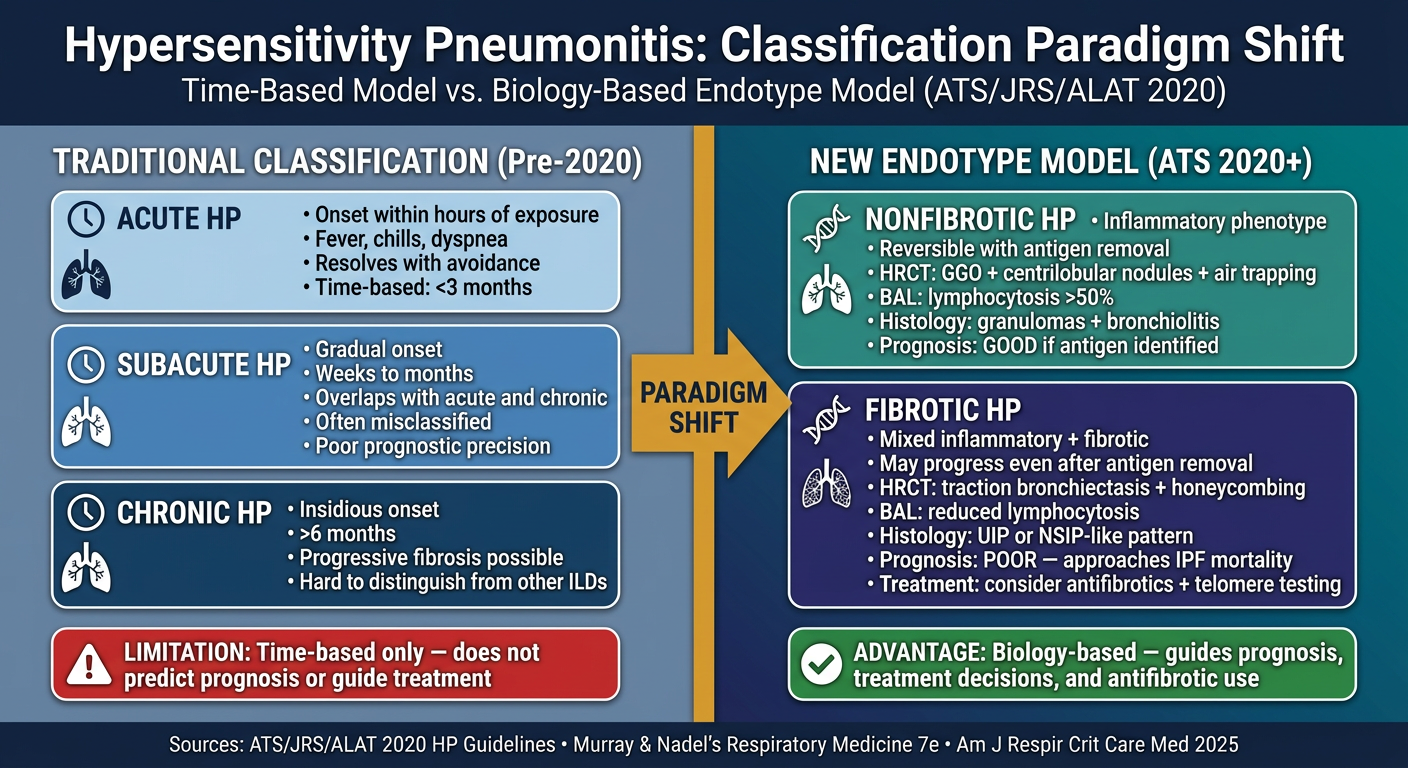
- Is fibrosis present on HRCT or histology?
- Has an antigen been identified?
- Nonfibrotic HP → focus on antigen removal; steroids if needed; good prognosis if antigen found
- Fibrotic HP → check telomere length before immunosuppression; consider nintedanib/pirfenidone if progressive; transplant evaluation if advanced
Write a 74 word short essay expressing interest to join as a fellow at the catalyst program at MIT for health professionals
Morton’s neuroma
"Morton Neuroma"
Morton's neuroma diagnosis treatment patient information Mayo Clinic
Typical symptoms
- Burning, sharp, or electric-shock pain in the ball of the foot
- Tingling or numbness radiating into adjacent toes
- Feeling as if there is a pebble or folded sock beneath the forefoot
- Pain worsened by walking, tight/narrow shoes, or high heels
- Relief after removing footwear or massaging the foot
Diagnosis
- Local tenderness in the intermetatarsal web space
- Pain provoked by compressing the metatarsal heads, sometimes with a palpable or audible click, called Mulder’s click
- Ultrasound or MRI can help when the diagnosis is uncertain or to exclude alternatives such as stress fracture, synovitis, plantar-plate injury, or a mass. Plain radiographs do not show the neuroma but can rule out bony causes.
First-line treatment
- Footwear modification: wide toe box, low heel, avoid compressive shoes.
- Metatarsal pad or orthotic: placed proximal to the painful metatarsal heads to spread them.
- Activity adjustment, ice, and short-term analgesia if safe for the individual.
- Ultrasound-guided corticosteroid plus local-anesthetic injection if symptoms persist.
Evidence update
Seek assessment promptly if
How can I distinguish Morton’s neuroma from metatarsalgia?
"Morton Neuroma" AND diagnosis
Morton's neuroma metatarsalgia difference diagnosis foot ankle clinical examination
| Feature | Morton’s neuroma | Mechanical metatarsalgia |
|---|---|---|
| Pain location | Very focal, in an intermetatarsal web space, usually between the 3rd and 4th toes | Broader tenderness directly beneath one or more metatarsal heads, commonly 2nd or 3rd |
| Pain quality | Burning, shooting, electric, tingling, numbness | Aching, bruised, pressure-like, “walking on a stone” |
| Radiation | Often radiates into the adjacent toes | Usually remains under the ball of the foot |
| Neurologic symptoms | Common: toe numbness, pins-and-needles, burning | Uncommon |
| Provocation | Squeezing the forefoot from the sides, pressing the web space, narrow shoes/high heels | Direct loading under a metatarsal head, prolonged standing or walking, thin-soled shoes |
| Examination | Focal web-space tenderness; compression may reproduce radiating pain or a Mulder click | Plantar metatarsal-head callus, local plantar tenderness, possible toe deformity or MTP instability |
| Imaging | Ultrasound or MRI can show an interdigital neuroma | X-ray helps identify deformity, arthritis, stress fracture; ultrasound/MRI if plantar-plate injury, bursitis, or stress injury is suspected |
Practical bedside distinction
-
Ask the patient to point with one finger to the worst spot.
- Between toes suggests neuroma.
- Directly under a metatarsal head suggests mechanical metatarsalgia.
-
Ask about sensory symptoms.
- Burning, tingling, or numb toes strongly favors a neuroma.
-
Perform two maneuvers.
- Web-space palpation plus side-to-side forefoot compression reproducing radiating pain favors neuroma.
- Direct plantar pressure on the metatarsal head reproducing localized ache favors metatarsalgia.
-
Inspect the sole.
- A focal callus under a metatarsal head suggests chronic mechanical overload.
- Absence of a callus does not exclude either condition.
Important caveat
Objective: To demonstrate comprehensive mastery of course concepts by developing an integrated AI strategy framework for a multidisciplinary healthcare environment. Students will synthesize knowledge from throughout the course to provide expert-level guidance on AI adoption, implementation, and ethical use in clinical settings.
Background: Healthcare organizations face complex decisions about AI adoption, from vendor selection and bias mitigation to clinician acceptance and ethical implementation. Successful AI integration requires understanding technical capabilities, organizational dynamics, ethical considerations, and evidence-based deployment strategies. As AI consultants, healthcare professionals must navigate competing priorities while ensuring patient safety, clinical efficacy, and equitable outcomes. This assignment challenges you to think strategically about AI implementation while addressing real-world concerns from diverse stakeholders including physicians, nurses, executives, and informatics professionals.
Vendor selection versus in-house development considerations (accuracy claims, validation needs)
Evidence-based deployment approaches beyond simple pilot testing
Transparency and explainability requirements for clinical acceptance
Part II: Organizational Change and Clinical Integration (400+ words) Provide integrated analysis addressing behavioral and operational challenges:
Strategies for promoting clinician adoption and behavior change with AI tools
Approaches to reducing physician and nurse burnout through AI implementation
"artificial intelligence" AND clinician burnout
"artificial intelligence" AND implementation AND health care
WHO ethics and governance artificial intelligence health transparency human oversight implementation healthcare
AI in Healthcare: A Current Overview
1. Clinical Documentation - AI Scribes
2. Large Language Models (LLMs) in Clinical Practice
3. Medical Imaging & Diagnostics
- Radiology: AI tools detect lung nodules, fractures, intracranial hemorrhage, and breast cancer on mammography with performance rivaling radiologists in controlled studies.
- Pathology: Digital pathology AI can classify tumors and predict molecular subtypes from histology slides.
- Ophthalmology: FDA-cleared AI (e.g., IDx-DR) autonomously screens for diabetic retinopathy without a specialist.
- GE HealthCare (June 2026) is actively expanding AI-enabled nuclear medicine workflows at the SNMMI Annual Meeting, integrating AI with PET imaging and theranostics.
4. Chronic Disease Management & Chatbots
5. Nursing & Patient Outcomes
6. Drug Discovery & Development
- AlphaFold (DeepMind) has predicted structures for virtually every known protein, transforming target identification.
- AI-designed molecules have entered clinical trials (e.g., Insilico Medicine's INS018_055 for IPF is in Phase II).
- IQVIA and other CROs are embedding "Healthcare-grade AI" into clinical trial design, patient recruitment, and pharmacovigilance.
7. Administrative AI
- Revenue cycle management: AI automates prior authorizations, coding, and claim denials. A KLAS 2026 report notes that while AI-driven clinical decision support is increasingly discussed, only ~40% of deep adopters are actively using archived data for AI-driven analytics in real production workflows.
- Scheduling & triage: NLP tools route patient messages and prioritize callbacks.
Key Challenges
| Challenge | Detail |
|---|---|
| Bias & equity | Models trained on non-representative data can perform worse for minority populations |
| Hallucinations | LLMs generate plausible but incorrect clinical information |
| Regulatory | FDA 510(k)/De Novo pathways for AI/ML-based SaMD (Software as Medical Device) are evolving |
| Privacy | HIPAA compliance, data governance, and de-identification requirements |
| Workflow integration | EHR interoperability and clinician adoption remain practical barriers |
| Accountability | Liability when AI contributes to a diagnostic or treatment error |
Bottom Line
Hypersensitivity Pneumonitis
Presentation · PPTX
What's Inside (24 Slides)
| # | Slide | Content |
|---|---|---|
| 1 | Title | Bold opening slide with accent design |
| 2 | Section divider | Overview & Classification |
| 3 | Definition | HP as a complex ILD, extrinsic allergic alveolitis, MDD cornerstone |
| 4 | Classification | Two-column: Nonfibrotic (acute) vs Fibrotic (chronic) HP |
| 5 | Section divider | Etiology & Antigens |
| 6 | Antigen Table | 9 named diseases — Farmer's Lung, Bird Breeder's, Hot Tub Lung, Metalworker's, Isocyanates, etc. |
| 7 | Section divider | Immunopathogenesis |
| 8 | Pathogenesis | Two-column: Type III immune complex vs Type IV cell-mediated |
| 9 | Histopathology | Classic triad, granuloma features, Schaumann bodies, fibrotic changes |
| 10 | Section divider | Clinical Features & Diagnosis |
| 11 | Clinical Presentations | Nonfibrotic vs fibrotic side-by-side |
| 12 | HRCT Findings | Centrilobular nodules, GGO, air trapping, traction bronchiectasis, HP vs IPF clues |
| 13 | Diagnostic Flowchart | Embedded Murray & Nadel Fig 91.2 flowchart image |
| 14 | Investigations | PFTs, serology limitations, BAL CD4:CD8 ratio, biopsy indications |
| 15 | Prognostic Factors Table | 8 domains from Murray & Nadel Table 91.1 (demographics → genetics) |
| 16 | Section divider | Management |
| 17 | Management Pillars | Antigen avoidance → steroids → steroid-sparing → antifibrotics |
| 18 | Management Algorithm | Embedded Murray & Nadel Fig 91.6 flowchart image |
| 19 | Advanced Disease | Transplant indications, mortality trends, acute exacerbation |
| 20 | Section divider | Differential Diagnosis |
| 21 | Differentials | IPF, Sarcoidosis, NSIP, RB-ILD, AEP — with distinguishing features |
| 22 | Clinical Pearls | Diagnosis + management pearls + "do not miss" |
| 23 | References | Murray & Nadel, Robbins, Radiology text, 2025-2026 guidelines (PMIDs included) |
| 24 | Closing | Take-home message slide |
HP Diagnosis Cheatsheet
PDF Document · PDF
| Section | What's covered |
|---|---|
| Header | Title + guideline sources (ATS 2020, Murray & Nadel 7e, S2k 2025) |
| Classification | Side-by-side: Nonfibrotic vs Fibrotic HP — symptoms, HRCT, BAL, histology |
| Diagnostic Certainty | 3-column traffic-light: Confident / Working / Unlikely — criteria for each, when MDD alone suffices vs when biopsy is needed |
| HRCT Criteria | Nonfibrotic (centrilobular nodules, GGO, "headcheese sign," air trapping) vs Fibrotic (reticulation, traction bronchiectasis, honeycombing, mid/upper zone clue vs IPF) |
| BAL Analysis | Lymphocytosis thresholds (>20%, >50%), reversed CD4:CD8 <1, sensitivity/specificity at optimal cutoff, caveats |
| Histopathology | Classic triad, Schaumann bodies, bronchiolocentric pattern, UIP/NSIP overlap |
| Exposure History | Structured triggers: birds, occupation, home mold, hobbies; "no antigen ≠ no HP" warning |
| Serology | IgG precipitins vs ELISA; false-positive pitfall; not a screening test |
| PFTs | Restrictive + low DLCO, isolated DLCO reduction, exercise desaturation, serial monitoring |
| Differential Diagnosis | IPF, Sarcoidosis, NSIP, COP, RB-ILD, Eosinophilic Pneumonia — key distinguishing features |
| Poor Prognosis Flags | 9 red-flag markers (MUC5B SNP, telomere length, PA:Ao ratio, acute exacerbation) |
| Clinical Pearls | 8 quick-fire reminders including transplant referral thresholds |
| Footer | Full source citations with PMIDs |
Hypersensitivity Pneumonitis: Latest Research Evidence (2023–2026)
1. SINGLE-CELL TRANSCRIPTOMICS — NOVEL IMMUNOPATHOGENESIS
Zhao AY, Unterman A, Abu Hussein NS, et al.
- 5' single-cell RNA sequencing (scRNA-seq) on PBMCs + BAL cells
- 45 fibrotic HP (FHP), 63 IPF, 4 nonfibrotic HP, 36 healthy controls (US + Mexico)
- 501,534 PBMCs and 88,336 BAL cells profiled
- Methods: Seurat (differential gene expression), DoRothEA-VIPER (TF activity), Monocle3 + Velocyto-scVelo-CellRank (trajectory)
- GZMhi cytotoxic CD4+ AND CD8+ T cells: significantly elevated in FHP vs both IPF and healthy controls — reflects a unique T cell-driven inflammatory signature
- These cells show active TGFβ, TNFα, and NFκB pathway transcription factor activity
- S100Ahi and CCL3hi/CCL4hi classical monocytes: significantly enriched in FHP
- Trajectory analysis shows S100Ahi monocytes differentiate into SPP1hi lung macrophages — the same pro-fibrotic macrophage population seen in IPF
- SPP1hi macrophage enrichment is a converging downstream fibrotic mechanism shared between FHP and IPF
- GZMhi cytotoxic T cells and SPP1+ macrophages are potential novel therapeutic targets specific to FHP
- Data publicly available at: http://ildimmunecellatlas.com
2. DIAGNOSTIC PITFALL — CT OVERLAP WITH CTD-ILD
Ryerson CJ, Marinescu DC, Muller NL, Hague CJ, Murphy D, Churg A, et al.
- Prospective registry study
- 164 patients with CT patterns classified as "typical fHP" per ATS 2020 guidelines
- Multidisciplinary diagnoses established by structured consensus MDD
| Multidisciplinary Diagnosis | n | % |
|---|---|---|
| fHP with probable/possible exposure identified | 49 | 30% |
| fHP without any exposure identified | 56 | 34% |
| CTD-ILD | 36 | 22% |
| Other diagnoses | 23 | 14% |
- fHP without identified exposure: significantly worse lung function decline and higher rate of death/transplantation
- 14% of antigen-negative fHP patients developed confirmed CTD features during follow-up (new autoimmune serology OR rheumatologist-confirmed CTD)
- A "typical fHP pattern" on HRCT does NOT confirm HP - 36% of such patients had non-HP diagnoses
- Always screen for CTD in antigen-negative fibrotic HP: ANA, anti-CCP, anti-Scl70, myositis panels
- Consider rheumatology referral at diagnosis for all antigen-negative cases
3. TELOMERE LENGTH — RETHINKING IMMUNOSUPPRESSION
Zhang D, Adegunsoye A, Oldham JM, Kozlitina J, et al.
- Retrospective multicentre cohort; 5 centres
- Discovery cohort: n=613 | Replication cohort: n=325
- Populations: fibrotic HP, unclassifiable ILD, CTD-ILD
- LTL measured by quantitative PCR; expressed as age-adjusted percentiles
- Outcome: 2-year transplant-free survival
| Group | HR (Mortality) | 95% CI | p-value |
|---|---|---|---|
| fHP + LTL <10th%ile + AZA or MMF (Discovery) | 4.97 | 2.26–10.92 | <0.001 |
| fHP + LTL <10th%ile + AZA or MMF (Replication) | 4.90 | 1.74–13.77 | 0.003 |
| Patients with LTL ≥10th percentile | No differential survival | — | NS |
- Significant interaction between telomere shortening and immunosuppressant exposure (p_interaction = 0.013 discovery; 0.011 replication)
- ~22% of fibrotic ILD patients had LTL <10th percentile
- Measure telomere length before starting AZA or MMF in fibrotic HP
- Short telomeres (<10th percentile) → avoid immunosuppression → consider antifibrotics or expedited transplant listing
- This interaction likely reflects accelerated telomere attrition from cytotoxic drug effects in already telomere-impaired cells
4. ANTIFIBROTIC THERAPY — PIRFENIDONE META-ANALYSIS
Giri B, et al.
| Outcome | Mean Difference | 95% CI | p-value | Significance |
|---|---|---|---|---|
| % predicted FVC | +3.65 | −1.63 to +8.94 | 0.18 | Non-significant |
| % predicted DLCO | +7.64 | −1.46 to +16.74 | 0.10 | Non-significant |
| SGRQ score (QoL) | −5.0 | −6.88 to −3.12 | <0.00001 | Significant ✓ |
- Pirfenidone does not significantly improve objective lung function (FVC/DLCO) in fibrotic HP in the current limited RCT pool
- Pirfenidone does significantly improve quality of life (SGRQ reduction of 5 points = clinically meaningful threshold)
- Important caveat: very limited HP-specific RCT data; results are driven by a small trial pool
- Pathophysiological overlap with IPF (TGFβ pathway, myofibroblast activation) supports continued investigation
5. NETWORK META-ANALYSIS — ANTIFIBROTICS IN PROGRESSIVE PF-ILDs
Singh P, Thampi G, Gupta K, Gangte N, Pattnaik B, Agrawal A, et al.
- HP-specific: 4 RCTs (259 patients) for 3 drugs in chronic HP (CHP)
- Pirfenidone + prednisolone: showed benefit in CHP from available RCT data
- Nintedanib: established efficacy in IPF and PPF (INBUILD); HP patients included via PPF progression criterion
- In IPF: pirfenidone, nintedanib, and IFN-γ-1b slowed lung function decline and reduced mortality
- In CTD-ILD: pirfenidone, nintedanib, tocilizumab, and cyclophosphamide improved outcomes
- Pirfenidone and nintedanib remain the most evidence-supported agents across PF-ILDs including progressive HP
- Emerging therapies (IFN-γ-1b) warrant further research
6. HRCT IMAGING ADVANCES
Yanagawa M, Han J, Wada N, et al.
- AI-based quantitative CT analysis for progressive ILD monitoring
- Computer-aided detection of traction bronchiectasis, GGO extent, and fibrosis scoring
- Emerging role in serial HP monitoring to quantify progression objectively
- Potential to replace subjective radiologist scoring for clinical trial endpoints
Sellers T, Martin MD, Kanne JP, et al.
- Updated pictorial review of HP HRCT patterns in the context of 2020 guideline classifications
- Distinguishing features between typical fHP pattern vs UIP (IPF) pattern reviewed with updated criteria
7. GERMAN NATIONAL PRACTICE GUIDELINE (S2k)
Koschel D, Behr J, Berger M, et al.
- National-level evidence synthesis covering HP diagnosis, antifibrotic use, monitoring framework
- Endorses antifibrotic therapy for progressive fibrotic HP
- Aligns with ATS 2020 on antigen avoidance as cornerstone
8. BROADER ILD / EPIDEMIOLOGY CONTEXT
Spagnolo P, Guler SA, Chaudhuri N, et al.
- HP is among the most common ILDs globally at tertiary centres
- Rising age-adjusted HP mortality: 0.1 → 0.7 per million (1988–2016); +5.6%/year average increase
- Fibrotic HP: 56–68% of all HP cases; prevalence 0.9–1.7 per 100,000/year
9. EMERGING PIPELINE (2025–2026)
| Drug / Intervention | Mechanism | Status | Notes |
|---|---|---|---|
| Nerandomilast (BI 1015550) | PDE4B inhibitor | Phase III (IPF + PPF) | HP with progressive phenotype eligible |
| MTX-463 | Anti-WISP1 mAb | Phase 2 (PPF) | Concomitant antifibrotics permitted |
| Inhaled treprostinil (TETON-2) | Prostacyclin analogue | Phase 3 — COMPLETED | +95.6 mL FVC vs placebo (p<0.0001); TETON-1 ongoing |
| Mosliciguat | sGC stimulator | Phase 2 (PH-ILD) | NCT06635850 — now recruiting |
| INS018_055 (Insilico Medicine) | AI-designed drug (IPF target) | Phase 2 | First AI-designed molecule in ILD trials |
| Anti-SPP1+ macrophage strategies | SPP1 pathway inhibition | Pre-clinical | Rationale from Zhao AJRCCM 2024 |
| GZMhi T cell targeting | Cytotoxic T cell blockade | Conceptual / pre-clinical | Unique FHP target — no clinical agent yet |
10. KEY TEXTBOOK EVIDENCE (Murray & Nadel 7e, Chapter 91)
| Domain | Adverse Factor |
|---|---|
| Demographics | Male sex, older age |
| Physical exam | Auscultatory crackles |
| Pulmonary physiology | Low FVC%, low DLCO% |
| HRCT | Honeycombing, traction bronchiectasis, inspiratory mosaic + expiratory air trapping, increased PA:Ao ratio |
| Pathology | Increased fibrosis, fibroblast foci |
| Genomics | MUC5B rs35705950 SNP, telomere length <10th percentile for age |
| Composite | Abnormal ILD-GAP index |
| Other | No known antigen, smoking, acute exacerbation, pulmonary hypertension |
- Peribronchiolar mononuclear cell infiltrate (lymphocytes predominate)
- Poorly-formed noncaseating granulomas (present in 2/3 of cases; peribronchiolar)
- Cellular bronchiolitis
SUMMARY: What Has Changed for Senior Pulmonologists
| Domain | Old Paradigm | New Evidence (2023–2026) |
|---|---|---|
| Pathogenesis | Type III + IV hypersensitivity; granulomatous inflammation | + GZMhi cytotoxic T cells; SPP1+ fibrotic macrophages (AJRCCM 2024) |
| Diagnosis | Typical fHP CT = confident HP | 36% of typical fHP CT = non-HP; 22% = CTD-ILD (AJRCCM 2025) |
| Immunosuppression | AZA/MMF standard for fibrotic HP | Check telomere length first — short LTL + AZA/MMF = 5x mortality (ERJ 2023) |
| Antifibrotics | Nintedanib only (via PPF label) | Pirfenidone improves QoL; NMA supports both in progressive HP (2025) |
| Biomarkers | Serum precipitins + BAL lymphocytosis | KL-6, SP-D, GZMhi T cell signatures, telomere length emerging |
| CT Monitoring | Visual radiologist scoring | AI quantitative CT analysis for objective fibrosis progression tracking |
| Pipeline | Limited HP-specific trials | Treprostinil (TETON met endpoint), nerandomilast, MTX-463, mosliciguat (PH-HP) |
- Is fibrosis present on HRCT or histology?
- Has an antigen been identified?
- Nonfibrotic HP → focus on antigen removal; steroids if needed; good prognosis if antigen found
- Fibrotic HP → check telomere length before immunosuppression; consider nintedanib/pirfenidone if progressive; transplant evaluation if advanced
Typical symptoms
- Burning, sharp, or electric-shock pain in the ball of the foot
- Tingling or numbness radiating into adjacent toes
- Feeling as if there is a pebble or folded sock beneath the forefoot
- Pain worsened by walking, tight/narrow shoes, or high heels
- Relief after removing footwear or massaging the foot
Diagnosis
- Local tenderness in the intermetatarsal web space
- Pain provoked by compressing the metatarsal heads, sometimes with a palpable or audible click, called Mulder’s click
- Ultrasound or MRI can help when the diagnosis is uncertain or to exclude alternatives such as stress fracture, synovitis, plantar-plate injury, or a mass. Plain radiographs do not show the neuroma but can rule out bony causes.
First-line treatment
- Footwear modification: wide toe box, low heel, avoid compressive shoes.
- Metatarsal pad or orthotic: placed proximal to the painful metatarsal heads to spread them.
- Activity adjustment, ice, and short-term analgesia if safe for the individual.
- Ultrasound-guided corticosteroid plus local-anesthetic injection if symptoms persist.
Evidence update
Seek assessment promptly if
| Feature | Morton’s neuroma | Mechanical metatarsalgia |
|---|---|---|
| Pain location | Very focal, in an intermetatarsal web space, usually between the 3rd and 4th toes | Broader tenderness directly beneath one or more metatarsal heads, commonly 2nd or 3rd |
| Pain quality | Burning, shooting, electric, tingling, numbness | Aching, bruised, pressure-like, “walking on a stone” |
| Radiation | Often radiates into the adjacent toes | Usually remains under the ball of the foot |
| Neurologic symptoms | Common: toe numbness, pins-and-needles, burning | Uncommon |
| Provocation | Squeezing the forefoot from the sides, pressing the web space, narrow shoes/high heels | Direct loading under a metatarsal head, prolonged standing or walking, thin-soled shoes |
| Examination | Focal web-space tenderness; compression may reproduce radiating pain or a Mulder click | Plantar metatarsal-head callus, local plantar tenderness, possible toe deformity or MTP instability |
| Imaging | Ultrasound or MRI can show an interdigital neuroma | X-ray helps identify deformity, arthritis, stress fracture; ultrasound/MRI if plantar-plate injury, bursitis, or stress injury is suspected |
Practical bedside distinction
-
Ask the patient to point with one finger to the worst spot.
- Between toes suggests neuroma.
- Directly under a metatarsal head suggests mechanical metatarsalgia.
-
Ask about sensory symptoms.
- Burning, tingling, or numb toes strongly favors a neuroma.
-
Perform two maneuvers.
- Web-space palpation plus side-to-side forefoot compression reproducing radiating pain favors neuroma.
- Direct plantar pressure on the metatarsal head reproducing localized ache favors metatarsalgia.
-
Inspect the sole.
- A focal callus under a metatarsal head suggests chronic mechanical overload.
- Absence of a callus does not exclude either condition.
Important caveat
Failed to create session: unauthorized: authentication failed: Bearer token is invalid
We encountered an error while processing your request. Please try again or reach out to us for help.
Methods for leveraging large language models in clinical decision-making while maintaining safety
Part III: Ethical Considerations and Future Strategy (200+ words) Synthesize ethical frameworks and forward-looking recommendations:
AI strategies to avoid due to ethical concerns or resource waste
Your personal philosophy on responsible AI use in healthcare
Long-term vision for improving patient outcomes through AI integration
Recommendations for maintaining ethical standards while advancing innovation
Write a reflective essay about the above , starting from the objective
"artificial intelligence" AND clinician burnout
"artificial intelligence" AND implementation AND health care
WHO ethics governance artificial intelligence health transparency human oversight healthcare implementation
Reflective Essay: An Integrated AI Strategy Framework for Multidisciplinary Healthcare
Objective
Part I: Strategic AI Adoption, Selection, and Deployment
- Pre-implementation evaluation: Map the clinical workflow, define the decision owner, conduct a failure-mode and effects analysis, and establish baseline metrics.
- Silent or shadow-mode testing: Run the model without showing its output to clinicians. Compare output with usual care and adjudicated outcomes while assessing data quality, calibration, and subgroup performance.
- Limited prospective rollout: Introduce the model in one clinical setting with trained users, explicit escalation pathways, and active safety monitoring.
- Comparative evaluation: Assess patient-centered outcomes, diagnostic delay, false alarms, clinician workload, equity effects, and cost rather than accuracy alone.
- Governed scaling: Expand only if predefined benefit and safety thresholds are met, with ongoing surveillance for drift and periodic revalidation.
Part II: Organizational Change and Clinical Integration
Part III: Ethical Considerations and Future Strategy
Apply all the above suggestions
Integrated AI Strategy Framework for Multidisciplinary Healthcare
Objective
Part I: Strategic AI Adoption, Vendor Selection, and Validation
- Pre-implementation assessment: Define the clinical problem, intended users, target population, workflow, potential harms, baseline performance, and outcome measures.
- Silent or shadow-mode validation: Run the algorithm without displaying results to clinicians. Compare model predictions with real outcomes and usual care.
- Local retrospective and prospective validation: Assess discrimination, calibration, sensitivity, specificity, predictive values, false-alert burden, and subgroup performance.
- Limited clinical rollout: Start in one unit or service line with trained users, clear escalation pathways, and active safety monitoring.
- Comparative outcome evaluation: Measure patient-centered outcomes, diagnostic delay, clinician workload, alert fatigue, equity effects, and financial impact.
- Governed scaling and continuous surveillance: Expand only if predefined thresholds for safety, effectiveness, usability, and equity are met.
Part II: Organizational Change and Clinical Integration
Part III: Ethical Considerations and Future Strategy
Adapt this into APA 7 format with scholarly citations
"artificial intelligence" AND "health care" AND implementation
"large language models" AND clinical decision support
WHO ethics governance artificial intelligence health 2021 transparency accountability