
Alkaptonuria
I'll look this up in the medical library for a thorough answer.
Reading File
Now let me search the medical library and PubMed in parallel for comprehensive coverage.
Finding Sources
Searching PubMed
alkaptonuria
Good. Now let me read the most comprehensive sources in parallel - Harrison's, Goldman-Cecil, Rheumatology, and Andrews' Dermatology.
Reading File
Reading File
Reading File
Reading File
Excellent. Now let me fetch the clinical images and also read the Lippincott Biochemistry and Emery's Genetics sections.
Loading Image
Loading Image
Reading File
Reading File
Let me also get the Lippincott biochemistry images and the Rheumatology spinal X-ray description.
Loading Image
Finding Sources
I now have comprehensive information from multiple authoritative textbooks plus recent PubMed evidence. Here is the complete answer:
Alkaptonuria
Historical Significance
Alkaptonuria holds a unique place in medicine: it was the first "inborn error of metabolism" described in medical literature, documented by Sir Archibald Garrod in 1896 - who famously called it "a rather harmless disease." That characterization has since been substantially revised. - Rheumatology, 2-Volume Set (Elsevier, 2022)
Genetics & Biochemistry
| Feature | Detail |
|---|---|
| Inheritance | Autosomal recessive (AR) |
| Gene | HGD (chromosome 3q13.33) |
| Enzyme defect | Homogentisate 1,2-dioxygenase (homogentisic acid oxidase) |
| Metabolic pathway | Tyrosine / phenylalanine catabolism |
| Incidence | ~1 : 250,000 births |
| Sex ratio | Males outnumber females 2:1 |
The HGD enzyme normally cleaves the aromatic ring of homogentisic acid (HGA) in the liver and kidney. Without it, HGA accumulates in blood, is excreted in massive amounts in urine, and deposits as oxidized black-brown pigment (benzoquinone acetate polymer) in connective tissues - the condition called ochronosis. - Lippincott Illustrated Reviews: Biochemistry, 8th ed.; Emery's Elements of Medical Genetics and Genomics
Pathophysiology
Phenylalanine / Tyrosine
        ↓
  4-Hydroxyphenylpyruvate
        ↓  (inhibited by nitisinone)
  Homogentisic acid (HGA)
        ↓  ← [HGD enzyme BLOCKED in alkaptonuria]
  Maleylacetoacetate → Fumarate + Acetoacetate
Accumulated HGA polymerizes upon oxidation into dark ochronotic pigment that:
- Deposits in collagen-rich tissues (cartilage, tendons, ligaments, heart valves, skin)
- Makes cartilage brittle and mechanically fragile
- Promotes local pyrophosphate accumulation, accelerating joint destruction
Clinical Features (Timeline)
Infancy / Childhood
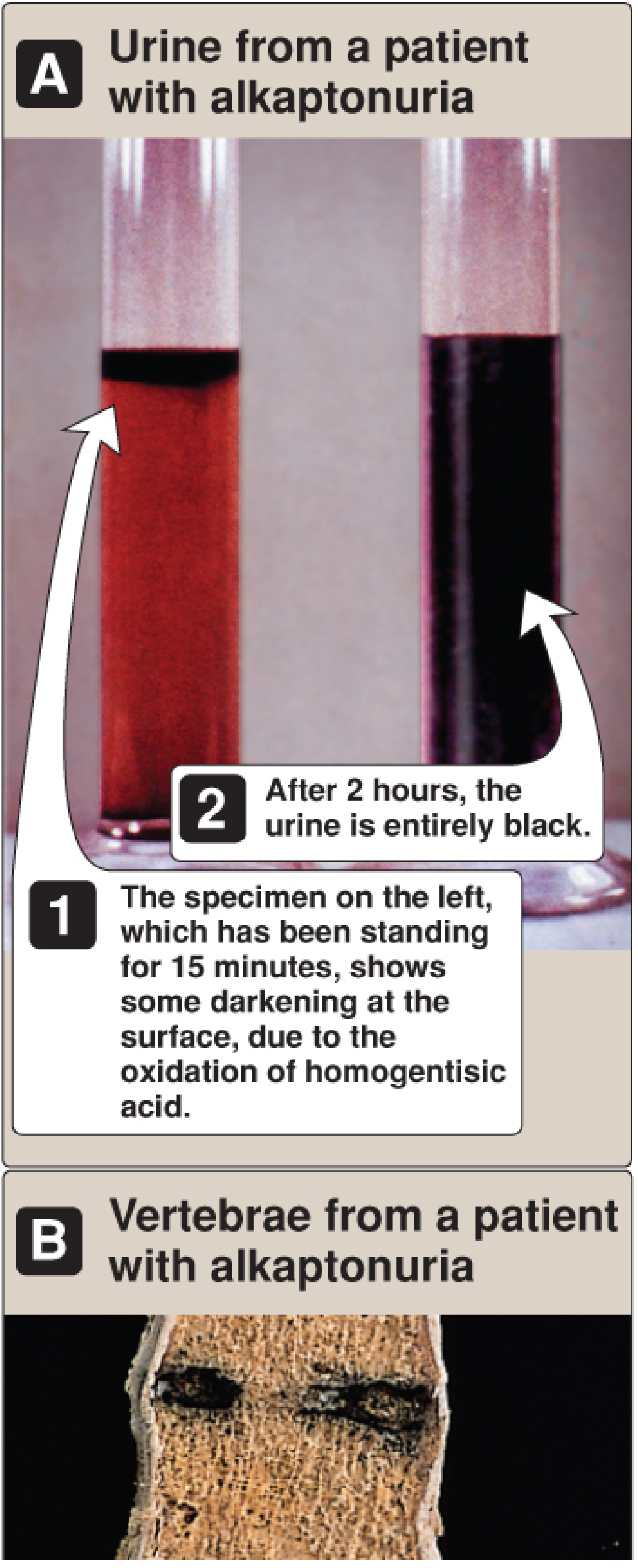
- Dark staining of diapers - the earliest clue
- Urine darkens on standing or with alkalization (HGA oxidizes to black pigment)
- Generally asymptomatic
Urine from a patient with alkaptonuria - showing progressive darkening (at 15 min on left, entirely black at 2 hours on right):
3rd Decade (ages 20-30)
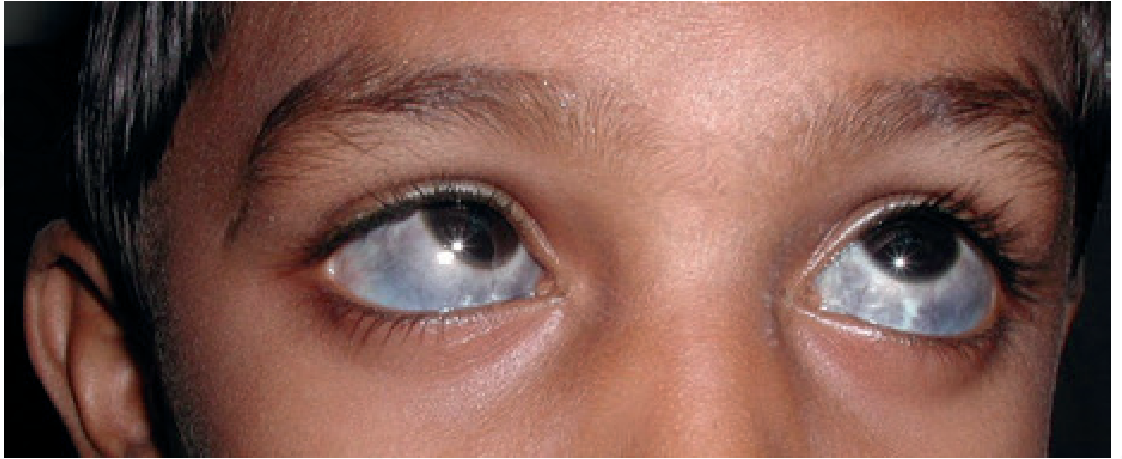
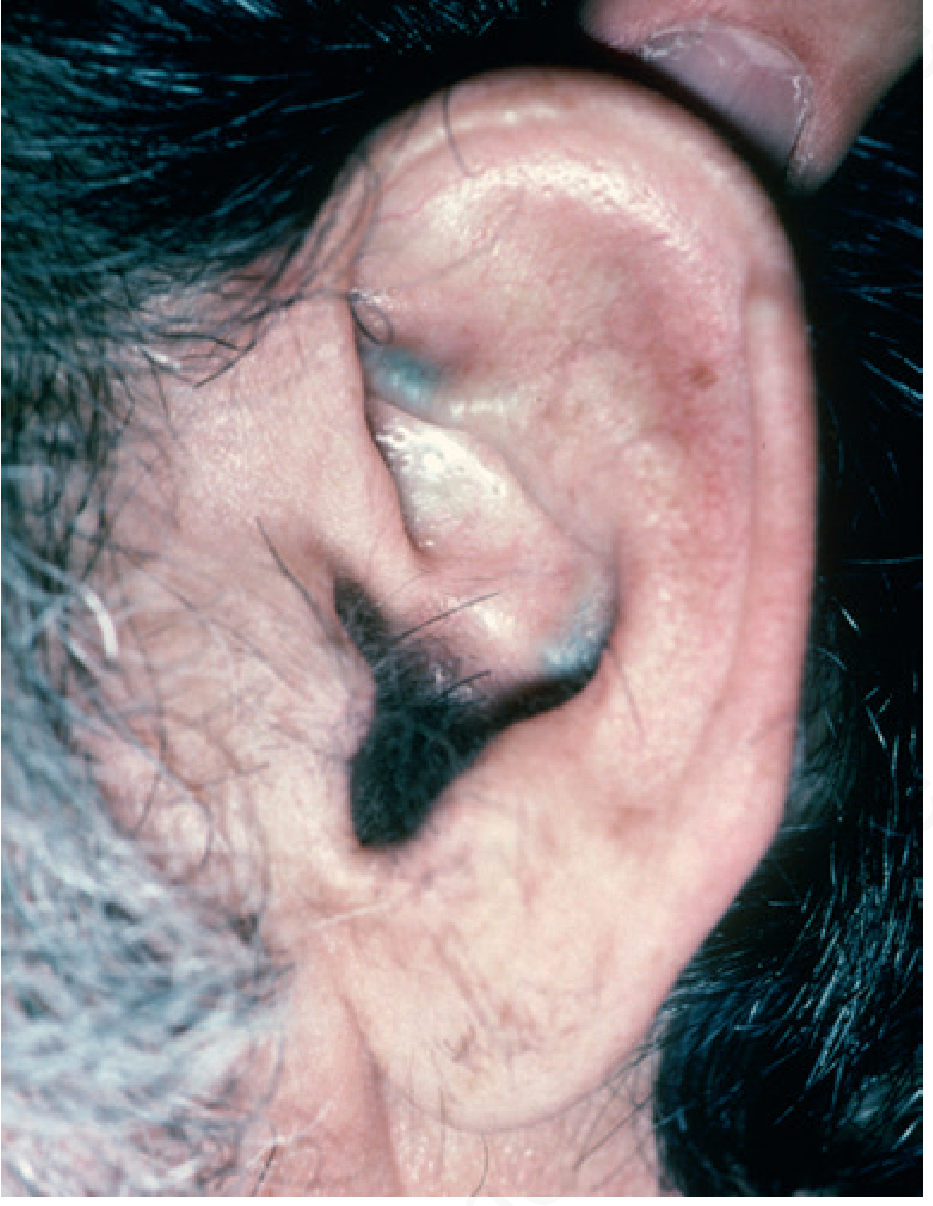
- Pigmentation appears in the sclera (Osler sign - grey-brown deposits, usually lateral to the cornea) and ear cartilage (concha, antihelix, helix)
- Black cerumen (ear wax)
- Skin: blue/brown macules on fingers, ears, nose, axillae, buccal mucosa
Osler sign - scleral pigmentation:
Auricular pigmentation:
4th-5th Decade (30-50 years)
- Ochronotic arthropathy - the dominant disabling feature
- Spine involved first: low back pain starting ages 30-40, progressive thoracic kyphosis mimicking ankylosing spondylitis
- Large joints follow: knees, shoulders, hips
- Small peripheral joints are typically spared
- Synovial fluid: noninflammatory; may contain tiny fragments of pigmented cartilage ("ground pepper" sign)
- Tendon ruptures may occur
- Cardiac involvement: HGA deposits in aortic and mitral valves; aortic stenosis may require valve replacement (particularly after age 60)
- Renal/prostatic calculi: pigmented stones from HGA deposition
Radiology
-
Pathognomonic finding: Dense calcification of intervertebral discs (disc space ossification), followed by disc space narrowing and collapse
-
Multiple vacuum discs
-
Distinguishes ochronotic spondylosis from ankylosing spondylitis (the latter does not calcify discs)
-
Harrison's 22E, Goldman-Cecil Medicine, Rheumatology 2022
Diagnosis
| Test | Finding |
|---|---|
| Urine organic acid analysis | Massive elevation of homogentisic acid - primary diagnostic test |
| Urine appearance | Darkens to black on standing or alkalinization |
| HGD gene sequencing | Confirms mutation (>300 mutations known) |
| Synovial fluid | Noninflammatory; "ground pepper" ochronotic fragments |
| Spine X-ray | Intervertebral disc calcification (pathognomonic) |
| Histology (skin) | Large irregular ochre bodies in reticular dermis; degenerated elastic fibers stain black with crystal violet or methylene blue |
Treatment
Disease-Modifying
-
Nitisinone (NTBC; 2-(2-nitro-4-trifluoromethylbenzoyl)-1,3-cyclohexanedione) - the primary treatment advance
- Originally a triketone herbicide; used in tyrosinemia type I
- Mechanism: inhibits 4-hydroxyphenylpyruvate dioxygenase (an upstream enzyme), blocking HGA production entirely
- Dose: 10 mg/day
- Effect: dramatically reduces urinary HGA to near-normal levels
- Caveat: most effective before joint disease is established; less benefit once arthropathy is advanced; can cause tyrosine keratopathy as a side effect (tyrosine levels rise)
- The SONIA 2 trial (Lancet Diabetes Endocrinol, 2020) was a landmark RCT demonstrating efficacy in reducing HGA
-
Dietary restriction of phenylalanine and tyrosine: reduces HGA substrate load, but does not reliably prevent disease progression
Symptomatic / Surgical
- Analgesics and NSAIDs for arthritis pain
- Joint replacement (hip, knee arthroplasty) for advanced ochronotic arthritis
- Spinal surgery when indicated
- Cardiac valve replacement (aortic/mitral) when valvular disease is severe
Key Differentials
- Ankylosing spondylitis: axial disease, HLA-B27+, sacroiliitis, no disc calcification, no darkening urine
- Exogenous ochronosis: topical hydroquinone use (skin lightening agents) causes similar skin pigmentation but no systemic features
- Rheumatoid arthritis: small joint involvement, seropositive, erosive; unlike ochronotic arthritis
Recent Evidence
A 2025 systematic review with meta-analysis (PMID 40157162) confirmed the efficacy and safety of nitisinone for alkaptonuria. A comprehensive 2024 Nature Reviews Disease Primers review (PMID 38453957) provides updated understanding of pathophysiology and disease staging. A 2025 review on ochronotic arthropathy (PMID 40071956) details orthopedic management strategies.
Summary Mnemonics
"DARK URINE + DARK JOINTS + DARK EARS = Alkaptonuria"
Enzyme: Homogentisate 1,2-dioxygenase (HGD gene)
Substrate: Homogentisic acid (HGA)
Inheritance: Autosomal Recessive
Treatment: Nitisinone (blocks upstream HGA synthesis)
Sources: Harrison's Principles of Internal Medicine 22E | Goldman-Cecil Medicine | Rheumatology 2-Volume Set (Elsevier 2022) | Andrews' Diseases of the Skin 11e | Lippincott Illustrated Reviews: Biochemistry 8e | Emery's Elements of Medical Genetics and Genomics
This is a shared conversation. Sign in to Orris to start your own chat.