
Total Intravenous Anaesthesia - MD Anaesthesia Pg Exam - 30 marks
Reading File
Now let me search the medical library for comprehensive TIVA content in parallel:
Finding Sources
Finding Sources
Finding Sources
Finding Sources
Finding Sources
Finding Sources
Good - found key sections in Miller's Anesthesia and Barash. Let me read the most relevant sections in parallel:
Reading File
Reading File
Reading File
Reading File
Finding Sources
Finding Sources
Reading File
Reading File
Now I have comprehensive content. Let me also get key sections on TIVA advantages/disadvantages and monitoring:
Finding Sources
Finding Sources
I now have comprehensive data from Miller's Anesthesia and Barash to write a thorough 30-mark MD Anaesthesia PG exam answer. Let me compose it now.
Total Intravenous Anaesthesia (TIVA)
MD Anaesthesia PG Exam Answer - 30 Marks
Definition
Total Intravenous Anaesthesia (TIVA) is a technique of general anaesthesia in which all anaesthetic agents are administered exclusively by the intravenous route, without the use of any volatile inhalational agents. The components of anaesthesia - hypnosis, analgesia, and muscle relaxation - are all delivered intravenously.
Historical Background
The concept of intravenous anaesthesia dates to 1656, when Christopher Wren administered opium intravenously via a quill. Modern TIVA became practical only with the introduction of propofol in the 1980s and the development of target-controlled infusion (TCI) systems. Kruger-Thiemer first described the theoretical framework for achieving steady-state blood concentrations using multi-compartment pharmacokinetic models, later clinically implemented by Schwilden and colleagues. The bolus-elimination-transfer (BET) scheme became the cornerstone of TCI design.
Components of TIVA
| Component | Drug(s) |
|---|---|
| Hypnotic | Propofol (most common), Ketamine, Midazolam, Etomidate |
| Opioid/Analgesic | Remifentanil (preferred), Fentanyl, Sufentanil, Alfentanil |
| Muscle Relaxant | Vecuronium, Rocuronium, Cisatracurium |
The propofol + remifentanil combination is the gold standard TIVA regimen due to their complementary pharmacokinetics.
Pharmacokinetics of Key Drugs
Propofol
Propofol (2,6-di-isopropyl phenol) is the cornerstone of TIVA.
Distribution:
- Highly lipophilic; rapid redistribution after bolus
- Three-compartment pharmacokinetic model
- Initial distribution half-life: 2-8 minutes
- Slow distribution half-life: 30-70 minutes
- Elimination half-life: 4-23.5 hours
- Volume of distribution at steady state: 150-700 L
- Central compartment volume: 6-40 L (smaller in elderly due to reduced cardiac output)
Metabolism:
- Clearance: 1.5-2.2 L/min (exceeds hepatic blood flow)
- Hepatic oxidation to 1,4-diisopropyl quinol, followed by glucuronide conjugation
- Extrahepatic metabolism confirmed (kidney accounts for ~30% of clearance; lungs contribute 20-30% first-pass)
- Propofol inhibits CYP3A4 (even at 3 mcg/mL, reduces CYP3A4 activity by ~37%)
Context-Sensitive Half-Time (CSHT):
- For infusions up to 8 hours, CSHT remains <40 minutes
- Since the required decrease in concentration for awakening is <50%, recovery remains rapid even after prolonged infusion - this makes propofol ideal for TIVA
Remifentanil
- Ultra-short-acting synthetic mu-opioid agonist
- Ester hydrolysis by nonspecific plasma and tissue esterases (independent of hepatic/renal function)
- Context-sensitive half-time: 3-5 minutes (does NOT increase with infusion duration)
- Elimination half-life: ~8-20 minutes
- Dose: 0.05-2 mcg/kg/min by infusion
- Uniquely, neonates have more rapid clearance than older children due to larger volume of distribution and esterase activity
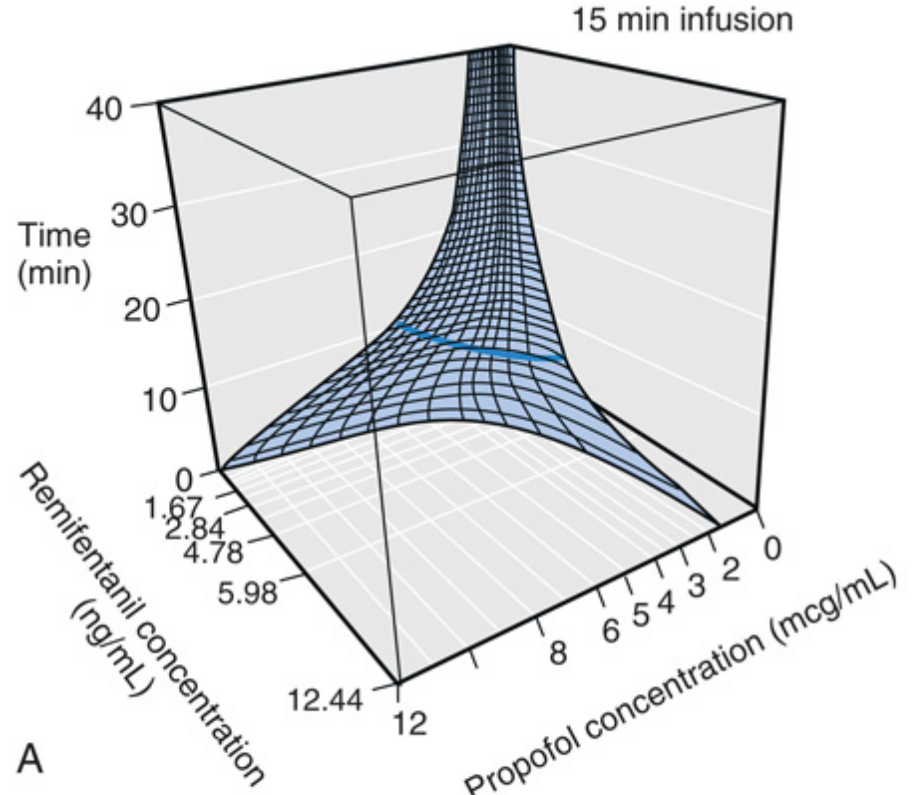
Remifentanil + Propofol interaction: When added to a propofol plasma concentration of 2 mcg/mL, remifentanil concentration required for suppression of surgical stimuli follows a synergistic interaction. The optimal combination is propofol ~2.5 mcg/mL and a lower remifentanil concentration to minimize recovery time.
Target-Controlled Infusion (TCI)
TCI is a computer-controlled infusion system that uses pharmacokinetic models to calculate and deliver drug infusions targeting a clinician-specified plasma or effect-site concentration.
Principle - BET Scheme
The Bolus-Elimination-Transfer (BET) scheme works via:
- Bolus: Initial bolus to rapidly achieve target concentration in the central compartment
- Elimination infusion: Constant rate infusion to replace drug lost by elimination
- Transfer infusion: Exponentially declining infusion to replace drug redistributing to peripheral compartments
Effect-Site (Ce) vs. Plasma (Cp) Targeting
- Plasma TCI (Cp target): Targets the plasma concentration; effect-site concentration lags behind due to the blood-brain equilibration delay (ke0)
- Effect-site TCI (Ce target): Targets the biophase/effect-site concentration; produces faster onset by temporarily overshooting plasma concentration
Propofol TCI Models
| Model | Key Features |
|---|---|
| Marsh | Simple three-compartment; uses total body weight; commonly used in clinical practice |
| Schnider | Uses age, total body weight, height, lean body mass; includes effect-site; more refined for elderly |
| Eleveld | Most recent; allometric scaling; better accuracy across a wide range of body weights including obese patients |
Schnider model limitation: Uses the James equation for lean body mass calculation, which yields negative values in morbidly obese patients - making it invalid in this population.
For obese patients: Adjusted body weight (ABW = ideal weight + 40% × [total - ideal weight]) with Marsh or Schnider models, or the Eleveld model, provides best accuracy.
Remifentanil TCI
- Minto model: Uses age, weight, height, and lean body mass; accounts for age-related changes in pharmacokinetics
Induction and Maintenance Doses
| Agent | Induction | Maintenance |
|---|---|---|
| Propofol (manual) | 1-2.5 mg/kg IV | 4-12 mg/kg/h (66-200 mcg/kg/min) |
| Propofol TCI (Cp) | Target 4-8 mcg/mL | Target 3-6 mcg/mL |
| Remifentanil infusion | 0.5-1 mcg/kg/min | 0.05-2 mcg/kg/min |
| Ketamine | 1-2 mg/kg IV | 1-3 mg/kg/h |
Advantages of TIVA
- Reduced PONV - Propofol has intrinsic antiemetic properties; avoiding volatile agents significantly reduces postoperative nausea and vomiting
- Safe in malignant hyperthermia (MH) susceptible patients - TIVA avoids all triggering volatile agents and succinylcholine; it is the technique of choice in MH-susceptible individuals
- Better maintenance of surgical field - Reduces bronchospasm; ideal for airway surgery, ENT, and sinus surgery (TIVA with remifentanil reduces coughing and improves surgical conditions)
- Smooth induction and emergence - No excitation on induction; rapid, clear-headed recovery
- Reduced pollution - No theatre pollution from volatile agents
- Better neurophysiologic monitoring - TIVA (propofol + remifentanil) causes less suppression of evoked potentials (MEP, SSEP) compared to volatile agents; preferred for spine and neurosurgery
- Use in remote locations - Can be administered without an anaesthetic machine
- Facial nerve monitoring - Propofol + remifentanil provides reliable conditions for facial nerve monitoring during ear surgery (Choe et al.)
- Reduced airway reactivity - Propofol suppresses laryngeal reflexes; ideal with LMA
- Anti-epileptic properties - Propofol useful in patients with epilepsy
- Opioid-free TIVA variants - Reduces PONV further in bariatric surgery beyond triple prophylaxis
Disadvantages of TIVA
- Risk of intraoperative awareness - No reliable exhaled agent monitoring; reliance on PK models which may be inaccurate; BIS/processed EEG monitoring strongly recommended
- Venous access dependent - Disconnection, dislodgement, or extravasation can cause awareness or drug toxicity
- Propofol infusion syndrome (PRIS) - Rare but life-threatening complication with high-dose, prolonged infusions (>4 mg/kg/h for >48h); characterised by metabolic acidosis, rhabdomyolysis, cardiac failure, lipaemia
- Injection pain - Propofol causes burning on injection (50-70% if given into small peripheral vein); using large antecubital vein, lidocaine pretreatment, or using lipid formulations mitigates this
- Haemodynamic effects - Propofol causes vasodilation and myocardial depression, especially at induction; caution in hypovolaemic and elderly patients
- Cost - Higher cost than inhalational anaesthesia for routine cases
- Pharmacokinetic variability - TCI models are population-based averages; individual variability (obesity, elderly, hepatic disease, cardiac failure) can lead to under- or overdosing
- Supports microbial growth - Propofol's lipid emulsion supports bacterial and fungal growth; strict aseptic handling required; discard within 12 hours of opening
- Apnoea - High-dose propofol causes respiratory depression and apnoea
- Dose calculation complexity - Manual TIVA requires careful calculation of infusion rates
Indications for TIVA
- Malignant hyperthermia susceptibility (absolute)
- Airway surgery (shared airway, laser surgery, microlaryngoscopy)
- ENT surgery - sinus surgery, middle ear surgery, thyroidectomy
- Neuroanaesthesia with neurophysiological monitoring
- Neurosurgery requiring cerebral protection (propofol reduces CMRO2)
- Patients prone to PONV
- Remote anaesthesia (MRI, radiotherapy, catheterisation labs)
- Robotic and laparoscopic surgery
- Paediatric anaesthesia (where TIVA is feasible and MH risk exists)
- Day-case and ambulatory surgery
Monitoring During TIVA
Depth of Anaesthesia Monitoring
Monitoring depth of anaesthesia is particularly important in TIVA because there is no end-tidal volatile agent concentration to guide dosing.
Processed EEG monitors:
- BIS (Bispectral Index): Most widely used; value 40-60 = adequate anaesthesia; <40 = deep; >60 = risk of awareness
- Entropy (State Entropy / Response Entropy)
- Narcotrend
BIS target range during TIVA: 40-60. An adequate TIVA requires BIS monitoring as TCI models alone cannot guarantee adequate depth in every individual.
Standard monitoring (AAGBI minimum):
- Continuous ECG
- SpO2 pulse oximetry
- NIBP (or IBP in high-risk patients)
- Capnography (EtCO2)
- Neuromuscular monitoring (if muscle relaxants used)
- Temperature monitoring
TIVA in Special Populations
Elderly Patients
- Reduced central compartment volume - higher peak plasma concentrations after bolus
- Reduced clearance and cardiac output
- Reduce induction dose of propofol by 30-50%
- Schnider model incorporates age as a covariate and is preferred
Obese Patients
- Marsh model using total body weight overestimates required dose
- Use adjusted body weight or Eleveld model
- Effect-site TCI with Schnider model risks negative lean body mass calculations
Paediatric Patients
- TIVA increasingly used; propofol + remifentanil are the main agents
- Remifentanil clearance is paradoxically more rapid in neonates (esterase-based clearance; not liver/kidney dependent)
- Propofol not licensed for sedation in paediatric ICU (<16 years) due to risk of PRIS
Hepatic/Renal Impairment
- Propofol clearance minimally affected by liver disease (extrahepatic metabolism predominates)
- Remifentanil is safe in renal and hepatic failure (ester hydrolysis)
Propofol Infusion Syndrome (PRIS)
A rare but potentially fatal complication associated with high-dose propofol infusion.
Risk factors:
- Dose >4 mg/kg/h (>67 mcg/kg/min)
- Duration >48 hours
- High carbohydrate, low fat intake
- Concomitant catecholamine or steroid infusion
- Sepsis, brain injury
Features (SCALP mnemonic):
- S - Severe metabolic acidosis (lactic/anion gap)
- C - Cardiac failure (new right bundle branch block, ST changes, arrhythmias)
- A - Acute rhabdomyolysis
- L - Lipaemia (hypertriglyceridaemia)
- P - Pancreatic enlargement / pancreatitis
Management: Stop propofol immediately, haemodynamic support, renal replacement therapy if needed.
TIVA vs. Inhalational Anaesthesia - Key Comparison
| Parameter | TIVA | Inhalation |
|---|---|---|
| PONV | Significantly lower | Higher |
| Emergence quality | Smoother, less agitation | More agitation possible |
| MH safety | Safe | Contraindicated in MH |
| Theatre pollution | None | Present |
| Intraoperative awareness | Higher risk (no exhaled monitor) | Lower risk (MAC-based monitoring) |
| Cost | Higher | Lower |
| Neurophysiology | Better EP preservation | Volatile agents suppress EPs |
| Recovery | Rapid (propofol CSHT <40 min) | Variable with long volatile use |
Closed-Loop TIVA
An advanced development where processed EEG feedback (BIS) is used to automatically adjust the TCI target concentration - creating a truly automated anaesthetic delivery system. Research demonstrates small improvements in haemodynamic control and BIS stability with closed-loop advisory display systems compared to standard TCI.
Summary Points for Exam
- TIVA = all anaesthetic components given IV; no volatile agents
- Gold standard regimen: propofol + remifentanil ± muscle relaxant
- Propofol is ideal for TIVA: rapid onset, short CSHT (<40 min for 8h infusions), antiemetic
- Remifentanil: ester hydrolysis, CSHT 3-5 min regardless of infusion duration
- TCI uses BET schemes based on 3-compartment PK models
- Common TCI models: Marsh (simple, total body weight) and Schnider (includes age, LBM; better for elderly)
- Plasma TCI vs Effect-site TCI - effect-site gives faster onset by overshooting plasma concentration
- TIVA is technique of choice in malignant hyperthermia and neurosurgery with neurophysiological monitoring
- Main risk: intraoperative awareness - always use processed EEG (BIS 40-60)
- PRIS: high-dose, prolonged propofol - present with lactic acidosis, cardiac failure, rhabdomyolysis
- Propofol: injection pain, supports microbial growth, CYP3A4 inhibitor, extrahepatic metabolism (30% renal, 20-30% pulmonary)
- TIVA reduces PONV significantly - benefit particularly in bariatric, ENT, and gynaecological surgery
Sources: Miller's Anesthesia 10th edition; Barash Clinical Anesthesia 9th edition; Morgan & Mikhail Clinical Anesthesiology 7th edition; Scott-Brown's Otorhinolaryngology
This is a shared conversation. Sign in to Orris to start your own chat.