
Status epilepticus
Reading File
Now let me search the medical library and PubMed in parallel for comprehensive coverage.
Finding Sources
Searching PubMed
"status epilepticus"[MeSH Terms] AND management
Good - multiple strong sources found. Now let me read the most comprehensive ones in parallel.
Reading File
Reading File
Reading File
Excellent content. Let me fetch the treatment flowchart image and read Katzung's pharmacology section and Tintinalli's remaining content in parallel.
Loading Image
Reading File
Reading File
I now have comprehensive information from multiple authoritative sources. Let me compile the full answer.
Status Epilepticus
Definition
Status epilepticus (SE) is a neurological emergency defined as:
- A single seizure lasting ≥5 minutes, or
- Two or more seizures without recovery of consciousness between them
The traditional 30-minute threshold has been replaced in practice by 5 minutes for generalized tonic-clonic seizures and 10 minutes for focal impaired awareness seizures, because seizures that last longer than 5 minutes rarely terminate spontaneously and are less drug-responsive. Permanent neuronal injury is not likely unless SE persists for >30 minutes (convulsive) or >60 minutes (focal impaired awareness).
- Tintinalli's Emergency Medicine, p. 1198
- Goldman-Cecil Medicine, p. 76
Types
| Type | Key Features |
|---|---|
| Generalized convulsive SE | Bilateral rhythmic limb jerking, impaired consciousness - the most dangerous form |
| Nonconvulsive SE (NCSE) | Coma, fluctuating mental status, subtle motor signs (twitching, blinking, eye deviation), or unexplained stupor - NO overt motor activity; diagnosed by EEG |
| Absence SE | Typical, atypical, or myoclonic forms |
| Focal SE | With or without impaired consciousness; may have focal motor/sensory features |
| NCSE in coma | Often follows treatment of convulsive SE; requires continuous EEG to detect |
- Katzung's Basic and Clinical Pharmacology, p. 677
Pathophysiology
After 5 minutes of continuous seizure activity, profound changes occur:
- GABA receptor downregulation - decreased expression and internalization of GABA-A receptors
- Glutamate/NMDA receptor upregulation - dramatically lowers the seizure threshold
- Blood-brain barrier disruption - potassium and albumin (both hyperexcitatory) enter the CNS
- After 20 minutes: hypotension, hypoxia, metabolic acidosis, hyperthermia, hypoglycemia, cardiac dysrhythmias, and pulmonary edema frequently develop
This hyperexcitatory milieu explains why standard antiseizure therapies become progressively less effective the longer seizures persist.
- Tintinalli's Emergency Medicine, p. 1198
Common Causes
- Subtherapeutic antiepileptic drug levels (most common in known epileptics)
- Acute stroke or cerebrovascular disease
- CNS infection / encephalitis (autoimmune encephalitis is a leading cause in one large study)
- Traumatic brain injury
- Anoxia/hypoxia
- Metabolic abnormalities (hypoglycemia, hyponatremia, hypocalcemia)
- Alcohol or drug intoxication/withdrawal
- ~50% remain cryptogenic even after detailed evaluation
Management - Time-Based Protocol
The goal is seizure control within 30 minutes of presentation. ABCs, IV access, monitoring, and drug treatment proceed simultaneously.
Immediate (0-5 min): Supportive Care
- IV/IO access (large-bore), cardiac monitor, pulse oximetry, end-tidal capnography
- Oxygen; airway positioning; suction available
- Check point-of-care glucose; correct hypoglycemia
- Send labs: glucose, electrolytes, calcium, magnesium, CBC, LFTs, RFTs, AED levels, toxicology
- Use normal saline (phenytoin is incompatible with glucose-containing solutions)
- Treat hyperthermia with antipyretics and cooling
Phase 1 - First-Line: Benzodiazepines (target: 5-10 min)
Benzodiazepines terminate SE in ~70% of patients. Delays >10 minutes in initiating them are associated with higher mortality, longer seizure duration, and more complications.
| Drug | Route | Dose |
|---|---|---|
| Lorazepam (IV) | IV | 0.1 mg/kg at 2 mg/min (up to 2 mg, repeat once) |
| Diazepam (IV) | IV | 5-10 mg bolus at 5 mg/min (up to 10-20 mg) |
| Midazolam (IM) | IM | 10 mg (prehospital preferred; shown non-inferior to IV lorazepam) |
| Midazolam (IN/buccal) | Intranasal/buccal | If IV/IO cannot be obtained within 1-2 min |
| Clonazepam | IV | 1 mg bolus at 0.5 mg/min (used outside USA) |
Lorazepam vs. Diazepam: Lorazepam is less lipophilic, redistributes less rapidly to peripheral fat, and has a longer effective CNS duration. Despite the pharmacokinetic advantage, clinical data do not conclusively favor one over the other.
A second benzodiazepine dose should only be given after 5 minutes of continued seizure following the first dose.
Phase 2 - Second-Line: Established SE (10-30 min)
If seizures continue 5 minutes after the second benzodiazepine dose, load a second-line agent. All three options below are approximately equally effective (~45-50% seizure cessation after benzodiazepine failure):
| Drug | Dose | Rate | Notes |
|---|---|---|---|
| Fosphenytoin | 15-20 mg PE/kg | 150 mg PE/min IV | Water-soluble; can be given IM; less cardiotoxic and less sclerosing than phenytoin; 3x faster infusion |
| Phenytoin | 20 mg/kg | 50 mg/min IV | Must use normal saline; cardiac monitoring required |
| Valproate | 30-40 mg/kg | 5 mg/kg/min IV | Contraindicated with liver disease, thrombocytopenia, suspected metabolic disease |
| Levetiracetam | 30-60 mg/kg (2000-4000 mg) | Over 10 min | Favorable adverse-effect profile; may have improved efficacy vs. phenytoin in some trials |
| Lacosamide | IV loading | Standard | ECG monitoring needed (PR interval prolongation, arrhythmia risk) |
| Phenobarbital | 10 mg/kg | 100 mg/min | Highly effective but causes severe sedation, respiratory depression, and hypotension |
Phase 3 - Refractory SE: ICU (>30 min after Phase 1 + 2 failure)
Refractory SE requires ICU admission, endotracheal intubation, and continuous EEG monitoring (especially if paralyzed). Use continuous IV infusion of anesthetic agents:
| Agent | Dose |
|---|---|
| Midazolam | Load 0.2 mg/kg; infusion 0.05-2 mg/kg/h |
| Propofol | 1 mg/kg IV, then 1-10 mg/kg/h |
| Ketamine | 2.2-5 mg/kg/h (NMDA antagonist; useful in highly refractory cases; preferred if intubating due to antiseizure properties) |
| Pentobarbital | 0.5-3 mg/kg/h |
| Thiopental | 3-5 mg/kg/h |
Note on intubation: If intubating, use a short-acting neuromuscular blocker (e.g., succinylcholine) to allow monitoring of ongoing seizure activity, and select a sedative with antiepileptic activity (propofol or ketamine). Arrange continuous EEG after paralytic use.
Therapeutic hypothermia is not beneficial in SE.
Treatment Flowchart
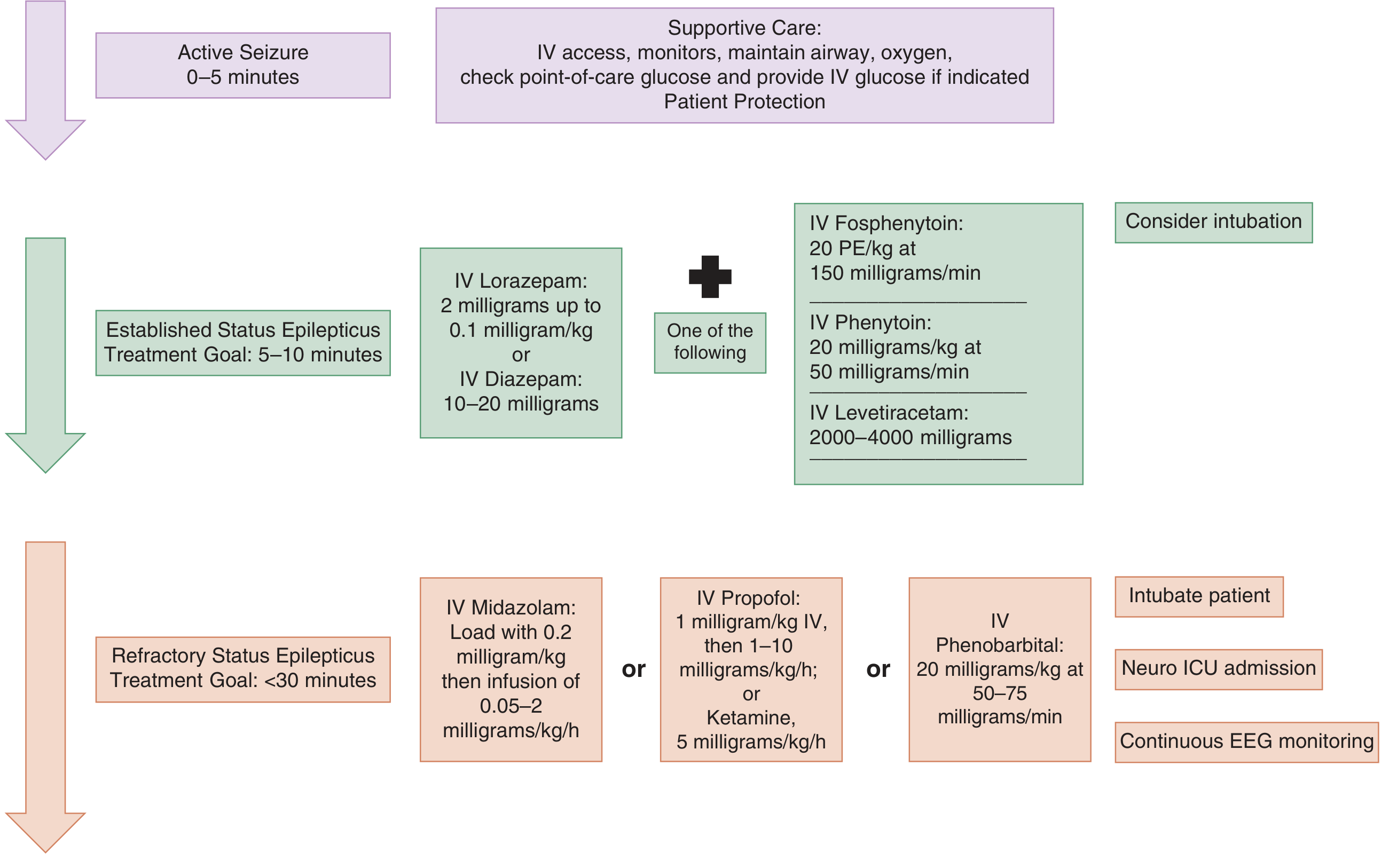
From Tintinalli's Emergency Medicine - Management of active seizures and status epilepticus
Nonconvulsive SE - Special Considerations
- Clinically subtle: prolonged postictal state, twitching/blinking, eye deviation, fluctuating consciousness, unexplained coma
- Diagnosis requires EEG
- Less urgency than convulsive SE; therapy can be started more cautiously with lower initial doses
- High suspicion warranted after convulsive SE appears to stop clinically (may evolve to NCSE)
Pediatric Dosing (Diazepam as example)
| Age | IV Dose |
|---|---|
| Neonate | 0.1-0.3 mg/kg/dose Q15-30 min; max total 2 mg |
| Child 1 mo - <5 yr | 0.2-0.5 mg/dose Q2-5 min; max total 5 mg |
| Child ≥5 yr | 1 mg/dose Q2-5 min; max total 10 mg |
| Adult | 5-10 mg/dose Q10-15 min; max 30 mg per 8-hr period |
- Harriet Lane Handbook, p. 1108
Recent Evidence (2024-2026)
A 2026 systematic review in J Neurol (PMID 41838218) evaluated brivaracetam as an emerging option for SE. A 2024 meta-analysis in Epilepsia (PMID 38881333) confirmed ketamine has meaningful evidence supporting its use in pediatric refractory SE. These agents may expand the armamentarium but are not yet first- or second-line in major guidelines.
Key Mnemonics:
- "5 is the new 30": treat at 5 minutes, not 30
- "BZD → Second-line → ICU anesthesia": three-phase escalation
- "NCSE hides": always consider EEG in unexplained coma or prolonged postictal state
This is a shared conversation. Sign in to Orris to start your own chat.