
Explain rigor mortis in violent death
Rigor mortis is the postmortem stiffening of muscles caused by ATP depletion and cross-linking of actin-myosin filaments. It typically begins 2-6 hours after death, reaches maximum stiffness around 12 hours, and resolves over 24-48 hours as putrefaction breaks down muscle proteins. In violent deaths, the pattern can be significantly altered.
Searching sources...
Reading File
Now searching the medical library and web in parallel:
Finding Sources
Searching the Web
rigor mortis violent death forensic pathology mechanism
Excellent - found dedicated sections in DiMaio's Forensic Pathology and Parikh's textbook. Reading both in parallel:
Reading File
Reading File
Good data. Let me get more from Parikh (violent death specific sections) and the rest of the DiMaio section:
Reading File
Reading File
Excellent content from both books. Let me also read the Parikh sections on cadaveric spasm and violent death-specific modifications, plus any conditions simulating rigor:
Reading File
Reading File
I now have rich content from both DiMaio's Forensic Pathology and Parikh's textbooks. Let me fetch the key forensic images to include:
Loading Image
Reading File
I have all the material needed for a thorough, well-sourced answer. Here is the complete explanation:
Rigor Mortis in Violent Death
Mechanism (Normal Physiology)
Rigor mortis is the postmortem stiffening of muscles caused by ATP depletion after death. In life, ATP is continuously replenished by three metabolic systems:
- Phosphagen system - provides maximal muscle power for ~10-15 seconds
- Glycogen-lactic acid system - sustains power for ~30-40 seconds
- Aerobic system - provides ATP indefinitely under normal conditions
After death, ATP generation stops but consumption continues. Without ATP, the actin and myosin filaments become permanently cross-linked, forming a rigid, inextensible gel - this is rigor mortis. The muscle pH also shifts from slightly alkaline to distinctly acidic due to lactic acid accumulation. Rigor persists until autolysis and putrefaction break down the myofilaments, at which point secondary (post-putrefaction) flaccidity sets in.
- DiMaio's Forensic Pathology, 3rd Ed., p. 34
- Parikh's Textbook of Medical Jurisprudence, p. 181
Normal Timeline
| Stage | Timing (Temperate) | Timing (Hot Climate / India) |
|---|---|---|
| Onset | 2-4 hours | 2-3 hours |
| Fully developed | 6-12 hours | ~12 hours (head to foot) |
| Persists | Up to 36 hours | ~12 hours |
| Passes off | 36-48 hours | ~12 hours after full development |
Nysten's Rule describes the sequence of onset: involuntary muscles (heart, within 1 hour) → eyelids → neck → jaw → face → upper extremities → trunk → lower extremities. It passes off in the same order.
How Violent Death Specifically Alters Rigor Mortis
This is the core forensic significance. Violent deaths are associated with intense physical activity, emotional arousal, and rapid ATP depletion - all of which dramatically accelerate onset.
1. Accelerated / Rapid Onset
Any violent exertion immediately before death depletes ATP stores. Because no new ATP is generated after death, the already-depleted reserves trigger faster onset of rigor:
- Victims chased before death: Rapid onset specifically in the legs, reflecting localized ATP exhaustion from running. The legs stiffen noticeably faster than the rest of the body.
- Drowning deaths: Violent struggling exhausts ATP; rigor may develop fully within only 2-3 hours rather than the normal 6-12 hours.
- Strychnine poisoning / convulsant deaths: Repeated severe convulsions deplete glycogen and ATP; onset may be nearly instantaneous.
- Electrocution: Rapid convulsive muscular discharge accelerates ATP depletion and rigor onset.
- Deaths preceded by severe hemorrhage: Paradoxically, rigor may be delayed in this situation due to prior metabolic changes.
DiMaio's Forensic Pathology, 3rd Ed., p. 34-35
2. Cadaveric Spasm - The Hallmark of Violent Death
Cadaveric spasm is the most forensically significant variant seen in violent deaths. It is instantaneous rigor - muscular stiffening that occurs at the precise moment of death, with no preceding period of primary flaccidity.
Conditions required for cadaveric spasm:
- Somatic death must occur with extreme rapidity
- The person must be in a state of great emotional tension at the moment of death
- The muscles involved must be in active physical use at that moment
Forensic significance:
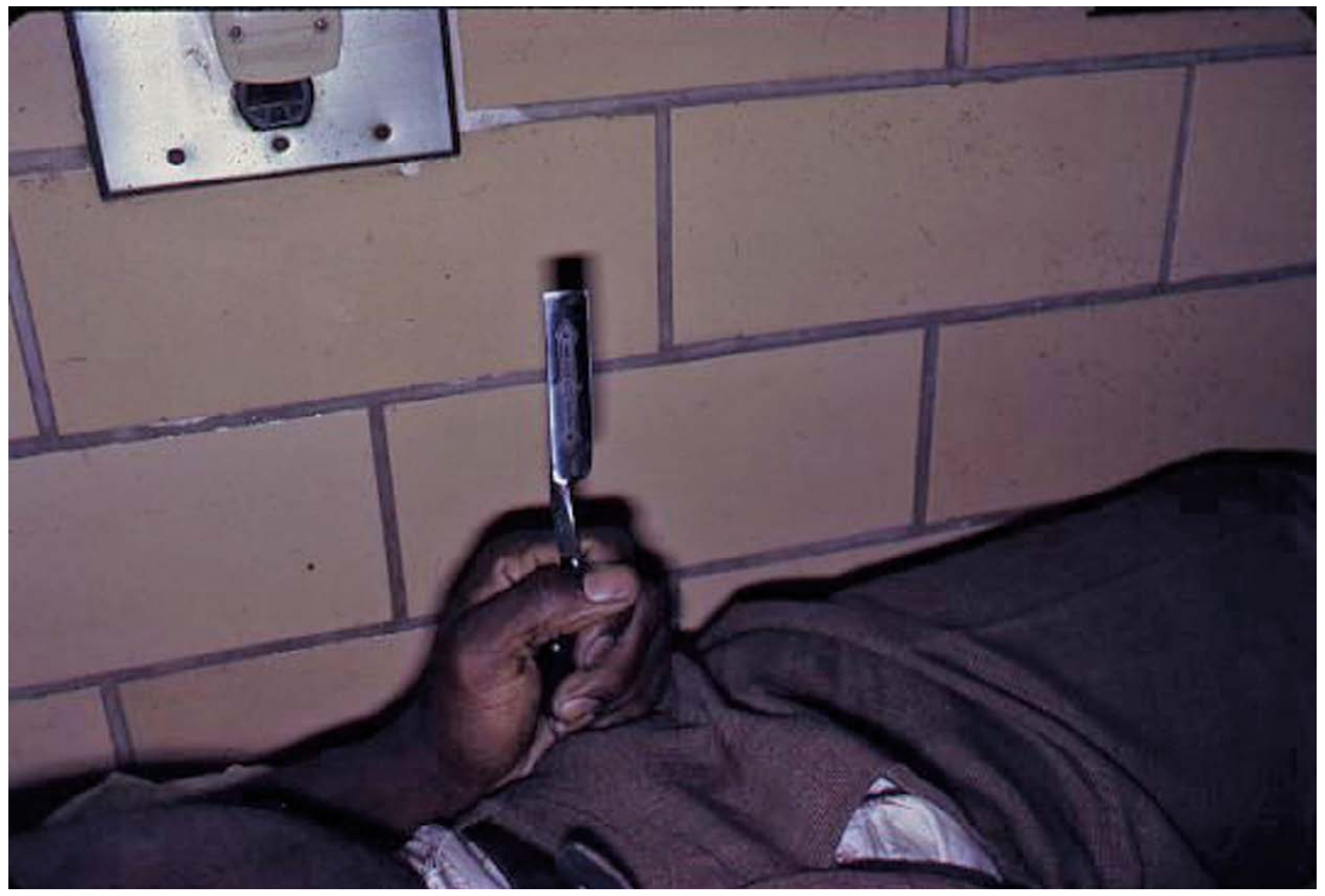
The image above shows cadaveric spasm in a homicide victim - the hand has firmly gripped a weapon at the instant of death and cannot be pried open without great force.
Objects commonly found gripped in cadaveric spasm include:
- A knife or razor (in suicidal cut-throat injuries)
- A firearm (in suicidal gunshot wounds)
- Grass, weeds, or vegetation (in drowning - victim grabbed at the ground while struggling)
- Hair or clothing of an assailant (in homicidal scuffles - this is particularly important as it provides evidence of the assailant)
"An object cannot be grasped in this manner during the development of rigor mortis. It is impossible to simulate cadaveric spasm." - Parikh's Textbook, p. 183
This means cadaveric spasm is conclusive proof that the object was gripped at or about the moment of death. A body cannot be staged to create this appearance after death.
Cadaveric Spasm vs. Rigor Mortis - Key Differences
| Feature | Cadaveric Spasm | Rigor Mortis |
|---|---|---|
| Onset | Instantaneous at death | After 2-3 hours (primary flaccidity first) |
| Preceded by flaccidity? | No | Yes |
| Muscles affected | Usually specific voluntary groups (forearm, hands) | All muscles - voluntary and involuntary |
| Degree of contraction | Very marked | Moderate |
| Force needed to break | Very great | Moderate |
| Mechanism | Unknown (likely neurogenic, vital phenomenon) | ATP depletion (well understood) |
| Medicolegal value | Indicates manner of death (suicide/homicide/accident) | Indicates time since death |
| Resolution | Only by putrefaction | By decomposition or mechanical stretching |
Parikh's Textbook, p. 183-184
Other Violent/Unusual Death Scenarios
Asphyxial Deaths (Hanging, Smothering)
Rigor mortis is often delayed in asphyxia deaths, notably hanging and CO2 poisoning. This is also noted following severe acute hemorrhage.
Firearm Deaths
Rapid death from a gunshot wound may be associated with cadaveric spasm, with the weapon firmly held in the hand (important in distinguishing suicide from staged homicide).
Burns / Heat Deaths (Pugilistic Attitude)
At temperatures over 70°C, heat coagulates muscle proteins - this is not true rigor mortis but heat stiffening. The body assumes a characteristic "pugilistic attitude" (boxer's stance): semi-flexed lower limbs and arms, clenched fists. This persists until coagulated albumin liquefies during decomposition. Importantly, true rigor mortis does not develop in bodies subjected to such intense heat.
Electrocution
High-voltage electrocution produces heat stiffening identical to burn deaths, producing the pugilistic attitude.
Forensic Uses in Violent Deaths
-
Estimating time of death - Though highly variable, the stage of rigor (absent, partial, full, or resolving) gives a rough bracket for time since death.
-
Detecting body movement - When livor mortis (pooling pattern) is inconsistent with the body's position, but rigor has fixed the body in a different position, the body was moved after rigor set in. This is a key indicator of a staged crime scene.
-
Identifying the nature of death - Cadaveric spasm distinguishes genuine suicidal gripping from staged placement of a weapon. A weapon placed in the hand post-mortem lies loosely; in cadaveric spasm it is locked in a death grip.
-
Localizing exertion - Regional accelerated rigor (e.g., only in the legs) indicates that muscle group was working hard before death (fleeing victim).
-
Breaking of rigor at crime scene - Transport of a body from the crime scene to the mortuary partially breaks rigor, which can mislead the examiner. Documenting the state of rigor at the scene itself is essential.
Sources:
- DiMaio's Forensic Pathology, 3rd Edition, pp. 34-35
- Parikh's Textbook of Medical Jurisprudence, Forensic Medicine and Toxicology, pp. 181-184
- Juniper Publishers - Time since Death from Rigor Mortis
This is a shared conversation. Sign in to Orris to start your own chat.