
Give answer for theory exam for PSM using all available standard resources
I need to clarify what specific PSM (Preventive & Social Medicine) theory exam questions you'd like answered before I can help effectively.
Asking for Preferences
Which PSM theory exam questions would you like answered?
The user skipped the clarification. I'll proceed with a comprehensive PSM (Preventive & Social Medicine) theory exam preparation covering all major high-yield topics. Let me first read the medical library skill, then pull content from standard PSM textbooks.
Reading File
Now let me check what PSM textbooks are available in the library and search for key PSM topics simultaneously.
Finding Sources
Searching the Web
PSM Preventive Social Medicine theory exam high yield topics 2025 MBBS
Park's Textbook of PSM is available. Let me now explore its table of contents and simultaneously search for the most high-yield PSM topics across multiple areas.
Finding Sources
Finding Sources
Finding Sources
Let me explore the Park's PSM book blocks and search for all key PSM topics in parallel.
Finding Sources
Finding Sources
Finding Sources
Now let me read the key PSM sections from Park's textbook - levels of prevention, epidemiology concepts, and more.
Reading File
Finding Sources
I have good data from Park's. Now let me read more key sections covering epidemiology, health indicators, disease surveillance, and the host-agent-environment triad.
Reading File
Reading File
Excellent! I now have rich content from Park's. Let me now read the epidemiology sections (incidence/prevalence, disease measurements, biostatistics, and natural history of disease) which are core exam topics.
Reading File
Reading File
I now have substantial content from Park's PSM textbook. Let me read more on health indicators, natural history, and disease measures.
Reading File
Reading File
Human development index
The Human Development Index (HDI) is a composite statistic developed by UNDP that measures a country's average achievement in three basic dimensions of human development: a long and healthy life (life expectancy), knowledge (education), and a decent standard of living (GNI per capita). It was introduced by Mahbub ul Haq and Amartya Sen in 1990.
Searching sources...
Finding Sources
Searching the Web
Human Development Index components dimensions 2024 UNDP calculation
Park's has dedicated sections. Let me read them now.
Reading File
Reading File
Loading Image
I now have everything needed for a comprehensive, exam-standard answer on HDI from Park's PSM textbook plus current UNDP data. Here is the full answer:
Human Development Index (HDI)
Source: Park's Textbook of Preventive and Social Medicine
Definition
The Human Development Index (HDI) is a composite index focusing on three basic dimensions of human development:
- To lead a long and healthy life - measured by life expectancy at birth
- The ability to acquire knowledge - measured by mean years of schooling and expected years of schooling
- The ability to achieve a decent standard of living - measured by Gross National Income (GNI) per capita in PPP US$
"HDI provides a more comprehensive picture of human life than income does." - Park's PSM
It was introduced in 1990 in the first Human Development Report by Mahbub ul Haq with the contribution of Amartya Sen, under the United Nations Development Programme (UNDP).
Structure of HDI
The diagram below from Park's illustrates how HDI is constructed:
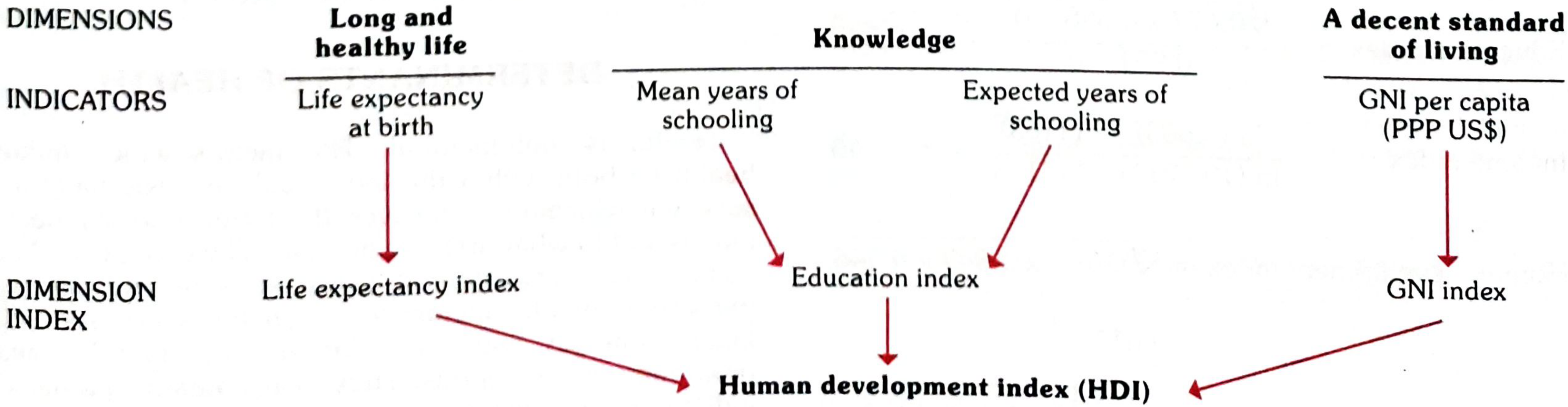
| Dimension | Indicator(s) | Dimension Index |
|---|---|---|
| Long and healthy life | Life expectancy at birth | Life Expectancy Index |
| Knowledge | Mean years of schooling + Expected years of schooling | Education Index |
| Decent standard of living | GNI per capita (PPP US$) | GNI Index |
Key Concepts
- HDI values range from 0 to 1
- The value shows the distance a country has already travelled towards the maximum possible value of 1
- It allows comparisons across countries
- It is a more comprehensive measure than per capita income alone - income is only a means to human development, not an end
Steps to Calculate HDI
Step 1 - Create Dimension Indices (Goalposts)
Minimum and maximum values (goalposts) are set to transform indicators into indices between 0 and 1:
| Dimension | Observed Maximum | Minimum |
|---|---|---|
| Life expectancy (years) | 83.2 | 20.0 |
| Mean years of schooling (years) | 13.2 | 0 |
| Expected years of schooling (years) | 20.6 (capped) | 0 |
| Combined education index | 0.951 | 0 |
| Per capita income (PPP US$) | 108,211 | 163 |
Formula for each dimension index:
Dimension index = (Actual value - Minimum value) / (Maximum value - Minimum value)
- For the Education index: equation is applied to each subcomponent (Mean years + Expected years), then a geometric mean is created, and the equation is reapplied.
- For the Income index: natural log (ln) of GNI per capita is used, because income has diminishing returns to human development.
Step 2 - Aggregate the Three Indices (Geometric Mean)
HDI = (Life Expectancy Index × Education Index × GNI Index)^(1/3)
The geometric mean is used (since 2010) instead of the old arithmetic mean, because it:
- Reflects that the three dimensions are not perfectly substitutable
- Penalizes unequal achievements across dimensions
Classification of Countries by HDI
| Category | HDI Value |
|---|---|
| Very High Human Development | ≥ 0.800 |
| High Human Development | 0.700 - 0.799 |
| Medium Human Development | 0.550 - 0.699 |
| Low Human Development | < 0.550 |
Related Composite Indices (UNDP)
Beyond the basic HDI, UNDP also publishes:
| Index | What it measures |
|---|---|
| IHDI (Inequality-adjusted HDI) | HDI adjusted for inequality within the country |
| GDI (Gender Development Index) | HDI values separately for females and males; ratio of female to male HDI |
| GII (Gender Inequality Index) | Gender-based disadvantage in reproductive health, empowerment, and labour market |
| MPI (Multidimensional Poverty Index) | Overlapping deprivations in health, education, and standard of living |
Why HDI is Important (PSM Perspective)
- It is a health indicator as well as a socioeconomic indicator - life expectancy is the health dimension
- It helps identify inequities between nations and within nations
- It is used to monitor progress toward SDGs (Sustainable Development Goals)
- HDI is superior to GNP/GDP alone because it captures human well-being and not just economic output
- It guides health policy - countries with low HDI are prioritized for international aid and health interventions
India's HDI (Current Status)
As per the UNDP Human Development Report 2023/24:
- India falls in the Medium Human Development category
- India's HDI continues to improve gradually, with gains primarily in education and income dimensions
Exam High-Points (One-Liners)
- HDI was introduced in 1990 by UNDP (Mahbub ul Haq, Amartya Sen)
- Three dimensions: Health (life expectancy), Education (MYS + EYS), Income (GNI per capita PPP)
- HDI is the geometric mean of the three dimension indices (since 2010)
- Range: 0 to 1 (closer to 1 = higher development)
- Very high HDI: ≥ 0.800
- Minimum life expectancy used: 20 years; Maximum: 83.2 years
- Minimum income used: $163 PPP
- Education uses two indicators: Mean years of schooling (adults ≥25 years) and Expected years of schooling (children of school-entry age)
- Income index uses ln (logarithm) of GNI - reflects diminishing returns
Park's Textbook of Preventive and Social Medicine, Chapter on Health Indicators, pp. 22-23
This is a shared conversation. Sign in to Orris to start your own chat.