
Function of patela
The patella (kneecap) serves several key functions:
- Mechanical advantage - It increases the leverage of the quadriceps muscle by moving the tendon away from the knee joint's axis of rotation, boosting extensor force by ~30-50%.
- Friction reduction - Acts as a pulley, reducing friction between the quadriceps tendon and the femur during knee movement.
- Bone protection - Shields the anterior knee joint and distal femur from direct trauma.
- Force distribution - Spreads compressive forces across the femoral condyles during flexion/extension.
Searching sources...
Reading File
Finding Sources
Searching the Web
patella function anatomy biomechanics
Reading File
Loading Image
Here is a full, textbook-sourced breakdown of the functions of the patella:
Functions of the Patella (Kneecap)
The patella is a sesamoid bone - the largest in the body - embedded within the quadriceps tendon. Its functions are primarily mechanical and protective.
1. Optimizing the Extensor Lever Arm (Primary Function)
The patella's most important role is to increase the mechanical advantage of the quadriceps during knee extension. The thickness of the patella physically displaces the quadriceps and patellar tendon force vectors away from the center of rotation of the knee, thereby lengthening the extensor lever arm.
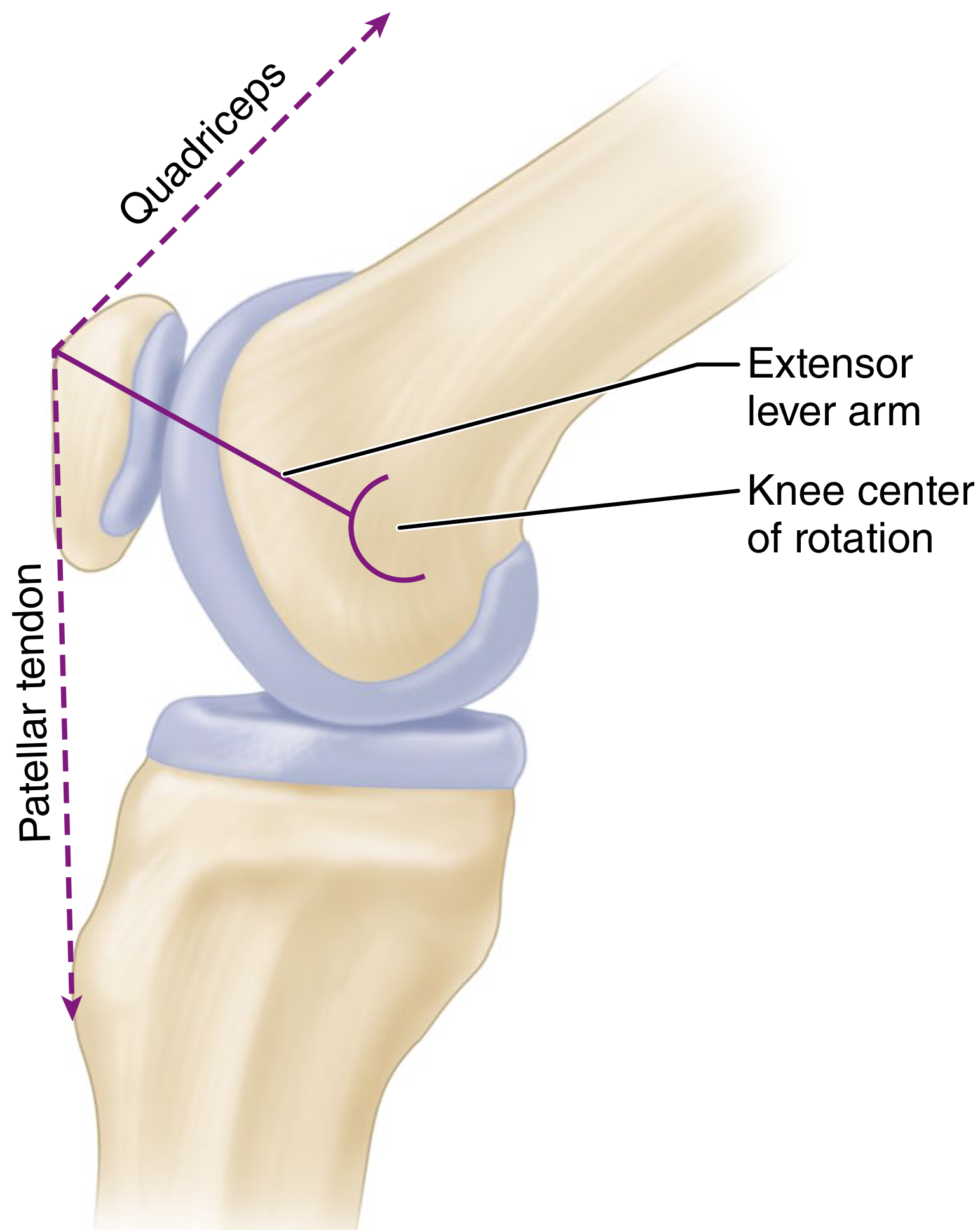
Figure: The patella lengthens the extensor lever arm by displacing the quadriceps and patellar tendon force vectors away from the knee's center of rotation. (Campbell's Operative Orthopaedics, 15th Ed. 2026)
- The lever arm is greatest at 20-30 degrees of flexion
- Quadriceps force required for extension increases significantly in the last 20 degrees as less patella contacts the trochlear groove
- Without the patella, quadriceps efficiency is reduced by approximately 30-50%
2. Part of the Extensor Mechanism
The patella is a key component of the entire extensor mechanism, which includes:
- Quadriceps muscle group
- Quadriceps tendon
- Patella itself
- Patellar tendon
- Patellar retinaculum and adjacent soft tissues
Together, these structures extend the knee and stabilize the patellofemoral joint (PFJ). - Rheumatology, 2-Volume Set (2022, Elsevier)
3. Force Transmission and Distribution
- The patella acts as a pulley, transmitting force from the quadriceps to the tibia via the patellar tendon
- It distributes compressive loads across the femoral trochlear groove, reducing focal stress on the articular cartilage
- Patellofemoral contact force changes with knee flexion angle - it is lowest near full extension and increases as the knee flexes
4. Protection of the Knee Joint
- As the anterior-most bony structure of the knee, the patella protects the distal femur and the knee joint from direct anterior trauma
- Its thick articular cartilage (the thickest in the human body) helps absorb impact forces
5. Patellofemoral Stability
The patella guides and centralizes quadriceps force through its tracking within the trochlear groove. Stability is maintained by:
- Articular surface geometry (bony constraint)
- The Q angle (the angle between the femoral axis and the line from the patella center to the tibial tubercle)
- Dynamic muscular stabilizers, especially the vastus medialis obliquus (VMO), which prevents lateral subluxation
- Passive ligamentous restraints (medial patellofemoral ligament)
Summary Table
| Function | Mechanism |
|---|---|
| Increase extensor lever arm | Displaces quadriceps/patellar tendon away from rotation axis |
| Force transmission | Pulley between quadriceps tendon and patellar tendon |
| Force distribution | Spreads load over femoral trochlea |
| Anterior protection | Shields knee joint from direct trauma |
| Patellar tracking/stability | Guided by trochlear groove, VMO, and medial retinaculum |
Sources: Campbell's Operative Orthopaedics 15th Ed. 2026; Rheumatology, 2-Volume Set (2022, Elsevier)
This is a shared conversation. Sign in to Orris to start your own chat.