
Polio
Reading File
Now let me search the medical library and web in parallel for comprehensive polio coverage.
Finding Sources
Searching the Web
poliomyelitis overview pathophysiology clinical features treatment 2024
Searching PubMed
poliomyelitis poliovirus
Good finds. Let me read the most relevant textbook sections in parallel.
Reading File
Reading File
Reading File
Let me get more clinical detail from Tintinalli's, and also the Bailey & Love section on poliomyelitis.
Reading File
Reading File
Now let me get the treatment/management and vaccine sections, and read the Park's Pulse Polio section for eradication details.
Reading File
Reading File
I now have comprehensive information from multiple textbooks. Let me also fetch the clinical image of polio from Bailey & Love.
Loading Image
I now have comprehensive information from multiple textbooks plus current sources. Here is the full synthesis:
Poliomyelitis (Polio)
Overview
Poliomyelitis is an acute, highly contagious infection caused by poliovirus - a neurotropic enterovirus (RNA virus, Picornaviridae family). It spreads person-to-person and causes paralysis through destruction of anterior horn motor neurons. Vaccination has nearly eradicated the disease worldwide, but it remains endemic in Pakistan and Afghanistan as of 2026.
There are three serotypes (Type 1, 2, 3). Type 1 is the most paralytogenic and was historically the most common cause of epidemics. Wild poliovirus Type 2 has not been recorded since 1999.
Transmission
- Developed countries: Oral-to-oral (respiratory droplets)
- Developing countries: Fecal-to-oral (poor sanitation)
- Humans are the only natural host
- Oral secretion lasts several days; stool excretion can persist for several weeks
- Immunocompromised patients are at significantly higher risk
Pathophysiology
The virus enters via the GI tract and replicates in gut-associated lymphoid tissue (GALT). At a critical concentration, viremia carries the virus to the:
- Spinal cord anterior horn cells (most common - causes spinal polio)
- Brainstem and reticular formation
- Vestibular nuclei, hypothalamus, thalamus, cerebellum, and precentral motor cortex
Infected motor neurons die, causing a cycle of muscle denervation and reinnervation, ultimately leading to irreversible muscle atrophy and paralysis. Sensory neurons are characteristically spared.
Clinical Spectrum
| Form | Frequency | Features |
|---|---|---|
| Asymptomatic | >90% of infections | Silent; still shed virus |
| Abortive (minor illness) | ~5% | Fever, malaise, headache, sore throat, GI symptoms; no neurologic involvement |
| Non-paralytic (aseptic meningitis) | ~1-5% | Meningeal signs, Kernig/Brudzinski signs; resolves in 1-2 weeks |
| Paralytic | <1-2% | Anterior horn cell destruction; the classic feared form |
Paralytic Polio - Key Features
- Asymmetric, proximal, flaccid weakness - lower extremities most commonly
- Absent tendon reflexes, fasciculations
- Sensory function preserved (no sensory deficit on examination despite pain/paresthesias)
- Autonomic dysfunction: sweating disturbances, urinary retention, constipation, delayed gastric emptying
- Maximal paralysis usually within 5 days
- Muscle wasting develops over several weeks
- Most patients with spinal polio show improved motor function within the first year
Bulbar Polio
Up to 20% of paralytic cases develop bulbar involvement:
- Speech and swallowing dysfunction (dysphagia, dysarthria)
- Facial and extraocular muscle weakness
- Reticular formation involvement causes cardiac dysrhythmias, BP alterations, hypoxia, and hypercarbia - potentially fatal
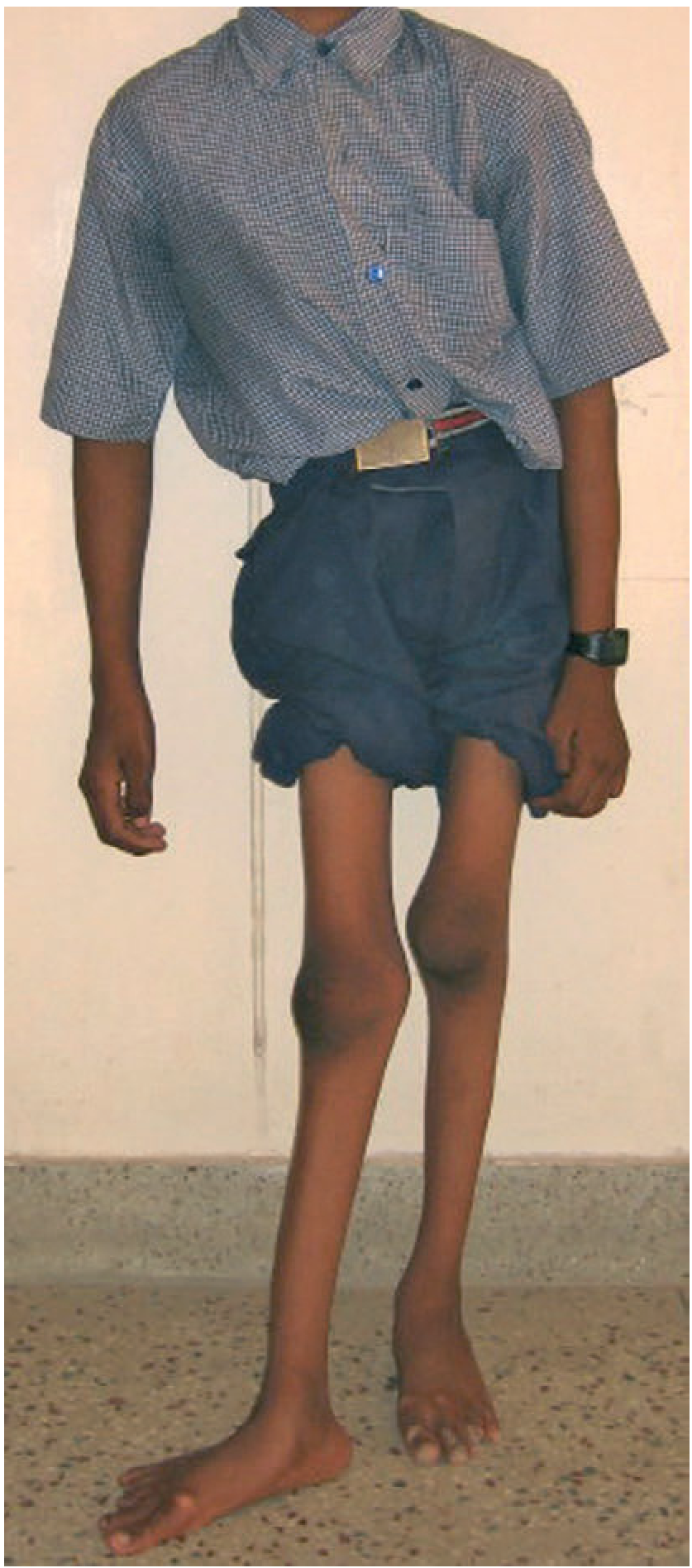
Young patient with polio showing paralysis of the lower limb and paraspinal muscles causing marked scoliosis and a deformed pelvis. - Bailey and Love's Short Practice of Surgery, 28th Ed.
Diagnosis
Suspect acute paralytic poliomyelitis when an at-risk patient develops:
- Acute febrile illness + aseptic meningitis + asymmetric flaccid paralysis + loss of deep tendon reflexes + normal sensation
Investigations
- CSF: Pleocytosis (WBC can be in the hundreds, neutrophil predominance early); elevated protein
- Viral culture: Throat and rectal swabs yield more than CSF
- Stool samples: Two specimens 24-48 hours apart (highest yield in the first 2 weeks)
- Serial serum antibody titers: To verify cultures once serotype identified
- Stool samples must be stored at 4-8°C and reach the lab within 72 hours
Differential Diagnosis
| Condition | Distinguishing Feature |
|---|---|
| Guillain-Barre syndrome | Symmetric weakness (most important to exclude) |
| Transverse myelitis | Sensory level + sphincter disturbance |
| Acute spinal cord compression | Sensory level present |
| Coxsackie/Echovirus/Enterovirus | Lab differentiation needed |
| Spinal muscular atrophy (in children) | No fever prodrome, genetic |
| Lyme disease, porphyria, infectious mono | Peripheral neuropathies |
Treatment
There is no specific antiviral therapy for polio. Management is supportive:
- Bed rest during acute phase
- Analgesics for pain and muscle spasm
- Physiotherapy / rehabilitation: Prevents contractures, maximizes function
- Respiratory support: Mechanical ventilation if bulbar/respiratory involvement
- Orthopedic interventions (late): Tendon transfers, arthrodesis for residual paralysis - should only be undertaken after careful assessment; most patients learn to live with their disabilities (Bailey & Love)
Post-Polio Syndrome (PPS)
Expected to affect up to 100,000 of the 250,000 U.S. adults who had prior polio. Onset is 20-35 years after initial infection, typically in patients >50 years old.
Characteristics:
- New or recurrent muscle fatigue, weakness, pain, atrophy, and fasciculations
- Affects previously unaffected AND previously involved muscle groups
- New bulbar, respiratory, or sleep difficulties (laryngeal weakness causing dyspnea, dysphagia, hoarseness)
- Sleep disturbances managed with benzodiazepines or dopaminergic drugs
- Diagnosis of exclusion
Risk factors for earlier PPS onset: Advanced age at initial infection, greater residual motor disability, residual bulbar/respiratory signs, recent limb immobilization
The mechanism is thought to involve dysfunction of nerve axons in surviving motor neurons (not reactivation of poliovirus).
Vaccines
Two main types:
| IPV (Inactivated Poliovirus Vaccine) | OPV (Oral Poliovirus Vaccine) | |
|---|---|---|
| Type | Killed virus, injectable | Live attenuated, oral |
| Route | Intramuscular/subcutaneous | Oral drops |
| Immunity | Systemic (IgG) | Systemic + mucosal (IgA) |
| VAPP risk | None | 1 in 1.4-2.8 million recipients; 1 in 6.7 million contacts |
| Use | Standard in developed countries | Mass campaigns (developing world) |
- Vaccine-Derived Paralytic Polio (VAPP): Can occur in immunocompromised OPV recipients, or in unvaccinated contacts of recently vaccinated children. A case of vaccine-derived paralytic poliomyelitis was identified in New York State in July 2022 in an unvaccinated person.
- Travelers who completed a primary vaccine series and are traveling to endemic regions should receive a one-time booster dose of IPV (Goldman-Cecil Medicine).
Surveillance & Eradication
Surveillance relies on Acute Flaccid Paralysis (AFP) surveillance - any child under 15 years with AFP must be reported and tested. The benchmark is at least 1 AFP case per 100,000 children under 15 annually as a sensitivity indicator.
Four steps of AFP surveillance:
- Find and report AFP cases promptly
- Transport stool specimens (two samples 24-48 hrs apart, at 4-8°C, within 72 hrs to lab)
- Isolate and characterize poliovirus (wild vs. vaccine-derived)
- Map the virus geographically using genetic sequencing
Global eradication milestones:
- Wild poliovirus eradicated from the USA in 1979; Western Hemisphere in 1991
- Wild poliovirus Type 2 last recorded in 1999
- India declared polio-free on 27 March 2014 (last case: Howrah, West Bengal, 13 Jan 2011)
- Wild polio currently endemic only in Pakistan and Afghanistan
India's Pulse Polio Immunization (PPI): Mass administration of OPV to all children 0-5 years on a single day, two rounds 4-6 weeks apart during low-transmission season (November-February). First conducted December 1995.
Key Risk Factors for Severe Disease (in developing countries)
- Recent intramuscular injections
- Prior tonsillectomy
- Strenuous exercise
- Immunocompromised state
Sources: Tintinalli's Emergency Medicine, 9e | Goldman-Cecil Medicine, 2e | Bailey & Love's Short Practice of Surgery, 28e | Park's Textbook of Preventive and Social Medicine | CDC Clinical Overview | Merck Manual
Recent evidence note: A 2025 systematic review (PMID: 41163052) examined immunogenicity and safety of polio vaccines in infants across randomized trials - no findings contradict the above standard guidance on vaccination. A 2025 review (PMID: 40740383) on advances in polio vaccines notes ongoing development efforts but no major changes to current eradication strategy.
This is a shared conversation. Sign in to Orris to start your own chat.