
Ancylostoma
Reading File
Ancylostoma is a genus of hookworms - parasitic nematodes that cause hookworm disease (ancylostomiasis). The two main human species are A. duodenale and Necator americanus. They infect via skin penetration, migrate through the lungs, and attach to the small intestinal mucosa causing blood-loss anemia.
Searching sources...
Finding Sources
Finding Sources
Good results. Let me read from the most comprehensive sources in parallel.
Reading File
Reading File
Reading File
Excellent data. Now let me get the clinical features, diagnosis, and treatment sections, plus the life cycle image.
Reading File
Reading File
Reading File
Excellent - I have very rich content. Let me fetch the life cycle image and get the diagnosis/lab section.
Loading Image
Reading File
Reading File
I have very comprehensive information now. Let me also fetch the hookworm ova/teeth image and the clinical section from Cecil Medicine.
Loading Image
Reading File
I now have a comprehensive, well-illustrated picture of Ancylostoma. Let me compile the full answer.
Ancylostoma (Hookworm)
Taxonomy and Species
Ancylostoma is a genus of parasitic nematodes (roundworms) in the family Ancylostomatidae. The clinically important species include:
| Species | Primary Host | Disease in Humans |
|---|---|---|
| A. duodenale | Humans | Hookworm disease (Old World hookworm) |
| Necator americanus | Humans | Hookworm disease (New World hookworm) |
| A. ceylanicum | Dogs/cats | Can cause true intestinal infection in humans |
| A. caninum | Dogs | Eosinophilic enteritis (Australia) |
| A. braziliense | Dogs/cats | Cutaneous larva migrans |
While Necator americanus is technically a separate genus, it is classified alongside A. duodenale as the two main agents of human hookworm disease (ancylostomiasis).
Epidemiology
-
Over 700 million people are infected with hookworms globally; approximately 460 million cases by some estimates
-
Prevalence is highest in sub-Saharan Africa and Asia
-
Endemic in tropical/subtropical zones between 45°N and 30°S of the equator - the larval stage cannot withstand freezing temperatures
-
A. duodenale predominates in northern Africa, the Middle East, southern Europe, and parts of Asia ("Old World hookworm")
-
N. americanus has a more widespread distribution in the Americas, tropical Africa, and Southeast Asia ("New World hookworm")
-
Approximately 44 million pregnant women are infected worldwide
-
Risk factors: poor sanitation, barefoot walking, use of human excrement as fertilizer
-
Yamada's Textbook of Gastroenterology, p. 3117; Park's Textbook of Preventive and Social Medicine, p. 284
Life Cycle
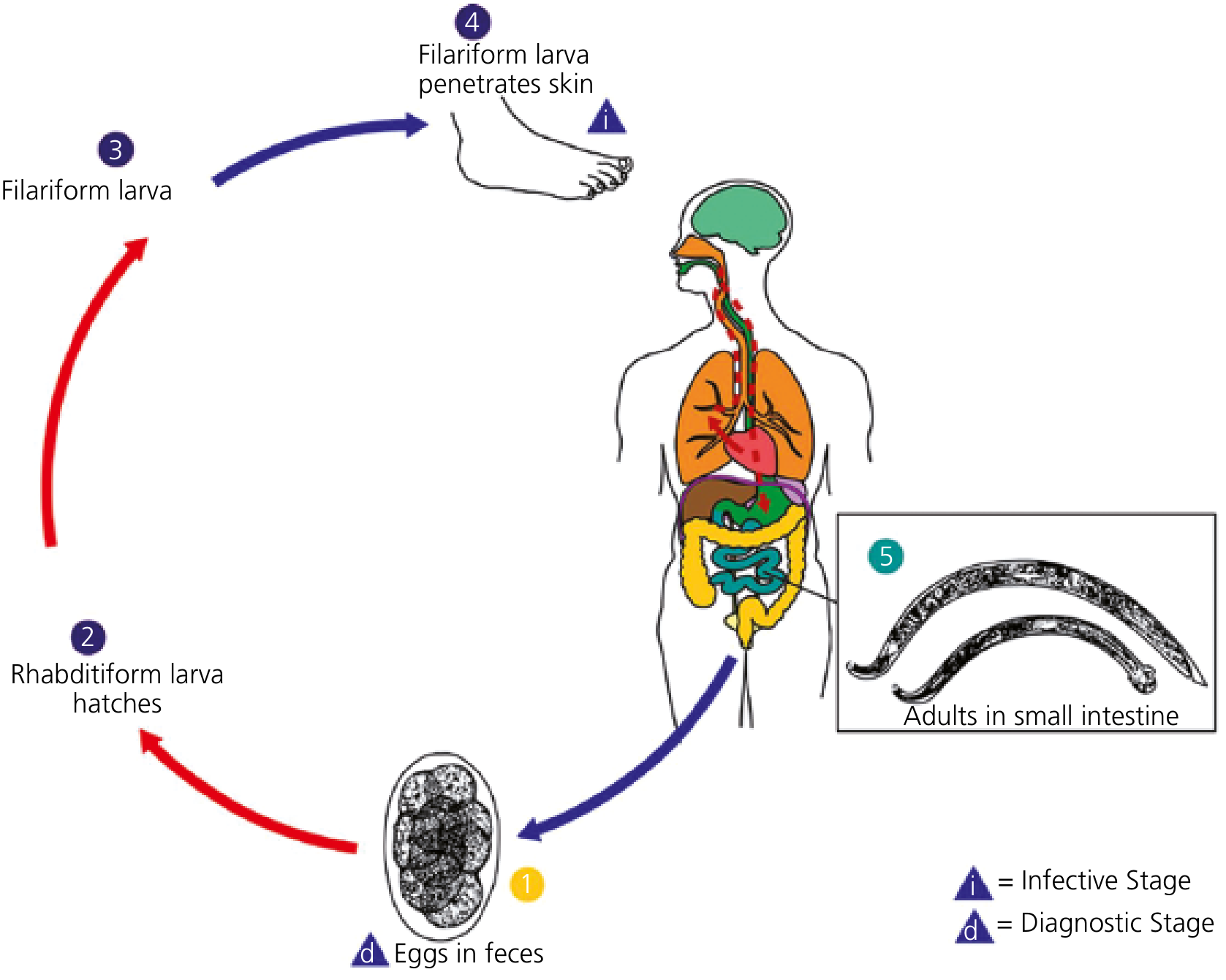
Step-by-step:
- Eggs in feces (diagnostic stage) - Adult female worms in the small intestine produce thousands of eggs daily: A. duodenale ~10,000-30,000 eggs/day; N. americanus ~5,000-10,000 eggs/day. Eggs pass with stool into soil.
- Rhabditiform larva hatches - In warm, moist soil, eggs embryonate and hatch within 1-2 days, releasing non-infective rhabditiform larvae.
- Filariform larva - The rhabditiform larva molts twice over 5-10 days in soil to become the infective third-stage filariform larva. These can survive in shaded, moist soil for up to 1 month.
- Skin penetration (infective stage) - Filariform larvae penetrate exposed skin (usually the feet), enter the venous circulation, and travel to the pulmonary vasculature. (A. duodenale can also be transmitted orally.)
- Lung migration - Larvae penetrate alveoli, ascend the bronchial tree to the trachea, are coughed up and swallowed.
- Adult worms in small intestine - Larvae mature in the small intestine over 5-9 weeks. Adults inhabit the proximal small intestine (mainly the jejunum), attaching to intestinal villi. A. duodenale survives ~1 year; N. americanus survives 3-5 years.
- Goldman-Cecil Medicine, p. 3477
Morphology and Pathobiology
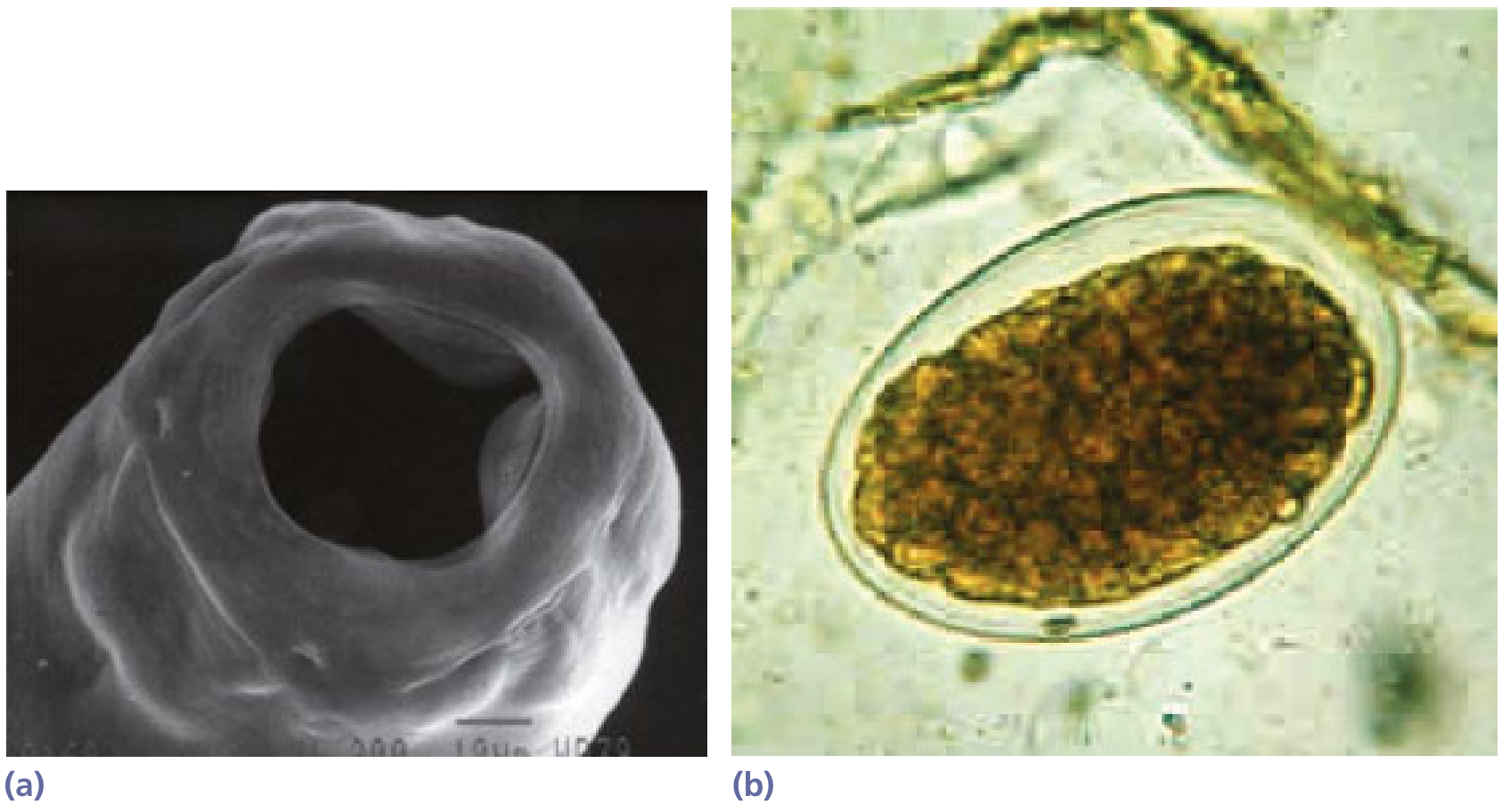
-
Adult worms measure 7-13 mm in length; males slightly smaller than females
-
Anterior end is dorsally curved (hence "hookworm")
-
Attachment mechanism: A. duodenale has cutting teeth; N. americanus has a rounded cutting plate
-
Each worm aspirates a plug of intestinal villus tissue, secretes anticoagulant and anti-platelet enzymes, and ingests blood - moving to fresh villi several times per minute
-
Blood loss per worm per day: N. americanus = 0.03-0.1 mL; A. duodenale = 0.15-0.26 mL (A. duodenale causes significantly more blood loss)
-
Hemoglobinases within the worm's digestive canal degrade host hemoglobin as a nutrient source
-
The major pathology is gastrointestinal blood loss → iron deficiency anemia
-
Goldman-Cecil Medicine, p. 3477; Yamada's Textbook of Gastroenterology, p. 3117
Clinical Manifestations
1. Ground Itch (Skin entry)
- Pruritic, erythematous, papular rash - typically on hands/feet - representing a hypersensitivity reaction at the site of larval skin penetration
2. Cutaneous Larva Migrans (CLM)
- Caused by zoonotic hookworms (A. caninum, A. braziliense) that penetrate human skin but cannot complete the life cycle
- Intensely pruritic, erythematous, serpiginous (snake-like) tracks on feet, legs, buttocks
- Tracks advance a few mm to cm per day; vesiculobullous lesions may form; self-resolves within weeks to months
3. Pulmonary Phase (Larval migration)
- Dry cough, sore throat, wheezing, low-grade fever
- Wakana syndrome (oral ingestion of A. duodenale larvae) - pharyngeal irritation, cough, dyspnea, hoarseness, nausea, vomiting
4. Intestinal Phase - Hookworm Disease
-
Heavy infections (≥2000 eggs/gram of feces) cause iron deficiency anemia: weakness, palpitation, dizziness, dyspnea, fatigue, headache
-
Hypoproteinemia and anasarca with very heavy worm burdens (protein loss)
-
Gastrointestinal symptoms per se are uncommon; the main disease is anemia
-
Endoscopy shows punctate mucosal erosions and pooling of blood in the small bowel lumen
-
Children are most vulnerable to chronic sequelae: stunted growth, cognitive impairment, malnutrition
-
Goldman-Cecil Medicine, p. 3477-3478
Diagnosis
-
Stool microscopy - identification of characteristic thin-shelled, oval eggs containing segmented larvae (4-8 cells at the time of passage); this is the gold standard
-
Quantitative stool examination (e.g., Kato-Katz technique) to estimate worm burden
-
PCR - highly sensitive and specific; currently available only in specialized/research laboratories
-
Peripheral eosinophilia is typically present
-
CBC may reveal hypochromic microcytic anemia
-
Serum albumin may be low in heavy infections
-
No need to differentiate between hookworm species clinically
-
Yamada's Textbook of Gastroenterology, p. 3118; Goldman-Cecil Medicine, p. 3478
Treatment
| Infection | First-line | Alternatives |
|---|---|---|
| Hookworm (A. duodenale / N. americanus) | Albendazole 400 mg daily x 3 days | Tribendimidine 400 mg once; Mebendazole 500 mg daily or 100 mg bid x 3 days; Pyrantel pamoate 11 mg/kg x 3 days (max 1 g/day) |
| Cutaneous larva migrans (A. caninum, A. braziliense) | Ivermectin 200 μg/kg once | Albendazole 400 mg daily x 3 days |
-
Iron supplementation (with folic acid) is essential for anemia treatment
-
Treat hypoproteinemia and hypereosinophilia as needed
-
Goldman-Cecil Medicine, p. 3479 (Table 327-1); Park's Textbook, p. 287
Prevention and Control
Primary prevention:
- Proper sanitary disposal of human excreta
- Provision of safe water and food hygiene
- Wearing protective footwear (the single most effective individual measure)
- Health education on use of sanitary latrines
Secondary prevention / WHO Mass Drug Administration (MDA):
-
Periodic deworming of at-risk groups without individual diagnosis in endemic areas:
- Preschool children, school-aged children
- Women of childbearing age (including pregnant women in 2nd/3rd trimester)
- Adults in high-risk occupations (tea-pickers, miners)
-
Once yearly if community prevalence >20%; twice yearly if >50%
-
Drugs used: albendazole (400 mg single dose) or mebendazole (500 mg single dose)
-
Park's Textbook of Preventive and Social Medicine, p. 287
Key Comparison: A. duodenale vs N. americanus
| Feature | A. duodenale | N. americanus |
|---|---|---|
| Common name | Old World hookworm | New World hookworm |
| Geography | Europe, Middle East, N. Africa, S. Asia | Americas, tropical Africa, SE Asia (more widespread) |
| Buccal cavity | 2 pairs of cutting teeth | Cutting plates (semilunar) |
| Egg output | ~28,000/day | ~10,000/day |
| Daily blood loss/worm | 0.15-0.26 mL | 0.03-0.1 mL |
| Lifespan in host | ~1 year | 3-5 years |
| Route of infection | Skin AND oral | Skin only |
| Size | Slightly larger | Slightly smaller |
Sources: Goldman-Cecil Medicine (9780323930345); Yamada's Textbook of Gastroenterology (9781119600169); Park's Textbook of Preventive and Social Medicine (9789382219163)
This is a shared conversation. Sign in to Orris to start your own chat.