
10. Sterilization & Autoclave - Classification, moist heat sterilization, indicators
Reading File
Now let me search the library for sterilization content in parallel:
Finding Sources
Finding Sources
Finding Sources
Finding Sources
The best sources are Medical Microbiology 9e, Sherris & Ryan's Medical Microbiology, and the Forensic Medicine book. Let me read all three in parallel:
Reading File
Reading File
Reading File
Good - the Forensic Medicine book is about surgical sterilization (reproductive), not what we need. The Medical Microbiology books have the right content. Let me read more from Sherris & Ryan for the autoclave details and indicators, and also read Park's Preventive Medicine for more comprehensive coverage:
Reading File
Finding Sources
Finding Sources
Reading File
Finding Sources
Reading File
Finding Sources
Now I have enough content from the textbooks. Let me fetch the autoclave diagram image:
Loading Image
I now have comprehensive content. Let me compile the full answer:
Sterilization & Autoclave
1. Key Definitions
| Term | Definition |
|---|---|
| Sterilization | Total destruction of ALL microorganisms including bacterial spores, mycobacteria, non-enveloped viruses, and fungi |
| Disinfection | Destruction of most microbial forms; more resilient organisms (e.g., spores) may survive |
| Antisepsis | Use of chemical agents on living tissue to inhibit or eliminate microbes; no sporicidal action implied |
| Sanitization | Reduction of microbial population to safe public health levels |
- Medical Microbiology 9e, BOX 3.1
2. Classification of Sterilization Methods
A. Physical Methods
| Method | Mechanism | Details |
|---|---|---|
| Autoclave (steam under pressure) | Protein denaturation by moist heat | 121°C / 15 min at 15 psi; gold standard |
| Flash autoclave | Moist heat | 134°C / 3 min; used in operating rooms |
| Dry heat (hot air oven) | Oxidation / protein denaturation | 160°C for 2 hours; damages many instruments |
| Incineration | Combustion | Rapid; used for wire loops, contaminated waste |
| Boiling | Moist heat (100°C, 1 atm) | High-level disinfection; some spores survive |
| Pasteurization | Moist heat (63°C/30 min or 72°C/15 sec) | Intermediate; kills vegetative bacteria; used for beverages and plastic hospital equipment |
| UV radiation | DNA damage | Sterilizing but poor penetration; surface use only |
| Ionizing radiation (gamma rays) | DNA strand breaks | Sterilizing; used for pre-packaged disposables and food |
| Filtration | Physical removal | For heat-labile solutions (Millipore/HEPA filters) |
B. Gaseous / Chemical Methods
| Agent | Mechanism | Details |
|---|---|---|
| Ethylene oxide (EtO) | DNA alkylation | 4-hour exposure + 12-hour aeration; for heat-labile plastics, lensed instruments, artificial heart valves; flammable, explosive, carcinogenic |
| Hydrogen peroxide vapor / plasma | Oxidizing free radicals | Efficient; no toxic by-products; replaces EtO in many applications |
| Peracetic acid | Oxidizing agent | Excellent activity; non-toxic end products (acetic acid + O₂) |
| Glutaraldehyde | Cross-links proteins | High-level disinfectant/chemical sterilant; safety concerns; used for endoscopes |
| Formaldehyde vapor | Alkylation | Decontaminates rooms/larger spaces (no pressure needed) |
- Sherris & Ryan's Medical Microbiology, Table 3-1; Medical Microbiology 9e
C. Spaulding Classification (Medical Device Risk)
| Category | Definition | Required Level | Examples |
|---|---|---|---|
| Critical | Contact with sterile tissue or vasculature | Sterilization | Biopsy forceps, surgical instruments, implants |
| Semi-critical | Contact with mucous membranes or non-intact skin | High-level disinfection | Endoscopes, laryngoscopes |
| Non-critical | Contact with intact skin only | Low-level disinfection | Blood pressure cuffs, stethoscopes |
- Clinical Gastrointestinal Endoscopy 3e
3. Moist Heat Sterilization
Moist heat is far more rapid and effective than dry heat. Reactive water molecules denature proteins irreversibly by disrupting hydrogen bonds between peptide groups, even at relatively low temperatures. Most vegetative bacteria are killed within a few minutes at 70°C or less, although some spores resist boiling for prolonged periods.
Forms of Moist Heat
| Method | Temperature | Time | Use |
|---|---|---|---|
| Pasteurization (LTLT) | 63°C | 30 min | Milk, beverages |
| Pasteurization (HTST) | 72°C | 15 sec | Commercial pasteurization |
| Boiling | 100°C | 10 min | General; kills vegetative forms |
| Autoclaving (standard) | 121°C | 15-20 min | Gold standard sterilization |
| Flash autoclaving | 134°C | 3 min | Operating room instruments |
Key fact: A drop of only 1.7°C from the target temperature of 121°C increases the required exposure time by 48%. - Medical Microbiology 9e
If no moisture is present (dry heat), the temperature must reach 160°C for sterilization.
The Autoclave - Mechanism & Structure
The autoclave is a sophisticated pressure cooker. It consists of a sealed chamber in which air is replaced with pure saturated steam under pressure.
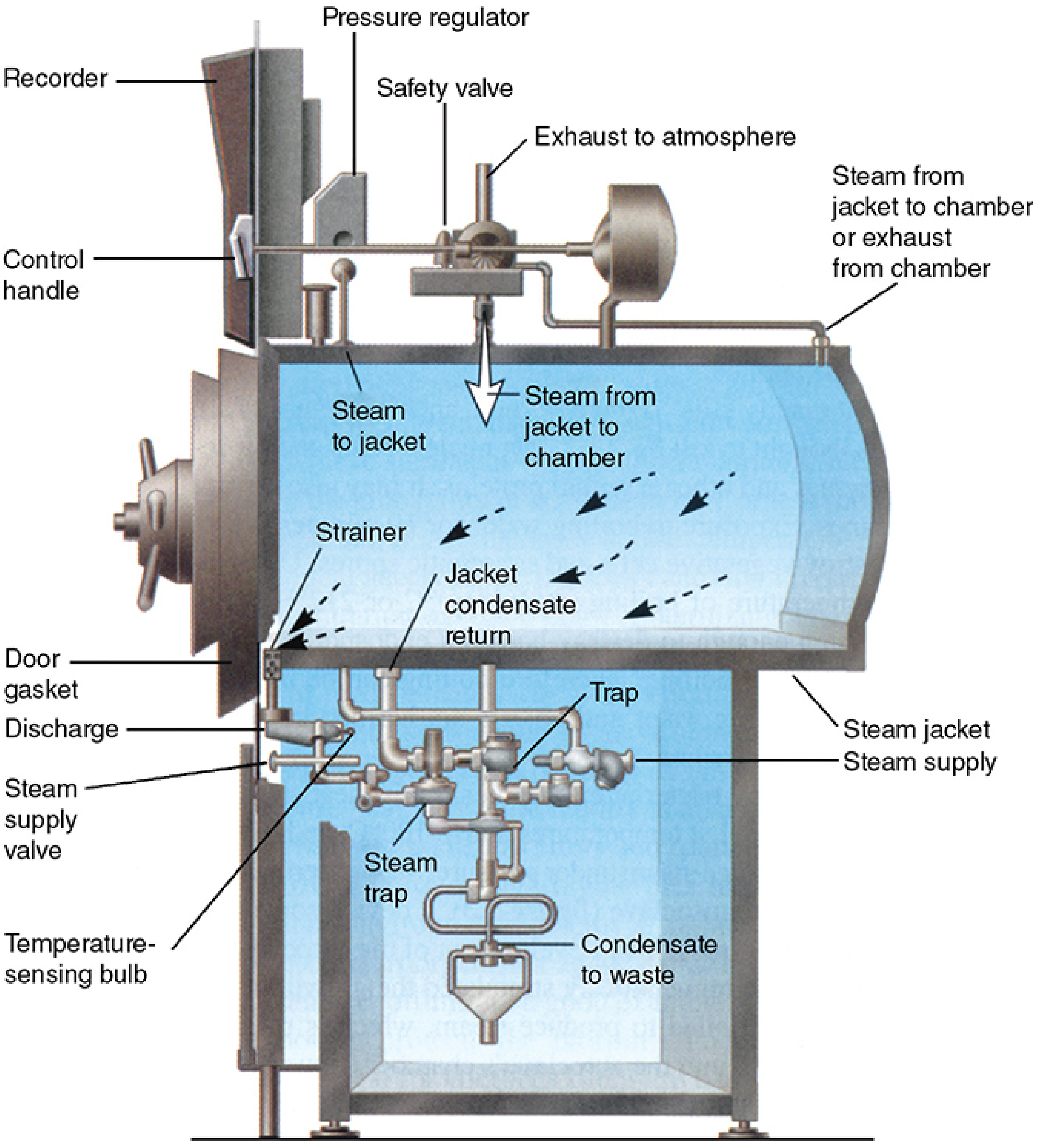
Air removal methods:
- Downward displacement (gravity) autoclave - air (heavier than steam) drains out via a valve at the bottom as steam fills from the top
- Pre-vacuum autoclave - chamber is evacuated before steam is introduced; more efficient penetration into porous loads
Critical parameters:
- Temperature: 121°C (standard) or 134°C (flash)
- Time: 15-20 min (standard); 10 min minimum if items are directly exposed to steam
- Moisture: saturated steam must be present; pressure per se plays NO role in killing - its only function is to raise the temperature of steam
- Steam quality: must be free of air; pure saturated steam; must have access to all surfaces
What autoclave sterilization kills: ALL microorganisms including bacterial spores (killed in <5 minutes at 121°C with direct steam exposure).
What it cannot be used for:
- Plastics and rubber that melt at 121°C
- Sharp instruments (repeated autoclaving blunts edges)
- Lensed/heat-sensitive instruments
- Items that absorb moisture
4. Sterilization Indicators
Indicators are used to confirm that sterilization has actually been achieved. They fall into three main categories:
A. Physical / Mechanical Indicators
- Pressure gauges, temperature charts, time recorders on the autoclave itself
- The recorder on the autoclave (visible in diagram above) documents each cycle
- Cheapest; detect equipment malfunction but do NOT confirm sterilization
B. Chemical Indicators
These contain chemicals that change color or form when exposed to sterilizing conditions.
| Type | Example | Principle |
|---|---|---|
| Autoclave tape (Type 1) | Bowie-Dick tape, indicator tape | Chemical changes color on exposure to steam; placed on outside of pack - confirms pack was processed, NOT that sterilization occurred |
| Browne's tube | Browne's tube (heat indicator) | Liquid changes from red → green at 121°C over time; checks time-temperature combination inside pack |
| Multi-parameter strips (Type 4/5/6) | PCD strips | Indicate exposure to correct temperature + time + steam quality |
- Bowie-Dick test: Used specifically for pre-vacuum autoclaves to detect air leaks or inadequate air removal. A test pack with indicator sheet is autoclaved; uniform color change = adequate steam penetration.
C. Biological Indicators (Most Reliable)
- Use spores of highly resistant organisms - if spores are killed, sterilization is confirmed
- Gold standard for monitoring sterilization efficacy
| Sterilization Method | Biological Indicator Organism |
|---|---|
| Autoclave (moist heat) | Geobacillus stearothermophilus (formerly Bacillus stearothermophilus) |
| Dry heat / EtO | Bacillus atrophaeus (formerly B. subtilis var. niger) |
| Ionizing radiation | Bacillus pumilus |
- Spore strips are placed inside loads; after processing, spores are cultured - no growth = sterilization confirmed
- Clinical Gastrointestinal Endoscopy 3e; Pfenninger & Fowler's Procedures for Primary Care
Summary Table: Indicator Comparison
| Feature | Physical | Chemical | Biological |
|---|---|---|---|
| Cost | Low | Low-moderate | Higher |
| Reliability | Low | Moderate | Highest |
| Detects | Equipment function | Physical parameters | Actual kill of organisms |
| Result time | Immediate | Immediate | 24-48 hours (culture) |
| Routine use | Yes | Yes (every cycle) | Yes (weekly/per load) |
5. Order of Resistance to Sterilization (Most to Least Resistant)
- Prions (CJD, vCJD) - not destroyed by standard autoclave
- Bacterial spores (B. subtilis, C. sporogenes)
- Mycobacteria (M. tuberculosis)
- Non-lipid/small viruses (Poliovirus, Coxsackievirus)
- Fungi (Trichophyton, Candida)
- Vegetative bacteria (Pseudomonas, Salmonella, Enterococci)
- Lipid/medium-sized viruses (HSV, CMV, Coronavirus, HBV)
- Clinical Gastrointestinal Endoscopy 3e, Box 4.1
Sources: Medical Microbiology 9e | Sherris & Ryan's Medical Microbiology 8e | Clinical Gastrointestinal Endoscopy 3e | Pfenninger & Fowler's Procedures for Primary Care 3e
This is a shared conversation. Sign in to Orris to start your own chat.