
Prophylaxis of migrane kd tripathi
Reading File
Now let me search the medical library for migraine prophylaxis from KD Tripathi (pharmacology textbook).
Finding Sources
Finding Sources
KD Tripathi isn't directly in the library, but I have Lippincott and Katzung. Let me search broadly for migraine content in pharmacology books, and also search paragraphs for detailed prophylaxis content.
Finding Sources
Finding Sources
I have great sources. Let me read the most relevant sections - Lippincott (closest to Tripathi style), Katzung, and Bradley & Daroff's (comprehensive neurology). I'll read them in parallel.
Reading File
Reading File
Reading File
Excellent content gathered. Let me also get the Katzung section on migraine prophylaxis drugs specifically, and also fetch the Lippincott figure showing the flowchart.
Reading File
Reading File
Loading Image
I now have comprehensive information. Let me also get the detailed Bradley & Daroff prophylaxis section covering beta-blockers, antidepressants, and indications.
Reading File
I have enough rich content now. Let me compile the comprehensive answer on migraine prophylaxis as covered by KD Tripathi-style pharmacology texts (using Lippincott, Katzung, Bradley & Daroff as authoritative sources).
Prophylaxis of Migraine - KD Tripathi Style
Indications for Prophylaxis
Prophylactic (preventive) therapy is indicated when:
- Attacks occur 2 or more times per month
- Headaches are severe, prolonged, or disabling (impair daily functioning)
- Acute abortive therapy is contraindicated, overused, or ineffective
- Headaches are complicated by serious neurologic signs (hemiplegic migraine, migraine with prolonged aura)
- Menstrual migraine with predictable timing
The goal is to reduce attack frequency, severity, and duration by at least 50%.
Drugs Used in Migraine Prophylaxis
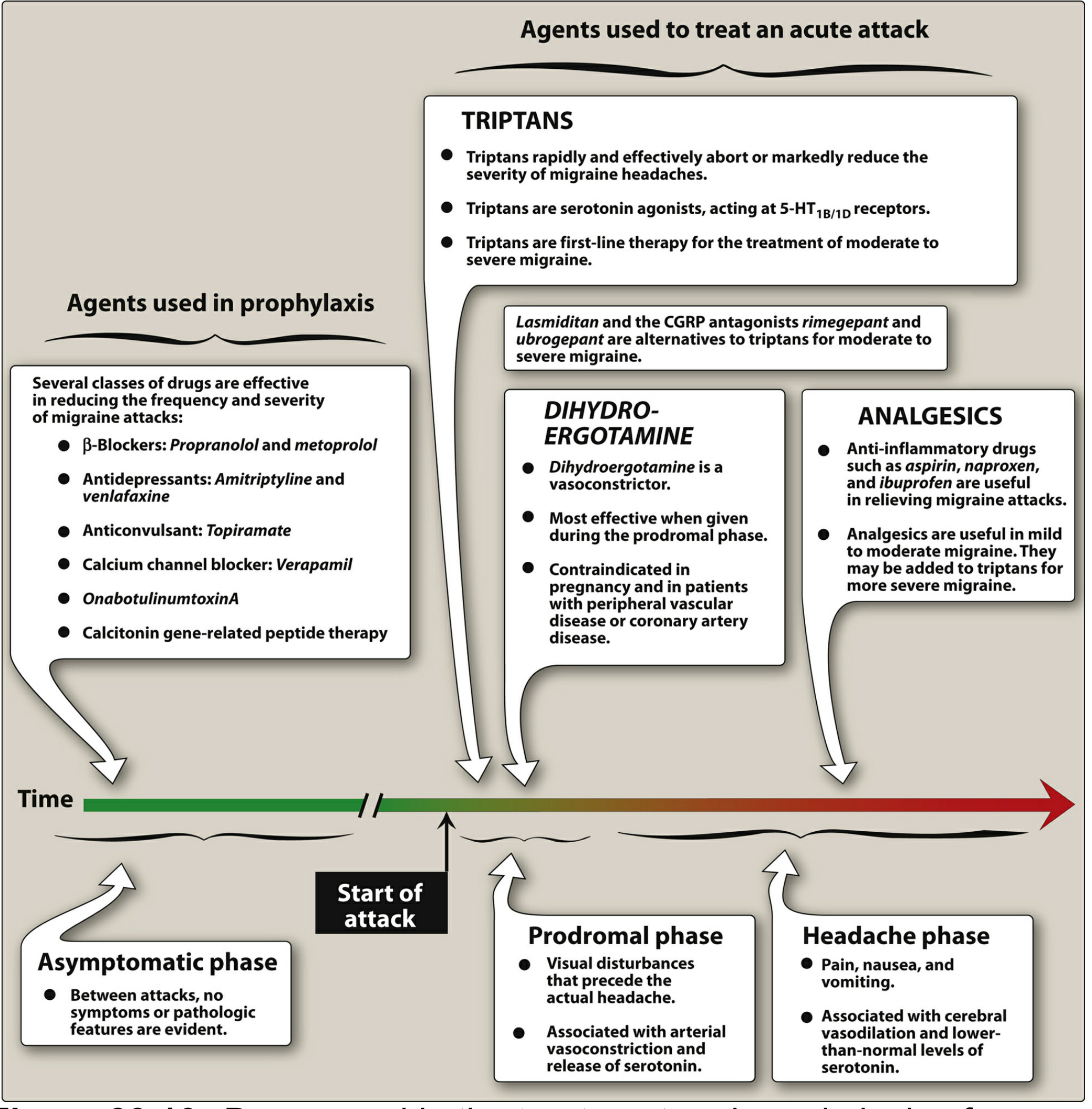
1. Beta-Blockers (Drugs of Choice)
Propranolol and metoprolol are the first-line drugs of choice for migraine prophylaxis.
| Drug | Dose |
|---|---|
| Propranolol | 40-240 mg/day in divided doses |
| Metoprolol | 100-200 mg/day |
| Timolol | 20-40 mg/day (FDA approved) |
| Atenolol | 50-100 mg/day |
| Nadolol | 20-240 mg/day |
Mechanism: Blockade of beta-adrenergic receptors reduces trigeminovascular activation and sympathetic tone. Also modulate serotonergic transmission.
Note: Beta-blockers with intrinsic sympathomimetic activity (ISA) like pindolol are not effective for migraine prophylaxis.
Contraindications: Asthma, COPD, heart block, depression, diabetes (masks hypoglycemia).
2. Antiepileptic Drugs (AEDs)
Valproate / Divalproex Sodium (Sodium Valproate)
- Dose: 500-1750 mg/day in divided doses
- 50% of patients show ≥50% reduction in migraine frequency
- Mechanism: Enhances GABA, reduces cortical hyperexcitability and neurogenic inflammation
- Side effects: Sedation, weight gain, hair loss, tremor, increased liver enzymes, thrombocytopenia, neural tube defects (teratogenic)
- Contraindicated in pregnancy (neural tube defects)
Topiramate
- Dose: 75-200 mg/day (start at 15-25 mg/week, titrate slowly)
- Evidence from large randomized controlled trials
- Mechanism: Blocks Na+ channels, enhances GABA, blocks kainate/AMPA glutamate receptors, inhibits carbonic anhydrase
- Side effects: Cognitive impairment ("dopamax"), paresthesia, weight loss, kidney stones (calcium phosphate)
- Slow titration essential to avoid precipitating depression
Gabapentin
- Dose: 900-2400 mg/day
- Limited evidence; useful when migraine co-exists with neuropathic pain, back pain, or peripheral neuropathy
- Side effects: Dizziness, sedation
3. Tricyclic Antidepressants (TCAs)
Amitriptyline is the most studied and widely used.
- Dose: 10-150 mg at night
- Effective even in patients without depression
- Mechanism: Blocks serotonin and norepinephrine reuptake; also has antihistamine and anticholinergic effects
- Side effects: Sedation, dry mouth, urinary retention, weight gain, cardiac arrhythmias
- Also used: Nortriptyline (better tolerated, fewer anticholinergic effects)
SNRIs: Venlafaxine (75-150 mg/day) is an alternative, particularly in patients with comorbid anxiety/depression.
Note: SSRIs (fluoxetine, sertraline) have limited evidence for migraine prophylaxis.
4. Calcium Channel Blockers
Flunarizine (not available in USA)
- Dose: 5-10 mg at night
- Very effective - reduces both frequency and severity
- Drug of choice in many countries (India, Europe)
- Mechanism: Non-selective calcium channel blocker + dopamine D2 antagonist
- Side effects: Weight gain, sedation, depression, extrapyramidal symptoms (parkinsonism with long-term use)
Verapamil
- Has modest efficacy in migraine prophylaxis
- Particularly useful in migraine with aura and cluster headaches
- Dose: 240-480 mg/day
Note: Nifedipine and amlodipine are less effective.
5. OnabotulinumtoxinA (Botox)
- Approved for chronic migraine (≥15 headache days/month for >3 months)
- Given as 31 fixed-site injections (155 units) into head/neck muscles every 12 weeks
- Mechanism: Inhibits release of CGRP and substance P from peripheral sensory nerve terminals
- Supported by two large multicenter placebo-controlled RCTs (PREEMPT 1 & 2)
6. CGRP-Targeted Therapies (Newer Agents)
Calcitonin gene-related peptide (CGRP) plays a key role in migraine pathophysiology. Blocking CGRP or its receptor is a major advance in migraine prevention.
Anti-CGRP Monoclonal Antibodies
| Drug | Target | Route | Frequency |
|---|---|---|---|
| Erenumab | CGRP receptor | SC | Monthly |
| Galcanezumab | CGRP ligand | SC | Monthly |
| Fremanezumab | CGRP ligand | SC | Monthly or quarterly |
| Eptinezumab | CGRP ligand | IV | Quarterly |
- Reserved for patients inadequately controlled by oral agents
- Very expensive; used as second-line when oral prophylaxis fails
Oral CGRP Receptor Antagonists (Gepants)
- Atogepant and Rimegepant - approved for prevention of migraine
- Administered orally, well tolerated
- Side effects: nausea, somnolence (low incidence)
7. Serotonin Antagonists (Older Agents)
Methysergide (no longer available in USA/Canada)
- Historically very effective; peripheral serotonin antagonist + central agonist
- Serious side effect: retroperitoneal, pulmonary, and cardiac fibrosis (drug holiday every 6 months was mandatory)
Cyproheptadine
- Peripheral serotonin + H1-antihistamine antagonist
- Primarily used in pediatric migraine
- Available as syrup for children who cannot swallow tablets
- Side effects: Drowsiness, significant weight gain
8. Other Agents
| Agent | Dose | Notes |
|---|---|---|
| Riboflavin (B2) | 400 mg/day | Small RCT showed efficacy; minimal side effects; effect takes 3 months |
| Magnesium | 600 mg/day (chelated or slow-release) | Mixed evidence; diarrhea, gastric irritation |
| Butterbur (Petasites) | 150 mg/day | Evidence from clinical trials but potential hepatotoxicity |
| Coenzyme Q10 | 300 mg/day | Some evidence; well tolerated |
| Aspirin/NSAIDs | 325 mg every other day | Modest benefit; especially for menstrual migraine |
Perimenstrual (Cyclic) Prophylaxis for Menstrual Migraine
For women with predictable menstrual migraines, short-course perimenstrual prophylaxis (days -3 to +3 of cycle) can be used:
- NSAIDs: Naproxen sodium 550 mg BD, mefenamic acid 250 mg TDS, ketoprofen 75 mg TDS
- Triptans: Frovatriptan (long t½ of 27 hours - preferred), naratriptan, zolmitriptan
- Ergots: Ergotamine tartrate + caffeine 1 mg qhs
Summary Table - First Line vs Second Line
| Category | Drug | Status |
|---|---|---|
| Beta-blocker | Propranolol, Metoprolol | 1st line (DOC) |
| AED | Topiramate, Valproate | 1st line |
| TCA | Amitriptyline | 1st line |
| Ca2+ channel blocker | Flunarizine, Verapamil | 2nd line |
| SNRI | Venlafaxine | 2nd line |
| Botox | OnabotulinumtoxinA | Chronic migraine only |
| Anti-CGRP mAb | Erenumab, Galcanezumab | Refractory cases |
| Oral gepants | Atogepant, Rimegepant | Newer; preventive use |
Key Points for Exams (KD Tripathi Style)
- Drug of choice for migraine prophylaxis = Propranolol (a non-selective beta-blocker without ISA)
- Valproate is contraindicated in pregnancy - risk of neural tube defects
- Flunarizine causes weight gain + extrapyramidal symptoms (depression, parkinsonism)
- Topiramate causes weight loss - useful in obese patients; but can cause cognitive blunting
- Amitriptyline is effective even in non-depressed migraineurs
- Methysergide can cause fibrosis (retroperitoneal, pulmonary, cardiac) - requires 1-month drug holiday every 6 months
- Cyproheptadine is preferred in children (syrup formulation)
- CGRP monoclonal antibodies are the newest class - given SC monthly; reserved for refractory cases
- Beta-blockers with ISA (pindolol, acebutolol) are NOT effective
- Prophylaxis is considered successful if attack frequency reduces by ≥50%
Sources: Lippincott Illustrated Reviews Pharmacology, p.1324; Katzung's Basic and Clinical Pharmacology, 16th ed., p.456; Bradley and Daroff's Neurology in Clinical Practice, pp.2479-2482
This is a shared conversation. Sign in to Orris to start your own chat.