
Inversion and version suture example
Reading File
Inversion and eversion sutures are used to control how wound edges are oriented - inverted edges (turned inward) or everted edges (turned outward). Common examples include the Lembert, Connell, and Cushing sutures for inversion; and horizontal mattress sutures for eversion.
Searching sources...
Finding Sources
Searching the Web
inversion eversion suture examples types surgical techniques
Good results found. Let me read the key textbook sections for detailed descriptions and images.
Reading File
Reading File
Now let me fetch the key images and also read the Roberts & Hedges section on the inverting/everting mattress sutures:
Loading Image
Loading Image
Reading File
Let me also fetch the inverting/everting mattress stitch comparison image and the Lembert/Cushing/Connell image:
Loading Image
Finding Sources
Now let me also get the Lembert/Cushing/Connell image from the textbook:
Finding Sources
Reading File
I now have enough information for a thorough answer. Let me also fetch the Connell suture image:
Loading Image
Here is a complete overview of inversion and eversion sutures with examples, descriptions, and illustrations drawn from surgical textbooks.
Suture Classification by Wound Edge Effect
Sutures can be grouped by what they do to the wound edges:
| Category | Effect | Primary Use |
|---|---|---|
| Inverting | Edges turned inward (tucked away) | Bowel anastomosis, hollow viscera, some skin |
| Everting | Edges turned outward (raised/rolled out) | Skin closure (reduces scar depression), vascular anastomosis |
INVERTING SUTURES
These sutures bury the wound edge inward, promoting serosal or mucosal apposition. They are the workhorses of gastrointestinal and hollow-organ surgery.
1. Lembert Suture
Type: Interrupted or continuous | Layers: Seromuscular (does NOT penetrate the mucosa)
The Lembert suture is the classic inverting suture for bowel work. It includes the muscular layer and some of the submucosal layer, producing serosal apposition. Before its introduction, no satisfactory intestinal anastomosis technique existed.
- Interrupted form (Fig. 2.9A): Each bite reaches into but not through the tough submucosal layer. Used for one-layer bowel anastomosis or closing the end of the bowel over a clamp.
- Continuous form (Fig. 2.9B): Useful for closing the end of bowel or anastomosing two ends. Use 4-0 braided non-absorbable suture - be sure to catch the submucosa.
Hinman's Atlas of Urologic Surgery, p. 36
2. Connell Suture
Type: Continuous | Layers: Mucosa + submucosa (or all layers)
The Connell suture is a continuous suture that inverts the inner wall of the intestine. The needle enters and exits the bowel on each side successively, passing from outside-in then inside-out on one side, then repeating on the other. Use 3-0 synthetic absorbable suture (SAS).
- When passed inside-out, it is especially useful for closing the angles of a bowel anastomosis.
- In pyloroplasty, the Connell technique closes the anterior inner layer while Lembert sutures close the outer layer.
Hinman's Atlas of Urologic Surgery, p. 35; Maingot's Abdominal Operations
3. Cushing Suture
Type: Continuous | Layers: Seromuscular (similar to continuous Lembert)
The Cushing suture is a continuous seromuscular inverting stitch. It runs parallel to the wound edge, taking bites on alternate sides without penetrating the mucosa. Used in gastric resections and pyloroplasty as the outer inverting layer.
Maingot's Abdominal Operations
4. Purse-String Suture
Type: Continuous circumferential | Used for: Inversion of the appendix stump, closure of hernia sacs, securing ostomy sites
A continuous suture placed around a defect in a circle. When tied, it inverts the central structure (e.g., the appendix stump is pushed inward and the purse-string tightens around it).
Hinman's Atlas of Urologic Surgery, p. 36
5. Inverting Horizontal Mattress Suture (Skin)
Type: Interrupted | Used for: Specific cosmetic indications on skin
This is a variation of the standard horizontal mattress stitch, modified to produce inversion rather than eversion. It should only be used when wound inversion is specifically desired - for example:
- Re-creating the rolled helical rim of the ear
- Re-creating the alar crease of the nose
In most skin wounds, inversion creates a depressed, more noticeable scar and is undesirable.
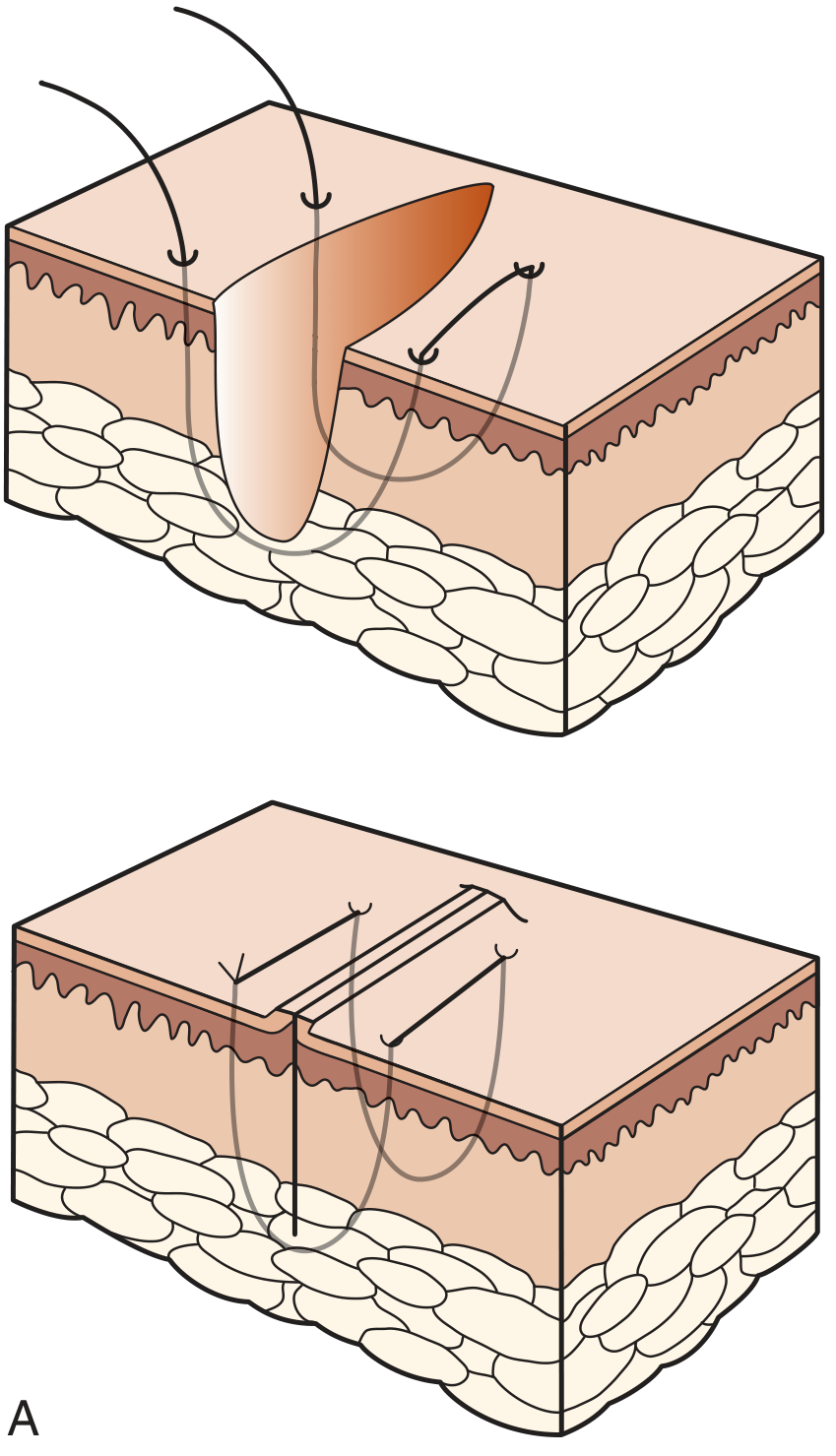
Figure 35.33A - Traditional everting horizontal mattress stitch (top) vs inverting horizontal mattress stitch (bottom). - Roberts and Hedges' Clinical Procedures in Emergency Medicine, p. 801
6. Halsted Mattress Suture (Skin)
Type: Interrupted | Effect: Inverts the wound edge
The needle passes into the skin and exits near the skin edge (shallow bite), producing edge inversion. This is the skin equivalent of the Lembert principle.
Hinman's Atlas of Urologic Surgery, p. 35
EVERTING SUTURES
These sutures raise the wound edges outward, which is ideal for skin closure because it counteracts the natural tendency of skin edges to invert as healing progresses and the scar contracts.
1. Vertical Mattress Suture
Type: Interrupted | Classic everting skin suture
A double stitch forming a loop around the tissue on both sides to produce strong eversion. The technique:
- First (deep, far) bite: enter far from the wound edge, exit far on the other side
- Second (shallow, near) bite: enter close to the wound edge, exit close on the starting side
Use monofilament non-absorbable suture (NAS). Catch only the very edge of the skin in the second bite. Throw 4-5 knots. This produces reliable eversion and good approximation of deeper tissues.
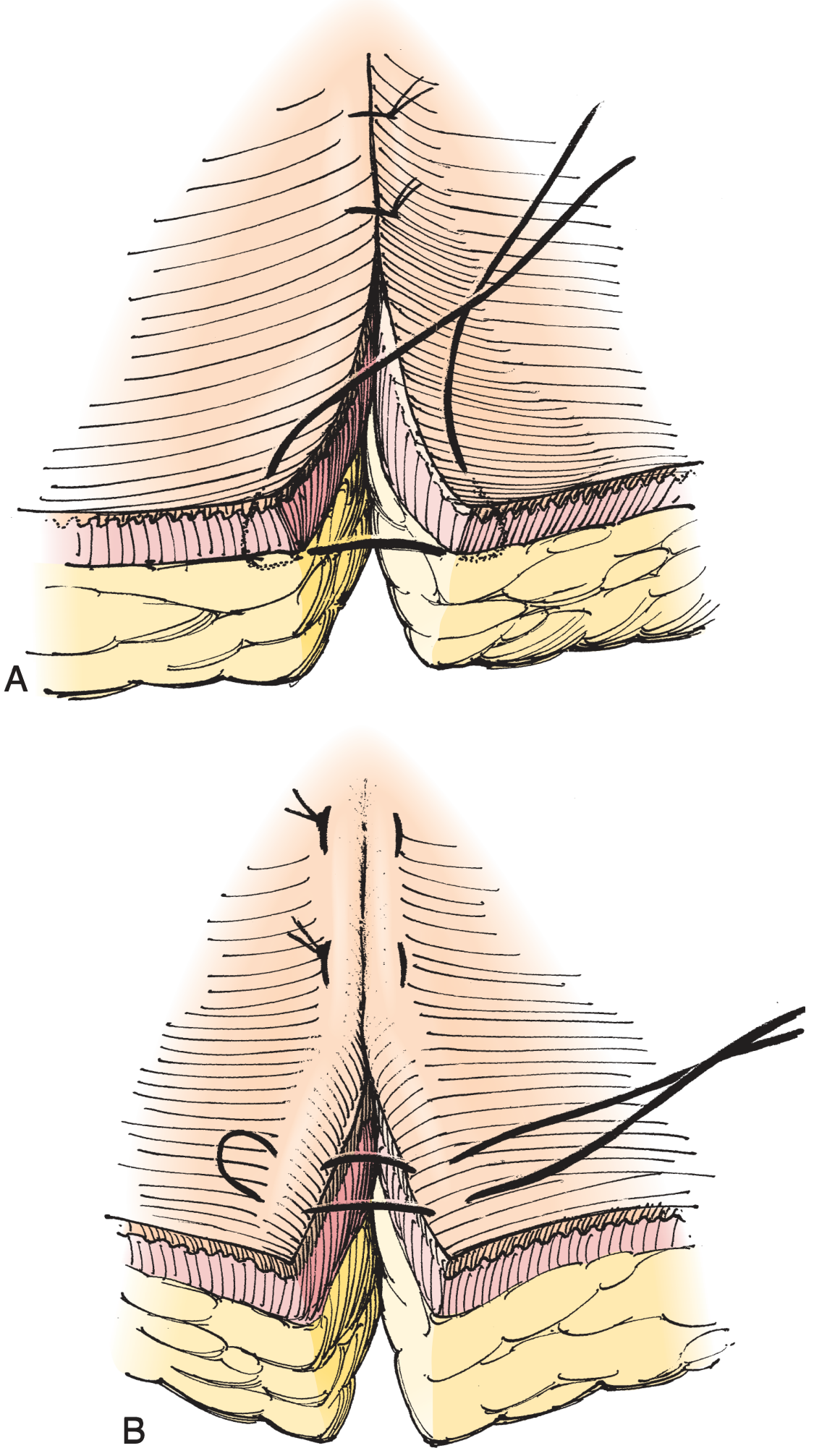
Figure 2.3 / 2.4 - Everting interrupted suture (A) and Halsted mattress suture (B). - Hinman's Atlas of Urologic Surgery, p. 35
2. Everting Interrupted Suture
Type: Interrupted | Used for: Plastic/cosmetic procedures
Penetrate the skin close to the edge of the incision, then encircle a larger amount of tissue beneath. This undermines the edge so when the knot is tied, the edge rolls outward (everts).
Hinman's Atlas of Urologic Surgery, p. 35
3. Standard Horizontal Mattress Suture
Type: Interrupted | Effect: Everting
The classic horizontal mattress stitch produces wound eversion by design. The knot is placed on the surface and the suture passes parallel to the wound in two parallel bites. This is distinguished from the inverting variant, which modifies the needle angle.
Disadvantage: Both horizontal and vertical mattress stitches cause more ischemia inside their loops compared to simple or continuous stitches. Alternating the side of the knot can reduce tension and risk of edge necrosis.
Roberts and Hedges' Clinical Procedures in Emergency Medicine, p. 800-801
Quick Reference Summary
| Suture | Type | Effect | Used In |
|---|---|---|---|
| Lembert | Interrupted or continuous | Inversion (seromuscular) | Bowel anastomosis, gastric surgery |
| Connell | Continuous | Inversion (mucosal) | Anterior layer of bowel anastomosis |
| Cushing | Continuous | Inversion (seromuscular) | Gastric/bowel outer layer |
| Purse-string | Continuous circumferential | Inversion | Appendix stump, hernia sac |
| Inverting HM | Interrupted | Inversion (skin) | Ear helix, nasal alar crease |
| Halsted mattress | Interrupted | Inversion (skin) | Select skin closures |
| Vertical mattress | Interrupted | Eversion (skin) | Skin closure under tension |
| Horizontal mattress | Interrupted | Eversion (skin) | Skin closure, fascia |
| Everting interrupted | Interrupted | Eversion (skin) | Plastic/cosmetic procedures |
This is a shared conversation. Sign in to Orris to start your own chat.