
Dark adaptation from Khurana anatomy a g physiology pg
Reading File
Now let me search for dark adaptation in Khurana's book.
Finding Sources
Finding Sources
Khurana isn't in the library directly. Let me search the full catalog and also search paragraphs for "dark adaptation" across all books, prioritizing ophthalmology/physiology content.
Finding Sources
Finding Sources
Khurana is not in the library. The best available sources are Ganong's and Guyton & Hall. Let me read both the Ganong and Guyton sections fully, and also fetch the dark adaptation graph image.
Reading File
Reading File
Loading Image
Reading File
I now have comprehensive content from Ganong's and Guyton & Hall. Note that Khurana's "Anatomy and Physiology of Eye" is not available in the library, but both Ganong and Guyton cover this topic in detail and align closely with what Khurana covers (Khurana draws from the same foundational physiology). Here is the full explanation:
Dark Adaptation
Note: Khurana's Anatomy and Physiology of Eye is not in the available textbook library. The content below is drawn from Ganong's Review of Medical Physiology (26th ed.) and Guyton & Hall Textbook of Medical Physiology, which cover dark adaptation in detail consistent with Khurana's standard presentation.
Definition
Dark adaptation is the progressive decline in visual threshold (i.e., increase in retinal sensitivity) that occurs when a person moves from a brightly lit environment to darkness. It is nearly maximal in about 20 minutes, though some further decline continues over longer periods.
The reverse process - moving from dim to bright light - is called light adaptation, which takes only about 5 minutes and is essentially the disappearance of dark adaptation.
Mechanism
Photochemical Basis
When exposed to bright light for a prolonged time:
- Large portions of photopigments in both rods and cones are broken down into retinal + opsins
- Much of the retinal is converted to vitamin A
- Result: reduced photopigment concentration → reduced sensitivity = light adaptation
In darkness:
- Retinal and opsins recombine to regenerate light-sensitive pigments
- Vitamin A is converted back to retinal (the final limit is determined by the amount of opsin available)
- Result: increasing photopigment concentration → increasing sensitivity = dark adaptation
The Dark Adaptation Curve (Biphasic)
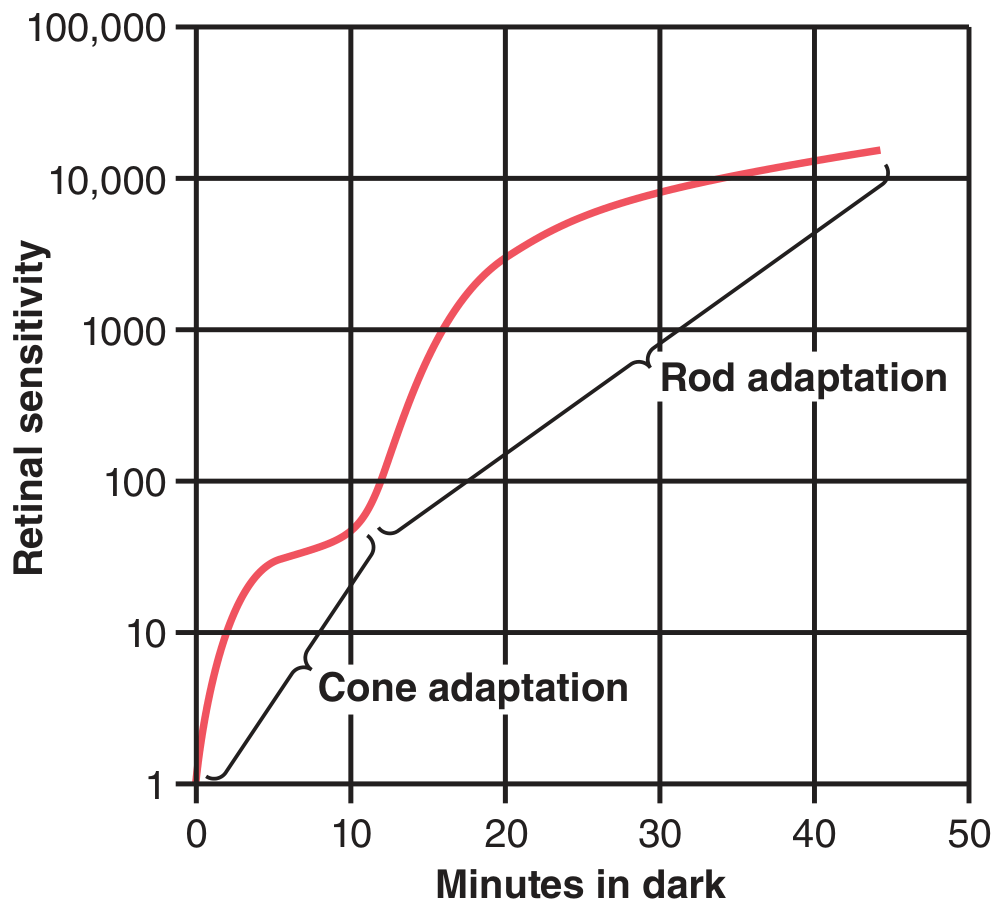
Figure: Dark adaptation demonstrating the relation of cone adaptation to rod adaptation (Guyton & Hall, Fig. 51.9)
The curve has a characteristic biphasic (two-component) shape with an inflection point at around 7-10 minutes:
Phase 1 - Cone Adaptation (Early, Fast but Small)
- Occurs in the first few minutes (approximately 0-7 min)
- Cones adapt ~4 times faster than rods
- The threshold drop is rapid but relatively small in magnitude
- When only the foveal (rod-free) region is tested, the curve stops here - no further improvement
- Cones plateau quickly and cease adapting after a few minutes
Phase 2 - Rod Adaptation (Slow, Large Magnitude)
- Begins after the cone plateau, seen in the peripheral retina (which contains rods)
- Much slower but achieves a far greater sensitivity increase
- Continues for many minutes, even up to 40+ minutes
- At 1 minute in dark: sensitivity increases ~10-fold
- At 20 minutes: ~6,000-fold increase
- At 40 minutes: ~25,000-fold increase
- Overall change between fully light-adapted and fully dark-adapted eye: 500,000 to 1 million-fold
The greater sensitivity of rods is also explained by neural convergence - 100 or more rods converge onto a single ganglion cell, providing spatial summation that amplifies the signal.
Additional Mechanisms of Dark Adaptation
Beyond photopigment regeneration, two other mechanisms contribute:
| Mechanism | Speed | Magnitude |
|---|---|---|
| Pupillary dilation | Fraction of a second | ~30-fold |
| Neural adaptation (bipolar, horizontal, amacrine, ganglion cells) | Fraction of a second | A few-fold only |
| Photopigment regeneration | Minutes to hours | Thousands-fold |
Neural adaptation involves rapid reduction in signal intensity in the successive stages of the visual chain (retina to brain), occurring within a fraction of a second, but contributing only a few-fold change compared to the vast range provided by photochemical adaptation.
Practical Application - Red Goggles
Radiologists, aircraft pilots, and others needing maximal scotopic (dim-light) vision can wear red goggles in bright light. This works because:
- Red wavelengths stimulate rods minimally while allowing cones to function
- The rods quietly undergo dark adaptation during this time
- On entering darkness, the person is already dark-adapted (no 20-minute wait)
Clinical Significance
- Nyctalopia (night blindness): Impaired dark adaptation - a hallmark symptom of retinitis pigmentosa, vitamin A deficiency, and other rod dystrophies
- Vitamin A deficiency: Impairs regeneration of rhodopsin (rod photopigment), directly impairing dark adaptation
- Abnormal dark adaptation curves are diagnostic in conditions like Oguchi disease (where the fundus appears golden/grey in light but normalizes after prolonged dark adaptation - the Mizuo-Nakamura phenomenon)
Sources:
- Ganong's Review of Medical Physiology, 26th ed., p. 206 (Section: Dark Adaptation)
- Guyton and Hall Textbook of Medical Physiology, pp. 637-638 (Section: Automatic Regulation of Retinal Sensitivity - Light and Dark Adaptation)
Give me kanski
Finding Sources
The key section is the Dark Adaptometry part. Let me read that fully along with surrounding context.
Reading File
Now let me fetch the Kanski dark adaptation curve image.
Loading Image
Here is the Dark Adaptometry section from Kanski's Clinical Ophthalmology (10th Edition):
Dark Adaptometry - Kanski's Clinical Ophthalmology
Definition
Dark adaptation (DA) is the phenomenon by which the visual system adapts to decreased illumination. Its evaluation is particularly useful in the investigation of nyctalopia (night blindness).
How It Is Measured (Dark Adaptometry Test)
- The retina is exposed to an intense light sufficient to bleach 25% or more of the rhodopsin
- After bleaching, normal rods are insensitive to light and cones respond only to very bright stimuli
- The subject is then placed in darkness, and spots of light of varying intensity are periodically presented
- The subject indicates whether they perceive each flash
- The threshold at which the subject just perceives a light is recorded at regular intervals
- Increasing sensitivity is plotted over time - this produces the dark adaptation curve
The Dark Adaptation Curve
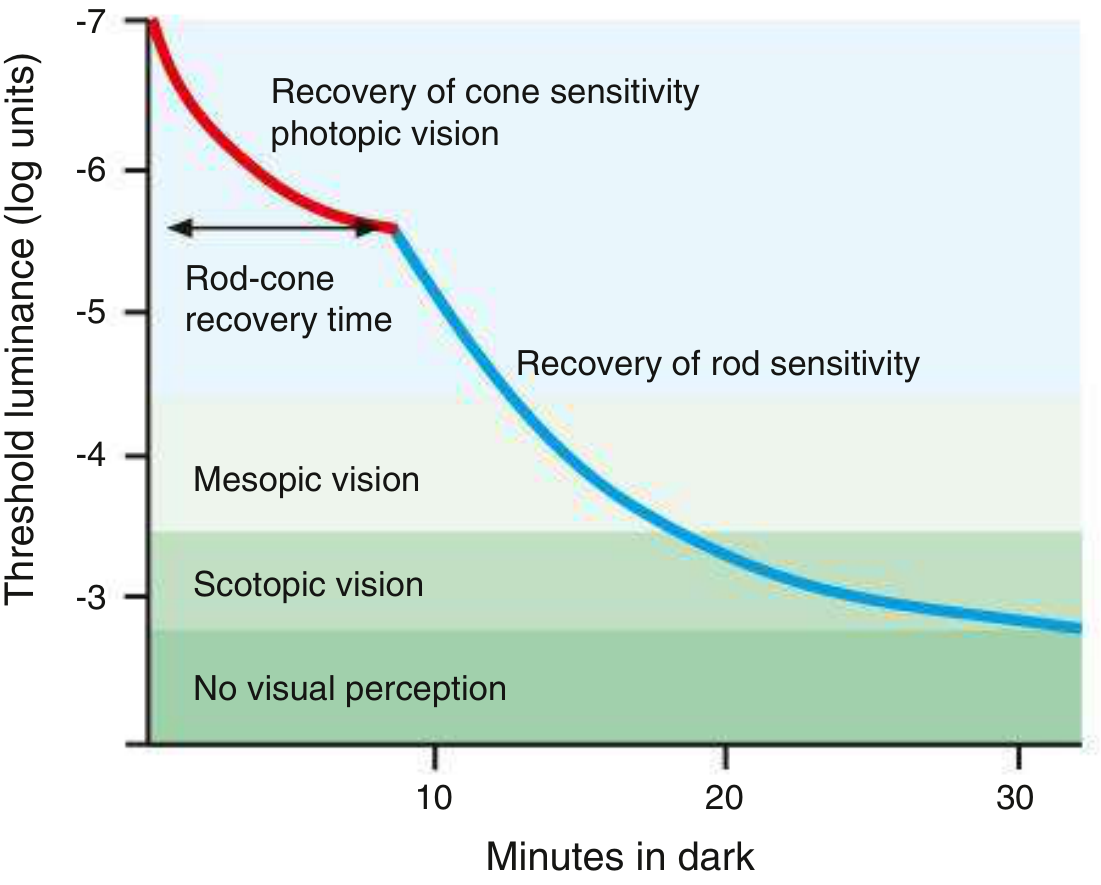
Fig. 15.6 Dark adaptation curve - Kanski's Clinical Ophthalmology 10th ed.
The curve has two distinct branches:
1. Cone Branch (Red portion - early phase)
- Represents the initial 5-10 minutes of darkness
- Cone sensitivity rapidly improves during this phase
- Rods are also recovering during this time, but more slowly
- Corresponds to photopic vision recovery
2. Rod-Cone Break
- Normally occurs at 7-10 minutes
- This is the inflection point where cones have reached their maximum sensitivity
- Beyond this point, rods become perceptibly more sensitive than cones
- The arrow on the graph labels this as the "rod-cone recovery time"
3. Rod Branch (Blue portion - late phase)
- Slower curve, representing continued improvement in rod sensitivity
- After 15-30 minutes, fully dark-adapted rods allow the subject to perceive a spot of light over 100 times dimmer than would be possible with cones alone
- Corresponds to mesopic then scotopic vision zones
If flashes are focused onto the foveola (where rods are absent), only the rapid cone adaptation segment is recorded - no rod branch appears.
Clinical Applications in Kanski
Retinitis Pigmentosa (RP)
- Nyctalopia and dark adaptation difficulties are frequently the first presenting symptoms
- Dark adaptation is prolonged - measuring this using the Dark Adaptation Test is useful in equivocal early cases
Oguchi Disease
- Fundus appears golden/grey in normal light
- Becomes normal after prolonged dark adaptation - the Mizuo-Nakamura phenomenon
- Rod function is absent after 30 minutes of dark adaptation but recovers to near-normal after a long period in the dark
Cancer-Associated Retinopathy
- Night blindness and impaired dark adaptation occur due to rod dysfunction
Drug-Induced Retinopathy (e.g., certain drugs)
- Prolonged dark adaptation and nyctalopia are initial symptoms
ERG Protocol Note
- The first three ERG recordings are elicited after a minimum of 20 minutes of dark adaptation (scotopic testing)
Source: Kanski's Clinical Ophthalmology - A Systematic Approach, 10th Edition, p. 645 (Section: Dark Adaptometry, Chapter 15 - Inherited Retinal Dystrophies)
This is a shared conversation. Sign in to Orris to start your own chat.