
When is HCC called non operable
Hepatocellular carcinoma (HCC) is considered inoperable (unresectable) when the tumor burden, liver function, or patient condition makes surgical resection unsafe or technically impossible. Key criteria include: large/multifocal tumors, vascular invasion, extrahepatic spread, poor liver reserve (Child-Pugh B/C), or poor performance status.
Searching sources...
Reading File
Now let me search the medical library and PubMed simultaneously for HCC resectability criteria.
Finding Sources
Finding Sources
Searching PubMed
hepatocellular carcinoma resectability criteria unresectable
Good - I found the key textbook section in Current Surgical Therapy. Let me read it along with the Bailey & Love section.
Reading File
Reading File
I have excellent content. Let me also fetch the BCLC staging diagram for visual reference.
Loading Image
I now have comprehensive information to give a thorough, well-structured answer.
When is HCC Called Non-Operable (Unresectable)?
Only 20-40% of HCC patients are candidates for surgical resection at the time of diagnosis. Inoperability is determined by two broad categories: oncological (tumor-related) and functional (liver/patient-related) factors.
1. Oncological Contraindications (Tumor Factors)
These make complete resection technically impossible or oncologically futile:
| Factor | Detail |
|---|---|
| Extrahepatic metastases | Any distant spread (lung, bone, adrenal, peritoneum) |
| Multiple / bilobar tumors | Tumor in both lobes making adequate resection impossible |
| Major vascular invasion | Tumor thrombus in the main portal vein or inferior vena cava |
| Main bile duct involvement | Direct invasion precluding clear margins |
| Lymph node involvement (N1) | Regional nodal disease |
| Inadequate future liver remnant (FLR) | FLR <20-30% in healthy liver, <30% in steatotic/chronic hepatitis liver, <40% in cirrhotic liver |
Note: Multifocal or large tumors (>5 cm) are poor prognostic indicators but not absolute contraindications - the decision requires individualized assessment.
- Bailey & Love's Short Practice of Surgery, 28th Ed., p. 1235-1236
- Current Surgical Therapy, 14th Ed., p. 424
2. Functional / Hepatic Contraindications (Liver Reserve)
These make the patient unable to survive surgery or the hepatic remnant unable to sustain life:
-
Child-Pugh Class C: Absolute contraindication to resection
-
Child-Pugh Class B: Major resection not feasible; minor resection possible but high risk
-
Child-Pugh Class A with portal hypertension: Significantly increases perioperative mortality
- Portal hypertension is defined by HVPG ≥10 mmHg, thrombocytopenia, splenomegaly, ascites, or esophageal varices
-
Current Surgical Therapy, 14th Ed., p. 424
-
Bailey & Love's, 28th Ed., p. 1235
3. Patient Performance Status
- ECOG Performance Status >2: Patient cannot tolerate major surgery
- Severe comorbidities that preclude safe anesthesia/surgery
BCLC Staging and Resectability
The Barcelona Clinic Liver Cancer (BCLC) system is the most widely used framework:
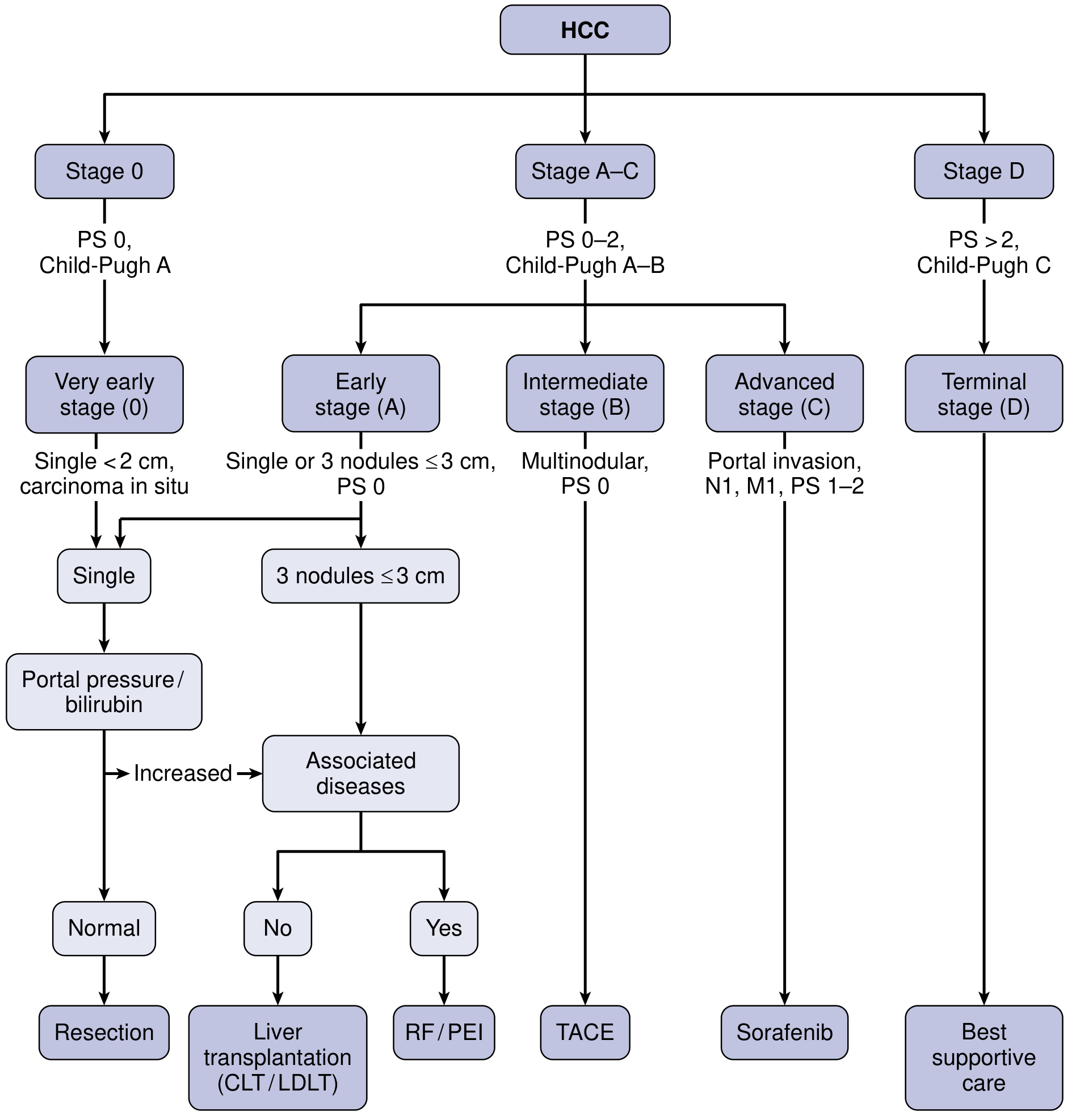
Under BCLC:
| Stage | Description | Standard Treatment |
|---|---|---|
| 0 / Very early | Single <2 cm, Child-Pugh A, PS 0 | Resection (if normal portal pressure) |
| A / Early | Single or ≤3 nodules ≤3 cm, PS 0 | Resection, transplant, or ablation |
| B / Intermediate | Multinodular, PS 0, no vascular invasion | TACE (not resection) |
| C / Advanced | Portal invasion, N1, M1, PS 1-2 | Sorafenib/systemic (not resection) |
| D / Terminal | Child-Pugh C, PS >2 | Best supportive care |
Stages B, C, and D are generally considered non-operable by standard BCLC criteria. However, studies show treatment beyond BCLC guidelines (including resection for stage B) can be effective in well-selected patients.
4. Technical Unresectability
- Tumor location precluding safe dissection (e.g., encasing all major hepatic veins or the confluence of the portal vein)
- Inability to achieve a clear (R0) margin
- Insufficient FLR volume - though preoperative portal vein embolization (PVE) can convert some patients to resectable by inducing compensatory hypertrophy of the FLR
Summary Table
| Category | Criterion | Absolute vs. Relative |
|---|---|---|
| Extrahepatic spread | Metastasis (M1) or N1 | Absolute |
| Main portal vein thrombus | Macrovascular invasion | Absolute |
| Child-Pugh C | End-stage liver disease | Absolute |
| Child-Pugh B | Decompensated cirrhosis | Absolute for major resection |
| Portal hypertension | HVPG ≥10, varices, ascites | Strong relative |
| Bilobar multifocal tumors | Beyond FLR capacity | Relative |
| ECOG PS >2 | Poor performance status | Absolute |
| Tumor size >5 cm | Risk factor for recurrence | Relative |
For patients deemed unresectable, alternatives include liver transplantation (if within Milan criteria), TACE, radiofrequency ablation, or systemic therapy (atezolizumab + bevacizumab or sorafenib).
This is a shared conversation. Sign in to Orris to start your own chat.