
One bone + One joint + One X-ray + One clinical case Example: Today: Femur anatomy Hip joint Femoral neck fracture X-ray Case discussion Make me so that I can make my ortho very strong, make me perfect detailed notes
Asking for Preferences
Which bone/joint topic should we start with today? · What is your current level?
Perfect. Let me build you a complete, exam-ready Ortho Day 1 note set. Reading the medical library skill first, then pulling everything in parallel.
Reading File
Now running all four parallel searches - femur anatomy, hip joint, femoral neck fracture X-ray, and clinical case:
Finding Sources
Finding Sources
Finding Sources
Finding Sources
Excellent results. Now reading the key sections in parallel:
Reading File
Reading File
Reading File
Reading File
Great content. Now fetching key images and reading more from Campbell's for the clinical case and treatment details, in parallel:
Loading Image
Loading Image
Loading Image
Reading File
Excellent. Now fetching the blood supply diagram and treatment section, plus the clinical case content:
Loading Image
Loading Image
Reading File
Reading File
I now have all the material needed to build comprehensive notes. Let me compile the complete Day 1 Ortho notes:
🦴 ORTHO DAY 1 - FEMUR + HIP JOINT + FEMORAL NECK FRACTURE X-RAY + CLINICAL CASE
Sources: Campbell's Operative Orthopaedics 15th Ed 2026, Rockwood & Green's Fractures in Adults 10th Ed 2025, Grainger & Allison's Diagnostic Radiology, THIEME Atlas of Anatomy, Rosen's Emergency Medicine
PART 1 - THE FEMUR (Bone)
General Facts (High-Yield)
- The femur is the longest, strongest, and heaviest bone in the human body
- It is subjected to forces during powerful muscle contraction and weight transmission
- Structurally, the femoral neck acts as an oblique strut between the pelvis (horizontal beam) and the femoral shaft (vertical beam) - this geometry allows wide range of motion but creates significant shearing forces at the neck
Regional Anatomy
| Region | Bone Type | Clinical Significance |
|---|---|---|
| Femoral head, neck, intertrochanteric | Predominantly cancellous | Less resistant to torsional forces; fractures from low-energy falls |
| Subtrochanteric region, femoral shaft | Cortical | Requires higher force to fracture |
| Distal metaphysis | Cortex thins, bone widens | Resistance to stress decreases |
Parts of the Femur
- Femoral head - 2/3 sphere; covered with articular cartilage except at the fovea capitis (where ligamentum teres attaches)
- Femoral neck - projects superolaterally from shaft; normal neck-shaft angle = 125-135° (coxa vara < 120°, coxa valga > 140°)
- Anteversion angle - femoral neck is anteverted ~10-15° relative to the femoral condyles
- Greater trochanter - attachment of gluteus medius and minimus (key abductors)
- Lesser trochanter - attachment of iliopsoas (main hip flexor)
- Intertrochanteric line (anterior) / Intertrochanteric crest (posterior) - mark the capsular attachment
- Femoral shaft - cylindrical; linea aspera on posterior surface provides attachment for adductors, hamstrings, and vastus muscles
- Distal femur - medial and lateral condyles; adductor tubercle on medial condyle (landmark)
Angulation Angles to Know
| Angle | Normal Value | Deformity if abnormal |
|---|---|---|
| Neck-shaft (collodiaphyseal) angle | 125-135° | Coxa vara (<120°) / Coxa valga (>140°) |
| Anteversion (torsion) | 10-15° | Increased = in-toeing gait |
| Pauwels' angle (fracture line) | - | Type I <30°, II 30-50°, III >50° |
Muscle Compartments of the Thigh
| Compartment | Muscles | Main Action | Nerve |
|---|---|---|---|
| Anterior | Quadriceps, sartorius | Knee extension, hip flexion | Femoral nerve (L2-L4) |
| Medial | Adductors, gracilis | Hip adduction | Obturator nerve (L2-L4) |
| Posterior | Hamstrings | Hip extension, knee flexion | Sciatic nerve (L4-S3) |
Blood Supply of the Femur
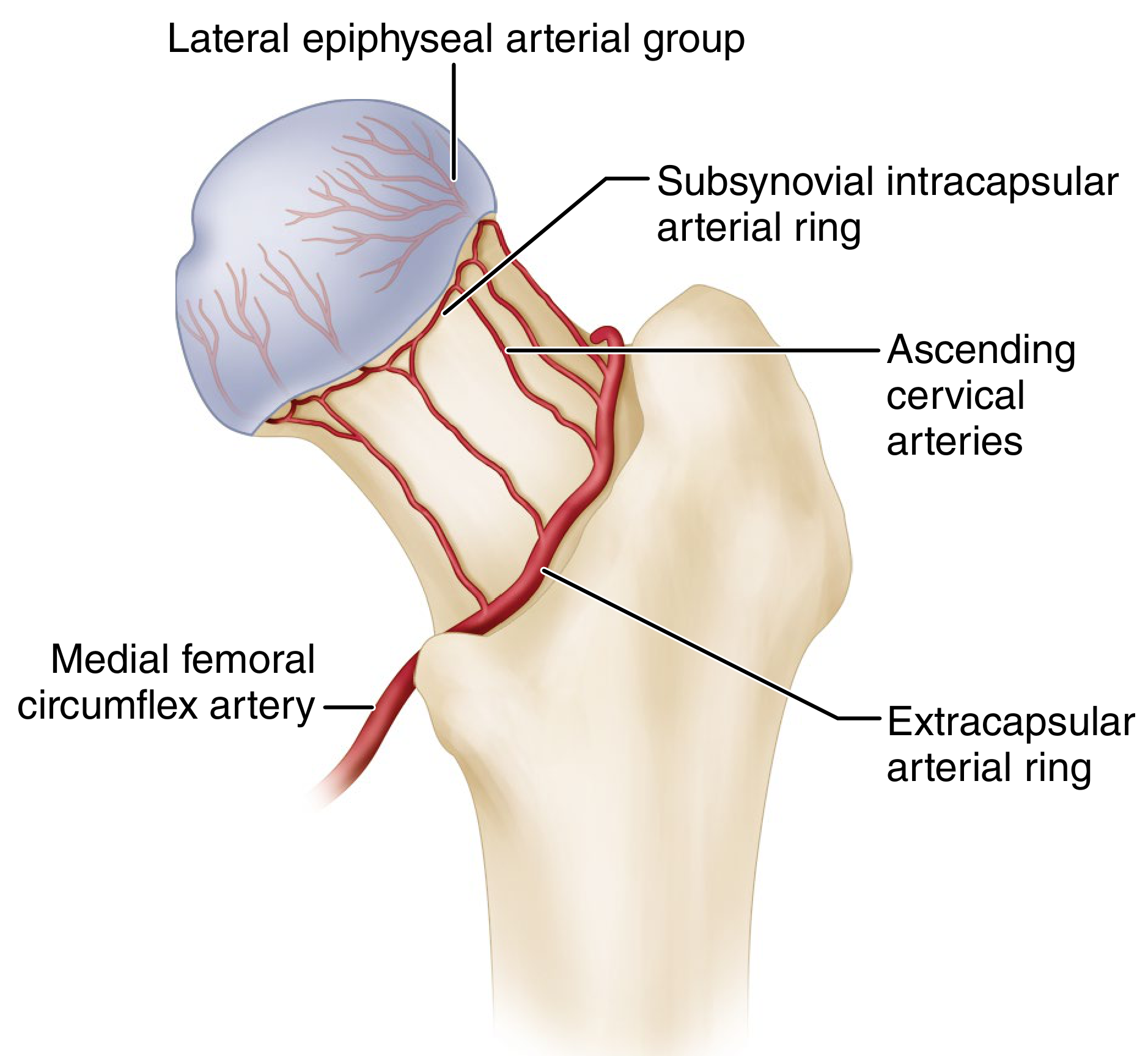
This diagram is THE key to understanding AVN - learn every vessel here.
Main supply to the femoral head:
- Medial femoral circumflex artery (MFCA) - most important; branch of profunda femoris (deep femoral artery). Runs posteriorly and ascends around the femoral neck → forms the extracapsular arterial ring → gives ascending cervical arteries → form subsynovial intracapsular ring → give lateral epiphyseal arterial group (retinacular vessels) which supply the bulk of the femoral head
- Lateral femoral circumflex artery (LFCA) - contributes less; supplies mostly the anterior head
- Artery of ligamentum teres (from obturator artery) - supplies only a small area near the fovea; clinically relevant mainly in children
Why displaced intracapsular fractures = AVN risk:
The ascending cervical / retinacular vessels hug the femoral neck within the capsule. An intracapsular fracture (subcapital especially) or hematoma raises intracapsular pressure → ruptures these vessels → avascular necrosis (15-35% risk with displaced fractures).
PART 2 - THE HIP JOINT (Joint)
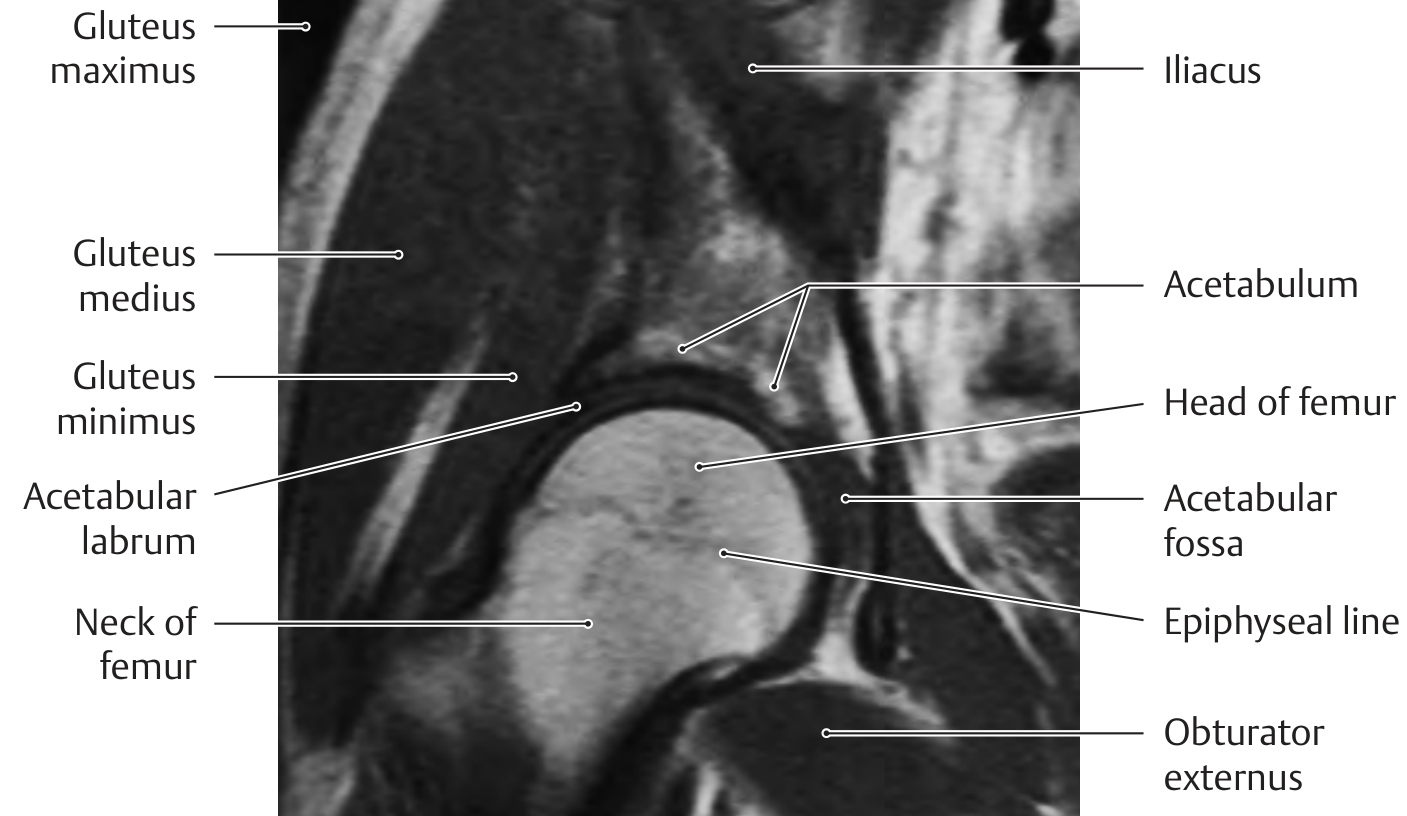
Joint Type
- Synovial ball-and-socket joint (enarthrosis)
- Most stable joint in the body due to: deep acetabulum + labrum + strong capsule + powerful muscles
Articular Surfaces
- Femoral head (ball) - fits into the acetabulum
- Acetabulum (socket) - formed by ilium (above), ischium (behind-below), pubis (front-below); covered by lunate surface (horseshoe-shaped articular cartilage); central acetabular fossa is non-articular (contains fat pad and ligamentum teres)
- Acetabular labrum - fibrocartilaginous rim that deepens the acetabulum by ~20%; seals the joint space
Capsule and Ligaments
| Ligament | Origin - Insertion | Function |
|---|---|---|
| Iliofemoral (Y-ligament of Bigelow) | Anterior inferior iliac spine (AIIS) → intertrochanteric line | Strongest ligament in the body; prevents hyperextension; tightens on extension and ER |
| Pubofemoral | Pubic ramus → lower intertrochanteric area | Prevents excessive abduction and extension |
| Ischiofemoral | Ischium → greater trochanter | Winds around neck posteriorly; prevents hyperextension |
| Ligamentum teres | Fovea capitis → acetabular notch | Carries artery of ligamentum teres; minimal mechanical role in adults |
| Transverse acetabular ligament | Bridges acetabular notch | Converts notch into foramen; helps seal joint |
Capsular attachment: Anteriorly at the intertrochanteric line (whole neck is intracapsular anteriorly); Posteriorly it only covers the medial 2/3 of the neck (outer third of posterior neck is EXTRAcapsular - that's where the MFCA is most vulnerable).
Movements and Muscles
| Movement | Range | Prime Mover | Nerve |
|---|---|---|---|
| Flexion | 0-120° (120-135° with knee bent) | Iliopsoas | Femoral + L1-L3 |
| Extension | 0-20° | Gluteus maximus | Inferior gluteal (L5-S2) |
| Abduction | 0-45° | Gluteus medius and minimus | Superior gluteal (L4-S1) |
| Adduction | 0-30° | Adductors | Obturator (L2-L4) |
| Internal rotation | 0-45° | Gluteus medius/minimus (ant fibres), TFL | Superior gluteal |
| External rotation | 0-45° | Deep 6 rotators (piriformis, obturators, gemelli, quadratus femoris) | Multiple |
Trendelenburg Sign (High-Yield)
- Tests gluteus medius (superior gluteal nerve L4-S1)
- Positive sign: when standing on the affected leg, the contralateral pelvis drops (instead of rising)
- Caused by: Superior gluteal nerve palsy, hip pathology, coxa vara, weak abductors
- Walking version = Trendelenburg gait (lurching toward affected side to reduce abductor moment arm)
Neurovascular Relations at the Hip
The femoral triangle contains (lateral to medial: NAVEL):
- Nerve (femoral nerve) - lateral
- Artery (femoral artery) - middle; midpoint between ASIS and pubic symphysis
- Vein (femoral vein) - medial
- Empty space (femoral canal - potential hernia site)
- Lymphatics
PART 3 - X-RAY: FEMORAL NECK FRACTURE
How to Read a Hip X-Ray - Systematic Approach
Radiographic lines to check on every AP pelvis X-ray:
- Shenton's line - smooth arc from inferior femoral neck to inferior pubic ramus. BROKEN in hip dislocation, fractures, developmental dysplasia
- Neck-shaft angle - should be 125-135°
- Trabecular pattern - medial compressive trabeculae / lateral tensile trabeculae of the femoral neck
- Acetabular reference lines - iliopectineal line (anterior column), ilioischial line (posterior column), Köhler's teardrop, acetabular roof
X-Ray Anatomy of the Proximal Femur
Classification of Femoral Neck Fractures
Three systems - know all three:
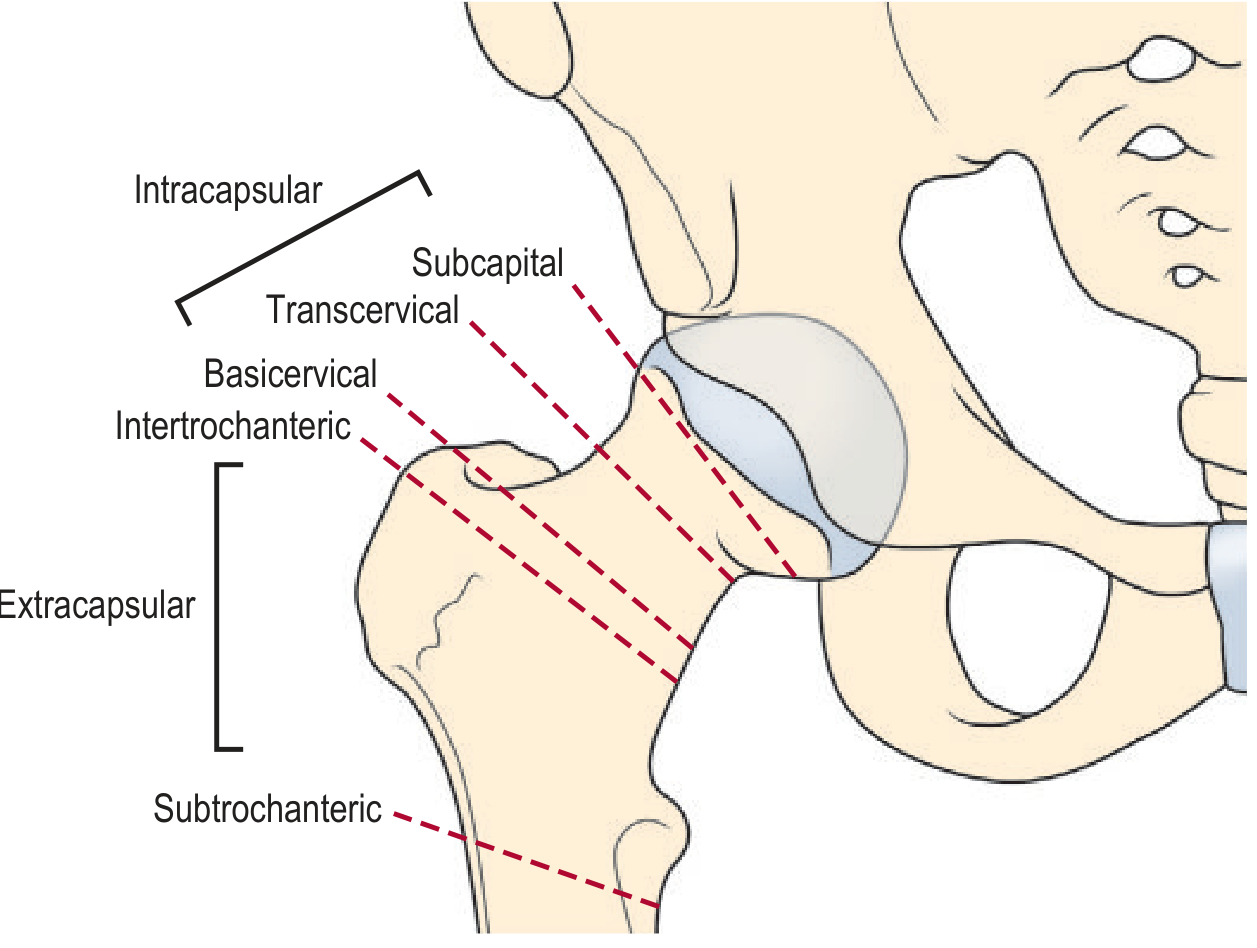
A. By Anatomical Location (most fundamental)
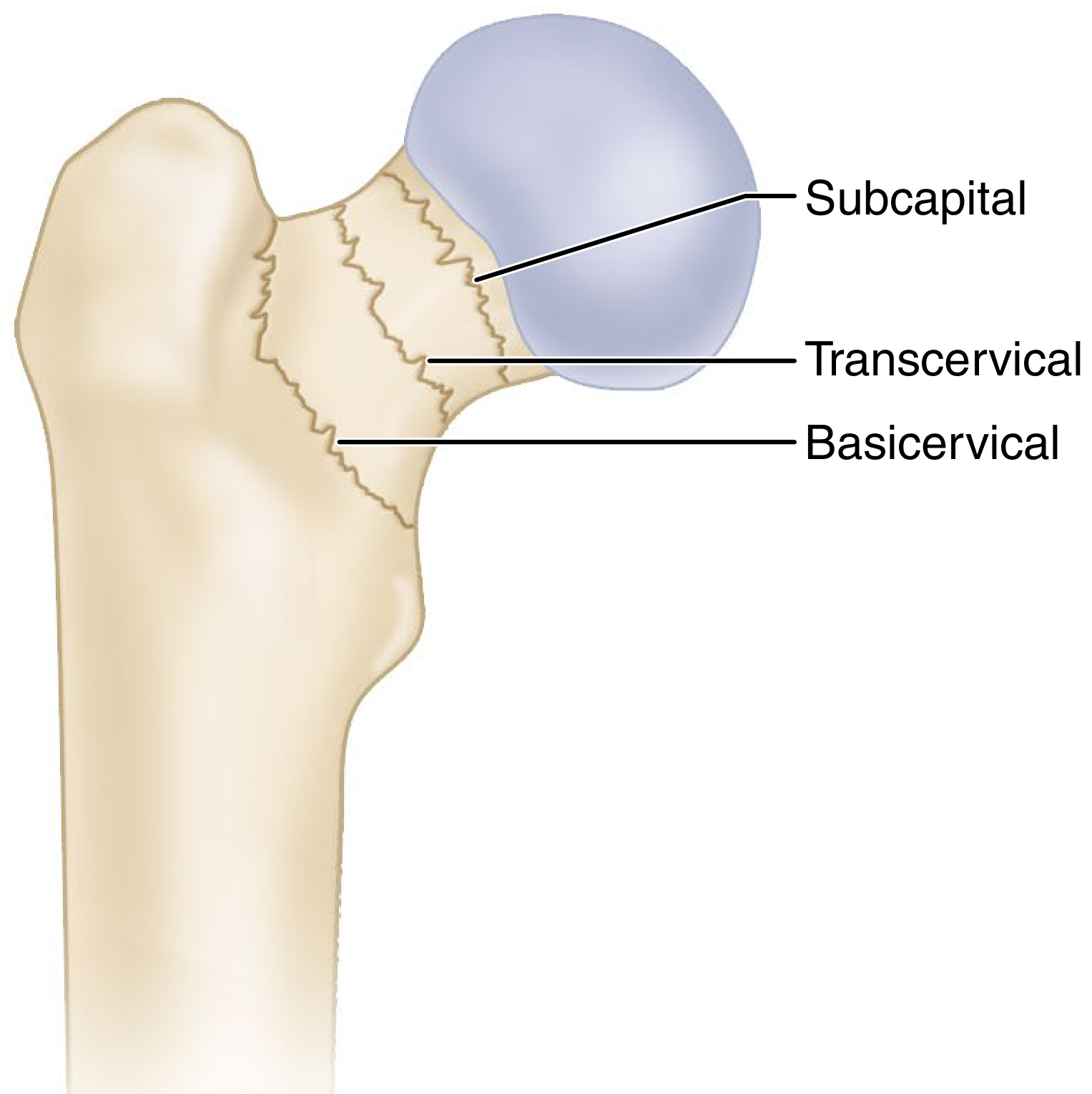
| Location | Intracapsular? | AVN Risk | Common Treatment |
|---|---|---|---|
| Subcapital | Yes | Highest | Hemiarthroplasty / THA (if displaced) |
| Transcervical | Yes | High | Internal fixation (if young/undisplaced) |
| Basicervical | Borderline/No | Lower | Usually fixation with DHS |
| Intertrochanteric | No (extracapsular) | Very low | DHS or IM nail |
| Subtrochanteric | No (extracapsular) | Very low | IM nail (first choice) |
B. Garden Classification (most widely used clinically)
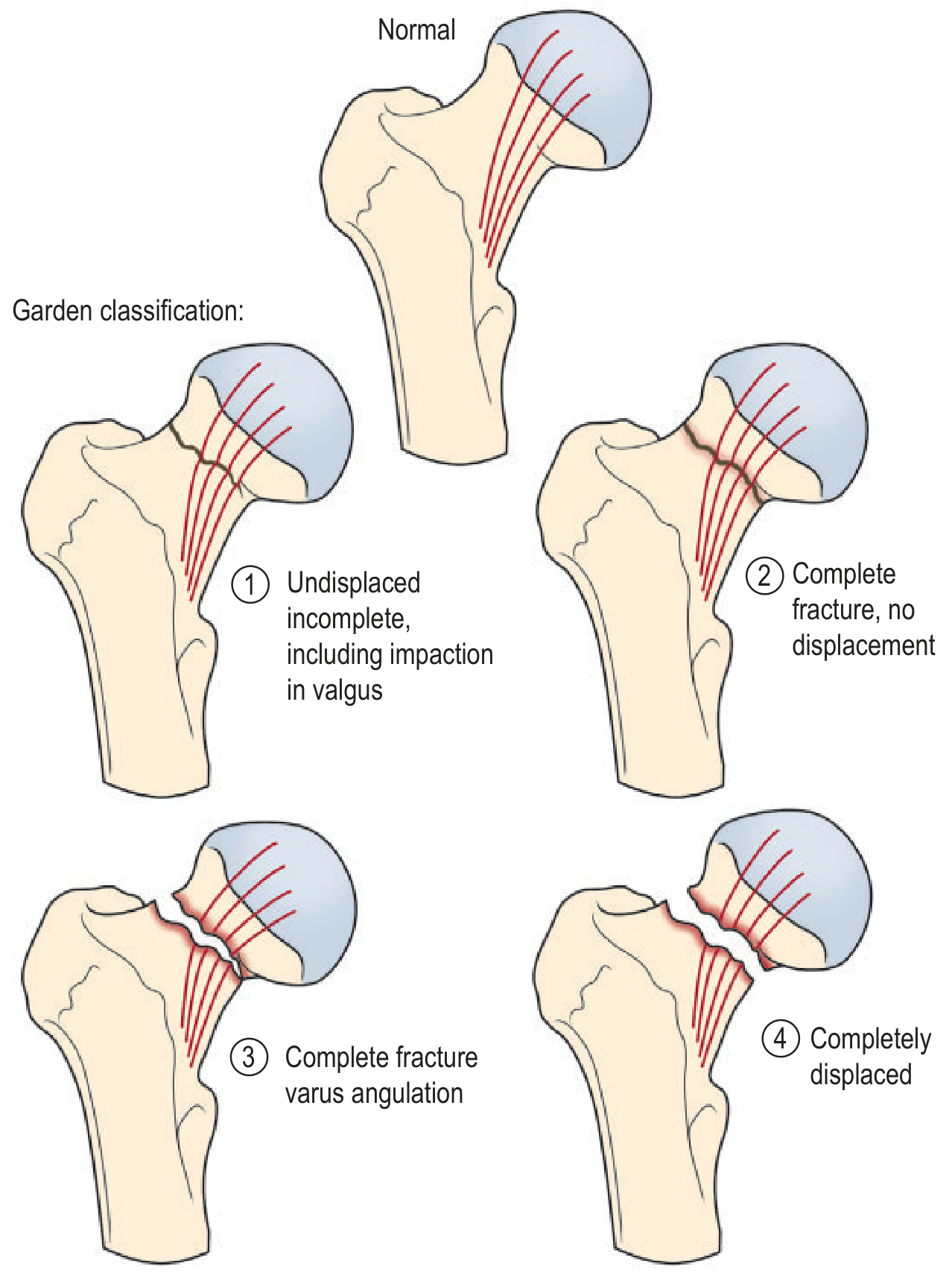
| Stage | Description | Trabecular pattern | Displacement |
|---|---|---|---|
| Garden I | Incomplete (impacted in valgus) | Medial trabeculae angled upward | No displacement - valgus impaction |
| Garden II | Complete fracture, no displacement | Trabeculae still aligned | No displacement |
| Garden III | Complete fracture, partial displacement | Head and neck trabeculae MIS-aligned | Partial - head tilted into varus |
| Garden IV | Complete fracture, full displacement | Trabeculae of head RE-aligned with acetabulum | Full displacement - no contact |
Exam trick for Garden III vs IV:
- Garden III: neck and head still have contact; trabecular lines between head and acetabulum are NOT aligned (head has tilted)
- Garden IV: neck and head have NO contact; BUT trabecular lines between head and acetabulum RE-align (head has rotated back with acetabulum, completely free from neck)
Practical simplification used by most surgeons:
- Garden I + II = Undisplaced → treat with internal fixation
- Garden III + IV = Displaced → treat with arthroplasty (hemi or THA) in elderly
C. Pauwels Classification (based on biomechanics)
| Type | Angle of fracture line to horizontal | Forces | Stability |
|---|---|---|---|
| Type I | 0-30° | Compressive - good for healing | Most stable |
| Type II | 30-50° | Mixed compressive and shear | Intermediate |
| Type III | >50° | Predominantly shear | Unstable - highest risk of nonunion |
Steeper fracture line = more shear = higher risk of fixation failure and nonunion.
What to Look for on the X-Ray (Checklist)
- Is the fracture intracapsular or extracapsular?
- Is there displacement? (Is Shenton's line broken?)
- What is the neck-shaft angle? (Varus = displaced)
- Are trabecular lines aligned in the femoral head vs acetabulum? (Garden grading)
- What is the Pauwels angle?
- Is there associated fracture (acetabulum, shaft, pelvis)?
- Any signs of pre-existing pathology (Paget disease, metastasis, osteoporosis)?
If plain X-ray is normal but clinical suspicion is high:
- ~15% of femoral neck fractures are radiographically occult on plain film
- MRI is the gold standard for occult fractures (detects marrow edema)
- CT useful if MRI unavailable or for assessing comminution
PART 4 - CLINICAL CASE
Case Presentation
A 75-year-old woman with a history of osteoporosis is brought to the Emergency Department by her family after she was found on the floor at home. She reports she heard a "crack" and then fell - note: the fracture may have caused the fall, not the other way around. She cannot bear weight.
Examination:
- Right lower limb is shortened and externally rotated (pathognomonic position)
- Groin pain that worsens with active movement
- Pain on axial loading (heel strike test / telescoping)
- No distal neurovascular deficit
Vitals: BP 130/80, HR 88, afebrile
Step-by-Step Approach
1. What is your immediate differential?
- Femoral neck fracture (most likely)
- Intertrochanteric fracture (also causes shortening + ER)
- Subtrochanteric fracture
- Acetabular fracture
- Pubic ramus fracture (less shortening/ER)
- Hip dislocation (posterior = flexed + IR; anterior = extended + ER - but usually requires high energy in elderly)
2. Investigations
| Investigation | Why |
|---|---|
| AP pelvis + cross-table lateral hip | First-line; classify fracture |
| Full-length femur X-ray | Never miss a distal fracture |
| Bloods: FBC, CMP, coagulation, group & hold | Pre-op workup |
| ECG | Pre-op cardiac assessment |
| MRI hip | If X-ray negative but high suspicion (occult fracture) |
| CT | If MRI unavailable; better for comminution |
3. X-ray shows Garden III subcapital fracture
Now you classify: Intracapsular + displaced = high AVN risk = need arthroplasty
4. Management Decision Tree
Femoral Neck Fracture
        │
        ├─── YOUNG patient (<60 yrs) + any garden grade
        │         → URGENT internal fixation (within 6-12 hrs)
        │         → Goal: save the femoral head
        │         → Cannulated screws or sliding hip screw
        │
        └─── ELDERLY patient (>60-65 yrs)
                  │
                  ├─── Undisplaced (Garden I/II)
                  │         → Internal fixation (cannulated screws)
                  │         → (some centres use hemiarthroplasty for very elderly)
                  │
                  └─── Displaced (Garden III/IV)
                            │
                            ├─── NOT independently mobile / dementia / limited prognosis
                            │         → HEMIARTHROPLASTY (cemented preferred in elderly)
                            │
                            └─── INDEPENDENTLY MOBILE (walking outdoors before injury)
                                      → TOTAL HIP ARTHROPLASTY (THA)
                                      → Better functional outcomes in active elderly
5. Surgical approach considerations
| Procedure | Access | Implant | Notes |
|---|---|---|---|
| Internal fixation | Lateral approach | 3 cannulated cancellous screws (inverted triangle) | Young patients; must achieve anatomic reduction first |
| Dynamic Hip Screw (DHS) | Lateral approach | Barrel + lag screw + side plate | Better for basicervical; not for true subcapital |
| Hemiarthroplasty | Posterolateral or Hardinge (lateral) | Unipolar or bipolar head (Austin-Moore / Thompson / Modern cemented) | Elderly, displaced; cemented = less subsidence |
| Total Hip Arthroplasty | Posterolateral or anterior | Full hip prosthesis | Active elderly; better QoL outcomes |
6. Complications to Know
| Complication | Timing | Mechanism | Prevention/Treatment |
|---|---|---|---|
| Avascular necrosis (AVN) | Months to years | Disruption of retinacular vessels; higher risk Garden III/IV | Prompt fixation in young; arthroplasty in elderly displaced |
| Non-union | 3-6 months | Inadequate fixation, shear forces (high Pauwels), AVN | Good reduction + fixation; salvage with arthroplasty |
| Implant failure / cut-out | Weeks to months | Varus malreduction, osteoporosis, tip-apex distance >25mm | Correct reduction; tip-apex distance |
| Deep vein thrombosis / PE | Days to weeks | Immobility, hypercoagulable state | LMWH chemoprophylaxis + mechanical (TED stockings) |
| Pneumonia / pressure sores | Days | Immobility | Early surgery (<48 hrs) reduces mortality |
| Mortality | 1 year mortality ~20-30% | Multi-morbidity, complications, inactivity | Early surgery (<48 hrs), geriatric co-management |
7. Mortality context (exam favourite):
- 1-year mortality after hip fracture in the elderly is 20-30%
- Surgery within 48 hours significantly reduces mortality
- Hip fracture is managed as a medical emergency, not an elective procedure
Exam Mnemonics
Garden classification memory trick:
"1 = Incomplete valgus; 2 = Complete no displacement; 3 = Complete varus; 4 = Completely gone (displaced)"
Pauwels - the steeper the line, the worse the shear:
"Vertical = Vicious" (Type III with steep vertical fracture is worst)
Leg position in fracture vs dislocation:
- Fracture = Shortened + Externally Rotated (capsule torn, limb collapses into ER)
- Posterior dislocation = Flexed + Internally Rotated + Adducted (FIAD)
- Anterior dislocation = Extended + Externally Rotated + Abducted
Blood supply mnemonic (MFCA is king):
"Medial Femoral Circumflex = Major Flow to Cartilage" - it's the primary supply. Destroy it = AVN.
QUICK-RECALL SUMMARY TABLE
| Topic | Key Fact |
|---|---|
| Longest, strongest bone | Femur |
| Neck-shaft angle | 125-135° (normal) |
| Most important artery to femoral head | Medial femoral circumflex artery (MFCA) |
| Garden I/II | Undisplaced → internal fixation |
| Garden III/IV | Displaced → arthroplasty in elderly |
| Pauwels III | >50° fracture line = most shear = worst prognosis |
| Classic clinical sign of neck fracture | Shortened + externally rotated limb |
| If X-ray normal but suspect fracture | MRI is gold standard |
| Timing for surgery | <48 hours (reduces mortality) |
| 1-year mortality hip fracture | 20-30% in elderly |
| AVN risk (displaced intracapsular) | 15-35% |
| Trendelenburg sign tests | Gluteus medius (superior gluteal nerve) |
| Shenton's line broken | Hip dislocation or fracture |
WHAT'S NEXT (Day 2 suggestion)
Following the natural ortho progression, Day 2 would be:
- Bone: Tibia/Fibula anatomy
- Joint: Knee joint (most complex joint - menisci, cruciate ligaments, collateral ligaments)
- X-ray: Tibial plateau fracture (Schatzker classification)
- Clinical case: 35-year-old motorcyclist, valgus knee injury - tibial plateau fracture
Sources: Campbell's Operative Orthopaedics 15th Ed 2026 | Rockwood and Green's Fractures in Adults 10th Ed 2025 | Grainger & Allison's Diagnostic Radiology | THIEME Atlas of Anatomy - General Anatomy & Musculoskeletal System | Rosen's Emergency Medicine
These notes are structured the same way every day will follow: anatomy first, then joint mechanics, then X-ray interpretation with classification systems, then clinical case with management algorithm. By Day 30 you will have covered every major bone-joint-fracture complex in orthopaedics. Say "Day 2" whenever you are ready to continue, or ask for any clarification on today's material.
This is a shared conversation. Sign in to Orris to start your own chat.