
CKD
Reading File
The query "CKD" is broad. Let me clarify what aspect you need before diving in.
Asking for Preferences
What aspect of CKD are you looking for?
Searching sources...
Finding Sources
Finding Sources
Searching PubMed
"chronic kidney disease"[MeSH Terms] AND classification
Good. Now let me read the key CKD sections from Brenner & Rector's The Kidney and the NKF Primer in parallel.
Reading File
Reading File
Reading File
Good data on staging. Now let me get the core CKD overview section - definition, KDIGO staging with albuminuria, and causes - from the NKF Primer and Comprehensive Clinical Nephrology.
Finding Sources
Finding Sources
Reading File
Finding Sources
I found the KDIGO heat map image and key sections. Let me read the CKD staging section from CCN and Washington Manual, plus fetch the heat map image.
Reading File
Reading File
Loading Image
I now have excellent, comprehensive data from authoritative textbooks. Let me compose the full overview.
Chronic Kidney Disease (CKD) - Overview
Definition
CKD is defined as kidney damage or decreased kidney function persisting for 3 months or more, regardless of cause. The two core criteria are:
- GFR < 60 mL/min/1.73 m² - present for ≥3 months, with or without other markers of kidney damage
- Markers of kidney damage (even with normal GFR) - including proteinuria/albuminuria, abnormal urine sediment, electrolyte abnormalities from tubular disorders, abnormal renal histology, or structural abnormalities on imaging
For G1 and G2 stages (GFR ≥60), additional evidence of kidney damage must be present for a diagnosis of CKD to be made.
- Comprehensive Clinical Nephrology, 7th Ed., p. 2133
- Washington Manual of Medical Therapeutics, p. 498
KDIGO 2012 Staging System
The current classification uses three dimensions: cause, GFR category (G), and albuminuria category (A).
GFR Categories (G Stages)
| Stage | Description | GFR (mL/min/1.73 m²) |
|---|---|---|
| G1 | Normal or high | ≥90 |
| G2 | Mildly decreased | 60–89 |
| G3a | Mildly to moderately decreased | 45–59 |
| G3b | Moderately to severely decreased | 30–44 |
| G4 | Severely decreased | 15–29 |
| G5 | Kidney failure | <15 |
G5 also includes patients on dialysis (G5D).
Albuminuria Categories (A Stages)
| Category | Description | Urine ACR |
|---|---|---|
| A1 | Normal to mildly increased | <30 mg/g |
| A2 | Moderately increased | 30–300 mg/g |
| A3 | Severely increased | >300 mg/g |
KDIGO Heat Map - Risk of CKD Progression
The numbers (1-4+) in the table below indicate visits per year recommended and reflect relative risk of progression (green = low risk, yellow = moderate, orange = high, red = very high):
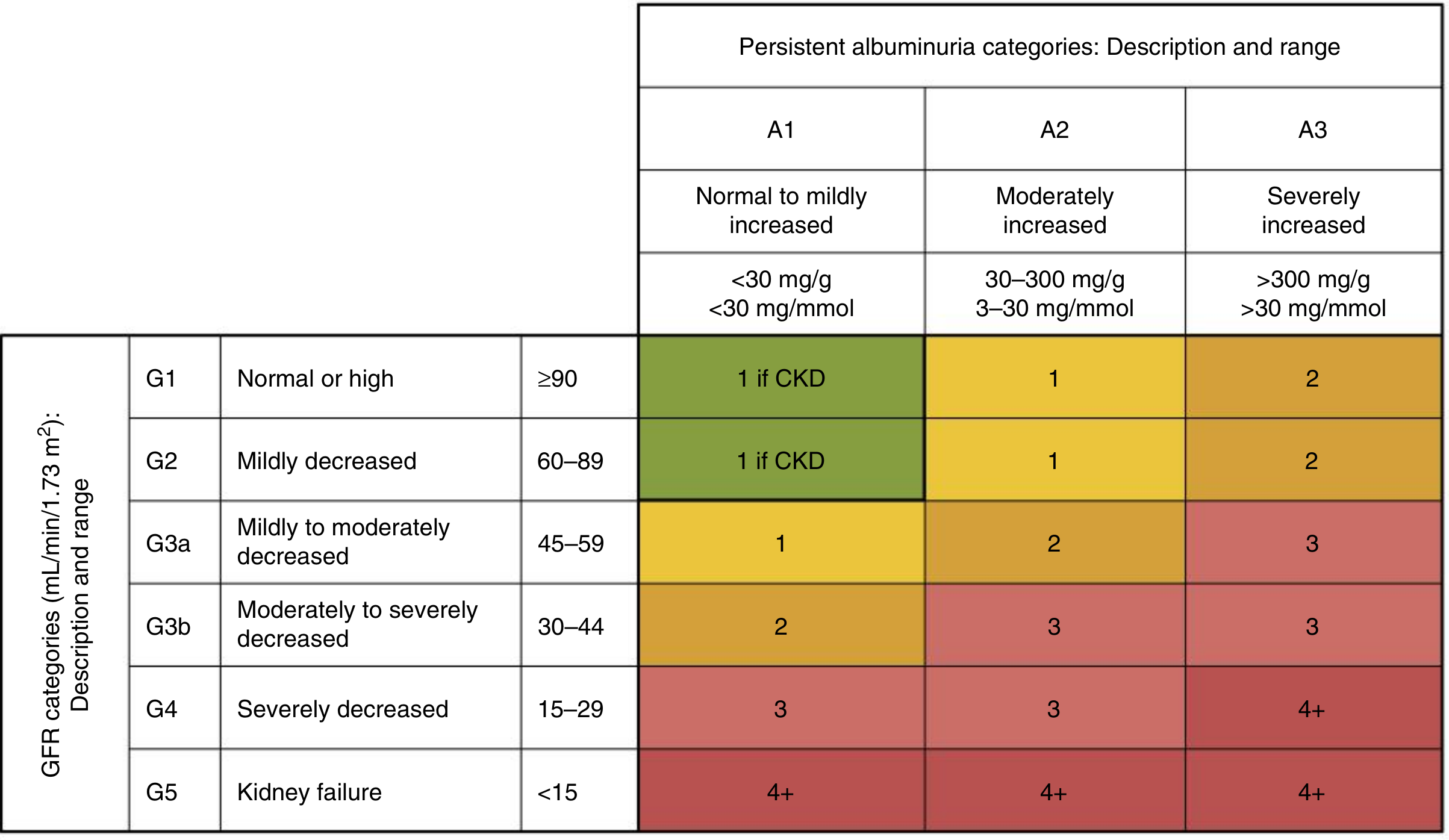
The heat map highlights a key principle: albuminuria independently amplifies risk at any GFR stage. A patient at G3a/A3 carries substantially higher risk than one at G3a/A1.
- Comprehensive Clinical Nephrology, 7th Ed., p. 2138
Estimating GFR
The preferred equations are:
- CKD-EPI (Creatinine) - best available in North America; uses serum creatinine, age, and sex
- CKD-EPI (Creatinine + Cystatin C) - most accurate when both markers are available
- MDRD - widely used historically; performs well but tends to underestimate GFR at higher levels
- Cockcroft-Gault - still used for drug dosing adjustments
Serum creatinine alone is an inadequate marker - even "normal" creatinine can correspond to significantly reduced GFR depending on age, sex, and muscle mass.
- Textbook of Family Medicine, 9e, p. 1192
Epidemiology
-
CKD affects approximately 10-15% of the global adult population
-
In the US, roughly 20 million people have CKD
-
Half of all Americans are expected to develop CKD at some point during their lifetime
-
It is a leading cause of mortality worldwide and carries immense healthcare costs, particularly at kidney failure stage
-
Comprehensive Clinical Nephrology, 7th Ed., p. 2130
Causes
The most common causes of CKD in adults globally are:
Primary causes (accounting for ~2/3 of cases)
- Diabetic nephropathy (diabetic kidney disease) - single leading cause, ~40% of incident cases in high-income countries
- Hypertensive nephrosclerosis / renovascular disease - second most common
- Glomerulonephritis (IgA nephropathy, focal segmental glomerulosclerosis [FSGS], lupus nephritis, membranous nephropathy, MPGN)
Other important causes
- Polycystic kidney disease (PKD) and other inherited disorders
- Obstructive uropathy (chronic obstruction from stones, BPH, etc.)
- Recurrent pyelonephritis / chronic interstitial nephritis
- HIV-associated nephropathy
- Analgesic/NSAID nephropathy
- Contrast or drug-induced nephrotoxicity progressing to CKD
In children
Causes differ markedly from adults - congenital anomalies of the kidney and urinary tract (CAKUT), renal dysplasia, reflux nephropathy, and glomerular diseases predominate.
- NKF Primer on Kidney Diseases, 8e
- Campbell-Walsh-Wein Urology, 5th ed.
Risk Factors for Progression
- Non-modifiable: older age, male sex, race/ethnicity, genetic variants (e.g., APOL1 in individuals of African ancestry), low birth weight/reduced nephron number
- Modifiable: poorly controlled diabetes, hypertension, proteinuria, obesity, smoking, high protein intake, nephrotoxin exposure, recurrent AKI episodes, chronic NSAID use
Key Points
| Feature | Detail |
|---|---|
| Duration criterion | ≥3 months |
| Main GFR stages | G1–G5 (subdivided G3a/G3b) |
| Main albuminuria stages | A1–A3 |
| Best GFR estimating equation | CKD-EPI Cr or CKD-EPI Cr+CysC |
| Leading cause in adults | Diabetic kidney disease |
| Refer to nephrology | GFR <30 (Stage G3b+) |
| Prepare for RRT | Stage G4 onward |
Would you like to go deeper into any specific aspect - pathophysiology, complications (anemia, CKD-MBD, acidosis), or management?
This is a shared conversation. Sign in to Orris to start your own chat.