
How does breastfeeding help in involution of uterus
During breastfeeding, the infant's suckling stimulates the posterior pituitary gland to release oxytocin. Oxytocin causes the myometrium (uterine muscle) to contract, which compresses blood vessels, reduces the uterine blood supply, and promotes the breakdown and resorption of excess uterine tissue - this process is called involution. These contractions are often felt as "afterpains," especially in multiparous women.
Searching sources...
Reading File
Finding Sources
Finding Sources
Reading File
Finding Sources
Reading File
Reading File
Now I have rich textbook content. Let me also fetch the key diagram.
Loading Image
Here is a thorough, textbook-grounded answer:
Breastfeeding and Uterine Involution
The Core Mechanism: The Suckling-Oxytocin Reflex
When an infant suckles at the breast, mechanoreceptors in the nipple and areola are stimulated. Sensory impulses travel along nerve pathways to the hypothalamus, which signals the posterior pituitary gland to release oxytocin into the bloodstream. This is a neuroendocrine reflex - the same one responsible for milk ejection (the "let-down" reflex).
The diagram below shows this pathway clearly:
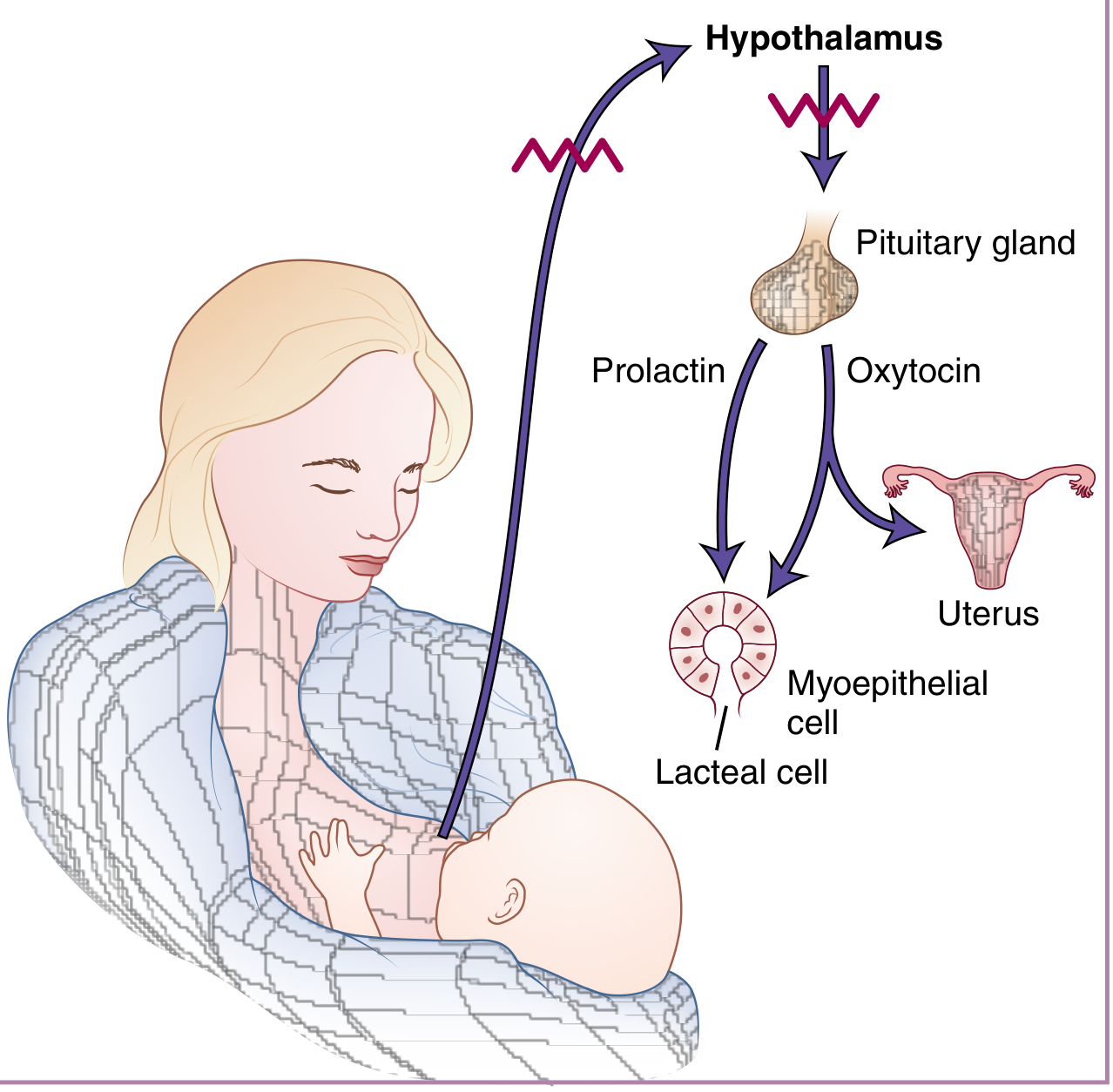
Figure: The let-down (ejection) reflex arc. Suckling stimulates oxytocin release, which acts on both the breast (myoepithelial cells) and the uterus. (From Creasy & Resnik's Maternal-Fetal Medicine)
How Oxytocin Causes Involution
Oxytocin released during breastfeeding acts on the myometrium (uterine muscle):
-
Uterine contractions - The uterine myoepithelial cells are highly sensitive to oxytocin, particularly during the first week after birth. Oxytocin causes these cells to contract rhythmically.
-
Reduced blood loss - Contractions compress the uterine blood vessels (especially at the placental site), dramatically reducing postpartum hemorrhage risk.
-
Accelerated involution - The repeated contractions promote ischemic breakdown of the hypertrophied uterine muscle (myometrial cells shrink via autolysis), and the uterus returns to its prepregnant size more rapidly. As stated directly in Creasy & Resnik: "The uterus of a mother who breastfeeds returns to a prepregnant state more rapidly."
-
Afterpains - The uterine cramping (afterpains) that mothers feel during nursing is a direct consequence of these oxytocin-driven contractions. It is more noticeable in multiparous women because the uterus has more muscle mass to contract.
Timing and Clinical Relevance
| Timepoint | Clinical significance |
|---|---|
| Immediately after birth | Breastfeeding can be initiated to promote uterine contraction and minimize bleeding |
| First week postpartum | Uterine myoepithelial cells are especially oxytocin-sensitive; each feed drives involution |
| By 2 weeks postpartum | Uterus should no longer be palpable abdominally (faster in breastfeeding mothers) |
| 6 weeks postpartum | Full puerperium; uterus returns to near prepregnant size |
Clinical Pearl: When Is It Used Therapeutically?
If the uterus fails to contract adequately with massage alone (uterine atony), oxytocin is administered exogenously (10 units IM, or dilute IV drip) - mimicking exactly what breastfeeding achieves naturally. Breastfeeding itself is thus a physiologic, drug-free method to reduce postpartum hemorrhage and speed involution.
Summary
| Step | What happens |
|---|---|
| Infant suckles | Mechanoreceptors in nipple/areola activated |
| Neural signal | Travels to hypothalamus → posterior pituitary |
| Oxytocin released | Into maternal bloodstream |
| Acts on uterus | Myometrial contractions (afterpains) |
| Result | Vessel compression, reduced bleeding, autolysis of excess muscle → involution |
Sources: Creasy & Resnik's Maternal-Fetal Medicine (p. 244-245); Textbook of Family Medicine, 9e (p. 895-896)
This is a shared conversation. Sign in to Orris to start your own chat.