
Mbbs 3rd year PSM University exam oriented answer for water purification in detail
Reading File
Now let me search the medical library for water purification content in PSM textbooks.
Finding Sources
Finding Sources
Park's PSM is available. Let me read the water purification sections comprehensively.
Reading File
Reading File
Reading File
Reading File
Reading File
I now have comprehensive content from Park's textbook. Let me also get the comparison table data and coagulation/sedimentation sections, plus check the chlorination section more carefully.
Reading File
I now have all the essential content. Let me also fetch the key diagrams from the textbook to include in the answer.
Loading Image
Loading Image
I now have all the content and diagrams needed. Let me compile the comprehensive university exam answer.
PURIFICATION OF WATER
PSM - University Exam Oriented Answer
Source: Park's Textbook of Preventive and Social Medicine
INTRODUCTION
Purification of water is of great importance in community medicine. The purpose of water treatment is to produce water that is safe and wholesome. The method of treatment depends upon the nature of raw water and the desired standards of quality.
- Ground water (wells, springs): may need only disinfection
- Surface water (rivers): turbid and polluted - requires extensive treatment
Water purification may be considered under two headings:
- Purification of water on a large scale
- Purification of water on a small scale
1. PURIFICATION OF WATER ON A LARGE SCALE
The components of a typical water purification system include one or more of the following:
- I. Storage
- II. Filtration
- III. Disinfection
(I) STORAGE
Water is drawn from the source and impounded in natural or artificial reservoirs. Storage provides a reserve of water from which further pollution is excluded, and a considerable amount of natural purification takes place.
Benefits of Storage:
| Type | Process |
|---|---|
| (a) Physical | About 90% of suspended impurities settle by gravity in 24 hours. Water becomes clearer, allowing light penetration and reducing filter workload. |
| (b) Chemical | Aerobic bacteria oxidize organic matter using dissolved oxygen. Free ammonia content is reduced; nitrates rise. |
| (c) Biological | Bacterial count drops by up to 90% in the first 5-7 days. Pathogenic organisms gradually die out. |
- Optimum storage period for river water: 10-14 days
- Prolonged storage may cause algal growth, imparting bad smell and colour
(II) FILTRATION
Filtration is the second - and very important - stage. It removes 98-99% of bacteria in addition to other impurities. Two types of filters are used:
- Slow Sand (Biological) Filter
- Rapid Sand (Mechanical) Filter
A. SLOW SAND OR BIOLOGICAL FILTER
First used in 1804 in Scotland, then London. Still accepted as the standard method of water purification.
Elements of a Slow Sand Filter:
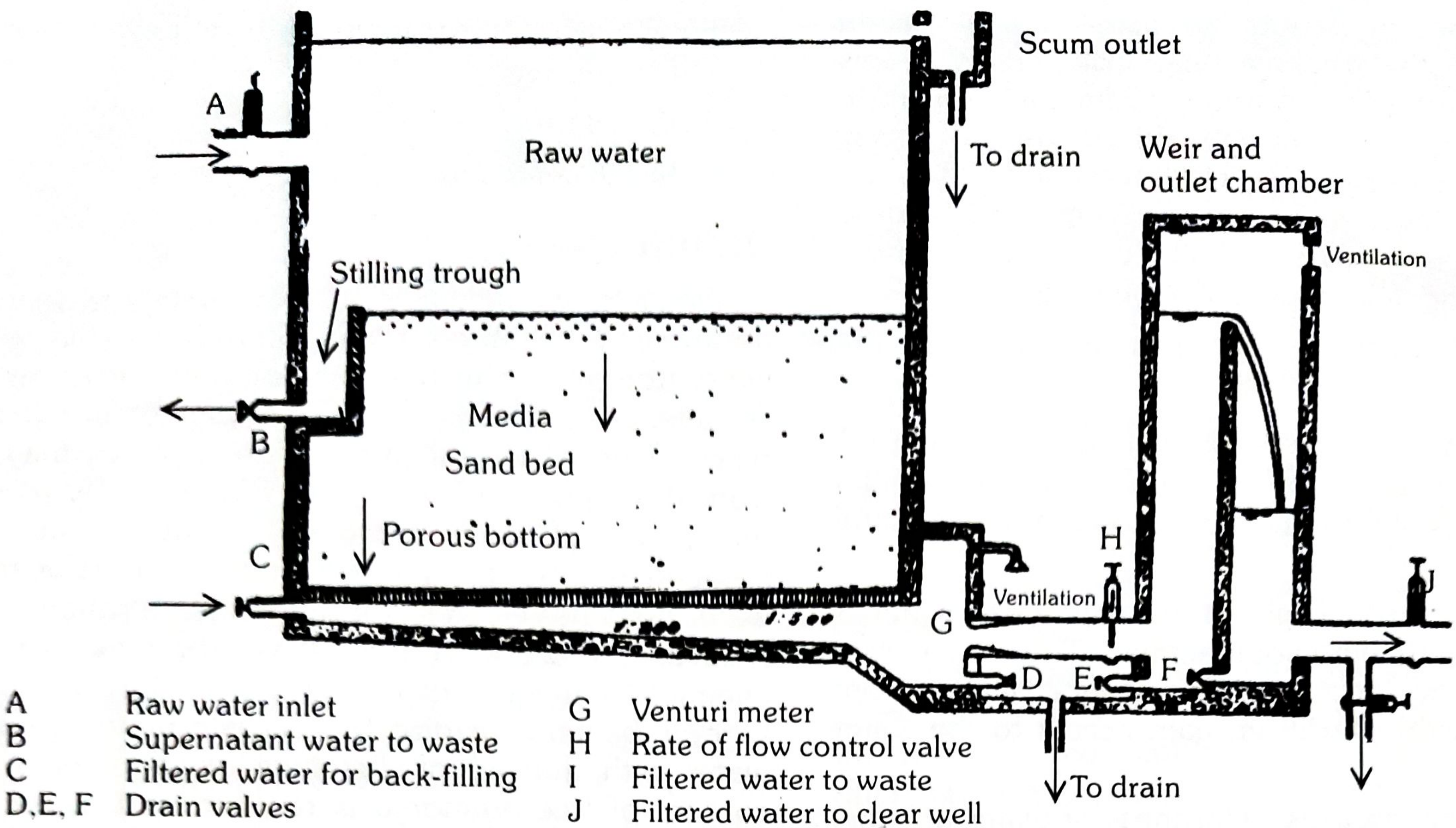
- Supernatant (raw) water - depth 1 to 1.5 m; provides constant head for downward flow; allows 3-12 hours of partial purification by sedimentation, oxidation and particle agglomeration
- Sand bed - 1 metre thick; sand grains with effective diameter 0.2-0.3 mm; provides ~15,000 sq. m surface area per cubic metre; filtration rate 0.1-0.4 m³/hour/m²; filtration processes include mechanical straining, sedimentation, adsorption, oxidation and bacterial action
- Under-drainage system - porous/perforated pipes at the bottom; provides outlet for filtered water and supports the filter medium
- Filter control valves - Venturi meter measures "loss of head"; when loss of head exceeds 1.3 metre, it is uneconomical to run the filter
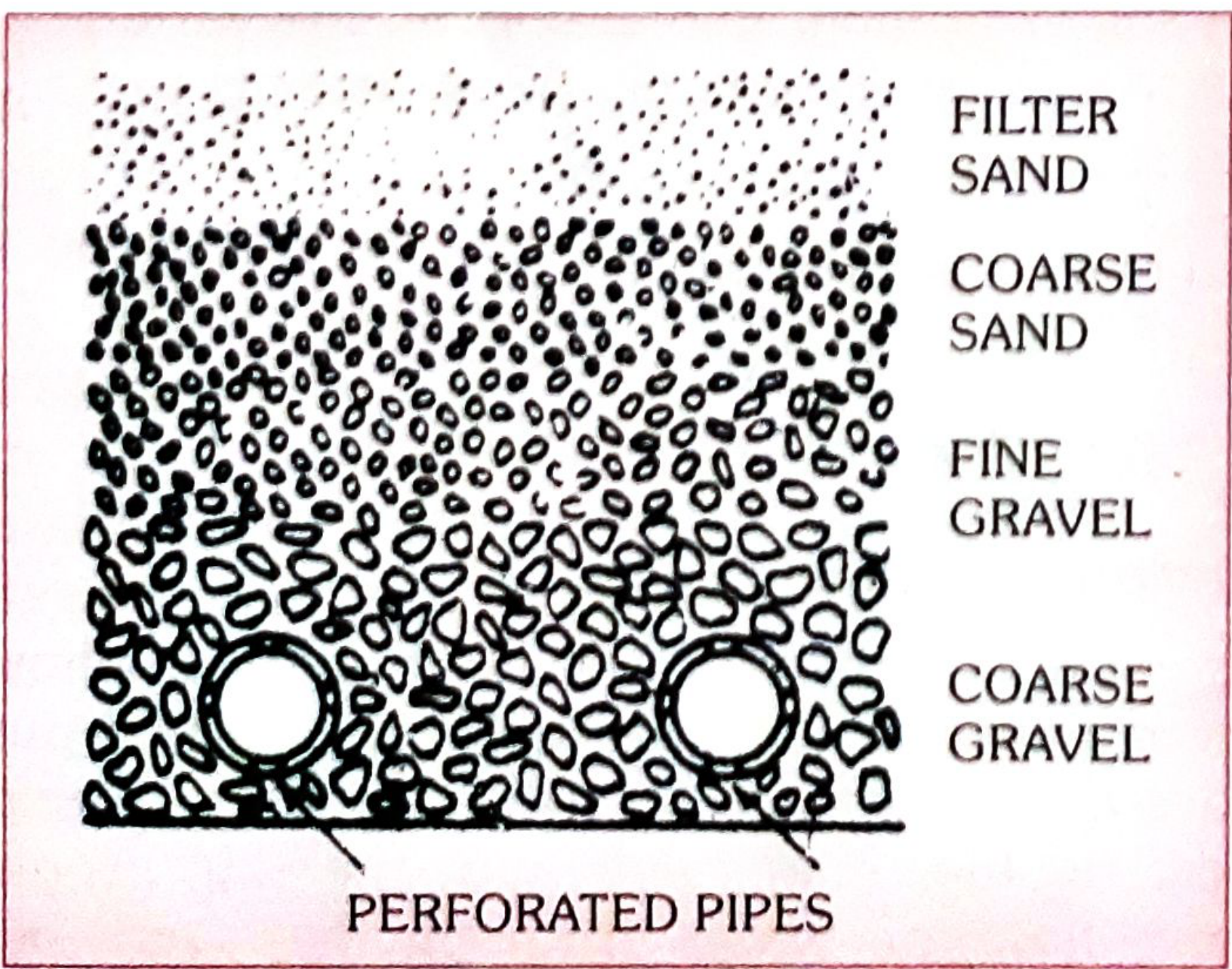
The Filter Box (top to bottom):
| Layer | Depth |
|---|---|
| Supernatant water | 1 to 1.5 metre |
| Sand bed | 1.2 metre |
| Gravel support | 0.30 metre |
| Filter bottom | 0.16 metre |
The Vital Layer (Schmutzdecke):
This is the "heart" of the slow sand filter - the most important examinable concept.
- When newly laid, the filter acts as a mechanical strainer only
- Very soon, the surface of the sand bed gets covered with a slimy growth called "Schmutzdecke" (also called vital layer, zoogleal layer, or biological layer)
- It is slimy and gelatinous and consists of threadlike algae, plankton, diatoms and bacteria
- Formation of the vital layer is called "ripening" of the filter - takes several days
- When fully formed, it extends 2-3 cm into the top of the sand bed
- Functions: removes organic matter, holds back bacteria, oxidizes ammoniacal nitrogen to nitrates, yields bacteria-free water
- First few days' filtrate is run to waste until the vital layer is fully formed
Filter Cleaning:
- When the filter clogs, the top 1.5-2 cm of sand is scraped off and the filter is allowed to drain, then resanded
- This is called "harrowing" or "resanding"
- After cleaning, the filter needs several days to re-ripen (reform the Schmutzdecke)
Advantages of Slow Sand Filter:
- Simple construction and operation
- No coagulants needed
- Produces biologically safe water
- Standard method for water purification
Disadvantages:
- Needs large land area
- Slow rate of filtration
- Requires preliminary settling for turbid water
- Costly to clean; needs re-ripening period after cleaning
B. RAPID SAND (MECHANICAL) FILTER
Operates much faster than slow sand filter. Requires pre-treatment with coagulation and sedimentation (Alum is used as coagulant).
Key features:
- Sand grain effective diameter: 0.4-0.7 mm (coarser than slow sand)
- Rate of filtration: 5-15 m³/hour/m² (40-50 times faster than slow sand)
- Does not develop a biological layer (Schmutzdecke)
- Action is purely mechanical (not biological)
- Bacteria removal: ~98-99% (but requires pre-coagulation and subsequent disinfection)
Backwashing:
- Rapid sand filters need frequent washing (daily or weekly), depending on loss of head
- Washing is done by reversing the flow of water through the sand bed = "backwashing"
- Backwashing dislodges impurities and cleans the sand bed
- Process takes about 15 minutes
- In some filters, compressed air is used as part of backwashing
Advantages of Rapid Sand Filter over Slow Sand Filter:
- Can deal with raw water directly - no preliminary storage needed
- Filter beds occupy less space
- Filtration is rapid (40-50 times faster)
- Washing is easy (backwashing)
- More flexibility in operation
COMPARISON TABLE: Slow Sand vs Rapid Sand Filter
| Feature | Slow Sand Filter | Rapid Sand Filter |
|---|---|---|
| Sand grain size (eff. dia.) | 0.2-0.3 mm | 0.4-0.7 mm |
| Rate of filtration | 0.1-0.4 m³/hr/m² | 5-15 m³/hr/m² |
| Biological layer | Present (Schmutzdecke) | Absent |
| Pre-treatment needed | Usually settling only | Coagulation + sedimentation |
| Cleaning method | Scraping (harrowing) | Backwashing |
| Cleaning frequency | Every 4-6 weeks | Daily/weekly |
| Re-ripening after cleaning | Required (several days) | Not required |
| Land area | Large | Small |
| Bacteria removal | 98-99% | 98-99% |
| Post-disinfection | Mandatory | Mandatory |
(III) DISINFECTION
Criteria for an ideal disinfectant:
- Should destroy pathogens within available contact time, not unduly influenced by temperature, pH, or mineral content
- Should NOT leave toxic products or impart colour/taste
- Should be readily available at reasonable cost
- Should leave residual concentration to deal with recontamination
- Should be detectable by simple analytical techniques
In water works practice, disinfection is synonymous with chlorination.
CHLORINATION
Chlorination is one of the greatest advances in water purification. It is a supplement, NOT a substitute to sand filtration.
- Kills: pathogenic bacteria
- Does NOT kill: spores, certain viruses (e.g., polio, viral hepatitis) except in high doses
Chemistry of Chlorination:
When chlorine gas dissolves in water:
Cl₂ + H₂O → HOCl + HCl HOCl → H⁺ + OCl⁻
Hypochlorous acid (HOCl) is the active germicidal agent. It penetrates bacterial cell walls and destroys enzyme systems.
Chlorine Demand:
The amount of chlorine consumed in reacting with organic matter, bacteria, algae, and other substances in water before any residual is left.
Chlorine dose = Chlorine demand + Residual chlorine
Break-point Chlorination:
- As chlorine is added progressively to water, residual first rises, then falls (due to chloramine destruction), then rises sharply again
- The point at which residual starts to rise sharply again = break-point
- Beyond the break-point, residual is free chlorine (most germicidal)
- Standard practice: add enough chlorine to produce 0.5 mg/litre free residual chlorine after 1 hour contact time at the consumer's tap
Methods of Chlorination:
- Plain chlorination - chlorine gas or chlorine compounds added directly
- Super-chlorination - adding larger doses of chlorine (up to 5-10 mg/litre) then followed by dechlorination with sodium thiosulphate or activated carbon
- Pre-chlorination - added before filtration (reduces algal growth, oxidizes iron/manganese)
- Post-chlorination - after filtration (most common)
- Double chlorination - both pre- and post-filtration
Agents used:
- Chlorine gas (Cl₂) - most efficient; used in large municipal supplies
- Bleaching powder (CaOCl₂): contains ~33% available chlorine; unstable on exposure to air/light/moisture
- High Test Hypochlorite (HTH/Perchloron): 60-70% available chlorine; more stable than bleaching powder
- Chloramines (chlorine + ammonia): produce combined chlorine; less powerful but more persistent; used in long distribution systems
Testing for Residual Chlorine:
| Test | Details |
|---|---|
| Orthotolidine (OT) Test | Yellow colour produced by both free and combined chlorine; free chlorine reacts instantaneously, reading within 10 seconds; standard test |
| Orthotolidine-Arsenite (OTA) Test | Modification of OT test; differentiates free from combined chlorine; overcomes errors from nitrites, iron, manganese |
| DPD Test | N,N-Diethyl-p-phenylenediamine; preferred modern test |
OTHER DISINFECTION METHODS
Ozonation:
- Ozone (O₃) is a powerful oxidant
- Formed by passing dry air/oxygen through a high-voltage electric field
- Dosed via porous diffusers at base of contactor tanks (~5 m deep; 10-20 minutes contact time)
- Dose for organic chemical oxidation: ~0.5 mg/l residual after 20 min contact
- Advantage: no toxic by-products at low doses; also removes taste/odour
- Disadvantage: no residual protection; expensive; carcinogenic by-products (bromate) may form
UV Irradiation:
- Destroys bacteria and viruses by disrupting DNA
- No residual protection
- Useful as a complementary agent to chlorine
- Limited usefulness as sole disinfectant in large-scale supply
Membrane Filtration:
- Reverse Osmosis (RO): operates at high pressure (>15 bar); removes dissolved solids, bacteria, viruses
- Ultrafiltration: pore size 0.002-0.03 μm; pressure <5 bar; removes molecules >800 daltons
- Microfiltration: pore size 0.01-12 μm; pressure 1-2 bar; removes particles >0.05 μm; used with coagulation or PAC
2. PURIFICATION OF WATER ON A SMALL SCALE
Three methods are available for household/individual scale purification (can be used singly or in combination):
(a) BOILING
- Bring to a "rolling boil" for 10-20 minutes
- Kills all bacteria, spores, cysts, and ova - yields sterilized water
- Also removes temporary hardness (drives off CO₂, precipitates CaCO₃)
- Disadvantage: No residual protection against subsequent contamination; alters taste; expensive for large quantities
- Water should be boiled and stored in the same container to avoid recontamination
(b) CHEMICAL DISINFECTION
| Agent | Details |
|---|---|
| Bleaching powder (CaOCl₂) | White amorphous powder; 33% available chlorine; unstable; store in dark, cool, dry, closed container |
| Chlorine solution | Made from bleaching powder (4 kg in 20 litres = 5% solution); used for wells/tanks |
| High Test Hypochlorite (HTH/Perchloron) | 60-70% available chlorine; more stable than bleaching powder |
| Halazone tablets | Para-dichlorosulphamoylbenzoic acid; 1 tablet per litre; residual 0.2-0.4 mg/l after 30 min |
| Chlorine tablets | Convenient; used by campers and military |
| Iodine | Effective; 2% tincture or iodine tablets; removes taste with Na₂S₂O₃ |
| Potassium permanganate | Pink colour indicates adequate disinfection; less effective |
(c) FILTRATION METHODS
| Filter | Details |
|---|---|
| Pasteur-Chamberland filter | Unglazed porcelain; removes bacteria by mechanical filtration |
| Berkefeld filter | Kieselguhr (diatomaceous earth) candle; removes bacteria |
| Katadyn filter | Silver-impregnated filter; oligodynamic action of silver kills bacteria |
| Sand filter / Biosand filter | Household-level biosand filter; used in developing countries |
(d) OTHER HOUSEHOLD METHODS
- Solar disinfection (SODIS): clear plastic PET bottles, place in sunlight for 6-8 hours (48 hours if cloudy); UV + heat kills pathogens; used in disaster/field conditions
- Ceramic filters: porous clay filters with colloidal silver coating; removes bacteria and protozoa
(e) MULTI-STAGE REVERSE OSMOSIS (RO):
- Combination of pre-filtration + activated carbon + RO membrane + UV stages
- Removes bacteria, viruses, dissolved solids (heavy metals, fluoride, nitrates)
- Used widely for household purification in urban areas of India
- Disadvantage: wastes water (reject water ~50-70%); removes beneficial minerals; requires electricity
COAGULATION AND SEDIMENTATION (Pre-treatment)
Before filtration, turbid surface water requires:
- Coagulant added: Alum (aluminium sulphate) is most commonly used
- Alum reacts with natural alkalinity of water to form Al(OH)₃ floc - a gelatinous precipitate
- Floc enmeshes fine particles, bacteria, and colloids - they settle by sedimentation
- This is called "flocculation" followed by "sedimentation"
- Reduces turbidity, colour, organic matter, and bacterial count dramatically before filtration
QUICK COMPARISON SUMMARY (High-yield for exam)
| Parameter | Storage | Slow Sand Filter | Rapid Sand Filter | Chlorination |
|---|---|---|---|---|
| Bacteria removed | 90% | 98-99% | 98-99% | Kills remaining |
| Mechanism | Gravity, oxidation, die-off | Schmutzdecke + mechanical | Mechanical | Chemical germicidal |
| Residual protection | None | None | None | YES |
| Pre-treatment | None | Storage | Coagulation+sedimentation | Post-filtration |
| Duration | 10-14 days | - | - | 1 hour contact |
HIGH-YIELD EXAM POINTS (Frequently Asked):
- Schmutzdecke = vital layer of slow sand filter = "heart of the filter" - composed of algae, diatoms, bacteria; removes organic matter, oxidizes ammonia to nitrates
- Break-point chlorination = point beyond which only free chlorine residual remains
- Free residual chlorine at tap = 0.5 mg/litre after 1 hour contact
- OT test = Orthotolidine test; reading within 10 seconds for free chlorine
- Bleaching powder = 33% available chlorine; stabilized with excess lime
- HTH/Perchloron = 60-70% available chlorine; most stable chlorine compound
- Chlorination is supplement NOT substitute for filtration
- Boiling = only method that kills spores and cysts; no residual protection
- Optimum storage for river water = 10-14 days
- Backwashing = cleaning method for rapid sand filter; takes ~15 minutes
- Harrowing/Scraping = cleaning method for slow sand filter (top 1.5-2 cm scraped)
- Ozonation = no residual protection; no taste/odour; forms bromate (carcinogenic)
Reference: Park's Textbook of Preventive and Social Medicine (Park's PSM), Chapter on Water Supply
This is a shared conversation. Sign in to Orris to start your own chat.