
Contraceptions
Reading File
Contraception is a broad topic. Let me search the medical library for comprehensive coverage.
Searching sources...
Finding Sources
Searching PubMed
"contraception"[MeSH Terms]
Good - I have strong sources. Let me now read the main contraception sections from the Family Medicine textbook (most comprehensive) and Ganong's (physiology mechanisms), plus the dedicated gynecology chapter.
Reading File
Reading File
Reading File
Good data so far. Let me read more of the Family Medicine contraception chapter which is the most comprehensive.
Reading File
Finding Sources
Let me grab the key pharmacology chapter from Lippincott, plus the main contraception content from the Family Medicine chapter, and fetch the effectiveness chart image.
Reading File
Reading File
Loading Image
Excellent. Now I have comprehensive data to write a full, well-structured response. Let me also get the emergency contraception and contraindications content from Lippincott.
Reading File
I now have comprehensive, well-sourced information to write a detailed response on contraception.
Contraception - A Comprehensive Overview
Contraception refers to methods used to prevent pregnancy by interfering with fertilization, ovulation, or implantation. Methods range from highly effective permanent procedures to less reliable barrier and behavioral options.
Effectiveness at a Glance
The image below shows typical-use failure rates (unintended pregnancies per 100 women in year 1):
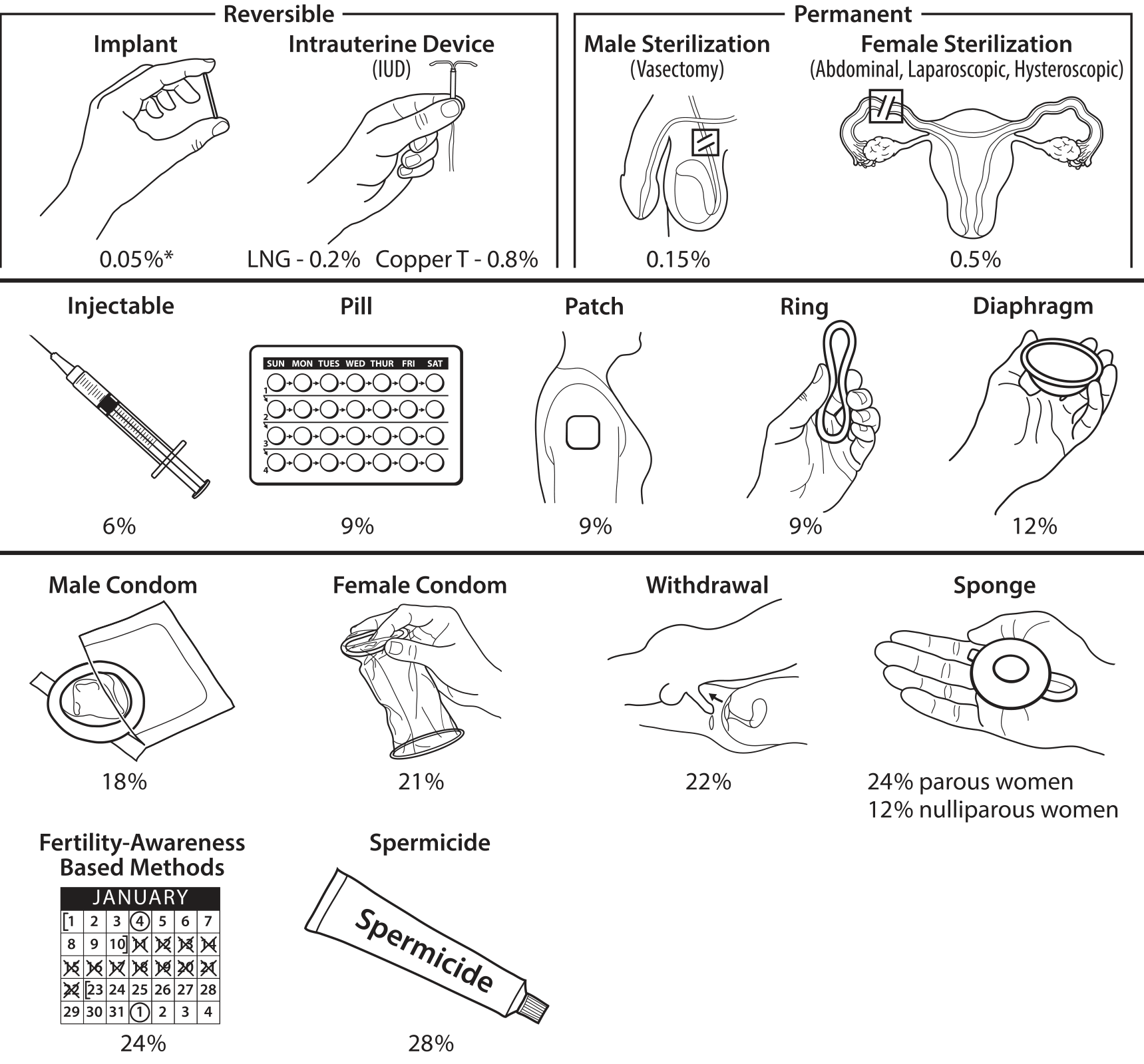
| Method | Typical-Use Failure Rate |
|---|---|
| Implant (etonogestrel) | 0.05% |
| LNG-IUD | 0.2% |
| Copper-T IUD | 0.8% |
| Vasectomy | 0.15% |
| Female sterilization | 0.5% |
| Injectable (DMPA) | 6% |
| Combined pill / patch / ring | 9% |
| Male condom | 18% |
| Female condom | 21% |
| Withdrawal | 22% |
| Fertility awareness | 24% |
| Spermicide alone | 28% |
- Ganong's Review of Medical Physiology, 26e (failure rates per 100 woman-years also confirm vasectomy 0.02, tubal ligation 0.13, combined OCP 0.27-0.32, IUD 1.3-1.5, diaphragm 1.9, condom 3.6, rhythm 15.5)
1. Combined Hormonal Contraceptives (CHCs)
These contain ethinyl estradiol + a progestin.
Mechanism of Action
- Suppress gonadotropins (both FSH and LH): estrogen suppresses FSH; progestin blunts the LH surge, preventing ovulation
- Thicken cervical mucus (progestin): impedes sperm penetration
- Alter endometrium: renders it inhospitable for implantation
- Low-dose estrogen preparations are as effective as high-dose ones
Forms
a) Combined Oral Contraceptive Pills (OCPs)
- Taken for 21 active days, then 5-7 days off for withdrawal bleeding (or 24/4 in newer formulations)
- Contain ethinyl estradiol + a synthetic progestin (norethindrone, levonorgestrel, desogestrel, norgestimate, drospirenone)
- Progestin generations matter:
- 1st-3rd generation (norethindrone, LNG, norgestimate): 3× risk of VTE over non-users
- 4th generation - drospirenone (Yaz, Yasmin): derived from 17α-spironolactone, has doubled VTE risk compared to LNG-containing pills, 6× over non-users - use has declined sharply due to over $1.6 billion in lawsuits
b) Transdermal Patch
- Contains ethinyl estradiol + norelgestromin or levonorgestrel
- Applied weekly for 3 consecutive weeks, then patch-free week for withdrawal bleed
- Less effective in women >90 kg; total estrogen exposure may be higher than oral pills, increasing VTE risk
- Contraindicated in BMI ≥30 kg/m²
c) Vaginal Ring (NuvaRing)
- Contains ethinyl estradiol + etonogestrel
- Inserted vaginally, left in place for 3 weeks, removed for 1 week
- Most common reason for discontinuation: vaginal irritation or ring expulsion
2. Progestin-Only Contraceptives
Preferred for breastfeeding women (estrogen reduces milk production by binding prolactin receptors), women with estrogen contraindications (VTE history, migraine with aura, age >35 + smoking).
a) Progestin-Only Pills ("Mini-pill")
- Usually contain norethindrone (low daily dose)
- Must be taken at same time each day - less margin for error
- Irregular menstrual cycles are more common
- Alternative: drospirenone 4 mg - 24 active + 4 placebo days per cycle
b) Injectable - DMPA (Depo-Provera)
- Medroxyprogesterone acetate (MPA) 150 mg IM or 104 mg SC every 3 months
- Provides high, sustained progestin levels; amenorrhea common
- Return to fertility may be delayed 6-12+ months after stopping
- Bone loss with long-term use - limit to 2 years unless no other option is appropriate
- Common side effect: weight gain
c) Progestin Implant (Nexplanon)
- Etonogestrel rod implanted subdermally in upper arm
- Effective for up to 3 years; as reliable as sterilization
- Fully reversible upon removal
- LARC (Long-Acting Reversible Contraceptive)
d) Levonorgestrel IUD
- Several options: 3, 5, or 7 years of contraception
- Also highly effective treatment for heavy menstrual bleeding
- Avoid in: active pelvic inflammatory disease, history of ectopic pregnancy
- LARC - most effective reversible methods
3. Non-Hormonal IUD - Copper-T
- Provides contraception for up to 10 years
- Mechanism: copper exerts a spermatocidal effect; also prevents sperm from fertilizing ova
- Does not suppress ovulation - suitable for women who prefer hormone-free contraception
- Important downside: increases menstrual bleeding (contrast to LNG-IUD which reduces it)
- IUDs in general may cause intrauterine infections, usually within first month of insertion and mainly in women with STI exposure
4. Barrier Methods
| Method | Failure Rate (typical use) | Notes |
|---|---|---|
| Male condom | 18% | Only method protecting against STIs - always recommend |
| Female condom | 21% | |
| Diaphragm + spermicide | 12% | Requires fitting; insert before intercourse |
| Cervical cap | Variable | Less effective in parous women |
| Sponge | 12-24% | 12% nulliparous, 24% parous |
| Spermicide alone | 28% | Not recommended as sole method |
Condoms remain the only contraceptive that also reduces STI transmission.
5. Fertility Awareness Methods (FAMs)
- Track menstrual cycles, basal body temperature, cervical mucus (Billings method), or combinations
- Typical use failure: ~24% - higher than most other methods
- Lactational Amenorrhea Method (LAM): effective only if exclusively breastfeeding, <6 months postpartum, and no return of menses
6. Permanent Sterilization
| Procedure | Failure Rate |
|---|---|
| Vasectomy | 0.15% (0.02/100 woman-years) |
| Female sterilization (tubal ligation, hysteroscopic) | 0.5% (0.13/100 woman-years) |
- For vasectomy: use backup contraception for first 3 months until azoospermia confirmed
7. Emergency Contraception (EC)
Used after unprotected intercourse. Reduces pregnancy probability to 0.2-3%.
| Method | Window | Notes |
|---|---|---|
| Levonorgestrel (Plan B, etc.) | Within 72 hours (best <24h) | Most common; well tolerated; OTC available |
| Ulipristal acetate (ella) | Within 120 hours (5 days) | Progesterone agonist/antagonist; prescription required; may be more effective late in window |
| Copper-T IUD | Within 5 days | Most effective EC (>99%); also provides ongoing contraception for 10 years |
- The copper IUD is the most effective form of emergency contraception - preferred when rapid, reliable EC is needed with ongoing protection
- Levonorgestrel EC is generally better tolerated than estrogen-progestin combination regimens
8. Choosing a Contraceptive Method - Key Questions
From Lippincott Pharmacology:
- Does the patient want hormonal contraception? If no → copper IUD, condom, diaphragm, fertility awareness
- Are there contraindications to estrogen? (VTE history, migraine with aura, age >35 + smoking, cardiovascular disease) → progestin-only methods
- What comorbidities exist? Consult the CDC US Medical Eligibility Criteria (USMEC) for guidance
- Desired duration? Short-term → pills/patch/ring; Long-term → LARC (implant, IUD)
- Breastfeeding? → progestin-only (estrogen inhibits milk production)
- STI risk? → always add condoms regardless of primary method
Key Contraindications to Combined OCPs (estrogen-containing)
- Active or history of thromboembolic disease (DVT/PE)
- Stroke or ischemic heart disease
- Migraine with aura
- Uncontrolled hypertension
- Breast cancer (current)
- Age >35 + cigarette smoking (carries higher death risk - only age group where OCPs increase mortality risk)
- Liver disease / hepatic tumors
Special Considerations
- Adolescents: Low-dose progestin IUDs are recommended for early adolescence to improve compliance. Estrogen and progestin dosing often needs adjustment from adolescent to perimenopausal years.
- Postmolar pregnancy: Oral contraceptives can be used safely after molar evacuation; IUDs should be deferred until hCG normalizes to avoid perforation risk.
- Drug interactions: Antiretrovirals significantly alter hormonal contraceptive efficacy - a 2024 systematic review (PMID 38762199) confirmed important interactions requiring method adjustment.
- Adolescents (2025 AAP guideline, PMID 40518137): The American Academy of Pediatrics reaffirmed broad access to all contraceptive methods for adolescents including LARCs as first-line options.
Sources
- Textbook of Family Medicine, 9e (Harper, Wilfing, Blanner - Chapter 26)
- Lippincott Illustrated Reviews: Pharmacology (Chapter 25)
- Ganong's Review of Medical Physiology, 26e (Chapter 22)
- U.S. Selected Practice Recommendations for Contraceptive Use, 2024 - CDC (PMID 39106301)
Say about contraceptions relevant to molar pregnancy
After molar pregnancy (hydatidiform mole), contraception is important during the hCG surveillance period to avoid confusion of a new pregnancy with persistent gestational trophoblastic disease. Oral contraceptives are generally safe post-evacuation, and IUDs should be deferred until hCG normalizes.
Searching sources...
Finding Sources
Finding Sources
Searching PubMed
"hydatidiform mole" AND "contraception"
Good sources found. Now let me read the dedicated contraception section within the Berek & Novak molar pregnancy chapter, plus the Schwartz surgery text, and get the abstract of the most relevant recent review.
Reading File
Reading Article
PMID: 38142524
Reading Article
PMID: 40638920
Let me now read the exact contraception section in the molar pregnancy follow-up, and the Schwartz surgery paragraph.
Reading File
Reading File
I now have all the detail needed for a thorough, focused answer.
Contraception After Molar Pregnancy
Why Contraception Matters Post-Molar
After evacuation of a hydatidiform mole, patients undergo serial serum β-hCG monitoring to detect persistent gestational trophoblastic neoplasia (GTN). This is the cornerstone of post-molar surveillance. A new pregnancy would:
- Cause hCG to rise, making it impossible to distinguish a new pregnancy from developing GTN
- Require interruption of the surveillance protocol
- Complicate or delay initiation of chemotherapy if GTN is confirmed
Therefore, effective contraception is mandatory throughout the entire hCG follow-up period - not just recommended, but a clinical requirement.
Duration of Contraception Required
| Mole Type | hCG Follow-up Duration | Contraception Required |
|---|---|---|
| Partial hydatidiform mole | Until hCG normal for 3 consecutive weeks, then monthly; total ~3-6 months | Throughout this period |
| Complete hydatidiform mole | Weekly hCG until normal for 3 consecutive weeks, then monthly until normal for 6 consecutive months | Throughout this period |
| After treatment for GTN | 12 months of surveillance post-chemotherapy | 12 months |
- Average time to first normal hCG after evacuation: ~9 weeks
- After achieving non-detectable hCG, risk of GTN approaches zero
Which Methods Are Safe?
✅ Oral Contraceptive Pills (OCPs) - SAFE
Early concern existed that OCPs might stimulate residual trophoblastic tissue (because rising gonadotropins from OCP-driven pseudo-cycles could theoretically promote tumor growth). However:
"Data from a prospective trial and other centers indicate that oral contraceptive use does not increase the risk of postmolar trophoblastic disease. It appears that oral contraceptives may be used safely after molar evacuation during the entire interval of hormonal follow-up." - Berek & Novak's Gynecology
- The early reports of increased persistent tumor in OCP users were not confirmed in prospective studies
- Combined OCPs and progestin-only pills are both acceptable options
- A key additional benefit: hormonal contraception keeps hCG interpretable because OCPs prevent ovulation and thus prevent a new intrinsic rise in hCG
A 2025 review by Braga, Berkowitz & Horowitz in Obstetrics & Gynecology (PMID 40638920) confirms that "to maintain the reliability of this tumor marker, hormonal contraception is indicated during postmolar follow-up."
✅ Barrier Methods - SAFE
- Male condom, female condom, diaphragm - all acceptable
- Condoms have the added benefit of STI protection
❌ Intrauterine Devices (IUDs) - DEFERRED Until hCG Normalizes
Both copper-T IUD and levonorgestrel IUD are contraindicated until the patient achieves a normal hCG level. The reason:
"Because of the potential risk of uterine perforation, bleeding, and infection, intrauterine devices should not be inserted until the patient achieves a normal hCG level." - Berek & Novak's Gynecology
The post-molar uterus is friable, vascular, and at risk from instrumentation. Once hCG has normalized and GTN has been excluded, IUD insertion is safe.
⚠️ Sterilization - Special Consideration
If the patient desires permanent contraception, hysterectomy may be performed at the time of molar evacuation (mole in situ) - this eliminates the need for separate sterilization and avoids re-instrumentation of the uterus. However:
- Hysterectomy does not eliminate the need for hCG follow-up - it does not prevent metastasis
- If the patient is unsure or desires future fertility, sterilization should be deferred
After GTN Treatment
After completing chemotherapy for invasive mole, choriocarcinoma, or other GTN:
- 12 months of surveillance with contraception is recommended following treatment to allow complete surveillance for relapse (Schwartz's Principles of Surgery)
- Any increase in β-hCG during surveillance triggers further evaluation and consideration of further chemotherapy
Summary Table
| Method | Status Post-Molar | Notes |
|---|---|---|
| Combined OCP | ✅ Recommended | Does not increase GTN risk; maintains hCG reliability |
| Progestin-only pill | ✅ Safe | Suitable if estrogen contraindicated |
| Barrier methods | ✅ Safe | Condom also protects against STI |
| Copper-T IUD | ❌ Defer | Until hCG normalises |
| LNG-IUD | ❌ Defer | Until hCG normalises |
| Hysterectomy (at evacuation) | ✅ If desired | Still requires hCG follow-up post-op |
| Pregnancy | ❌ Avoid | Until surveillance period complete |
Sources:
- Berek & Novak's Gynecology, Chapter 41 (Gestational Trophoblastic Disease)
- Schwartz's Principles of Surgery, 11e
- Braga A, Berkowitz R, Horowitz N. Etiology, Natural History, and Management of Recent Advances in Molar Pregnancy. Obstet Gynecol. 2025. (PMID 40638920)
- Cooper M, Cameron S. Contraception after abortion, miscarriage, ectopic and molar pregnancy. Best Pract Res Clin Obstet Gynaecol. 2024. (PMID 38142524)
This is a shared conversation. Sign in to Orris to start your own chat.