
Hydatid lung definition etiology pathogenesis clinical features and diagnostic and treatment with drug dosage from fishman and Murray only with hrct findings point wise
Reading File
Now let me search the library database for hydatid lung in Fishman and Murray textbooks.
Finding Sources
Finding Sources
I need to find Fishman's and Murray's textbooks specifically. Let me search for them.
Finding Sources
Finding Sources
Both Fishman's and Murray & Nadel's are in the library. Let me now search specifically for hydatid disease sections in both books.
Finding Sources
Finding Sources
Excellent! I found the key sections. Let me now read the detailed content from both Fishman's block 28 (main hydatid chapter) and Murray & Nadel's blocks.
Reading File
Reading File
Excellent content! Let me now read more from Fishman's to get the clinical features, diagnosis, HRCT findings, and treatment with drug dosages.
Reading File
I have comprehensive content. Let me also get the HRCT section from Murray & Nadel and the drug dosage table from Fishman's, plus check for HRCT-specific findings.
Finding Sources
Reading File
Now let me get the drug dosage table from Fishman's and also check for any HRCT-specific content in Fishman's (Grainger's has HRCT content).
Reading File
Finding Sources
I now have all the key content. Let me also fetch the HRCT-specific content from Grainger's (which appeared in the earlier search) and the CT image from Fishman's.
Reading File
Loading Image
Now let me also get the Murray eFigure with the water lily sign, and the full drug dosage text from Fishman's treatment section.
Reading File
Loading Image
I now have comprehensive data from both Fishman's and Murray & Nadel's. Let me compile the full, detailed answer.
Hydatid Lung Disease (Pulmonary Echinococcosis/Cystic Echinococcosis)
Sources: Fishman's Pulmonary Diseases and Disorders, 2-Vol Set | Murray & Nadel's Textbook of Respiratory Medicine, 2-Vol Set
1. DEFINITION
- Pulmonary hydatid disease (cystic echinococcosis, CE) is a parasitic infection of the lung caused by the larval (metacestode) cyst stage of the tapeworm Echinococcus granulosus.
- The lungs are the second most common organ involved (20%) after the liver (50-80%).
- In children, pulmonary involvement is more frequent than hepatic, due to greater lung elasticity permitting faster cyst growth.
(Fishman's, p. 2424; Murray & Nadel's, p. 1349)
2. ETIOLOGY
- Caused by zoonotic cestodes of the genus Echinococcus. Four species cause human disease: E. granulosus, E. multilocularis, E. vogeli, and E. oligarthus.
- Most common pulmonary cause: E. granulosus (dog tapeworm), causative agent of CE or hydatid disease.
- E. granulosus is now recognized as a complex of 10 distinct genotypes, some elevated to distinct species.
- Geographic distribution: Worldwide; endemic in pastoral communities of South America, Australia, eastern Europe, north Africa, the Middle East, central Asia, western China, Mediterranean basin (Italy, Spain, Albania, former Yugoslavia), Central/South America, sub-Saharan Africa, China, Russia, and former Soviet countries.
- Definitive hosts: Domestic dogs, foxes, wolves, other canids.
- Intermediate hosts: Sheep, pigs, cattle, goats; humans are accidental intermediate hosts.
(Fishman's, p. 2424; Murray & Nadel's, p. 1349)
3. PATHOGENESIS / LIFE CYCLE
- Definitive host (canids) ingest hydatid cysts in infected viscera of intermediate host → cyst matures into adult tapeworm in canine intestine → adult sheds embryonated eggs in feces.
- Humans are infected by ingestion of eggs in contaminated food/water or by close contact/handling of dogs.
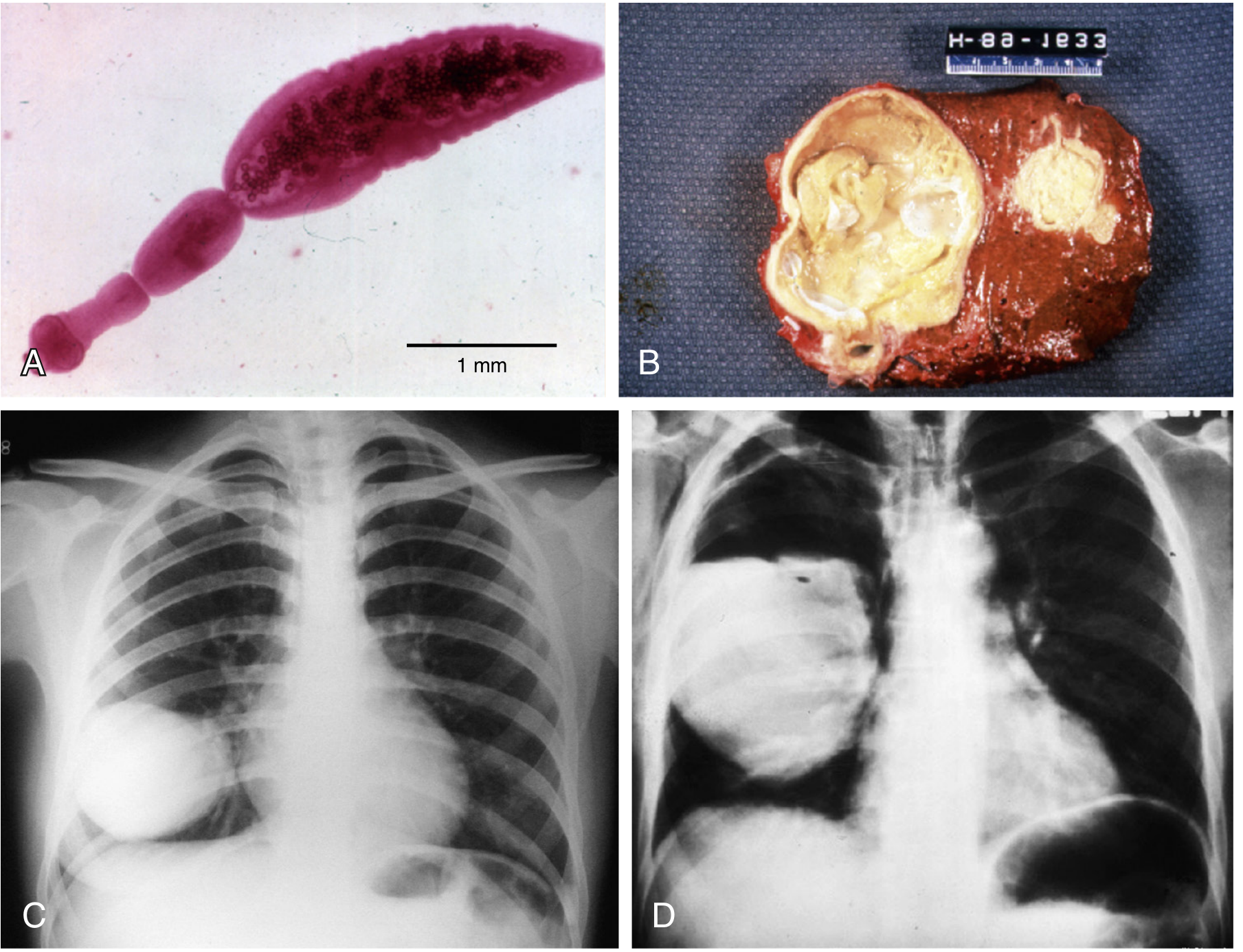
- In the human stomach, oncospheres are released → penetrate intestinal wall → spread via bloodstream → lodge in liver or lungs (or other organs: kidney, bone, brain) → mature into metacestode cysts.
- The maturing cyst forms a space-occupying lesion with three layers:
- Outer layer (pericyst): Host-derived, composed of compressed lung tissue and granulomatous inflammation that progresses to fibrosis.
- Middle layer (laminated layer): Acellular, derived from the parasite.
- Inner layer (endocyst/germinal layer): Produces protoscolices, daughter cysts, and deposits hydatid sand into the enlarging cyst.
- The cyst grows slowly over years to decades until it causes symptoms by mass effect.
- Eventually the cyst may: (a) degenerate into a calcified mass, or (b) acutely rupture into a bronchus, pleural space, or adjacent structures.
- Lung disease is more common in children whose lungs accommodate faster cyst growth.
(Fishman's, p. 2424-2425; Murray & Nadel's, p. 1349-1350)
4. CLINICAL FEATURES
Asymptomatic Presentation
- Pulmonary hydatid cysts are often asymptomatic and found incidentally on imaging.
- Children are more likely to be asymptomatic even with very large cysts.
Symptomatic - Intact/Enlarging Cyst
- Cough (most common)
- Chest pain
- Dyspnea (from mass effect of enlarging cyst)
- Hemoptysis (less frequent)
- Cysts can erode into adjacent structures causing bone pain, hemorrhage, or airway compression.
Symptomatic - Cyst Rupture (Abrupt onset of new/worsening symptoms)
- Rupture into a bronchus: Fever, cough with abrupt onset; patient may expectorate macroscopic fragments of the parasite; can become secondarily infected with bacteria and/or fungi (lung abscess).
- Rupture into the pleural space: Hypersensitivity responses (fever, urticaria, wheezing); frank anaphylaxis can develop (rarely fatal); empyema with or without bacterial superinfection.
Epidemiology of Cysts
- Usually unilateral (50-80%), solitary (60%), with predilection for the lower lobes.
- Up to 35% of individuals have concomitant hepatic involvement.
- 10-15% of individuals have more than one organ involved.
- Cysts may be ruptured (two-thirds) or unruptured (one-third) at presentation.
Laboratory
- Peripheral eosinophilia seen in fewer than 25% of cases (non-specific).
(Fishman's, p. 2425; Murray & Nadel's, p. 1350)
5. DIAGNOSIS
A. Imaging
Plain Chest Radiograph
- Uncomplicated (unruptured) cysts: Well-defined, round or oval homogeneous masses of uniform density, 1-20 cm in diameter, with smooth borders and normal adjacent lung tissue.
- Cyst rupture into bronchus: Air-fluid level within the cyst due to partial discharge of cyst contents (endocyst detachment).
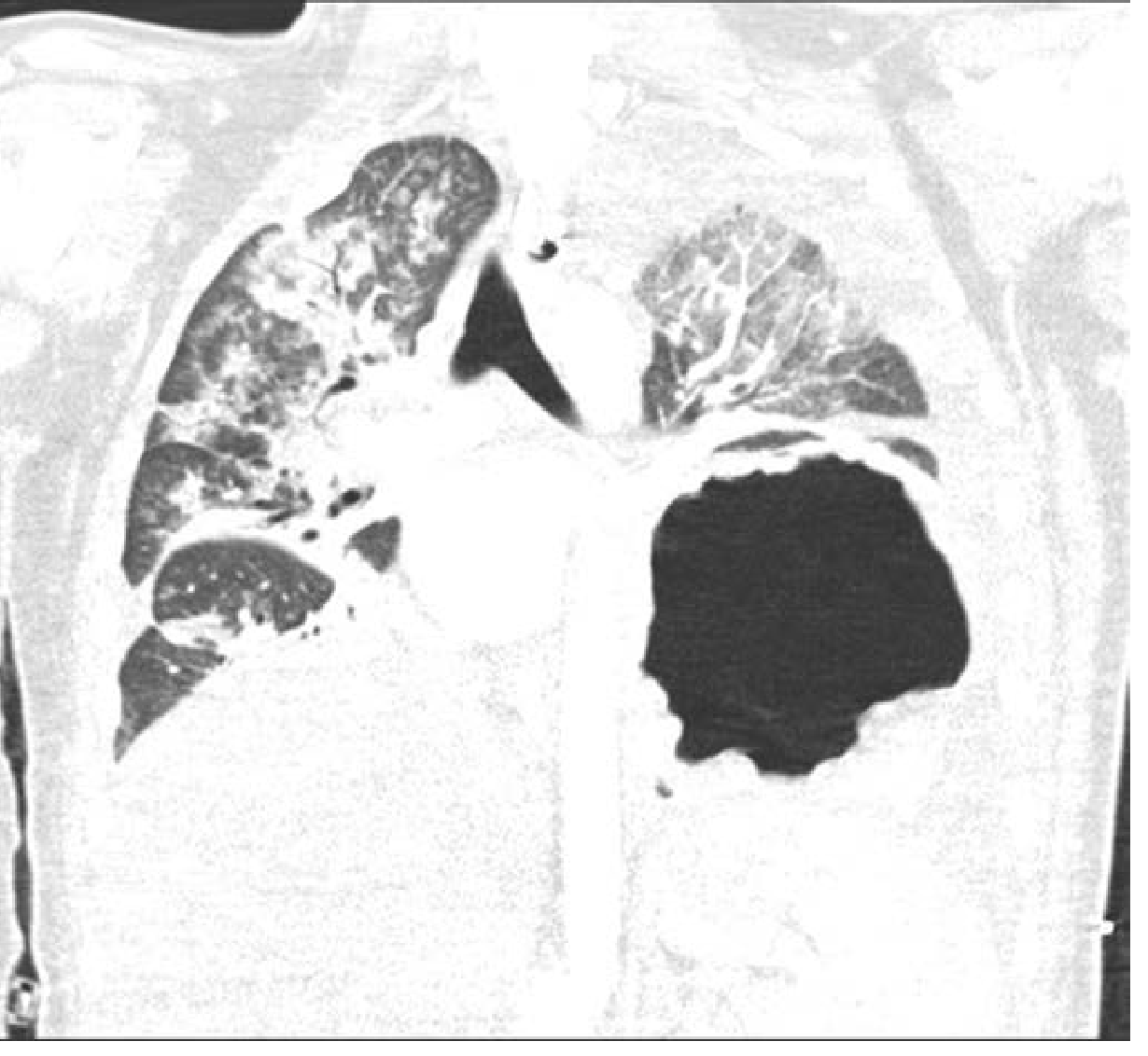
- "Water lily" sign (camalote sign): Pathognomonic of a collapsed cyst. Air enters the cyst → detachment of inner endocyst from outer pericyst → endocyst collapses to float on remaining fluid in the partially filled pericyst → appearance of a "water lily floating on a pond." Rare but diagnostic.
- "Meniscus sign": Air crescent between pericyst and endocyst; resembles the air crescent of a mycetoma.
- Aggressive vascular invasion may cause massive hemoptysis and hemorrhage.
CT / HRCT FINDINGS (Point-Wise)
- Uncomplicated cysts: Well-defined, round or oval, near-water-density (0-20 HU) unilocular cyst with a smooth wall; no contrast enhancement of cyst contents; mass effect on surrounding lung.
- Daughter cysts: CT may reveal daughter cysts (smaller cysts) within a larger parent cyst - this finding distinguishes hydatid cysts from other pulmonary cysts and is highly characteristic.
- Pericyst wall: Smooth, well-defined outer wall (may calcify in degenerated/old cysts). Contrast enhancement can be seen around the cyst wall in secondary infection.
- Air crescent sign: Crescent of air between pericyst and endocyst, mimicking a mycetoma on CT.
- Air-fluid level: Present when cyst ruptures into bronchus with partial fluid evacuation.
- "Water lily" / "camalote" sign on CT: Collapsed, floating endocyst membrane seen as a floating structure within residual cyst fluid - appears as a wavy, serpentine or lily pad-shaped membrane floating on the cyst fluid.
- Ruptured cyst with secondary infection: Contrast enhancement around the cyst wall; communication with the bronchial tree visible; associated lung consolidation or abscess.
- "Serpentine sign": Detached, collapsed inner membrane forming a serpentine or wavy line within the cyst cavity.
- Multiorgan involvement: CT permits identification of concomitant hepatic cysts (dome of liver/sub-diaphragmatic region).
- Pleural complications: Pleural effusion (from rupture into pleural space); empyema.
- Cyst location: Predilection for lower lobes; may be bilateral; multiple cysts in 10% of cases.
- Cardiac/vascular involvement (rare): Cysts in mediastinum, heart, and pulmonary arteries are rarely seen on CT.
(Fishman's, p. 2425-2426; Murray & Nadel's, p. 1350)
B. Serology
- ELISA, indirect hemagglutination, or latex agglutination as adjunctive confirmation.
- Lower sensitivity in lung vs. hepatic disease: 50-60% vs. 85-98%.
- Positive results must be confirmed with Western blot (purified antigens) due to cross-reactivity with other helminth diseases, malignancies, and autoimmune disease.
- Cyst complications or multiorgan involvement are associated with higher seropositivity rates.
C. Microscopy
- Direct microscopy of protoscolices or other parasite features from aspirated cyst fluid or surgical histopathology is diagnostic.
- Ruptured cysts: scolices and cyst fragments may be detected in sputum or pleural fluid.
D. WHO Guidelines
- WHO expert consensus guidelines (last updated 2009) summarize key diagnostic and management recommendations.
(Fishman's, p. 2425-2426; Murray & Nadel's, p. 1350)
6. TREATMENT
A. Surgery (Mainstay)
- Surgery is the mainstay of treatment and can both confirm diagnosis and treat local complications.
- Primary goal: Remove as much of the cyst as possible while avoiding intraoperative spillage and dissemination (rupture causes anaphylaxis and parasite dissemination with subsequent relapse).
- Surgical approaches:
- Cyst enucleation
- Cystotomy with drainage
- Complete cyst excision after aspiration
- Lung parenchyma-preserving surgery preferred; recurrence rates < 2%.
- More extensive resection (lobectomy) reserved for giant cysts or those complicated by secondary bacterial abscesses.
- Intraoperative precautions: Hypertonic saline-soaked surgical drapes to protect the operative field; a helminthicidal agent such as hypertonic saline or 1% formaldehyde is left in place in the cyst lumen for ≥15 minutes before further manipulation to minimize consequences of spillage.
- Cavity marsupialization or surgical drain placement after removal is often required.
B. Drug Treatment (with Dosages)
From Fishman's (TABLE 136-1 - Treatments for Helminthic Pulmonary Diseases)
| Drug | Dose | Indication |
|---|---|---|
| Albendazole (preferred) | 400 mg orally twice daily for 3-6 months | Small, uncomplicated cysts; when surgery is not feasible |
| Albendazole + Praziquantel (combination) | Albendazole 400 mg BD + praziquantel | Ruptured cysts; for synergistic scolicidal effect; perioperative use |
| Mebendazole (older agent, less preferred) | Previously used but inferior bioavailability | Replaced by albendazole |
- Preoperative albendazole: Reduces consequences of dissemination if intraoperative spillage occurs.
- Perioperative/postoperative albendazole combined with praziquantel shows promise for improved efficacy (data more robust for hepatic disease; limited for pulmonary).
- Albendazole alone is curative in only a minority of cases when used as sole therapy.
- Key side effects of albendazole: Hepatotoxicity, leukopenia, hair loss, GI distress (monitor LFTs and CBC).
From Murray & Nadel's
- Surgical removal is the principal therapeutic approach in patients who can tolerate the procedure.
- Preoperative albendazole: Recommended to reduce consequences of dissemination.
- Praziquantel: Added to albendazole particularly if the cyst has ruptured, because it has a scolicidal effect.
- Intraoperative helminthicide: Hypertonic saline or 1% formaldehyde in cyst lumen ≥15 minutes before further manipulation.
- In patients who cannot tolerate surgery: Prolonged albendazole may improve symptoms but is curative in only a minority; albendazole + praziquantel combination may have greater efficacy than either drug alone.
- Serial serologic assays are of no value for monitoring treatment response; monitoring must be based on clinical findings and imaging.
C. PAIR Procedure (Not Recommended for Lung)
- The PAIR procedure (Percutaneous Aspiration, Injection of cysticidal agent, Re-aspiration) - used for hepatic cysts - is NOT recommended for pulmonary cysts due to higher complication rates.
(Fishman's, p. 2426; Murray & Nadel's, p. 1350)
SUMMARY TABLE
| Feature | Detail |
|---|---|
| Causative agent | Echinococcus granulosus (dog tapeworm) |
| Lung involvement | 20-40% of CE cases; 2nd most common organ |
| Cyst type | Unilocular (CE); fluid-filled with 3 layers |
| Typical presentation | Incidental finding; lower lobe, solitary, unilateral |
| Key radiologic sign | Water lily / camalote sign (pathognomonic of ruptured cyst) |
| CT hallmark | Daughter cysts within parent cyst |
| Serology sensitivity (lung) | 50-60% (lower than liver 85-98%) |
| Mainstay treatment | Surgery (enucleation/cystotomy) |
| Drug of choice | Albendazole 400 mg PO BD x 3-6 months |
| PAIR procedure | Contraindicated in lung |
References:
- Fishman's Pulmonary Diseases and Disorders, 2-Volume Set - Chapter 136 (Helminthic Pulmonary Diseases), pp. 2424-2426, Table 136-1
- Murray & Nadel's Textbook of Respiratory Medicine, 2-Volume Set - Chapter 58 (Cestodes: Echinococcosis), pp. 1349-1350
This is a shared conversation. Sign in to Orris to start your own chat.