

IMG-20260620-WA0015.jpg
interpret
I'll read the medical library skill first, then interpret this MRI ankle report.
Reading File
Now let me search the library for relevant content on ankle ligament MRI findings, while also searching PubMed for current evidence.
Finding Sources
Finding Sources
Searching PubMed
ankle lateral ligament sprain MRI diagnosis
Reading File
I have enough information for a thorough interpretation. Let me also fetch a relevant anatomical image to help visualize.
Loading Image
Here is a thorough plain-language interpretation of this MRI ankle report.
MRI Ankle - Report Interpretation
What Was Done
A high-resolution MRI ankle was performed using FSE-T1W (anatomical detail) and fat-saturated FSE-T2W/STIR (fluid/oedema-sensitive) sequences in all three planes - sagittal, axial, and coronal. This is the standard protocol for evaluating soft tissue injuries of the ankle.
Key Finding: Talofibular Ligament Sprain
The report's main finding is:
Intrasubstance signal alteration appearing hyperintense on T2W/STIR involving the talofibular ligament, with mild tibio-talar and subtalar joint effusion - Possibly Sprain.
Here is what that means in plain terms:
| MRI Term | What It Means |
|---|---|
| Intrasubstance signal alteration | A signal change within the ligament itself (not a complete tear through it) |
| Hyperintense on T2W/STIR | Appears bright white on fluid-sensitive sequences - this indicates oedema (swelling) and/or micro-tearing/haemorrhage within the ligament fibres |
| Talofibular ligament | This is the Anterior Talofibular Ligament (ATFL) - the most commonly injured ankle ligament, running from the fibula to the talus on the lateral side of the ankle |
| Mild tibio-talar and subtalar joint effusion | A small amount of fluid has collected inside both the main ankle joint and the subtalar joint below it - a reactive response to the ligament injury |
In simple language: The ligament on the outer (lateral) side of your ankle has internal swelling/bruising consistent with a sprain (Grade I or Grade II). The ligament is injured but the overall structure appears intact enough that a complete rupture was not reported.
What Was Normal (Reassuring Findings)
- Bones - Normal shape, outline, and signal in all visualized bones (no fracture, bone bruise, or osteochondral injury noted)
- Lateral and medial ligament complexes - Both the rest of the lateral complex and the medial (deltoid) ligament appear normal
- Tibia and fibula - Normal
- Tendo Achilles (Achilles tendon) - Normal
- Flexor, extensor, and peroneal tendons - All normal
This is an important negative finding: no bony injury, no Achilles or tendon tear, and the other ligaments are intact.
Anatomy Reference
Here is the anatomy of the relevant ligaments:
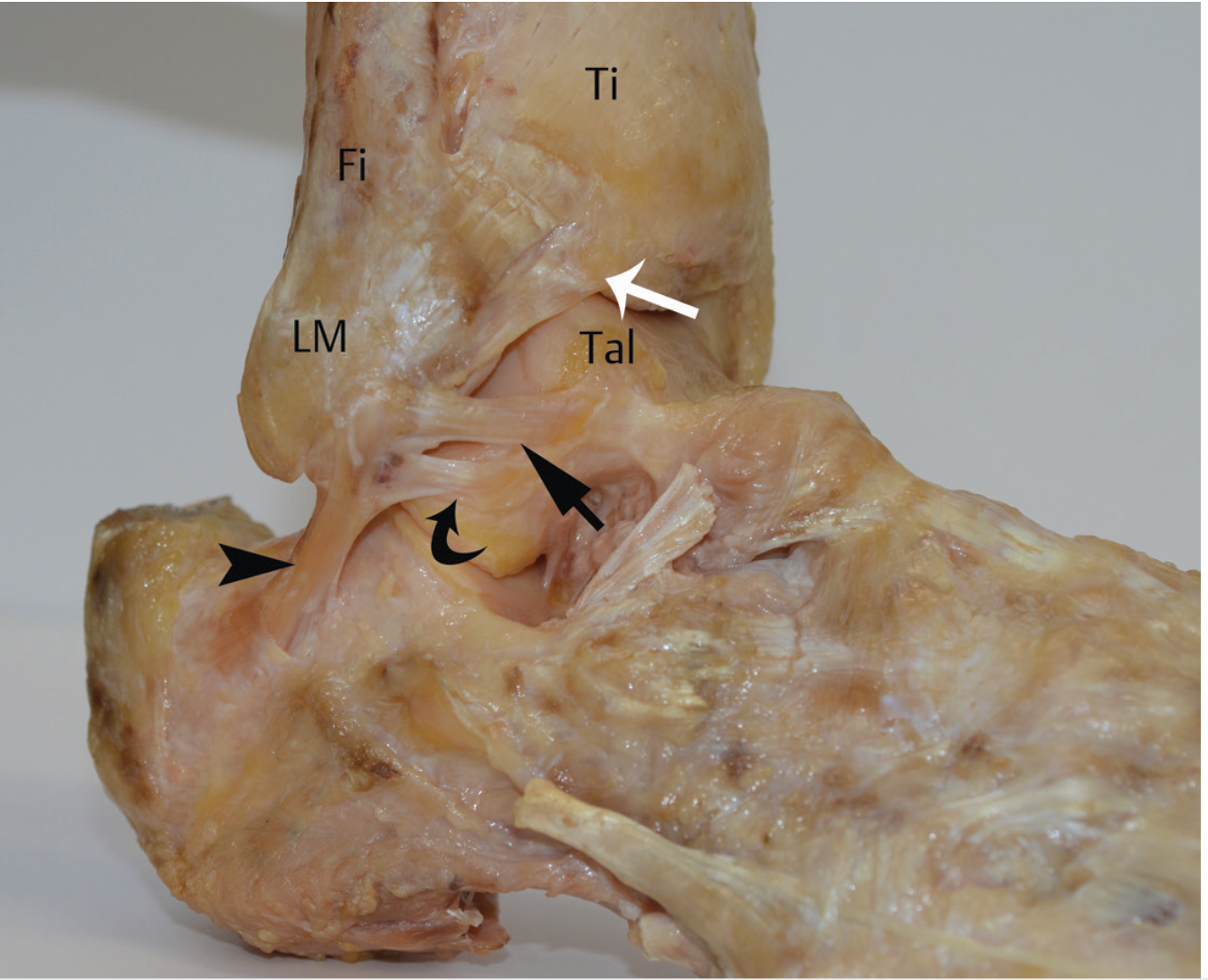
Anterolateral ankle dissection: The ATFL runs from the lateral malleolus (LM) to the talus (Tal). This is the ligament affected in this scan. Ti = tibia, Fi = fibula. - Imaging Anatomy: Bones, Joints, Vessels and Nerves
The ATFL is the most fragile of the three lateral collateral ligaments and the most commonly damaged in ankle sprains. It is particularly vulnerable to injury during inversion combined with plantar flexion (rolling the ankle inward and downward). - Imaging Anatomy, Vol. 3
Grading Context (What the Report Doesn't Explicitly State)
The radiologist says "possibly sprain" without grading, which is common. Based on the MRI description:
| Grade | MRI Appearance | What Was Seen Here |
|---|---|---|
| Grade I | Intrasubstance signal change, intact ligament fibres | Likely - signal change present, no complete tear described |
| Grade II | Partial tear, thickening, surrounding oedema | Possible - intrasubstance change with effusion |
| Grade III | Complete disruption, fibres not visible | NOT reported here |
What Should Happen Next
The radiologist appropriately advises: "Please correlate clinically and with other investigations."
This means:
- The MRI finding of a sprain should be matched against your symptoms (lateral ankle pain, swelling, tenderness over the lateral malleolus, mechanism of injury)
- If you had a mechanism of sudden inversion/rolling of the ankle with pain, swelling, and difficulty weight-bearing, this MRI finding fits perfectly
- Treatment for a Grade I-II ATFL sprain typically includes: RICE (Rest, Ice, Compression, Elevation), NSAIDs for pain/swelling, physiotherapy for strengthening and proprioception, and gradual return to activity
- A follow-up with an orthopaedic surgeon or sports medicine physician is advisable, especially if symptoms are significant or you are an athlete
Bottom line: This MRI shows a sprained lateral ankle ligament (ATFL) - an internal bruise/micro-tear of the ligament with mild joint fluid accumulation. No broken bones, no tendon tears, and no complete ligament rupture. This is consistent with a common ankle sprain and is generally treated conservatively.
This interpretation is for educational purposes. Please follow up with your treating physician for clinical correlation and management.
This is a shared conversation. Sign in to Orris to start your own chat.