
My 25 day old baby has very small bumps on her face, what are they and how can they be treated
small bumps newborn baby face 25 days milia neonatal acne treatment
Small Bumps on Your Newborn's Face
1. Milia (tiny white/yellowish pinpoint bumps)
- Textbook of Family Medicine 9e
2. Neonatal Acne / Neonatal Cephalic Pustulosis (small red/white pimples)
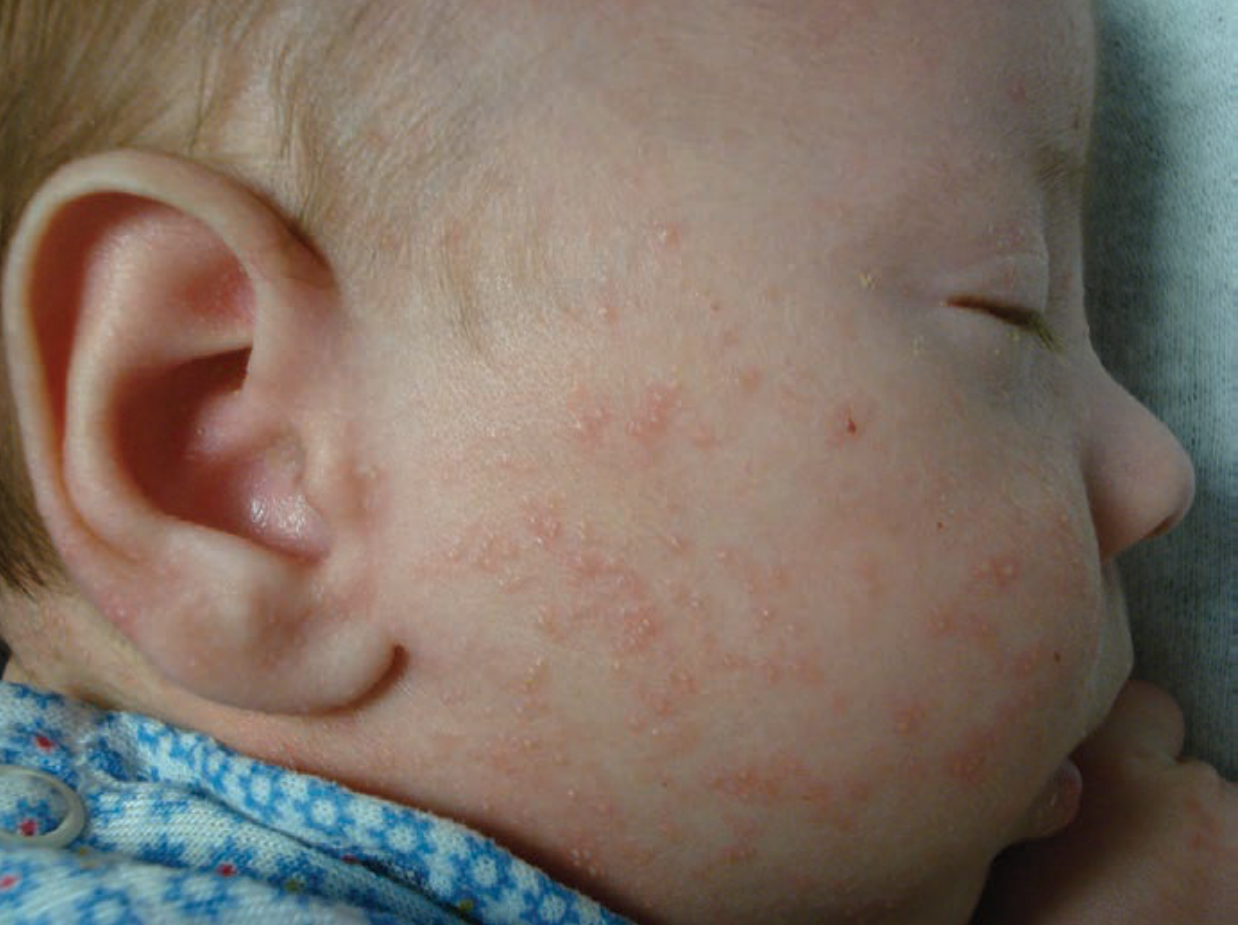
- Fitzpatrick's Dermatology, 8th ed.
- Textbook of Family Medicine 9e
Other possibilities (less likely but worth knowing)
| Condition | Appearance | Key feature |
|---|---|---|
| Erythema toxicum neonatorum | Red blotches with central yellow/white pimples | Appears within days of birth, resolves in 2 weeks |
| Miliaria (heat rash) | Tiny red or clear bumps from sweat | Worsens in heat/humid conditions |
| Sebaceous hyperplasia | Tiny yellowish bumps on nose/cheeks | Due to maternal hormone stimulation |
What to do (and not do)
| DO | DON'T |
|---|---|
| Gently wash your baby's face daily with warm water | Pop, squeeze, or pick at the bumps |
| Pat dry softly | Apply adult creams, acne products, or oily lotions |
| Keep her cool if heat rash is suspected | Use exfoliating or scented products on her skin |
| Just wait - they will go away on their own | Panic - this is completely normal |
When to see a doctor
- The bumps spread extensively beyond the face (to trunk, limbs)
- She develops a fever
- The bumps become crusty, oozing, or smell infected
- She seems unwell or irritable
- The bumps do not improve at all by 3 months of age
A newborn has jaundice after 24 hr should I be worried
jaundice newborn within 24 hours pathological causes treatment guidelines
Jaundice in a Newborn Within the First 24 Hours - Yes, This Needs Urgent Attention
Why the first 24 hours matter so much
- ROSEN's Emergency Medicine
- Quick Compendium of Clinical Pathology
What causes jaundice in the first 24 hours?
| Cause | Details |
|---|---|
| Blood group incompatibility (ABO/Rh) | Most common serious cause - mother's antibodies destroy baby's red blood cells (Hemolytic Disease of the Fetus & Newborn - HDFN) |
| G6PD deficiency | A genetic enzyme defect that causes rapid red blood cell breakdown |
| Sepsis (infection) | A newborn infection can cause rapid bilirubin rise |
| TORCH infections | Infections acquired in the womb (toxoplasmosis, rubella, CMV, herpes, syphilis) |
| Hereditary spherocytosis | A genetic red blood cell shape defect |
| Cephalhematoma | A large bruise from delivery causing excess red blood cell breakdown |
What brain damage (kernicterus) looks like - warning signs
- Poor feeding / extreme sleepiness
- High-pitched or unusual cry
- Limpness or unusual stiffness
- Backward arching of the neck or back (opisthotonos)
- Fever
- Seizures
What the doctor will do
- Total and fractionated serum bilirubin (to measure how high and what type)
- Full blood count + peripheral smear (to check for hemolysis/destruction of red blood cells)
- Blood group typing + Coombs/DAT test (to check for blood group incompatibility between mother and baby)
- Blood culture and sepsis workup if infection suspected
- Phototherapy (blue light) - the main treatment; converts bilirubin in the skin into a form the body can excrete
- Frequent feeding - breast or bottle feeding should be encouraged as it helps clear bilirubin through the gut
- Exchange transfusion - reserved for very high or rapidly rising bilirubin levels that do not respond to phototherapy, or when there are signs of brain injury
- Intravenous immunoglobulin (IVIG) - used when blood group incompatibility is the cause
Quick summary
| Type | Timing | Concern level |
|---|---|---|
| Pathological (this case) | Within first 24 hrs | HIGH - see a doctor urgently |
| Physiological | Days 2-5 (peaks day 4-5) | Usually benign, monitor |
| Breast milk jaundice | Peaks days 10-21, can last weeks | Usually benign, monitor |
| Prolonged jaundice | >2-3 weeks | Must be investigated |

Here's usg report after 25 days of discovery, last time stone was 7.5mm, that day i had c-section also
gallstones after C-section postpartum management bulky pancreatic tail USG significance
Your USG Whole Abdomen Report - Explained
Finding 1: Gallstones - The Main Issue
- Estrogen increases cholesterol secretion into bile
- Pregnancy causes gallbladder sluggishness (reduced motility)
- Rapid weight shifts after delivery also contribute
| Situation | Recommendation |
|---|---|
| You have biliary symptoms (right upper belly pain, pain after fatty meals, nausea, vomiting) | Needs elective laparoscopic cholecystectomy (gallbladder removal) - the gold standard treatment |
| Stones found incidentally with no symptoms | Can be monitored, but watch for symptoms |
| Diabetic patients with symptomatic stones | Should have surgery promptly |
Finding 2: Bulky-Looking Pancreatic Tail - Watch This
- The main pancreatic duct is not dilated (dilation would suggest a blockage or chronic pancreatitis)
- There is no fluid collection around the pancreas (which would indicate acute pancreatitis)
- Blood tests: serum lipase and amylase - to check if there is any pancreatic inflammation
- Follow-up with your doctor - if you have any upper abdominal pain radiating to the back, nausea, or fever, seek care urgently
- Possibly a repeat ultrasound or CT scan if your doctor suspects early pancreatitis
Finding 3: Enlarged Uterus - Expected After C-Section
Finding 4: Everything Else - All Normal
| Organ | Result | Meaning |
|---|---|---|
| Liver | 12.4cm, normal texture, no lesions | Normal |
| Portal vein | Normal diameter | Normal |
| Spleen | Normal bipolar diameter | Normal |
| Both kidneys | 9.7cm and 10.5cm, no stones, no hydronephrosis | Normal |
| Urinary bladder | Normal, no mass | Normal |
| Lymph nodes | No significant nodes | Normal |
| Ascites/effusion | None | Normal - no fluid accumulation |
Summary - What to Do Now
- See your doctor soon (within days) - specifically about the gallstones AND the bulky pancreatic tail together
- Get blood tests: serum lipase, amylase, liver function tests (LFTs), CBC
- Avoid fatty, fried, and heavy meals until you are seen - this is the single most important thing to prevent a painful gallstone attack or pancreatitis
- Go to emergency immediately if you develop: severe right upper or upper-middle belly pain, pain radiating to the back, fever, vomiting, or yellowing of your eyes/skin
- The uterine finding needs no special action - it is normal post-C-section recovery

This was the last report at the time of detection
Side-by-Side Comparison: Then vs. Now
| Report 1 (25 May 2026) | Report 2 (25 days later - June 2026) | |
|---|---|---|
| Context | During pregnancy, pre-C-section | 25 days post C-section |
| Gallstones | Multiple calculi, largest 7.5mm | Multiple calculi, largest 6.1mm |
| GB wall | Normal thickness | Normal thickness |
| CBD | Normal calibre | Normal calibre |
| Pancreas | Normal | Mildly bulky tail (MPD not dilated, no fluid) |
| Pleural effusion | Minimal right-sided present | Not mentioned (resolved) |
| Uterus | Viable intrauterine pregnancy, normal fetal movement | Enlarged (9.1 x 3.1 cm) - postpartum involution |
| Kidneys | Normal, no stones | Normal, no stones |
| Liver | Normal | Normal |
What Has Changed and What It Means
1. Gallstones: Slightly Smaller but Still There
- Measurement variability between operators/machines
- Possible fragmentation of the larger stone into smaller ones (hence "multiple" still noted)
2. The New Pancreas Finding - The Most Important Change
- Gallstones sitting in or near the gallbladder can occasionally migrate into the bile duct and temporarily block it, irritating the pancreas
- Even without obvious pancreatitis findings (no fluid, no duct dilation - both reassuring), a bulky pancreatic tail is a signal to check blood enzyme levels now
3. Pleural Effusion: Resolved (Good News)
4. Uterus: Normal Post-C-Section Changes
Overall Picture and What You Should Do
Immediate steps (this week):
-
Blood tests: Serum lipase, amylase, full liver function tests (ALT, AST, ALP, bilirubin), CBC. Your original referring doctor Dr. Anwar Nezam (MS Gen. Surgery) is the right person to follow up with.
-
Diet strictly: No fried food, no fatty food, no large meals, no spicy food. Eat small, frequent, low-fat meals. This is non-negotiable until the gallbladder is dealt with.
-
Watch for danger signs - go to emergency immediately if:
- Severe pain in the right upper abdomen or centre of the abdomen
- Pain radiating to your back or right shoulder
- Fever with chills
- Yellowing of eyes or skin (jaundice)
- Persistent vomiting
Medium-term plan (discuss with your surgeon):
- Laparoscopic cholecystectomy (keyhole gallbladder removal) will be the definitive treatment. This is the gold standard and eliminates the problem permanently. Your surgeon will advise when you are sufficiently healed from the C-section (typically 6-12 weeks post-delivery, depending on recovery).
- Do not leave the gallstones untreated long-term - with multiple mobile stones, the risk of one migrating and causing a bile duct blockage or pancreatitis is real, especially in the postpartum period.
Can it be because of infection, because many guests have came and picked her up
newborn baby skin infection from visitors handling kissing neonatal risk
Can Guests Cause the Bumps on Your Baby's Face?
For Milia and Neonatal Acne - No
- Milia - caused by trapped keratin under undeveloped skin pores. Completely internal, no external cause.
- Neonatal acne - caused by maternal hormones the baby received in the womb, and a naturally occurring skin yeast (Malassezia) that is always present on human skin. Again, not caused by visitors.
However - Guests Can Cause Real Infections in Newborns
The most dangerous infection from kissing/touching: Herpes Simplex Virus (HSV)
- Skin vesicles (fluid-filled blisters) - especially on the face
- Eye infection leading to blindness
- Brain infection (encephalitis)
- Disseminated disease affecting the liver and lungs
- Death in severe cases
- Small fluid-filled blisters (vesicles) on the skin, face, or mouth
- Redness or discharge from the eyes
- Fever
- Unusual sleepiness or poor feeding
- Seizures
How to tell the bumps apart
| Appearance | Likely cause | Urgent? |
|---|---|---|
| Tiny white/pearly firm bumps, no redness | Milia | No - harmless |
| Small red pimples on cheeks/forehead | Neonatal acne | No - harmless |
| Fluid-filled blisters or vesicles, especially on face/mouth | HSV infection | Yes - see a doctor today |
| Yellow crusted sores, oozing | Impetigo (bacterial skin infection) | Yes - see a doctor |
| Red swollen area with warmth | Bacterial infection (cellulitis) | Yes - see a doctor |
| Widespread red rash with fever | Sepsis risk | Emergency |
Other infections visitors can pass to a newborn
| Infection | How transmitted | Risk to newborn |
|---|---|---|
| Herpes (HSV-1) | Kissing face/hands, touching mouth then touching baby | Potentially life-threatening |
| RSV (respiratory virus) | Coughing, sneezing, hands | Severe breathing difficulty |
| Whooping cough (pertussis) | Coughing near baby | Can be fatal in newborns |
| Flu (influenza) | Respiratory droplets | Severe illness |
| COVID-19 | Respiratory droplets | Serious in newborns |
| Bacterial skin infections | Unwashed hands | Impetigo, cellulitis |
What you should do going forward
- No kissing the baby's face, hands, or anywhere - this is the single most important rule
- All visitors must wash hands with soap and water before touching the baby
- Anyone with a cold sore, fever, cough, runny nose, or any illness should not hold the baby at all
- Limit the number of visitors, especially in the first 4-6 weeks
- Do not let strangers or people you don't know well hold the baby
- Any fluid-filled blisters or unusual new spots (different from the small flat bumps)
- Fever (temperature above 38°C / 100.4°F in a newborn = emergency)
- Unusual lethargy, poor feeding, or crying differently than normal
Tomato in gallbladder stone
tomatoes gallbladder stones safe to eat diet cholelithiasis
tomato seeds oxalate gallbladder stones trigger biliary colic evidence
Tomatoes and Gallbladder Stones
The Short Answer: Tomatoes Are Safe to Eat with Gallstones
Why the Myth Exists
- Gallbladder stones are made of cholesterol (mostly) or bilirubin/pigment - neither of which is linked to tomatoes or oxalates
- Even for kidney stones, 100g of tomatoes contains only ~5mg of oxalates - a very small amount
- Gallstones and kidney stones are completely different conditions with completely different causes
What Actually Triggers Gallbladder Pain
| Triggers (avoid these) | Why |
|---|---|
| Fatty foods - fried food, butter, ghee, cream, full-fat dairy | Fat is the strongest signal for the gallbladder to contract |
| Large meals | Big meals cause strong gallbladder contractions |
| Very spicy food | Can irritate and stimulate gallbladder activity |
| Refined carbs - white bread, sweets, sugary drinks | Increase cholesterol in bile over time |
| Red and processed meat | High in saturated fat |
What to Eat Freely (Good for Gallbladder)
| Foods safe and beneficial | Why |
|---|---|
| Tomatoes | Low fat, high in vitamin C and fibre - good for gallbladder |
| All vegetables and fruits | High fibre, reduce cholesterol in bile |
| Whole grains | Reduce stone formation risk |
| Lean protein - chicken, fish, lentils, dal | Low fat, doesn't stress the gallbladder |
| Low-fat dairy | Better than full-fat alternatives |
Practical Advice for Tanya (Post C-section, multiple gallstones)
- You can eat tomatoes - raw, cooked, in dal, curry (but cook in minimal oil)
- The problem is not what vegetable you add - it is how much oil/ghee/butter you cook with
- A tomato sabzi cooked in 2 tablespoons of ghee is a problem. The same sabzi in half a teaspoon of oil is fine.
What foods and cooking methods should I avoid with gallstones?
gallstones diet foods avoid cooking methods biliary colic prevention evidence based
https://www.wsh.nhs.uk/CMS-Documents/Patient-leaflets/Nutrit…
Complete Gallstone Diet Guide
Why Diet Matters
Foods to AVOID
Fats and Oils - The Most Important Category
| Avoid completely | Why |
|---|---|
| Ghee | Pure saturated fat - strong gallbladder contraction trigger |
| Butter | Same as ghee |
| Dalda / vanaspati / hydrogenated oil | Trans fats - directly increase cholesterol stone formation |
| Coconut oil | High in saturated fat |
| Cream, malai | High fat dairy |
| Fried anything - pakoras, puri, bhatura, samosa, chips | Deep frying multiplies fat content dramatically |
Important: Even "healthy" oils like olive oil and sunflower oil can still trigger pain if used in large amounts. Keep total oil/fat per meal to a minimum - no more than 1 teaspoon per serving.
Dairy Products to Avoid
| Avoid | Choose instead |
|---|---|
| Full-fat milk (whole milk) | Skimmed or toned milk (1.5% fat) |
| Paneer (regular) | Small amount of low-fat paneer only |
| Full-fat curd / dahi | Low-fat curd |
| Khoya / mawa | Avoid |
| Ice cream, milkshakes | Avoid |
| Cream-based sweets - rasmalai, rabri, halwa | Avoid |
| Cheese (processed or full fat) | Avoid |
Meats
| Avoid | Choose instead |
|---|---|
| Mutton, lamb, pork | Skinless chicken (boiled/grilled) |
| Red meat curries cooked in oil/ghee | Fish (steamed, grilled, minimal oil) |
| Sausages, processed meat | Lentils, dal, legumes |
| Egg yolk in large amounts | Egg white is fine |
Other Foods to Avoid
| Food | Reason |
|---|---|
| Maida / refined flour - white bread, naan, paratha | Refined carbs increase cholesterol in bile |
| Sugary foods and sweets - mithai, chocolates, biscuits | Sugar promotes cholesterol stone formation |
| Full-fat coconut milk (used in South Indian/coastal curries) | Very high saturated fat |
| Very spicy food | Can irritate and over-stimulate the gallbladder |
| Alcohol | Stresses both gallbladder and pancreas (especially relevant given your bulky pancreatic tail) |
| Carbonated drinks | Gas and bloating worsen discomfort |
| Caffeine in excess (strong chai, coffee) | Can stimulate gallbladder motility |
Cooking Methods - This Is Just as Important as What You Eat
| AVOID these methods | USE these methods instead |
|---|---|
| Deep frying (talna) - puri, bhatura, pakora, fries | Boiling (ubalna) |
| Shallow frying in lots of oil | Steaming |
| Tadka with large amounts of ghee | Grilling / roasting |
| Pressure cooking in oil-heavy masala bases | Baking |
| Adding cream or butter at the end | Dry roasting spices then adding water-based gravy |
| Air frying (uses minimal oil) |
Practical Indian Kitchen Tips:
- Tadka: Use just ½ teaspoon of oil for tadka. Use mustard seeds, cumin, curry leaves - these are fine. Avoid big dollops of ghee.
- Roti: Eat without ghee. Dry roti is perfectly fine.
- Dal: Cook with minimal oil tadka. Dal itself is excellent - full of fibre and low fat.
- Sabzi: Cook with 1 tsp oil maximum. Add water instead of oil to prevent sticking.
- Rice: Plain rice is fine. Avoid biryani cooked in lots of ghee/oil.
- Paratha: Avoid if made with ghee/oil. A plain dry roti is better.
What You CAN Eat Freely
| Food | Notes |
|---|---|
| All vegetables | Cooked with minimal oil |
| All fruits | Tomatoes, papaya, guava, apple, banana - all safe |
| Lentils and dal | Excellent - high fibre, low fat |
| Plain rice | Fine in moderate amounts |
| Roti (dry, no ghee) | Fine |
| Oats, daliya (broken wheat) | Excellent for gallbladder health |
| Skimmed/toned milk | Fine |
| Low-fat curd | Fine |
| Skinless chicken (boiled/grilled) | Fine |
| Fish (grilled/steamed) | Good - omega-3 fats are actually protective |
| Nuts (small amounts) | Evidence shows nuts may reduce gallstone risk |
Meal Pattern Rules - As Important as Food Choice
- Never skip meals - skipping meals causes the gallbladder to stagnate and concentrate bile, which worsens stones
- Eat small, frequent meals - 4-5 small meals rather than 2-3 large ones
- Never overeat at one sitting - a large caloric load is the most likely trigger for an attack
- Eat slowly and chew well
- Drink 8-10 glasses of water daily - keeps bile dilute