
Explain translation
Translation is the process by which the genetic code in mRNA is decoded by ribosomes to build a protein. Here is a quick summary:
- Initiation - The ribosome assembles around the start codon (AUG) on the mRNA.
- Elongation - tRNA molecules bring amino acids; peptide bonds form sequentially.
- Termination - A stop codon signals release of the finished polypeptide.
Searching sources...
Reading File
The query is broad - "translation" could mean biological protein synthesis, language translation, or mathematical translation (geometry). Let me check before diving deep.
Asking for Preferences
What context are you asking about translation in?
Finding Sources
Searching the Web
translation protein synthesis mRNA ribosome steps biology
Reading File
Finding Sources
Good sources found. Let me read the most detailed textbook sections - Lippincott Biochemistry and the Tietz/Thompson genetics sections in parallel.
Reading File
Reading File
Reading File
Excellent - I now have rich content. Let me also read the elongation/termination details from Lippincott and fetch the key diagram.
Reading File
Loading Image
I now have everything needed for a thorough answer. Let me also read the elongation section from Lippincott.
Reading File
I now have comprehensive content. Here is the full explanation of translation:
Translation (Protein Synthesis)
Translation is the process by which the nucleotide sequence of an mRNA is decoded by the ribosomal machinery to produce a specific sequence of amino acids - a polypeptide. It is the second step of gene expression, following transcription. - Biochemistry, Lippincott Illustrated Reviews, 8th ed.
Overview: The Central Dogma
DNA → (transcription) → mRNA → (translation) → Protein
After transcription and post-transcriptional processing (capping, poly-A tail addition, intron splicing), the mature mRNA travels from the nucleus to the cytoplasm, where ribosomes read its sequence and build the protein. - Histology: A Text and Atlas, 9th ed.
Key Molecular Players
1. mRNA and the Genetic Code
The mRNA carries the genetic message as a series of codons - triplets of three nucleotides. There are 4³ = 64 possible codons, encoding:
- 20 amino acids
- 3 stop codons: UAA, UAG, UGA
- 1 universal start codon: AUG (codes for methionine)
The code is degenerate - most amino acids are specified by more than one codon. Leucine and arginine each have 6 codons; only methionine and tryptophan have a single codon. - Thompson & Thompson Genetics and Genomics in Medicine, 9th ed.
The Complete Genetic Code:
| First Base | U | C | A | G |
|---|---|---|---|---|
| U | Phe, Phe, Leu, Leu | Ser, Ser, Ser, Ser | Tyr, Tyr, Stop, Stop | Cys, Cys, Stop, Trp |
| C | Leu, Leu, Leu, Leu | Pro, Pro, Pro, Pro | His, His, Gln, Gln | Arg, Arg, Arg, Arg |
| A | Ile, Ile, Ile, Met | Thr, Thr, Thr, Thr | Asn, Asn, Lys, Lys | Ser, Ser, Arg, Arg |
| G | Val, Val, Val, Val | Ala, Ala, Ala, Ala | Asp, Asp, Glu, Glu | Gly, Gly, Gly, Gly |
(Third base varies within each cell; Stop = UAA/UAG/UGA)
2. Transfer RNA (tRNA)
tRNA molecules are the adaptors that bridge the codon-amino acid relationship:
-
Each is 70-100 nucleotides long, folded into a cloverleaf structure
-
The 3' end carries a specific amino acid (attached by aminoacyl-tRNA synthetase) - a charged tRNA
-
The anticodon loop contains three bases that base-pair with the complementary mRNA codon
-
At least 50 tRNA species exist in humans; since some amino acids have multiple codons, one tRNA can recognize more than one codon via the wobble hypothesis (flexible pairing at the third/wobble position)
-
Biochemistry, Lippincott Illustrated Reviews, 8th ed.
3. Ribosomes
Ribosomes are macromolecular machines composed of ribosomal RNA (rRNA) and proteins:
| Feature | Prokaryotic | Eukaryotic |
|---|---|---|
| Size | 70S | 80S |
| Small subunit | 30S | 40S |
| Large subunit | 50S | 60S |
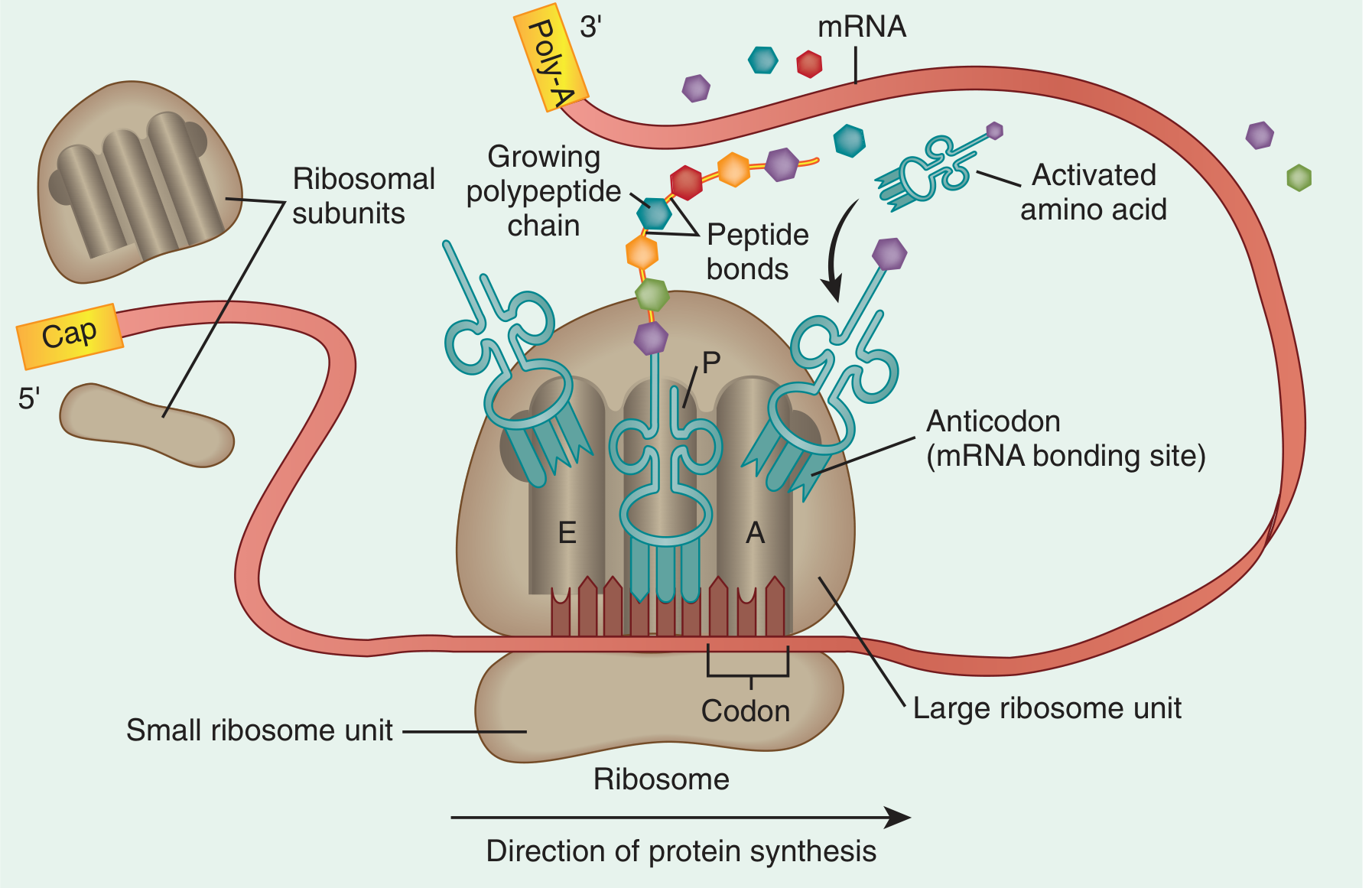
The ribosome has three tRNA-binding sites:
- A site (Aminoacyl) - accepts incoming charged tRNA
- P site (Peptidyl) - holds the tRNA linked to the growing polypeptide chain
- E site (Exit) - holds the outgoing uncharged (empty) tRNA before it leaves
The small subunit ensures accurate codon-anticodon pairing; the large subunit catalyzes peptide bond formation. - Tietz Textbook of Laboratory Medicine, 7th ed.
The Three Stages of Translation
Stage 1 - Initiation
The goal is to assemble the ribosome around the start codon on mRNA.
In eukaryotes:
- Initiation factor eIF-4E binds the 5' methylguanosine cap of the mRNA
- Poly(A)-binding protein (PABP) binds the 3' poly-A tail
- eIF-4G bridges eIF-4E and PABP, circularizing the mRNA
- The pre-initiation complex forms: 40S small subunit + eIF-2 + Met-tRNA
- This complex scans the mRNA 5'→3' until it finds the AUG start codon
- The 60S large subunit joins, forming the complete 80S initiation complex
- Translation elongation begins
- Tietz Textbook of Laboratory Medicine, 7th ed.
In prokaryotes, the 30S subunit binds directly at the Shine-Dalgarno sequence (a purine-rich region ~10 bases upstream of AUG), placing AUG in the P site directly.
Stage 2 - Elongation
Amino acids are added one at a time, reading the mRNA 5'→3'. Each cycle has three steps:
-
Aminoacyl-tRNA binding (A site entry)
- A charged tRNA with the matching anticodon enters the A site (assisted by elongation factor EF-Tu·GTP in prokaryotes; eEF-1·GTP in eukaryotes)
- GTP hydrolysis confirms correct codon-anticodon pairing
-
Transpeptidation (Peptide bond formation)
- The peptidyl transferase activity of the large subunit rRNA (a ribozyme) transfers the growing peptide chain from the P-site tRNA to the amino acid on the A-site tRNA
- A new peptide bond forms; the chain grows by one amino acid
-
Translocation
- The ribosome moves exactly 3 nucleotides (one codon) in the 5'→3' direction (powered by EF-G·GTP in prokaryotes; eEF-2·GTP in eukaryotes)
- The tRNA in A site shifts to P site; the now-empty P-site tRNA moves to E site and exits
- The A site is free for the next aminoacyl-tRNA
This cycle repeats for every codon, building the polypeptide from the N-terminus to the C-terminus.
- Biochemistry, Lippincott Illustrated Reviews, 8th ed.
Stage 3 - Termination
When a stop codon (UAA, UAG, or UGA) enters the A site:
-
No tRNA matches a stop codon
-
Release factors (RF-1/RF-2 in prokaryotes; single eRF in eukaryotes) recognize the stop codon
-
Release factors trigger hydrolysis of the bond between the peptide and the P-site tRNA
-
The completed polypeptide is released
-
The ribosomal subunits, mRNA, and tRNA dissociate and are recycled
-
Biochemistry, Lippincott Illustrated Reviews, 8th ed.
After Translation - Post-Translational Events
Once released, the polypeptide undergoes further processing:
- Protein folding - spontaneous or chaperone-assisted, into native 3D conformation
- Cleavage of the N-terminal signal peptide (for secreted/membrane proteins)
- Phosphorylation (serine, threonine, tyrosine) - regulates activity
- Glycosylation - on asparagine, serine, threonine residues (secreted/membrane proteins)
- Disulfide bond formation (via cysteine cross-linking)
- Acetylation of the N-terminus (prevents degradation)
These modifications mean the proteome (total protein diversity) far exceeds the number of genes - estimated 250,000 to several million distinct protein forms in human cells. - Tietz Textbook of Laboratory Medicine, 7th ed.
Efficiency: Polysomes
A single mRNA is not translated by just one ribosome. Multiple ribosomes can bind the same mRNA simultaneously (spaced ~80 nucleotides apart), forming a polyribosome (polysome). This maximises the number of protein copies produced from a single mRNA molecule. - Histology: A Text and Atlas, 9th ed.
Antibiotics That Inhibit Translation
The structural difference between prokaryotic (70S) and eukaryotic (80S) ribosomes is clinically exploited:
| Antibiotic | Target | Mechanism |
|---|---|---|
| Aminoglycosides (streptomycin) | 30S | Misreading of mRNA codons |
| Tetracyclines | 30S | Block aminoacyl-tRNA entry to A site |
| Macrolides (erythromycin) | 50S | Block translocation |
| Lincosamides (clindamycin) | 50S | Block peptidyl transferase |
| Chloramphenicol | 50S | Inhibits peptidyl transferase |
- Histology: A Text and Atlas, 9th ed.; Biochemistry, Lippincott Illustrated Reviews, 8th ed.
Summary Flowchart
mRNA (5' cap → AUG → codons → UAA/UAG/UGA → poly-A tail 3')
         ↓
    Ribosome assembles at AUG (Initiation)
         ↓
    tRNA delivers amino acids, peptide bonds form (Elongation)
         ↓
    Stop codon → release factor → polypeptide released (Termination)
         ↓
    Post-translational modifications → Functional protein
This is a shared conversation. Sign in to Orris to start your own chat.