
Hymenolpsis nana
Reading File
Finding Sources
Finding Sources
Good results from multiple textbooks. Let me read the most comprehensive sources in parallel.
Reading File
Reading File
Reading File
Reading File
Now let me fetch the life cycle diagram and egg image, and also get the treatment info from Harrison's:
Loading Image
Reading File
I now have comprehensive information from multiple authoritative sources. Here is a complete summary:
Hymenolepis nana (Dwarf Tapeworm)
Nomenclature note: Recent molecular data have reclassified this organism to Rodentolepis nana (previously Hymenolepis nana) — Harrison's Principles of Internal Medicine 22E uses this new name, though H. nana remains widely used in clinical literature.
Classification
- Class: Cestoda (tapeworm)
- Common name: Dwarf tapeworm
- Unique distinction: The only human cestode that does not require an intermediate host to complete its life cycle
Morphology
| Feature | Detail |
|---|---|
| Adult length | 2–4 cm (some sources up to 40 mm) — "dwarf" compared to Taenia (several metres) |
| Scolex | 4 muscular suckers + crown of hooklets (rostellum) |
| Eggs | Oval, 30–47 µm, thin smooth outer shell; inner membrane with 4–8 polar filaments extending from two poles; contain a 6-hooked oncosphere (hexacanth embryo) |
Life Cycle
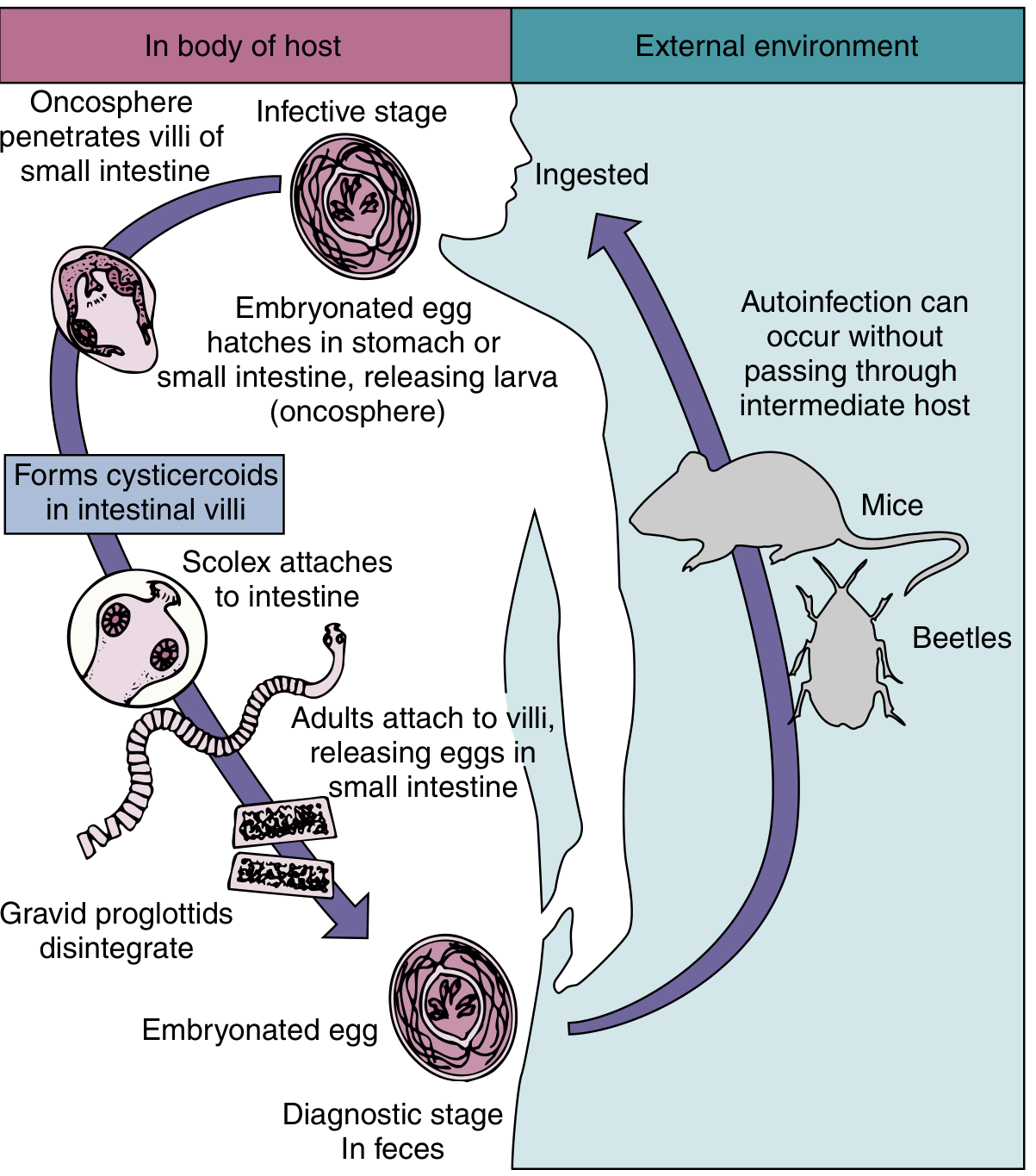
Life cycle of H. nana (dwarf tapeworm) — Medical Microbiology 9e
Three routes of infection:
- Direct (fecal-oral, no intermediate host) — Embryonated eggs ingested → oncosphere released → penetrates intestinal villi → develops into cysticercoid larva → re-enters intestinal lumen → scolex attaches to small intestinal mucosa → matures into adult in 10–12 days → gravid proglottids disintegrate in situ, releasing eggs into feces
- Via arthropod intermediate host — Accidental ingestion of infected beetles (contaminating grain/flour) containing cysticercoids
- Autoinfection (internal) — Eggs hatch within the intestinal lumen without leaving the host → new cysticercoids form → leads to hyperinfection with very heavy worm burdens
- Adult worm lifespan: ~4–10 weeks; infection perpetuated by repeated autoinfection cycles
Reservoir hosts: Mice (also beetles as intermediate hosts)
Epidemiology
- Most prevalent tapeworm infection worldwide: estimated 50–75 million cases globally
- Distribution: worldwide, including temperate and tropical regions
- Most common tapeworm infection in North America
- Highest risk: children, institutionalized patients, immunocompromised hosts
- Transmission: primarily person-to-person fecal-oral route; also via contaminated grain/flour containing infected beetles
- Capable of person-to-person spread (unlike most cestodes)
Clinical Features
| Worm burden | Symptoms |
|---|---|
| Light infection | Asymptomatic (most common) |
| Heavy infection / hyperinfection | Diarrhea, abdominal pain, anorexia, headache, weight loss, malabsorption |
Heavy infection is particularly seen in children harboring hundreds or thousands of worms, and in immunocompromised patients where autoinfection is less controlled.
Diagnosis
- Stool microscopy: Detection of characteristic eggs in wet mount of concentrated stool — oval, 30–47 µm, with polar filaments and a 6-hooked oncosphere inside
- More than one specimen may be required
- Culture, serology, antigen detection, and PCR are not routinely used
- Adult worms occasionally found during colonoscopy
Treatment
| Drug | Dose | Notes |
|---|---|---|
| Praziquantel (drug of choice) | 25 mg/kg once | Active against both adult worms and cysticercoids in the intestinal wall |
| Nitazoxanide (alternative) | 500 mg twice daily × 3 days | Alternative when praziquantel unavailable |
| Niclosamide | Standard dose | Alternative (older agent) |
Prevention & Control
- Hand hygiene (especially in households, schools, day-care centers)
- Improved sanitation
- Mass chemotherapy in epidemic settings
- Proper food storage to prevent beetle contamination of grain/flour
Sources: Medical Microbiology 9e | Harrison's Principles of Internal Medicine 22E | Goldman-Cecil Medicine | Tietz Textbook of Laboratory Medicine 7e
This is a shared conversation. Sign in to Orris to start your own chat.