


IMG_6367.jpeg
IMG_6366.jpeg
Diagnose
Reading File
The images show well-defined hypopigmented (depigmented) patches on the dorsal forearm/wrist — irregular, asymmetric, pale macules against darker surrounding skin. Let me search the medical library for the differential.
Finding Sources
Finding Sources
Searching the Web
vitiligo vs hypopigmentation differential diagnosis forearm patches clinical features
Reading File
Reading File
Searching Images
vitiligo depigmented patches forearm wrist
Loading Image
Reading File
Reading File
Reading File
Based on the images and textbook evidence, here is a thorough clinical analysis:
Clinical Findings (from the Images)
Both forearms show well-demarcated, irregular hypopigmented to depigmented macules/patches on the dorsal surface near the wrist. The patches have:
- Sharp, clearly defined borders
- Flat surface (no scaling, no crusting, no erythema)
- Distribution on dorsal forearm/wrist
- Surrounding skin appears normal in texture
- No signs of inflammation
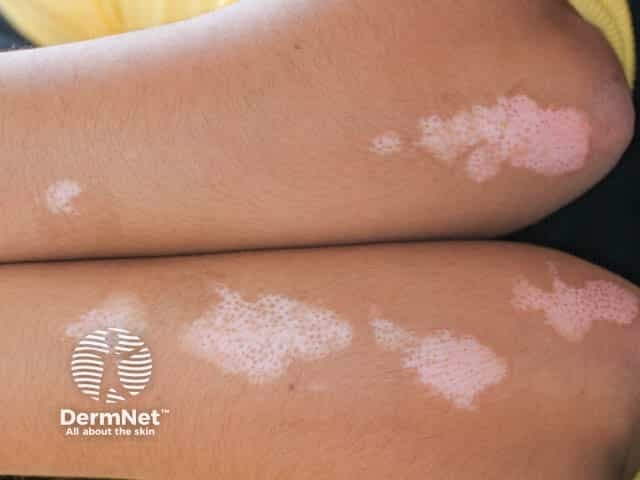
Most Likely Diagnosis: Vitiligo
Vitiligo is an acquired autoimmune disease characterized by T-cell-mediated destruction of melanocytes, resulting in complete depigmentation of discrete skin patches. The presentation here is classic.
Why Vitiligo Fits
| Feature | This Case |
|---|---|
| Well-defined depigmented patches | ✅ |
| Dorsal forearm/wrist location | ✅ (a commonly affected site) |
| No scaling or surface change | ✅ |
| Flat macules/patches | ✅ |
| Appears acquired (not congenital) | ✅ |
Fitzpatrick's Dermatology (8e) states: "The most commonly affected sites are the face, upper part of the chest, dorsal aspects of the hands, axillae, and groin... Lesions appear at areas of trauma, so vitiligo favors the elbows and knees." The dorsal forearm/wrist is one of the classic sites.
The pattern here is consistent with generalized (non-segmental) vitiligo, the most common subtype — bilateral, symmetric patches without dermatomal restriction.
Differential Diagnosis
| Condition | How to Distinguish |
|---|---|
| Pityriasis versicolor (tinea versicolor) | Has fine scaling; KOH prep shows "spaghetti and meatballs" fungal hyphae; hypopigmented (not fully depigmented); Wood lamp shows yellow-green fluorescence |
| Post-inflammatory hypopigmentation | History of prior inflammatory lesion (eczema, psoriasis, burn); hypopigmented, not depigmented; Wood lamp does not enhance |
| Pityriasis alba | Faint, poorly defined borders; fine scale; usually in children; cheeks most common |
| Nevus depigmentosus | Usually congenital; stable; irregular jagged ("coast-of-Maine") borders; single lesion |
| Ash-leaf macules (tuberous sclerosis) | Hypopigmented (not fully depigmented); associated with seizures, CNS features |
| Chemical leukoderma | History of phenol/chemical exposure; otherwise identical to vitiligo |
Key differentiating tool: Wood lamp (UV-A light) — vitiligo patches enhance/fluoresce bright white (chalk-white) under Wood lamp because the depigmentation is complete; hypopigmented conditions do not enhance.
Pathogenesis
Vitiligo results from a self-amplifying cycle:
- Metabolically stressed melanocytes produce reactive oxygen species and activate the unfolded protein response
- Danger signals recruit innate immune cells
- CD8+ T cells are activated and infiltrate the epidermis
- CD8+ T cells target and destroy melanocytes → clinically visible depigmentation
(Fitzpatrick's Dermatology, Chapter 76)
Associated Conditions to Screen For
Vitiligo correlates with increased risk of other autoimmune diseases. Ask about / consider screening for:
- Thyroid disease (Hashimoto's thyroiditis, Graves' disease) — most common association
- Type 1 diabetes mellitus
- Alopecia areata
- Addison's disease (adrenal insufficiency)
- Pernicious anemia
Management Overview
| Category | Options |
|---|---|
| Topical | Corticosteroids, tacrolimus/pimecrolimus (calcineurin inhibitors), ruxolitinib cream (JAK inhibitor — first FDA-approved targeted therapy for vitiligo) |
| Phototherapy | Narrowband UVB (NB-UVB) — first-line for widespread disease |
| Systemic | Oral mini-pulse corticosteroids (for rapidly progressing disease) |
| Surgical | Melanocyte transplantation (for stable, limited disease) |
| Camouflage | Cosmetic cover-up products |
Important: Response to treatment is better in areas with pigmented hair follicles, as these serve as melanocyte reservoirs for repigmentation. Lesions with white hairs (poliosis) have a poorer prognosis for repigmentation.
Recommendation: Confirm with Wood lamp examination and refer to dermatology. Screen for associated thyroid autoimmunity (TSH, anti-TPO antibodies).
— Fitzpatrick's Dermatology, 8e, Chapter 76 (Vitiligo); Andrews' Diseases of the Skin, Chapter 36
This is a shared conversation. Sign in to Orris to start your own chat.