
A 50 year female patient has come at my clinic with complaint Ghabarat sweating, loss of appetite alp increase h/o Hypothyroidism tsh 125, 325 cholestrol no h/o diabetes
Clinical Assessment - 50-Year-Old Female
Presenting Complaints (Decoded)
- Ghabarat (Urdu/Hindi) = palpitations / restlessness / anxiety-like sensation
- Sweating (hyperhidrosis)
- Loss of appetite (anorexia)
- ALP raised (elevated alkaline phosphatase)
- Known hypothyroid, TSH = 125 mIU/L - severely elevated, undertreated
- Cholesterol = 325 mg/dL - markedly elevated
- No diabetes
Primary Diagnosis
| Symptom | Hypothyroid Mechanism |
|---|---|
| Loss of appetite / anorexia | Common in hypothyroidism - "weight gain despite poor appetite" is classic |
| Cholesterol 325 mg/dL | Thyroid hormone (T3) upregulates LDL receptors; hypothyroidism reverses this - a direct, linear relationship exists between TSH and total cholesterol, LDL, and triglycerides |
| Raised ALP | Hypothyroidism is a known cause of low ALP (via reduced bone turnover), BUT if ALP is elevated here, consider obstructive liver involvement, associated autoimmune hepatitis, or non-alcoholic fatty liver (MASLD) - which is associated with hypothyroid-driven metabolic dysfunction |
| Ghabarat / palpitations | Paradoxically seen in poorly controlled hypothyroid due to adrenergic hypersensitivity, or could represent associated anxiety / autonomic dysregulation |
| Sweating | Can occur in hypothyroidism due to autonomic dysfunction; also rule out perimenopause (age 50) |
"Other abnormal laboratory findings in hypothyroidism may include increased creatine phosphokinase, elevated cholesterol and triglycerides, and anemia... depending upon the degree and duration of hypothyroidism." - Harrison's Principles of Internal Medicine, 22E
"Thyroid dysfunction is well established as a modifiable factor in dyslipidemia, with a direct, linear relationship observed between increasing TSH levels and total cholesterol, LDL-C, and triglycerides." - Fitzpatrick's Dermatology
Diagnostic Evaluation Algorithm
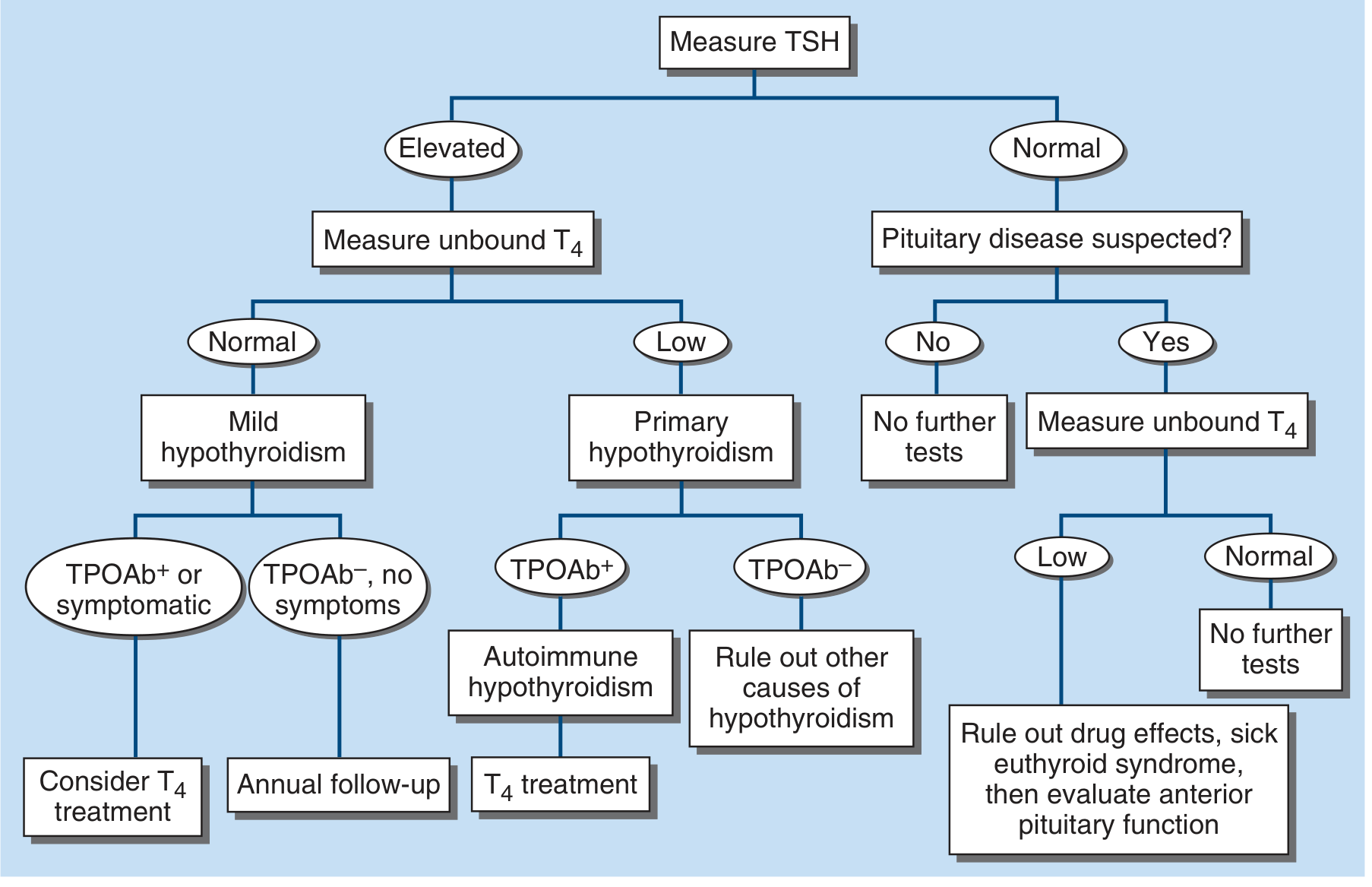
Investigations to Order Now
- Free T4 (fT4) - to confirm severity of deficiency
- TPO antibodies (anti-thyroid peroxidase) - to confirm autoimmune hypothyroidism (Hashimoto's); present in >95% of autoimmune hypothyroid cases
- ALT, AST, GGT, total bilirubin
- If ALP elevated with GGT - suggests hepatic source (rule out fatty liver, autoimmune hepatitis, or drug effect)
- If ALP elevated with normal GGT - consider bone source (rare in this context)
- LDL, HDL, triglycerides, non-HDL cholesterol
- Cholesterol of 325 mg/dL is secondary dyslipidemia from hypothyroidism - treat the thyroid FIRST before adding statins
- CBC (anemia is common in hypothyroidism - normocytic or macrocytic)
- Serum creatinine / urea (renal function - hypothyroid can impair GFR)
- Fasting glucose / HbA1c (despite no known diabetes, TSH 125 with metabolic derangement warrants screening)
- CK / CPK (muscle enzyme - elevated in hypothyroidism)
- Consider: Ultrasound thyroid (if TPO Ab positive - assess for Hashimoto's echogenicity)
- USG abdomen (for fatty liver assessment given raised ALP + metabolic syndrome)
- FSH, LH, estradiol (at age 50 with sweating/ghabarat - menopausal symptoms can overlap with hypothyroid)
Treatment Plan
1. Levothyroxine (T4) Replacement - PRIORITY
- Full replacement dose = 1.6 mcg/kg/day body weight
- However, in a 50-year-old, do NOT start at full dose immediately
- Start low, go slow: Begin at 25-50 mcg/day, then increase by 25 mcg every 4-6 weeks
"The initial dosage of levothyroxine may be as little as 12.5 μg per day up to a full replacement dose... dosage dependent on the patient's weight, age, cardiac status, and duration and severity of hypothyroidism." - Berek & Novak's Gynecology
"In the elderly, patients with cardiac insufficiency or severe hypothyroidism, the initial dose is 25 μg, increased by 25 μg every 4 weeks until normal metabolism is achieved." - Scott-Brown's Otolaryngology
- Take on empty stomach, 30-60 min before breakfast
- Avoid taking with: calcium, iron, antacids (aluminum hydroxide), cholestyramine - these reduce absorption
2. Dyslipidemia (Cholesterol 325)
- Do NOT start a statin yet - secondary hypercholesterolaemia from hypothyroidism will improve with levothyroxine treatment
- Recheck lipid profile after TSH is normalized (approximately 3-6 months)
- If cholesterol remains elevated after achieving euthyroidism - then consider statin therapy
Hypothyroidism is a well-recognized cause of secondary dyslipidemia; treating the underlying thyroid deficiency is the first step. - Henry's Clinical Diagnosis and Management by Laboratory Methods
3. Address ALP elevation
- Await liver function tests
- If hepatic cause confirmed: screen for NAFLD/MASLD (likely given metabolic derangement), autoimmune hepatitis (check ANA, ASMA), or primary biliary cholangitis (AMA antibody)
- Many of these conditions improve with thyroid correction
4. Ghabarat / Sweating / Perimenopausal Symptoms
- At age 50, vasomotor symptoms (hot flushes, sweating, palpitations) from perimenopause overlap heavily with hypothyroid symptoms
- Check FSH/LH/Estradiol
- Optimize levothyroxine first - many symptoms will resolve
- If perimenopausal symptoms persist after thyroid correction, reassess for HRT
Important Safety Points
- Do not ignore cardiac status - get ECG before aggressively titrating levothyroxine (severe hypothyroid can cause bradycardia, pericardial effusion, prolonged QT)
- Autoimmune workup - Hashimoto's thyroiditis (TPO Ab+) is associated with other autoimmune diseases: pernicious anemia, Addison's disease, T1DM, celiac disease, RA, SLE
- Compliance assessment - TSH of 125 in a known hypothyroid patient means she is either non-compliant with medication, or on inadequate dose. Assess:
- Is she taking the medication?
- Any absorption issues (concurrent antacid/iron use)?
- Correct dose prescribed?
Summary Management Table
| Priority | Action |
|---|---|
| 1 | Start Levothyroxine 25-50 mcg/day, increase slowly every 4-6 weeks |
| 2 | Check fT4, TPO Ab, CBC, CK, LFT, RFT, glucose |
| 3 | ECG (before escalating dose) |
| 4 | USG thyroid + abdomen |
| 5 | Recheck TSH + lipids after 6-8 weeks |
| 6 | FSH/LH/Estradiol for perimenopause evaluation |
| 7 | Statin only if cholesterol persists after euthyroidism achieved |
Now patient weight 54 kg recently patient take 100 mch thyroxin
Dose Analysis - 54 kg Female on 100 mcg Levothyroxine
Step 1: Calculate Required Full Replacement Dose
| Formula | Calculation |
|---|---|
| Standard full replacement | 1.6-1.7 mcg/kg/day |
| For 54 kg: | 54 × 1.6 = 86.4 mcg/day |
| Upper estimate: | 54 × 1.7 = 91.8 mcg/day |
| Required dose range | ~86 - 92 mcg/day |
"The average daily adult full replacement dose of levothyroxine is 1.7 mcg/kg body weight. Dosing should generally be based on lean body mass." - Goodman & Gilman's Pharmacological Basis of Therapeutics
Step 2: Assess Her Current Dose
| Parameter | Value |
|---|---|
| Weight-based required dose | ~86-92 mcg/day |
| Current dose | 100 mcg/day |
| Status | Dose is ADEQUATE / slightly above weight-based calculation |
Step 3: Why is TSH Still 125?
| Cause | How to Identify |
|---|---|
| Non-compliance / Irregular intake | Most common - patient not taking tablet daily |
| Wrong timing (taking with food/tea/milk) | Reduces absorption by 30-40% |
| Drug interaction (calcium, iron, antacid, PPI taken together) | Always ask about concurrent medicines |
| Malabsorption (celiac disease, gastric bypass, atrophic gastritis) | Check anti-tTG antibodies if suspected |
| Recent lab error / old result | Confirm with fresh TSH |
| Dose recently started (not yet 6 weeks) | TSH takes 6-8 weeks to respond to a dose change |
Key quote: "The half-life of levothyroxine is nearly 7 days; therefore, nearly 6 weeks of treatment are necessary before the effects of a dosage change can be evaluated." - Berek & Novak's Gynecology
Step 4: Practical Advice for This Patient
-
Confirm compliance - Ask directly: "Kya aap daily tablet lete hain?" Many patients skip doses or take irregularly.
-
Correct timing - Levothyroxine must be taken:
- On an empty stomach, 30-60 minutes before breakfast
- NOT with chai/milk (calcium in milk blocks absorption)
- NOT with iron tablets or calcium supplements (very common in women)
-
Recheck TSH in 6-8 weeks after confirming correct, consistent daily intake at right time.
-
If TSH still very high at recheck - then increase dose by 25 mcg increments (to 125 mcg) and recheck again after 6 weeks.
-
Target TSH for a 50-year-old: 0.5 to 2.5 mIU/L
Step 5: Monitoring Plan
| Timepoint | Test |
|---|---|
| Now | fT4, CBC, LFTs, CK, lipid profile, ECG |
| 6-8 weeks | TSH recheck |
| If TSH still high | Increase to 125 mcg, recheck TSH at 6 weeks |
| After TSH normalized | Repeat fasting lipid profile (cholesterol will likely fall) |
| Every 6-12 months | Routine TSH once stable |
Bottom Line
Can we change the dose now 25 mch thyroxin
Should You Change to 25 mcg Now?
Short Answer: NO - Do NOT reduce to 25 mcg
Why Reducing is Harmful Here
| Risk | Explanation |
|---|---|
| Worsen hypothyroidism | TSH will climb even higher |
| Worsen cholesterol | Already at 325 mg/dL - will rise further |
| Risk of Myxedema | Severe prolonged hypothyroidism can progress to myxedema coma |
| Worsen cardiac function | Bradycardia, pericardial effusion, reduced cardiac output |
| Worsen all symptoms | Anorexia, fatigue, edema will all get worse |
Where the "25 mcg" Principle Applies
"In elderly patients, patients with cardiac insufficiency or severe hypothyroidism - the initial dose is 25 mcg, increased by 25 mcg every 4 weeks." - Scott-Brown's Otolaryngology
- New to treatment → start at 25 mcg ✅
- Already on 100 mcg with TSH 125 → never reduce ❌
What to Actually Do
| Scenario | Action |
|---|---|
| Patient was NOT taking 100 mcg regularly | Educate on compliance + continue 100 mcg correctly |
| Patient was taking 100 mcg at wrong time (with food/chai) | Fix timing + continue 100 mcg |
| Patient was taking correctly for >6 weeks and TSH still 125 | Increase to 125 mcg (add 25 mcg), recheck TSH in 6 weeks |
| Patient newly diagnosed, never treated | Start at 25-50 mcg, titrate up |
The Correct Dose Ladder for Her
Current:   100 mcg  →  TSH = 125  (undertreated / compliance issue)
Step 1:    Confirm correct intake for 6-8 weeks → Recheck TSH
Step 2 if still high:  125 mcg  →  Recheck TSH at 6 weeks
Step 3 if needed:      150 mcg  →  Recheck TSH at 6 weeks
Target for 54 kg:      ~86-92 mcg (but 100 mcg is acceptable and standard tablet size)
Key Message
- Ask: "Tablet khali pet lete hain? Chai ke saath toh nahi?"
- Educate: Empty stomach, 30-60 min before breakfast, plain water only
- Maintain 100 mcg - do not reduce
- Recheck TSH in 6-8 weeks with confirmed proper intake
Create a patient education handout on levothyroxine compliance and timing5 days can we should change or not now
mkdir -p /tmp/workspace/thyroid-handout && ls /tmp/workspace/thyroid-handout/
~/thyroid-handout/create_handout.py
from docx import Document
from docx.shared import Pt, Inches, RGBColor
from docx.enum.text import WD_ALIGN_PARAGRAPH
from docx.oxml.ns import qn
from docx.oxml import OxmlElement

doc = Document()

# ── Page margins ──────────────────────────────────────────────
section = doc.sections[0]
section.page_width  = Inches(8.27)   # A4
section.page_height = Inches(11.69)
section.left_margin   = Inches(0.9)
section.right_margin  = Inches(0.9)
section.top_margin    = Inches(0.8)
section.bottom_margin = Inches(0.8)

# ── Default style ─────────────────────────────────────────────
normal = doc.styles['Normal']
normal.font.name = 'Arial'
normal.font.size = Pt(11)

# ── Helper functions ──────────────────────────────────────────
def add_colored_heading(doc, text, level=1, r=0, g=80, b=160):
    p = doc.add_heading(text, level=level)
    p.alignment = WD_ALIGN_PARAGRAPH.CENTER if level == 1 else WD_ALIGN_PARAGRAPH.LEFT
    for run in p.runs:
        run.font.color.rgb = RGBColor(r, g, b)
        run.font.bold = True
    return p

def add_colored_para(doc, text, bold=False, color=None, size=11, center=False):
    p = doc.add_paragraph()
    run = p.add_run(text)
    run.bold = bold
    run.font.size = Pt(size)
    if color:
        run.font.color.rgb = RGBColor(*color)
    if center:
        p.alignment = WD_ALIGN_PARAGRAPH.CENTER
    return p

def add_shaded_para(doc, text, shade_color="DCE6F1"):
    p = doc.add_paragraph()
    pPr = p._p.get_or_add_pPr()
    shd = OxmlElement('w:shd')
    shd.set(qn('w:val'), 'clear')
    shd.set(qn('w:color'), 'auto')
    shd.set(qn('w:fill'), shade_color)
    pPr.append(shd)
    run = p.add_run(text)
    run.bold = True
    run.font.size = Pt(11)
    return p

def add_bullet(doc, text, bold_part=None):
    p = doc.add_paragraph(style='List Bullet')
    if bold_part and bold_part in text:
        idx = text.index(bold_part)
        before = text[:idx]
        after = text[idx+len(bold_part):]
        if before:
            p.add_run(before)
        r = p.add_run(bold_part)
        r.bold = True
        if after:
            p.add_run(after)
    else:
        run = p.add_run(text)
    return p

def add_divider(doc):
    p = doc.add_paragraph()
    p.alignment = WD_ALIGN_PARAGRAPH.CENTER
    run = p.add_run('─' * 70)
    run.font.color.rgb = RGBColor(0, 80, 160)
    run.font.size = Pt(9)

# ═══════════════════════════════════════════════════════════════
#  HEADER
# ═══════════════════════════════════════════════════════════════
title = doc.add_paragraph()
title.alignment = WD_ALIGN_PARAGRAPH.CENTER
r1 = title.add_run('THYROID TABLET (LEVOTHYROXINE) - PATIENT GUIDE')
r1.bold = True
r1.font.size = Pt(16)
r1.font.color.rgb = RGBColor(0, 80, 160)

subtitle = doc.add_paragraph()
subtitle.alignment = WD_ALIGN_PARAGRAPH.CENTER
r2 = subtitle.add_run('تھائیرائڈ کی دوائی - مریض کے لیے ہدایات')
r2.bold = True
r2.font.size = Pt(14)
r2.font.color.rgb = RGBColor(180, 0, 0)

add_divider(doc)

# ── IMPORTANT BOX ─────────────────────────────────────────────
doc.add_paragraph()
imp = doc.add_paragraph()
imp.alignment = WD_ALIGN_PARAGRAPH.CENTER
r_imp = imp.add_run('⚠  THIS MEDICINE MUST BE TAKEN EVERY SINGLE DAY  ⚠')
r_imp.bold = True
r_imp.font.size = Pt(12)
r_imp.font.color.rgb = RGBColor(200, 0, 0)

imp_ur = doc.add_paragraph()
imp_ur.alignment = WD_ALIGN_PARAGRAPH.CENTER
r_ur = imp_ur.add_run('یہ دوائی ہر روز لینا ضروری ہے')
r_ur.bold = True
r_ur.font.size = Pt(12)
r_ur.font.color.rgb = RGBColor(180, 0, 0)

add_divider(doc)

# ═══════════════════════════════════════════════════════════════
#  SECTION 1: HOW TO TAKE
# ═══════════════════════════════════════════════════════════════
add_colored_heading(doc, '1.  HOW TO TAKE YOUR TABLET  /  گولی کیسے لیں', level=2, r=0, g=80, b=160)

add_shaded_para(doc, 'STEP 1: Wake up in the morning  |  صبح اٹھیں', shade_color='E2EFDA')
doc.add_paragraph()

add_bullet(doc, 'Take the tablet IMMEDIATELY on waking - before doing anything else.', 'IMMEDIATELY on waking')
add_bullet(doc, 'صبح اٹھتے ہی، ناشتے سے پہلے، سب سے پہلے یہ گولی لیں')

doc.add_paragraph()
add_shaded_para(doc, 'STEP 2: Take with plain water ONLY  |  صرف سادہ پانی کے ساتھ لیں', shade_color='E2EFDA')
doc.add_paragraph()

add_bullet(doc, 'Use a FULL glass of plain water (250 ml).', 'FULL glass of plain water')
add_bullet(doc, 'صرف سادہ پانی - ایک پورا گلاس پیئیں')

doc.add_paragraph()
add_shaded_para(doc, 'STEP 3: Wait 30-60 minutes before eating or drinking', shade_color='E2EFDA')
doc.add_paragraph()

add_bullet(doc, 'Wait at least 30 to 60 minutes before breakfast, tea, or milk.', '30 to 60 minutes')
add_bullet(doc, 'گولی لینے کے بعد 30 سے 60 منٹ تک کچھ نہ کھائیں پئیں')
add_bullet(doc, 'Then eat breakfast, drink tea - after waiting.', 'after waiting')
add_bullet(doc, 'پھر ناشتہ کریں، چائے پیئیں - لیکن پہلے انتظار کریں')

add_divider(doc)

# ═══════════════════════════════════════════════════════════════
#  SECTION 2: WHAT TO AVOID
# ═══════════════════════════════════════════════════════════════
add_colored_heading(doc, '2.  WHAT TO AVOID  /  کیا نہ کریں', level=2, r=180, g=0, b=0)

table = doc.add_table(rows=1, cols=2)
table.style = 'Table Grid'
hdr = table.rows[0].cells
hdr[0].text = 'Do NOT take tablet with... / ان کے ساتھ گولی نہ لیں'
hdr[1].text = 'Why / وجہ'
hdr[0].paragraphs[0].runs[0].bold = True
hdr[1].paragraphs[0].runs[0].bold = True

rows_data = [
    ('Chai / Tea / چائے', 'Milk in tea blocks absorption / دودھ جذب ہونے سے روکتا ہے'),
    ('Milk / Doodh / دودھ', 'Calcium blocks the tablet / کیلشیم دوائی کو روکتا ہے'),
    ('Iron tablets / آئرن کی گولیاں', 'Blocks absorption completely / مکمل جذب نہیں ہوتی'),
    ('Calcium tablets / کیلشیم گولیاں', 'Blocks absorption / جذب روک دیتا ہے'),
    ('Antacids / تیزابیت کی دوائی', 'Reduces effect of tablet / اثر کم کر دیتا ہے'),
    ('Food / Khana / کھانا', 'Reduces absorption by 40% / 40% کم جذب ہوتی ہے'),
]
for eng, ur in rows_data:
    row = table.add_row().cells
    row[0].text = eng
    row[1].text = ur

doc.add_paragraph()
add_divider(doc)

# ═══════════════════════════════════════════════════════════════
#  SECTION 3: NEVER SKIP / NEVER STOP
# ═══════════════════════════════════════════════════════════════
add_colored_heading(doc, '3.  NEVER SKIP - NEVER STOP  /  گولی کبھی نہ چھوڑیں', level=2, r=180, g=0, b=0)

add_bullet(doc, 'Take this tablet EVERY DAY - including weekends and holidays.', 'EVERY DAY')
add_bullet(doc, 'یہ گولی ہر روز لیں - چھٹی ہو یا عید ہو - روز لیں')
add_bullet(doc, 'Never stop on your own - even if you feel better.', 'Never stop on your own')
add_bullet(doc, 'اپنے آپ سے بند نہ کریں - چاہے بہتر محسوس ہو')
add_bullet(doc, 'If you miss ONE dose - take it as soon as you remember (same day).', 'miss ONE dose')
add_bullet(doc, 'اگر ایک دن بھول جائیں - اسی دن یاد آتے ہی لے لیں')
add_bullet(doc, 'If you miss a full day - do NOT take double next day. Just continue normally.', 'do NOT take double')
add_bullet(doc, 'اگر پورا دن چھوٹ گیا - اگلے دن دو گولیاں نہ لیں، معمول کے مطابق چلتے رہیں')

add_divider(doc)

# ═══════════════════════════════════════════════════════════════
#  SECTION 4: WHY THIS MATTERS (5-DAY CONTEXT)
# ═══════════════════════════════════════════════════════════════
add_colored_heading(doc, '4.  WHY TIMING MATTERS  /  وقت کیوں ضروری ہے', level=2, r=0, g=100, b=0)

p_why = doc.add_paragraph()
r_why = p_why.add_run(
    'Levothyroxine has a LONG half-life of 7 days. '
    'This means it takes 6-8 WEEKS for any dose change to fully show its effect in your blood test. '
    'Taking the tablet at the wrong time or skipping doses is the most common reason TSH remains high.'
)
r_why.font.size = Pt(11)

p_why_ur = doc.add_paragraph()
r_why_ur = p_why_ur.add_run(
    'اس دوائی کا اثر 7 دن تک رہتا ہے۔ '
    'خون کے ٹیسٹ میں بہتری دیکھنے کے لیے صحیح طریقے سے 6 سے 8 ہفتے لگتے ہیں۔ '
    'غلط وقت پر لینا یا بھول جانا - یہی وجہ ہے کہ TSH بلند رہتا ہے۔'
)
r_why_ur.font.size = Pt(11)

add_divider(doc)

# ═══════════════════════════════════════════════════════════════
#  SECTION 5: DOSE CHANGE - 5 DAYS
# ═══════════════════════════════════════════════════════════════
add_colored_heading(doc, '5.  ABOUT YOUR DOSE  /  آپ کی خوراک کے بارے میں', level=2, r=0, g=80, b=160)

box = doc.add_paragraph()
r_box = box.add_run(
    'Your current dose of 100 mcg is correct for your body weight (54 kg). '
    'DO NOT change this dose on your own. '
    'After only 5 days of taking the tablet, it is TOO EARLY to judge whether the dose is working. '
    'The body needs 6-8 full weeks of correct, daily intake before a blood test can show the result.'
)
r_box.font.size = Pt(11)
r_box.bold = True
r_box.font.color.rgb = RGBColor(0, 80, 160)

box_ur = doc.add_paragraph()
r_box_ur = box_ur.add_run(
    'آپ کی موجودہ خوراک 100 mcg آپ کے وزن (54 کلو) کے مطابق درست ہے۔ '
    'خود سے خوراک تبدیل نہ کریں۔ '
    'صرف 5 دن میں یہ اندازہ نہیں لگایا جا سکتا کہ دوائی کام کر رہی ہے یا نہیں۔ '
    'خون کے ٹیسٹ میں نتیجہ دیکھنے کے لیے 6 سے 8 ہفتے درکار ہیں۔'
)
r_box_ur.font.size = Pt(11)

add_divider(doc)

# ═══════════════════════════════════════════════════════════════
#  SECTION 6: STORAGE
# ═══════════════════════════════════════════════════════════════
add_colored_heading(doc, '6.  HOW TO STORE  /  دوائی کیسے رکھیں', level=2, r=0, g=100, b=0)

add_bullet(doc, 'Keep at room temperature - away from heat and moisture.', 'room temperature')
add_bullet(doc, 'کمرے کے درجہ حرارت پر رکھیں - گرمی اور نمی سے دور')
add_bullet(doc, 'Do NOT store in bathroom or kitchen near the stove.', 'NOT store in bathroom')
add_bullet(doc, 'باتھ روم یا چولہے کے قریب نہ رکھیں')
add_bullet(doc, 'Keep in original packaging until use.', 'original packaging')
add_bullet(doc, 'استعمال تک اصلی ڈبے میں رکھیں')

add_divider(doc)

# ═══════════════════════════════════════════════════════════════
#  SECTION 7: FOLLOW-UP
# ═══════════════════════════════════════════════════════════════
add_colored_heading(doc, '7.  YOUR FOLLOW-UP PLAN  /  آپ کا فالو اپ', level=2, r=0, g=80, b=160)

fu_table = doc.add_table(rows=1, cols=3)
fu_table.style = 'Table Grid'
fh = fu_table.rows[0].cells
fh[0].text = 'When / کب'
fh[1].text = 'What / کیا'
fh[2].text = 'Why / کیوں'
for c in fh:
    c.paragraphs[0].runs[0].bold = True

fu_data = [
    ('6-8 weeks / 6-8 ہفتے بعد', 'TSH blood test / TSH خون ٹیسٹ', 'Check if dose is working / خوراک کا اثر دیکھیں'),
    ('6-8 weeks / 6-8 ہفتے بعد', 'Cholesterol test / کولیسٹرول ٹیسٹ', 'Should improve with thyroid / تھائیرائڈ ٹھیک ہونے سے بہتر ہو گا'),
    ('Every 6 months / ہر 6 ماہ', 'TSH check / TSH چیک', 'Routine monitoring / معمول کی نگرانی'),
]
for w, wh, wy in fu_data:
    row = fu_table.add_row().cells
    row[0].text = w
    row[1].text = wh
    row[2].text = wy

doc.add_paragraph()
add_divider(doc)

# ═══════════════════════════════════════════════════════════════
#  QUICK REMINDER BOX
# ═══════════════════════════════════════════════════════════════
reminder = doc.add_paragraph()
reminder.alignment = WD_ALIGN_PARAGRAPH.CENTER
r_rem = reminder.add_run(
    'REMEMBER  /  یاد رکھیں\n'
    'Wake Up  →  Take tablet with water  →  Wait 30-60 min  →  Breakfast / Tea\n'
    'اٹھیں  →  پانی سے گولی لیں  →  30-60 منٹ انتظار کریں  →  ناشتہ / چائے'
)
r_rem.bold = True
r_rem.font.size = Pt(12)
r_rem.font.color.rgb = RGBColor(0, 80, 160)

add_divider(doc)

# ── Footer note ──────────────────────────────────────────────
footer_p = doc.add_paragraph()
footer_p.alignment = WD_ALIGN_PARAGRAPH.CENTER
r_f = footer_p.add_run(
    'This handout is for educational purposes only. '
    'Always follow your doctor\'s specific instructions.\n'
    'یہ ہدایات صرف معلومات کے لیے ہیں۔ ہمیشہ اپنے ڈاکٹر کی ہدایات پر عمل کریں۔'
)
r_f.font.size = Pt(9)
r_f.italic = True
r_f.font.color.rgb = RGBColor(100, 100, 100)

# ── Save ─────────────────────────────────────────────────────
out_path = '/tmp/workspace/thyroid-handout/Levothyroxine_Patient_Handout.docx'
doc.save(out_path)
print(f'Saved: {out_path}')
python3 /tmp/workspace/thyroid-handout/create_handout.py
python3 -c " from docx import Document doc = Document('/tmp/workspace/thyroid-handout/Levothyroxine_Patient_Handout.docx') for p in doc.paragraphs[:30]: if p.text.strip(): print(p.text[:100]) "
Clinical Answer: After Only 5 Days - Should You Change the Dose?
Answer: NO - Do NOT change the dose after only 5 days
| Fact | Explanation |
|---|---|
| Levothyroxine half-life | 7 days |
| Time to reach steady state | 5-6 half-lives = 35-42 days |
| Minimum wait before judging response | 6-8 weeks of correct daily intake |
| Current status at 5 days | Barely one half-life - blood levels not yet stable |
Only 5 days of taking 100 mcg means the drug has not yet reached steady-state blood levels. You cannot make any dose decision at this point - whether to increase, decrease, or change.
Patient Education Handout
Levothyroxine Patient Handout
Word Document · DOCX
The handout covers:
| Section | Content |
|---|---|
| How to take | Step-by-step: wake up → tablet with plain water → wait 30-60 min → breakfast |
| What to avoid | Table: chai, milk, iron, calcium, antacids, food - all block absorption |
| Never skip / Never stop | What to do if a dose is missed |
| Why timing matters | 7-day half-life, 6-8 weeks needed to see effect |
| About her dose (5 days) | Explicitly explains why 5 days is too early to judge |
| Storage | Keep away from heat/moisture |
| Follow-up plan | TSH + cholesterol at 6-8 weeks, then 6-monthly |
| Quick reminder | Visual flow: Wake → Tablet → Wait → Eat |
Now what i given to patient reliefe
Create a prescription template with levothyroxine + symptomatic relief medications0 mg , imipramine 25 mg hs proton pump inhibitors