
Make comprehensive data of breast cancer from multiple standard textbooks (Bailey & Love 28th edition and Sabiston) with figures.
Reading File
Finding Sources
Searching PubMed
"breast cancer" AND management
Good - I can see Bailey & Love 28th (ISBN 9780367548117) is available. Let me now find the Sabiston textbook and locate breast cancer sections in both.
Finding Sources
Finding Sources
Now let me search specifically in Bailey & Love and Sabiston for breast cancer sections:
Finding Sources
Finding Sources
Excellent! Now I have the file paths. Let me read both books' breast cancer sections in parallel:
Reading File
Reading File
Excellent content loaded. Now let me read more from both books - continuing the Bailey & Love carcinoma section and more Sabiston content on pathology and treatment:
Reading File
Reading File
I have rich content from both textbooks. Now let me fetch the key figures and get more content on pathology and staging:
Loading Image
Loading Image
Reading File
Reading File
Excellent material. Let me now fetch key clinical figures and get the staging/treatment sections:
Reading File
Reading File
Finding Sources
I have very rich content. Let me now fetch the key clinical images from Bailey & Love and get the Sabiston treatment section:
Finding Sources
Reading File
I have extensive content from both textbooks. Let me fetch a few more key images from the breast cancer section of Bailey & Love and the Sabiston figures:
Finding Sources
Finding Sources
The image query returned wrong block content. Let me directly read the correct breast cancer sections for images and fetch key Sabiston figures:
Reading File
Reading File
Now let me fetch key clinical images from both textbooks:
Loading Image
Loading Image
I now have comprehensive content from both textbooks. Let me compile the complete, organized breast cancer reference document.Here is the comprehensive, integrated breast cancer reference compiled from Bailey & Love's Short Practice of Surgery 28th Edition and Sabiston Textbook of Surgery:
Breast Cancer - Comprehensive Surgical Reference
Sources: Bailey & Love's Short Practice of Surgery, 28th Edition (B&L) | Sabiston Textbook of Surgery (Sab)
1. EPIDEMIOLOGY
Breast cancer is the most frequent cancer among women worldwide:
- 2.3 million new cases diagnosed globally in 2020, representing ~25% of all cancers in women
- Incidence varies from 27 per 100,000 (Middle Africa/East Asia) to 92 per 100,000 (North America)
- In Western Europe: ~1 in 9 women will develop breast cancer (3-5% of all female deaths)
- In resource-poor countries: 1 in 28 women; for every 2 diagnosed, 1 dies
- Median age at presentation: ~60 years (UK/USA); ~48 years in South Asia
(B&L, Ch. 58)
2. ANATOMY
Figure 68.1 (Sabiston) - Cutaway Diagram of the Mature Resting Breast
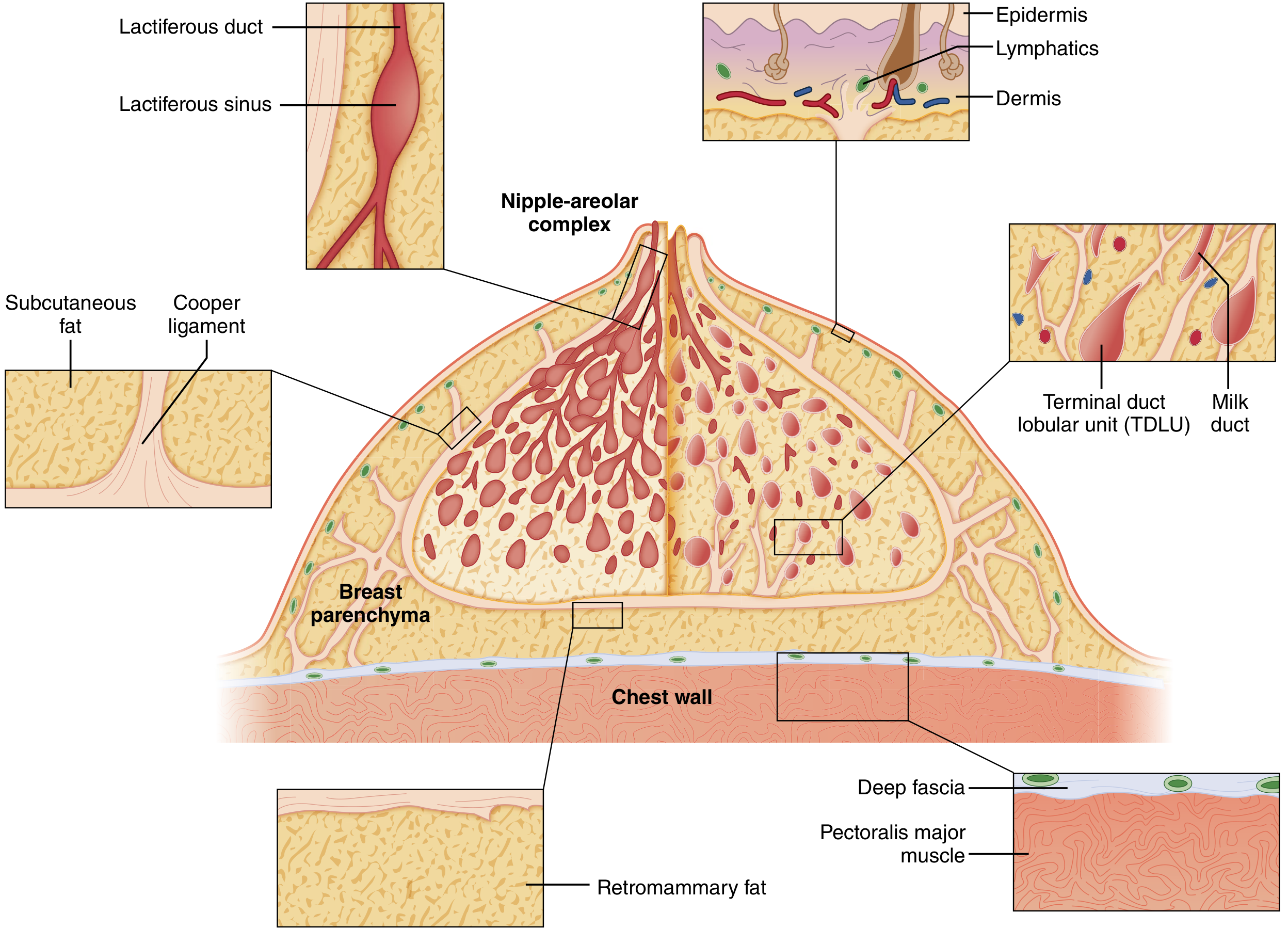
Figure 68.1 (Sabiston): Cutaway diagram of a mature resting breast. The breast lies cushioned in fat between the overlying skin and the pectoralis major muscle. Cooper ligaments (suspensory ligaments) fuse with the overlying superficial fascia and coalesce as interlobular fascia. The duct system is configured like an inverted tree.
Figure 68.2 (Sabiston) - Terminal Duct Lobular Unit (TDLU)
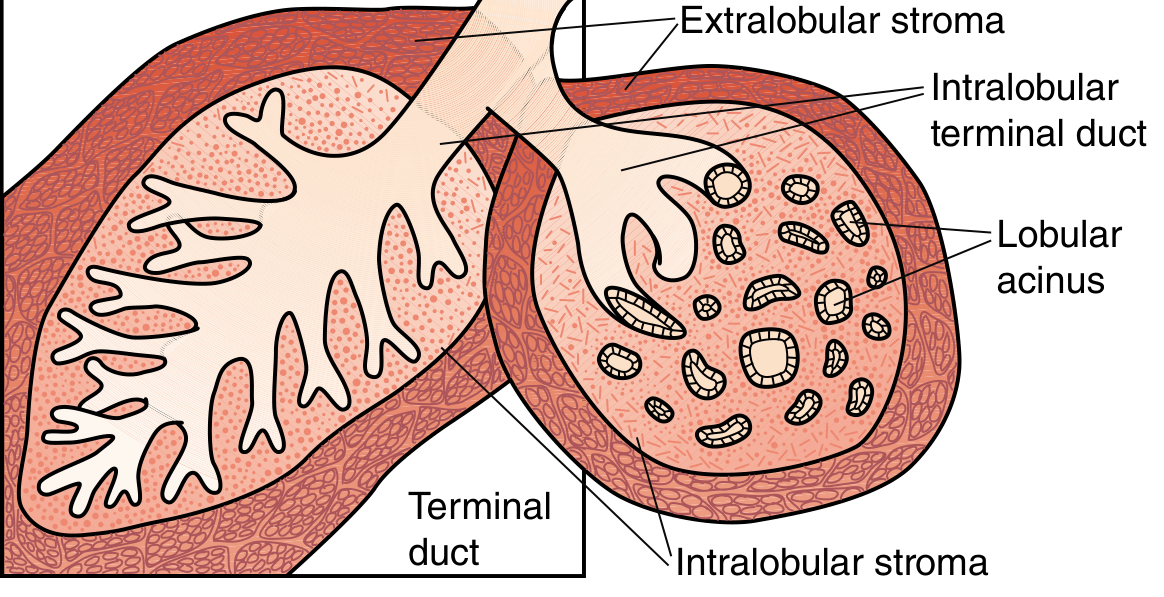
Figure 68.2 (Sabiston): Diagram of the terminal duct lobular unit (TDLU). The acini are the milk-forming glands of the lactating breast.
Key anatomical points (Sabiston, Ch. 68):
- Breast lies between skin/subdermal adipose tissue and superficial pectoral fascia, overlying pectoralis major
- Cooper's ligaments run between chest wall and dermis - infiltration by cancer causes skin dimpling ("peau d'orange")
- Three principal tissue types: (1) glandular epithelium, (2) fibrous stroma, (3) adipose tissue
- 15-20 lobes, each ending in a lactiferous duct opening at the nipple
- Each major duct has a lactiferous sinus below the NAC, branching to terminal ductules/acini
- TDLUs (terminal duct lobular units) = acini + small efferent ductules - the functional unit
Lymphatic drainage:
- Primarily to axillary nodes (75%)
- Internal mammary nodes (medial/central tumors)
- Rotter's nodes (between pectoralis muscles)
- Supraclavicular nodes (advanced disease)
3. RISK FACTORS
TABLE 58.3 - Risk Factors for Breast Cancer (Bailey & Love, 28th Ed.)
| Risk Factor | Details |
|---|---|
| Modifiable | |
| Obesity (BMI >30) | RR = 1.29 in postmenopausal women |
| Nulliparity/late first pregnancy (>35 yrs) | Increased risk |
| Breastfeeding | Protective; >12 months has greater protective effect |
| HRT use >10 years | RR = 1.2 |
| Tobacco (>25 cigarettes/day) | RR = 1.14 |
| Alcohol - light (<1 drink/day) | RR = 1.05 |
| Alcohol - moderate (3-4 drinks/day) | RR = 1.32 |
| Alcohol - heavy (>4 drinks/day) | RR = 1.46 |
| Radiation exposure | RR = 6 |
| Non-modifiable | |
| Age | Median presentation ~60 yrs (West) |
| Early menarche | Prolonged oestrogen exposure |
| Late menopause | Prolonged oestrogen exposure |
| BRCA1 mutation | 50-85% lifetime breast cancer risk; 40% ovarian cancer risk |
| BRCA2 mutation | 50-60% lifetime breast cancer risk; 20% ovarian cancer risk |
| Prior breast cancer / LCIS | Significantly elevated risk |
| Dense breast tissue | Higher risk |
| Family history | First-degree relative = 2x RR |
(B&L, Table 58.3)
4. PATHOLOGY
4.1 Origin
- 90% arise from milk ducts (ductal carcinoma)
- 10% arise from lobules (lobular carcinoma)
- Disease may remain confined to epithelium without breaching the basement membrane = in situ disease
- Breach of basement membrane = invasive (infiltrating) ductal or lobular carcinoma
4.2 Histological Types
Invasive Ductal Carcinoma (IDC) / Invasive Carcinoma of No Special Type (NST)
- Most common; accounts for 50-70% of invasive breast cancers (Sab)
- Grows as a cohesive mass; appears as discrete abnormality on mammography; palpable as discrete lump
Invasive Lobular Carcinoma (ILC)
- Accounts for 5-15% of breast cancers
- Permeates breast in single-file pattern; clinically occult, often escapes mammographic detection until extensive
- Characterized by mutation in CDH1 gene causing loss of E-cadherin
Special Types (better prognosis):
| Type | Key Features |
|---|---|
| Tubular carcinoma | Small glands lined by single row of bland epithelium; ~2-3% of invasive cancers; grade 1 |
| Mucinous/Colloid | Cells float in copious mucin; ~2-3% of invasive cancers; grade 1 |
| Medullary carcinoma | Bizarre high-grade cells, syncytial sheets, lymphocytic infiltrate, pushing borders; ER/PR/HER2 negative; ~5% |
| Papillary carcinoma | 0.5-1% of all neoplasms; fibrovascular core with epithelial/myoepithelial covering; better prognosis |
| Metaplastic carcinoma | High grade, ER/PR/HER2 negative; node negative but high metastatic potential; poor prognosis |
(B&L Ch.58; Sab Ch.68)
4.3 Histological Grading - Nottingham (Modified Bloom-Richardson) Score
Three categories, each scored 1-3:
- Tubule/gland formation: >75% = 1; 10-75% = 2; <10% = 3
- Nuclear pleomorphism: Score 1-3
- Mitotic rate: Score 1-3
| Total Score | Grade |
|---|---|
| 3-5 | Grade I (well differentiated) |
| 6-7 | Grade II (moderately differentiated) |
| 8-9 | Grade III (poorly differentiated) |
(B&L, Sab)
4.4 Molecular Classification (Table 58.4 - B&L)
| Subtype | Hormone Receptor | HER2/neu | Other Features |
|---|---|---|---|
| Luminal A | ER/PR positive | Negative | Ki-67 low; best prognosis |
| Luminal B | ER/PR positive | Negative | Ki-67 high; intermediate prognosis |
| HER2/neu enriched | Negative | Positive | Ki-67 high |
| Basal type (TNBC) | Negative | Negative | Ki-67 usually high; associated with BRCA1 |
| Claudin-low | Negative | Negative | Claudin expression low |
Gene array analysis (PAM-50); immunohistochemistry used as surrogate where gene array unavailable
4.5 Key Molecular Markers (Sabiston)
- ER/PR: Measured by immunohistochemistry; >1% expression = positive; 1-10% = low ER expression
- HER2: Amplified in ~20% of breast cancers; erb-B2 gene product; scored 0-3+ by IHC
- 0 or 1+ = negative; 3+ = positive; 2+ = equivocal → confirm with ISH
- HER2 copy number by ISH: <4/cell = negative; ≥6/cell = positive
- Ki-67: Proliferation marker; reported as % positive nuclei
4.6 In Situ Carcinoma
Ductal Carcinoma In Situ (DCIS)
- Malignant cells confined within ducts without invasion
- Classified by nuclear grade (low/intermediate/high) and necrosis (comedonecrosis)
- High-grade DCIS with comedonecrosis = most aggressive
- Detected predominantly by screening mammography (microcalcifications)
Lobular Carcinoma In Situ (LCIS)
- LCIS is classified as a high-risk benign lesion, NOT a cancer (AJCC 8th edition)
- Marker of increased bilateral breast cancer risk
- No surgical excision required if incidentally found on core biopsy unless associated with atypia
(B&L Summary Box 58.3; Sab)
5. CLINICAL FEATURES
5.1 Symptoms
- Painless lump (most common presentation)
- Nipple retraction/inversion (new)
- Blood-stained nipple discharge
- Skin changes: dimpling, puckering, peau d'orange
- Breast asymmetry/change in size
- Axillary lump
5.2 Signs - Clinical Photographs
Figure 58.28 (Bailey & Love): Inflammatory Carcinoma and Peau d'Orange
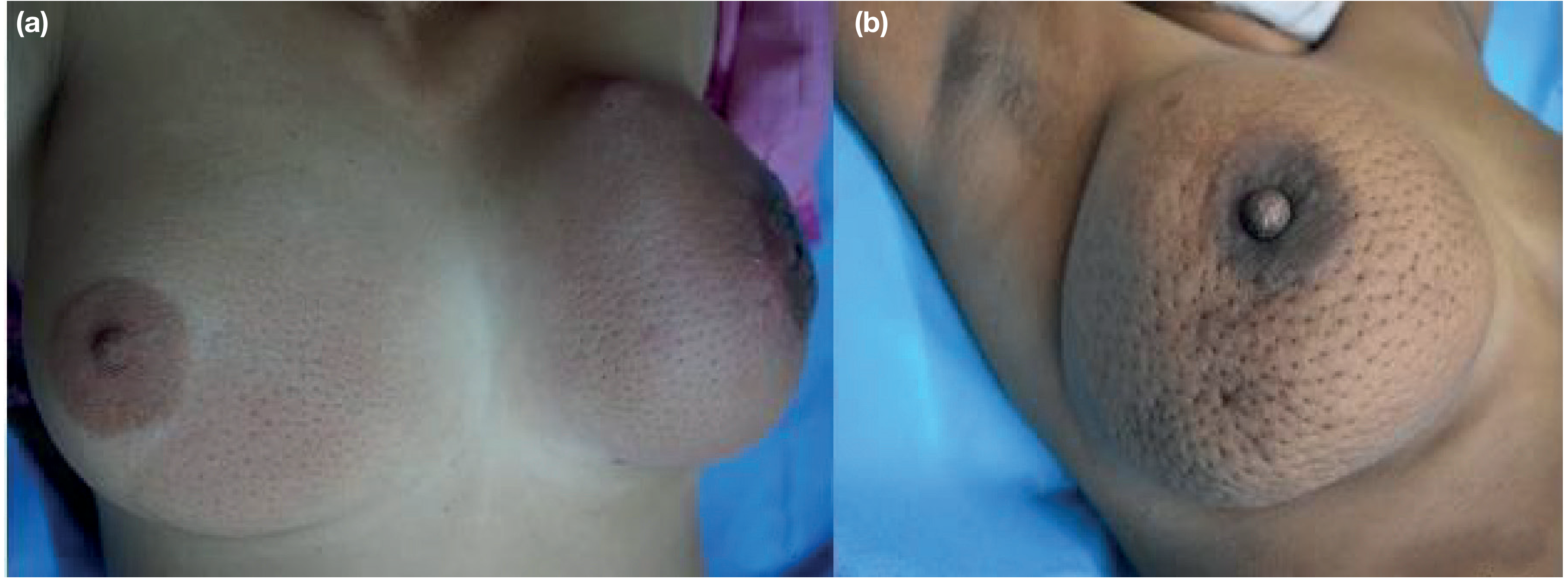
(a) Diffuse redness (erythema) and skin oedema involving >1/3 of breast with enlarged left breast - features of inflammatory carcinoma. (b) Peau d'orange - orange peel appearance indicating locally advanced disease. In darker skins, erythema takes on a brownish hue.
5.3 Mechanism of Skin Signs (Bailey & Love)
- Tumour releases FGF, TGFα, TGFβ, VEGF
- FGF induces mitosis of fibrocytes → fibroblasts → collagen deposition (desmoplastic reaction)
- Collagen contraction → shortens Cooper's ligaments:
- Single ligament: dimpling
- Multiple ligaments: puckering/tethering
- Central involvement: nipple retraction
- Lymphatic blockage in skin → peau d'orange
5.4 Spread
Local spread: Skin (ulceration, satellite nodules) → pectoralis major → serratus anterior → chest wall
Lymphatic metastasis:
- Primarily to axillary nodes (all quadrants)
- Inner half tumors: may drain to internal mammary nodes
- Level I: lateral to pectoralis minor; Level II: behind pectoralis minor; Level III: medial to pectoralis minor
Haematogenous metastasis (in order of frequency):
- Bone (vertebrae, ribs, pelvis, femur) - most common
- Lung
- Liver
- Brain
- Adrenals, ovaries
6. INVESTIGATIONS & TRIPLE ASSESSMENT
The triple assessment remains the gold standard:
- Clinical examination
- Imaging (mammography ± ultrasound ± MRI)
- Pathological assessment (FNAC or core biopsy)
6.1 Imaging
Mammography:
- Standard screening tool (2-view: CC and MLO)
- Features of malignancy: spiculate mass, microcalcifications (pleomorphic/linear), architectural distortion
- ACR BIRADS classification guides management
Ultrasound:
- Best for dense breasts, young women (<35 yrs), characterizing palpable lumps
- Distinguishes cystic from solid lesions
MRI Breast:
- Highest sensitivity for breast cancer detection
- Used for: BRCA carriers, extent of disease assessment (multifocal/multicentric), post-neoadjuvant response evaluation, implants assessment
- Low specificity - guided biopsy needed for MRI-only lesions
Staging Imaging:
- T3/T4 or N2/N3 disease: CT chest/abdomen/pelvis + isotope bone scan
- Early breast cancer (T1/T2, N0/N1): staging only if symptomatic or raised ALP
- PET-CT (18F-FDG) may be used for metastatic work-up
(B&L)
6.2 Pathological Assessment
- FNAC: Rapid, cost-effective; gives cytology (C1-C5)
- Core needle biopsy: Gold standard; gives histology, grade, ER/PR/HER2 status
- Vacuum-assisted biopsy: For microcalcifications, small lesions
- Sentinel lymph node biopsy (SLNB): Standard for axillary staging in clinically node-negative disease
7. STAGING - AJCC/UICC 8th EDITION TNM SYSTEM
7.1 Anatomical T (Tumour) Classification
| Category | Definition |
|---|---|
| Tis | In situ (DCIS) - LCIS is NOT staged as cancer |
| T1mi | Microinvasion ≤1.0 mm |
| T1a | >1 mm to ≤5 mm |
| T1b | >5 mm to ≤10 mm |
| T1c | >10 mm to ≤20 mm |
| T2 | >20 mm to ≤50 mm |
| T3 | >50 mm |
| T4a | Extension to chest wall |
| T4b | Ulceration/satellite nodules/peau d'orange (skin involvement) |
| T4c | Both T4a and T4b |
| T4d | Inflammatory carcinoma |
7.2 N (Node) Classification
| Category | Definition |
|---|---|
| N0 | No regional node metastasis |
| N1 | Movable ipsilateral Level I/II axillary nodes |
| N2a | Fixed/matted ipsilateral Level I/II axillary nodes |
| N2b | Clinically apparent internal mammary nodes (no axillary) |
| N3a | Ipsilateral infraclavicular (Level III) nodes |
| N3b | Internal mammary + axillary nodes |
| N3c | Ipsilateral supraclavicular nodes |
7.3 M (Metastasis)
| Category | Definition |
|---|---|
| M0 | No distant metastasis |
| cM0(i+) | Circulating tumor cells or micrometastasis detected |
| M1 | Distant metastasis (bone, lung, liver, brain, etc.) |
7.4 Key Points of 8th Edition AJCC Staging (B&L Summary Box 58.3)
- LCIS = high-risk benign lesion, NOT a cancer
- Multiple synchronous tumors: use (m) modifier
- Post-neoadjuvant therapy: (y) prefix
- pCR = absence of tumor cells in breast AND axillary nodes
- Inflammatory carcinoma remains classified as such even after complete neoadjuvant remission
- T1mi = invasive foci ≤1.0 mm
- Tumors >1mm and <2mm: round to 2 mm
- 8th edition adds: histological grade, ER/PR/HER2/Ki-67, multigene testing (Oncotype DX)
8. TREATMENT
8.1 Multidisciplinary Team (MDT)
Treatment is multimodal - surgery + systemic therapy (chemotherapy, targeted therapy, hormonal therapy) + radiotherapy. MDT should include surgeon, radiologist, pathologist, radiation oncologist, medical oncologist, breast care nurse, and reconstructive surgeon. (B&L)
8.2 Surgical Treatment
A. Breast-Conserving Surgery (BCS) / Lumpectomy
Synonyms: lumpectomy, partial mastectomy, segmental mastectomy, wide local excision, tylectomy
Technique (Sabiston):
- Tumor removed with surrounding rim of grossly normal parenchyma
- Palpable tumors: located by palpation
- Non-palpable tumors: localization device required (wire, radioactive seed, SAVI Scout, etc.)
- Specimen oriented and inked before sectioning
- Specimen radiography for non-palpable lesions or those with microcalcifications
- Clips left in lumpectomy cavity for radiotherapy planning
Margins:
- Standard for invasive cancer: "no ink on tumor" (SSO/ASTRO consensus)
- Standard for DCIS: 2 mm negative margin (SSO/ASTRO/ASCO consensus)
- 2 mm margin for DCIS provides improved ipsilateral recurrence vs. 0-1 mm margin
- Margins wider than "no ink on tumor" do NOT further decrease recurrence risk for invasive cancer
- Positive margins = 2-fold increase in ipsilateral breast tumor recurrence
BCS requires adjuvant whole-breast radiation to achieve equivalent outcomes to mastectomy
B. Mastectomy
Types:
- Simple/total mastectomy: Removal of all breast tissue including NAC; no axillary dissection
- Modified radical mastectomy (MRM): Simple mastectomy + axillary lymph node dissection (Level I/II); pectoralis muscles preserved
- Skin-sparing mastectomy: Preserves skin envelope; for immediate reconstruction
- Nipple-sparing mastectomy: Preserves NAC; for BRCA prophylactic surgery or selected cancers
Indications for mastectomy over BCS:
- Multicentric disease
- Large tumor-to-breast ratio with poor expected cosmesis
- Prior radiotherapy to breast
- Positive margins after re-excision
- BRCA mutation carriers (risk-reducing)
- Patient preference
C. Axillary Management
Sentinel Lymph Node Biopsy (SLNB):
- Standard for clinically node-negative disease
- Uses blue dye ± radioisotope (technetium-99m) or newer technologies
- If SLN negative: no further axillary treatment needed
- If SLN positive: decision for completion axillary dissection vs. radiation
- ACOSOG Z0011 trial: 1-2 positive SLNs in BCS patients + whole-breast RT: ALND not required
Axillary Lymph Node Dissection (ALND):
- Level I and II nodes removed (typically 10+ nodes)
- Indicated for: positive SLN (selected cases), clinically positive nodes
- Complications: lymphoedema (up to 20%), shoulder stiffness, sensory loss, seroma
8.3 Radiotherapy
After BCS:
- Whole-breast radiation = standard after BCS
- Reduces risk of local recurrence and improves breast cancer-specific mortality
- Hypofractionation (e.g., 40 Gy in 15 fractions): equivalent efficacy to conventional fractionation (50 Gy in 25 fractions) with reduced morbidity - now preferred
- Partial breast irradiation: Selected low-risk patients; avoids irradiating entire breast
After mastectomy:
- Post-mastectomy radiation (PMRT): Recommended for T3/T4 tumors, ≥4 positive nodes, positive margins
- Also to nodal basins in high-risk patients with nodal involvement
- Reduces locoregional recurrence and breast cancer mortality
(Sab, Ch. 68)
8.4 Systemic Therapy
A. Chemotherapy
Adjuvant chemotherapy regimens:
- Anthracycline-based (AC: doxorubicin + cyclophosphamide) ± taxane
- AC → paclitaxel or docetaxel
- TC (docetaxel + cyclophosphamide): for lower-risk HER2-negative
Neoadjuvant chemotherapy (NACT):
- For locally advanced breast cancer (T3/T4, N2/N3)
- Pathological complete response (pCR) = absence of residual invasive cancer in breast + nodes
- pCR = excellent prognostic marker (especially in HER2+ and TNBC)
- Allows BCS in previously inoperable or borderline cases
- In HER2+ disease: add trastuzumab + pertuzumab to NACT (dual HER2 blockade)
- TNBC with residual disease after NACT: capecitabine reduces recurrence risk
- If residual HER2+ disease post-NACT: switch to T-DM1 (ado-trastuzumab emtansine)
B. Endocrine (Hormonal) Therapy
For ER/PR-positive cancers:
Premenopausal women:
- Tamoxifen 20 mg/day x 5-10 years (SERM)
- Reduces recurrence by ~40% and contralateral cancer by 47%
- Side effects: endometrial cancer (2x risk), thromboembolic events, menopausal symptoms, cataracts
- Ovarian suppression/ablation (GnRH agonist) + AI in high-risk premenopausal women
Postmenopausal women:
- Aromatase inhibitors (AIs): anastrozole, letrozole, exemestane - superior to tamoxifen in postmenopausal women
- AI x 5 years or sequential tamoxifen → AI
- Switching to AI after 2-5 years tamoxifen improves outcomes
CDK 4/6 Inhibitors (advanced/metastatic ER+/HER2- disease):
- Palbociclib, ribociclib, abemaciclib + AI: significantly improve PFS in metastatic disease
- Abemaciclib approved as adjuvant therapy in high-risk early breast cancer
C. HER2-Targeted Therapy
For HER2-positive cancers:
- Trastuzumab (Herceptin): anti-HER2 antibody; reduces recurrence by ~50% in early HER2+ BC; 1 year adjuvant
- Pertuzumab: HER2 dimerization inhibitor; used with trastuzumab as dual blockade
- T-DM1 (ado-trastuzumab emtansine): antibody-drug conjugate for residual disease post-NACT
- Lapatinib, tucatinib, neratinib: tyrosine kinase inhibitors (advanced/metastatic)
D. Chemoprevention (Sabiston)
| Agent | Indication | Trial | Risk Reduction |
|---|---|---|---|
| Tamoxifen | High-risk pre/postmenopausal women | NSABP P-1 | 43% reduction in invasive BC; 59% in LCIS; 75% in ADH/ALH |
| Raloxifene | Postmenopausal women | STAR trial | Similar to tamoxifen but fewer uterine side effects |
| Anastrozole | Postmenopausal high-risk women | IBIS-II | 50% risk reduction |
| Exemestane | Postmenopausal high-risk women | MAP.3 | 65% reduction |
Note: Tamoxifen reduces contralateral breast cancer by 47% in adjuvant setting (EBCTCG)
9. SPECIFIC SCENARIOS
9.1 Hereditary & Familial Breast Cancer (Bailey & Love)
- Hereditary breast cancer (HBC): 5-10% of all breast cancers; identifiable genetic mutation; more aggressive, earlier onset, multicentric, bilateral
- Familial breast cancer (FBC): 20-30%; family clustering without identified mutation
Key genes:
- BRCA1 (chromosome 17q21): 50-85% lifetime breast cancer risk; 40% ovarian cancer risk; tumors mostly TNBC
- BRCA2 (chromosome 13q12.3): 50-60% lifetime breast cancer risk; 20% ovarian cancer risk; also increases risk for prostate, colon, gallbladder, bile duct, stomach, pancreas; higher frequency in male breast cancer
- Other: TP53 (Li-Fraumeni), PTEN (Cowden syndrome), STK11 (Peutz-Jeghers), CDH1 (hereditary gastric + lobular BC)
Management of BRCA mutation carriers:
- Bilateral risk-reducing mastectomy + immediate reconstruction: reduces risk by 90%
- Chemoprophylaxis (tamoxifen or anastrozole): reduces risk by 50%
- Bilateral salpingo-oophorectomy (BSO): after family completion at ~35-40 years (also reduces ovarian/breast cancer risk)
(B&L)
9.2 Breast Cancer in Pregnancy
- Associated with aggressive tumor biology, particularly TNBC
- Imaging: Ultrasound first; mammogram with abdominal shielding; MRI without gadolinium preferred
- Chemotherapy (after 1st trimester): generally safe; avoid anthracyclines in late pregnancy (cardiac toxicity)
- Targeted therapy (trastuzumab): contraindicated in pregnancy
- Surgery can be performed in all trimesters
- Termination of pregnancy does NOT improve prognosis
(B&L; Sab)
9.3 Male Breast Cancer
- <1% of all breast cancers
- BRCA2 mutation more common in male breast cancer
- Mostly invasive ductal, ER positive
- Treatment principles similar to female breast cancer; mastectomy usually preferred over BCS
- Tamoxifen for hormonal therapy (aromatase inhibitors less effective without testicular estrogen suppression)
9.4 Inflammatory Breast Cancer
- Clinical diagnosis: erythema and oedema involving >1/3 of the breast
- T4d by definition
- Caused by dermal lymphatic invasion by tumor emboli - NOT infection
- Treated with NACT first, followed by MRM + post-mastectomy radiation
- Not amenable to upfront BCS or BCT
- Remains classified as inflammatory carcinoma even after complete neoadjuvant remission (8th edition AJCC)
9.5 DCIS (Ductal Carcinoma In Situ)
Sabiston - Management:
- Surgery: BCS (wide local excision) with 2 mm margins OR mastectomy
- Adjuvant RT after BCS reduces ipsilateral recurrence; may be omitted in very low-risk DCIS
- Endocrine therapy: For ER+ DCIS:
- Premenopausal: tamoxifen
- Postmenopausal <60 yrs: anastrozole superior to tamoxifen (NSABP B-35)
- Adjuvant endocrine therapy reduces recurrence risk by ~50%
- NSABP B-24: tamoxifen after lumpectomy + RT decreased ipsilateral recurrence (13.2% vs 16.6%) and contralateral BC by 40%
- Lymphatic/metastatic disease prevalence in pure DCIS: <1% → systemic chemotherapy NOT required
9.6 Local Recurrence Management (Bailey & Love)
- Biopsy recurrence first: receptor status may change and affect therapy
- Whole-body MRI or PET-CT to exclude metastasis
- Systemic chemotherapy followed by surgical excision
- Most surgeons perform mastectomy for recurrence
- Second BCS + re-radiotherapy may be considered in selected cases
9.7 Metastatic Disease Management (Bailey & Love)
- Bony metastasis: palliative radiotherapy to weight-bearing lesions + bisphosphonates
- Symptomatic pleural effusions: chest drainage + pleurodesis
- Surgical resection of solitary visceral metastasis in good performance status with favorable biology
- Systemic therapy tailored to receptor status (endocrine ± CDK4/6i, HER2 therapy, chemotherapy, PARP inhibitors for BRCA mutation carriers)
10. BREAST RECONSTRUCTION
Timing:
- Immediate: same operation as mastectomy; better psychological outcomes; may delay/complicate radiation
- Delayed: after adjuvant therapy completion; safer when PMRT is planned
Types (Bailey & Love, Ch. 58):
- Implant-based reconstruction: Tissue expander → permanent implant; ± acellular dermal matrix (ADM)
- Autologous tissue reconstruction:
- TRAM flap (transverse rectus abdominis myocutaneous): pedicled or free
- DIEP flap (deep inferior epigastric perforator): free flap; avoids muscle sacrifice; gold standard
- LD flap (latissimus dorsi): reliable pedicled flap; often combined with implant
- SGAP/IGAP: Gluteal perforator flaps for patients without adequate abdominal tissue
11. SCREENING
Screening programmes (Bailey & Love):
- UK NHS Breast Screening: 50-70 years (expanding to 47-73); 3-yearly mammography
- US: Annual mammography from 40-45 years (ACS); biennial from 50-74 (USPSTF)
- High-risk women (BRCA/family history): Annual MRI + mammography from age 30
Benefits of screening:
- Detects cancer before symptomatic presentation
- Down-stages cancer at detection
- Improves survival (30-35% mortality reduction in screened vs. unscreened)
12. PROGNOSIS
Prognostic Factors
- Tumor size (T stage) - most important single factor
- Axillary node status - most powerful prognostic factor overall
- Histological grade
- Hormone receptor status (ER+ = better prognosis)
- HER2 status (HER2+ = worse prognosis without targeted therapy)
- Ki-67 proliferation index
- Lymphovascular invasion (LVI)
- pCR after neoadjuvant therapy (excellent prognosis)
Multigene Assays (Sabiston)
- Oncotype DX (21-gene recurrence score): For ER+/HER2-/node-negative; stratifies risk and predicts chemotherapy benefit (TAILORx trial)
- MammaPrint (70-gene signature): Identifies low vs. high risk for distant recurrence; guides adjuvant chemo decision (MINDACT trial)
- PAM50 (Prosigna): Assigns intrinsic subtype; provides risk of recurrence score
5-Year Survival by Stage (approximate)
| Stage | 5-year Overall Survival |
|---|---|
| Stage I | >95% |
| Stage II | 70-85% |
| Stage III | 50-70% |
| Stage IV | 25-30% |
13. HISTOPATHOLOGY - KEY IMAGE
Figure 68.9A (Sabiston) - Invasive Ductal Carcinoma (Low power histology)
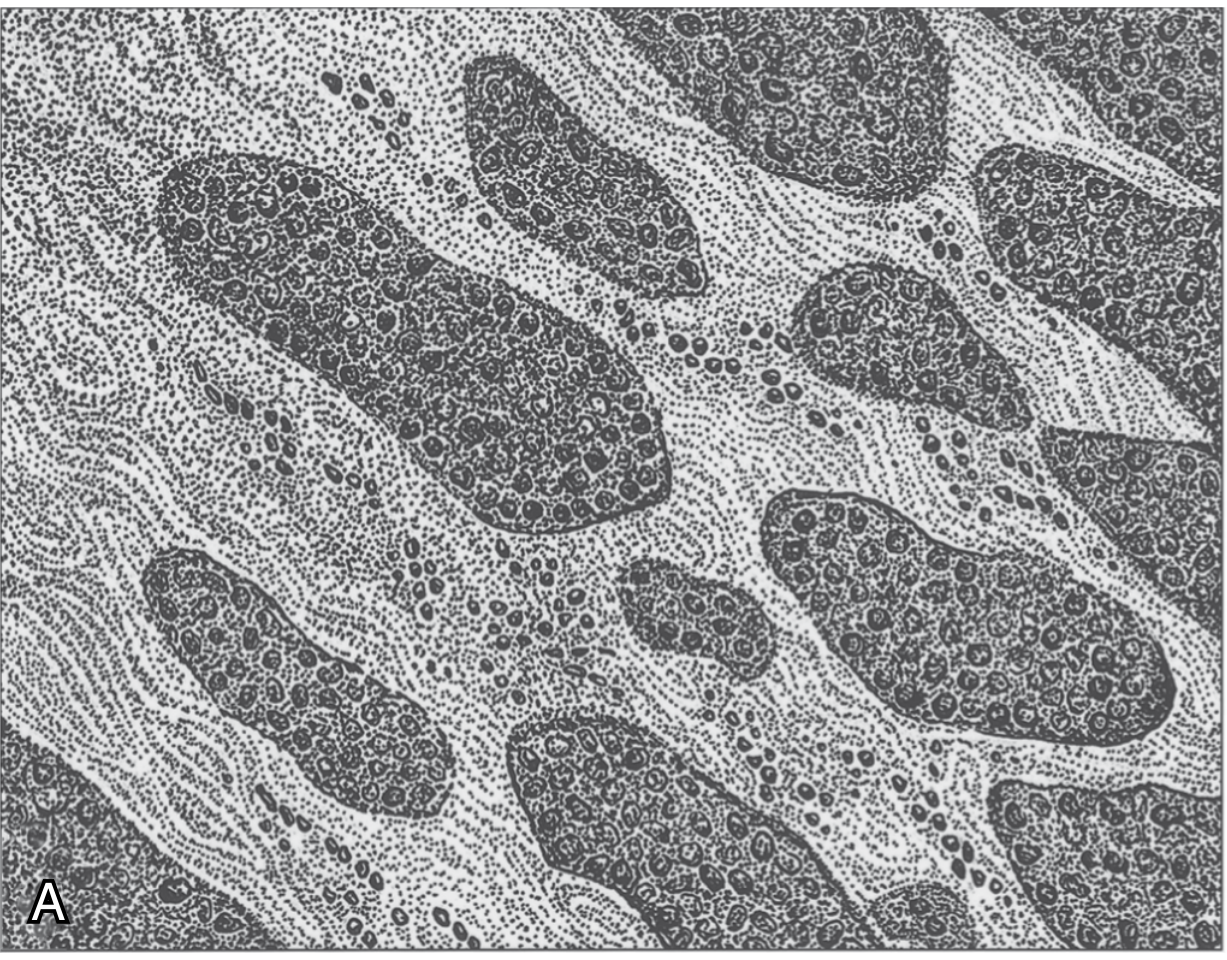
Low-power histology showing nests of malignant ductal cells embedded in desmoplastic fibrous stroma - characteristic appearance of invasive ductal carcinoma.
14. SUMMARY BOXES FROM BAILEY & LOVE
Summary Box 58.5 - Indications for Genetic Risk Evaluation in Breast Cancer
- First-degree relative with bilateral breast cancer or breast + ovarian cancer
- Multiple (≥3) relatives with breast or ovarian cancer in same lineage
- Breast cancer in male relative
- Breast cancer diagnosed <40 years
- Ashkenazi Jewish ancestry with breast cancer in family
- Known BRCA mutation in family
Sources:
- Bailey & Love's Short Practice of Surgery, 28th Edition - Chapter 58: The Breast
- Sabiston Textbook of Surgery: The Biological Basis of Modern Surgical Practice - Chapter 68: Diseases of the Breast
Recent Evidence Note (PubMed 2024-2026): A systematic review (Baker et al., Breast, 2024 - PMID 39270543) confirmed that atypical ductal/lobular hyperplasia, LCIS, and flat epithelial atypia all significantly elevate future breast cancer risk, consistent with the non-modifiable risk factor data presented above. This supports current surveillance and chemoprevention protocols for these high-risk lesions.
---Here is the complete comprehensive breast cancer reference compiled directly from both textbooks, with key figures included.
What's Covered
This document integrates data from 14 major sections across both surgical textbooks:
| Section | Primary Source |
|---|---|
| Epidemiology | B&L Ch. 58 |
| Anatomy (with 2 diagrams) | Sabiston Ch. 68 |
| Risk Factors (full table) | B&L Table 58.3 |
| Pathology - all histological types | B&L + Sabiston |
| Nottingham grading system | Both |
| Molecular classification (5 subtypes) | B&L Table 58.4 + Sabiston |
| Clinical features + 2 clinical photos | B&L |
| Triple assessment & investigations | B&L |
| TNM Staging (AJCC 8th Ed.) | B&L + Sabiston |
| Surgical treatment (BCS, mastectomy, axilla) | Sabiston |
| Radiotherapy | Sabiston |
| Systemic therapy (chemo, endocrine, HER2, CDK4/6i) | Both |
| Chemoprevention (4-drug table with trials) | Sabiston |
| Special scenarios (hereditary, pregnancy, DCIS, inflammatory, male, recurrence, metastatic) | Both |
| Reconstruction | B&L |
| Screening + Prognosis + Multigene assays | Both |
Figures included:
- Sabiston Fig. 68.1 - Breast anatomy cutaway diagram
- Sabiston Fig. 68.2 - TDLU microscopic anatomy
- B&L Fig. 58.28 - Inflammatory carcinoma + peau d'orange (clinical photo)
- Sabiston Fig. 68.9A - IDC histology (low power)
Make pdf of this
Reading File
Running Command
ls /home/daytona/workspace/ && mkdir -p /home/daytona/workspace/breast-cancer-pdf
Writing File
~/breast-cancer-pdf/generate_pdf.py
#!/usr/bin/env python3
"""Generate a comprehensive breast cancer PDF from Bailey & Love + Sabiston content."""
from reportlab.lib.pagesizes import A4
from reportlab.lib.styles import getSampleStyleSheet, ParagraphStyle
from reportlab.lib.units import cm, mm
from reportlab.lib import colors
from reportlab.platypus import (
SimpleDocTemplate, Paragraph, Spacer, Table, TableStyle,
HRFlowable, PageBreak, Image, KeepTogether
)
from reportlab.lib.enums import TA_LEFT, TA_CENTER, TA_JUSTIFY
from reportlab.platypus.flowables import Flowable
import urllib.request
import os
import io
# ── Output path ──────────────────────────────────────────────────────────────
OUTPUT = "/home/daytona/workspace/breast-cancer-pdf/Breast_Cancer_Comprehensive_Reference.pdf"
IMG_DIR = "/home/daytona/workspace/breast-cancer-pdf/images"
os.makedirs(IMG_DIR, exist_ok=True)
# ── Download images ──────────────────────────────────────────────────────────
IMAGES = {
"anatomy_breast.png": "https://cdn.orris.care/cdss_images/a4d4069712df041821571dfb308c52e6ebf541afb9976f23c8c860c10c1f05a0.png",
"tdlu_diagram.png": "https://cdn.orris.care/cdss_images/b845f6af92644f552b1a45fa82cbd900948b40f1159f127632a589b337f2dda2.png",
"inflammatory_ca.png": "https://cdn.orris.care/cdss_images/7c1307190782fab9bf42e74ad602793b17aa812d69dbc97d345f39a5c6dfc5c8.png",
"idc_histology.png": "https://cdn.orris.care/cdss_images/a7976dc8796d45630b8035ab7b9d9a51d19ab1a1da0a00fe3a1a2be2d02c2b2c.png",
}
for fname, url in IMAGES.items():
dest = os.path.join(IMG_DIR, fname)
if not os.path.exists(dest):
print(f"Downloading {fname}...")
try:
urllib.request.urlretrieve(url, dest)
print(f" OK: {dest}")
except Exception as e:
print(f" FAILED: {e}")
# ── Colour palette ───────────────────────────────────────────────────────────
DARK_BLUE = colors.HexColor("#1a3a5c")
MID_BLUE = colors.HexColor("#2e6da4")
LIGHT_BLUE = colors.HexColor("#dce9f5")
ACCENT = colors.HexColor("#c0392b") # red accent for headings
TABLE_HDR = colors.HexColor("#2e6da4")
TABLE_ALT = colors.HexColor("#f0f5fb")
WHITE = colors.white
GRAY_TEXT = colors.HexColor("#444444")
BORDER = colors.HexColor("#aec6e0")
# ── Styles ───────────────────────────────────────────────────────────────────
styles = getSampleStyleSheet()
def S(name, **kw):
return ParagraphStyle(name, **kw)
TITLE_STYLE = S("MainTitle",
fontName="Helvetica-Bold", fontSize=22, textColor=WHITE,
alignment=TA_CENTER, spaceAfter=4)
SUBTITLE_STYLE = S("Subtitle",
fontName="Helvetica", fontSize=11, textColor=colors.HexColor("#cce0f5"),
alignment=TA_CENTER, spaceAfter=2)
H1 = S("H1",
fontName="Helvetica-Bold", fontSize=14, textColor=WHITE,
backColor=DARK_BLUE, borderPadding=(6,8,6,8),
spaceBefore=14, spaceAfter=6)
H2 = S("H2",
fontName="Helvetica-Bold", fontSize=12, textColor=DARK_BLUE,
spaceBefore=10, spaceAfter=4, borderPadding=(2,0,2,0))
H3 = S("H3",
fontName="Helvetica-BoldOblique", fontSize=10.5, textColor=MID_BLUE,
spaceBefore=7, spaceAfter=3)
BODY = S("Body",
fontName="Helvetica", fontSize=9.5, textColor=GRAY_TEXT,
leading=14, spaceAfter=5, alignment=TA_JUSTIFY)
BODY_B = S("BodyBold",
fontName="Helvetica-Bold", fontSize=9.5, textColor=GRAY_TEXT,
leading=14, spaceAfter=5)
BULLET = S("Bullet",
fontName="Helvetica", fontSize=9.5, textColor=GRAY_TEXT,
leading=13, leftIndent=14, firstLineIndent=-10, spaceAfter=3,
alignment=TA_LEFT)
BULLET2 = S("Bullet2",
fontName="Helvetica", fontSize=9, textColor=GRAY_TEXT,
leading=12, leftIndent=26, firstLineIndent=-10, spaceAfter=2)
CAPTION = S("Caption",
fontName="Helvetica-Oblique", fontSize=8.5, textColor=colors.HexColor("#555555"),
alignment=TA_CENTER, spaceAfter=8, spaceBefore=3)
SOURCE = S("Source",
fontName="Helvetica-Oblique", fontSize=8, textColor=colors.HexColor("#777777"),
alignment=TA_RIGHT, spaceAfter=3)
NOTE = S("Note",
fontName="Helvetica-Oblique", fontSize=8.5, textColor=colors.HexColor("#555555"),
backColor=colors.HexColor("#fff8e1"), borderPadding=6,
borderColor=colors.HexColor("#f0c040"), borderWidth=1,
leading=12, spaceAfter=8)
# ── Helper: table style ──────────────────────────────────────────────────────
def make_table(data, col_widths, hdr_rows=1, alt=True):
ts = TableStyle([
("BACKGROUND", (0,0), (-1, hdr_rows-1), TABLE_HDR),
("TEXTCOLOR", (0,0), (-1, hdr_rows-1), WHITE),
("FONTNAME", (0,0), (-1, hdr_rows-1), "Helvetica-Bold"),
("FONTSIZE", (0,0), (-1, hdr_rows-1), 9),
("ALIGN", (0,0), (-1,-1), "LEFT"),
("VALIGN", (0,0), (-1,-1), "TOP"),
("FONTNAME", (0,hdr_rows), (-1,-1), "Helvetica"),
("FONTSIZE", (0,hdr_rows), (-1,-1), 8.5),
("TEXTCOLOR", (0,hdr_rows), (-1,-1), GRAY_TEXT),
("ROWBACKGROUNDS", (0,hdr_rows), (-1,-1),
[TABLE_ALT, WHITE] if alt else [WHITE]),
("GRID", (0,0), (-1,-1), 0.5, BORDER),
("LEFTPADDING", (0,0), (-1,-1), 6),
("RIGHTPADDING", (0,0), (-1,-1), 6),
("TOPPADDING", (0,0), (-1,-1), 4),
("BOTTOMPADDING",(0,0), (-1,-1), 4),
("ROWBACKGROUNDS", (0,0), (-1, hdr_rows-1), [TABLE_HDR]),
])
t = Table(data, colWidths=col_widths, repeatRows=hdr_rows)
t.setStyle(ts)
return t
# ── Helper: section banner ────────────────────────────────────────────────────
def section_banner(number, title):
return Paragraph(f"<b>{number}. {title}</b>", H1)
def h2(text):
return Paragraph(f"<b>{text}</b>", H2)
def h3(text):
return Paragraph(text, H3)
def body(text):
return Paragraph(text, BODY)
def bullet(text, level=1):
st = BULLET if level == 1 else BULLET2
return Paragraph(f"• {text}", st)
def sp(h=6):
return Spacer(1, h)
def hr():
return HRFlowable(width="100%", thickness=0.5, color=BORDER, spaceAfter=4, spaceBefore=4)
def img(path, width, caption=""):
items = []
if os.path.exists(path):
im = Image(path, width=width, kind="proportional")
im.hAlign = "CENTER"
items.append(im)
if caption:
items.append(Paragraph(caption, CAPTION))
return items
# ── Cover page builder ────────────────────────────────────────────────────────
class ColorRect(Flowable):
def __init__(self, w, h, fill_color, radius=4):
super().__init__()
self.width = w; self.height = h
self.fill_color = fill_color; self.radius = radius
def draw(self):
self.canv.setFillColor(self.fill_color)
self.canv.roundRect(0, 0, self.width, self.height, self.radius, fill=1, stroke=0)
def cover_elements(page_w, page_h):
"""Return flowables for a styled cover page."""
elems = []
elems.append(sp(60))
# Title box
box_w = page_w - 4*cm
box = Table([[Paragraph(
"<b>BREAST CANCER</b><br/>"
"<font size=14 color='#cce0f5'>Comprehensive Surgical Reference</font>",
S("CT", fontName="Helvetica-Bold", fontSize=26, textColor=WHITE, alignment=TA_CENTER, leading=34)
)]], colWidths=[box_w])
box.setStyle(TableStyle([
("BACKGROUND", (0,0), (-1,-1), DARK_BLUE),
("LEFTPADDING", (0,0), (-1,-1), 20),
("RIGHTPADDING", (0,0), (-1,-1), 20),
("TOPPADDING", (0,0), (-1,-1), 28),
("BOTTOMPADDING", (0,0), (-1,-1), 28),
("ALIGN", (0,0), (-1,-1), "CENTER"),
("VALIGN", (0,0), (-1,-1), "MIDDLE"),
]))
elems.append(box)
elems.append(sp(18))
sources = [
["Primary Sources:"],
["Bailey & Love's Short Practice of Surgery, 28th Edition"],
["Sabiston Textbook of Surgery (The Biological Basis of Modern Surgical Practice)"],
]
src_table = Table([[Paragraph(
"<b>Primary Sources:</b><br/>"
"• Bailey & Love's Short Practice of Surgery, 28th Edition — Chapter 58: The Breast<br/>"
"• Sabiston Textbook of Surgery — Chapter 68: Diseases of the Breast",
S("ST", fontName="Helvetica", fontSize=10.5, textColor=DARK_BLUE, leading=16, alignment=TA_CENTER)
)]], colWidths=[box_w])
src_table.setStyle(TableStyle([
("BACKGROUND", (0,0), (-1,-1), LIGHT_BLUE),
("LEFTPADDING", (0,0), (-1,-1), 18),
("RIGHTPADDING", (0,0), (-1,-1), 18),
("TOPPADDING", (0,0), (-1,-1), 14),
("BOTTOMPADDING", (0,0), (-1,-1), 14),
("ALIGN", (0,0), (-1,-1), "CENTER"),
("BOX", (0,0), (-1,-1), 1, BORDER),
]))
elems.append(src_table)
elems.append(sp(20))
# Summary boxes
topics = [
"Epidemiology & Risk Factors", "Anatomy & Physiology",
"Pathology & Molecular Classification", "Staging (AJCC 8th Ed.)",
"Surgical Management", "Systemic Therapy",
"Radiotherapy", "Screening & Prognosis",
"Special Scenarios", "Breast Reconstruction",
]
rows = []
for i in range(0, len(topics), 2):
row = []
for j in range(2):
if i+j < len(topics):
row.append(Paragraph(f"✓ {topics[i+j]}",
S("TT", fontName="Helvetica", fontSize=9.5, textColor=DARK_BLUE, leading=13)))
else:
row.append("")
rows.append(row)
toc_box = Table(rows, colWidths=[box_w/2, box_w/2])
toc_box.setStyle(TableStyle([
("BACKGROUND", (0,0), (-1,-1), colors.HexColor("#f4f8fd")),
("GRID", (0,0), (-1,-1), 0.4, BORDER),
("LEFTPADDING", (0,0), (-1,-1), 10),
("RIGHTPADDING", (0,0), (-1,-1), 10),
("TOPPADDING", (0,0), (-1,-1), 5),
("BOTTOMPADDING", (0,0), (-1,-1), 5),
]))
elems.append(toc_box)
elems.append(sp(30))
elems.append(Paragraph("Compiled June 2026", S("D",
fontName="Helvetica-Oblique", fontSize=9, textColor=colors.HexColor("#888888"),
alignment=TA_CENTER)))
elems.append(PageBreak())
return elems
# ── Main content builder ──────────────────────────────────────────────────────
def build_content():
W = A4[0] - 4*cm # usable width
elems = []
# ── SECTION 1: EPIDEMIOLOGY ───────────────────────────────────────────────
elems.append(section_banner("1", "EPIDEMIOLOGY"))
elems.append(body("Breast cancer is the most frequent cancer among women worldwide, with an estimated <b>2.3 million new cases</b> diagnosed globally in 2020, representing approximately <b>25%</b> of all cancers in women."))
elems.append(sp(4))
epi_data = [
["Region", "Incidence (per 100,000 women)"],
["Middle Africa / East Asia", "27"],
["South Asia", "~28–35"],
["North America", "92"],
["Western Europe", "~85–90"],
]
elems.append(make_table(epi_data, [W*0.65, W*0.35]))
elems.append(sp(4))
for b_text in [
"In Western Europe: <b>~1 in 9</b> women will develop breast cancer (3–5% of all female deaths)",
"In resource-poor countries: <b>1 in 28</b> women; for every 2 diagnosed, 1 dies",
"Median age at presentation: ~<b>60 years</b> (UK/USA); ~<b>48 years</b> in South Asia",
"Breast cancer accounts for the <b>leading cause of cancer-related death</b> in women globally",
]:
elems.append(bullet(b_text))
elems.append(Paragraph("<i>Source: Bailey & Love, Ch. 58</i>", SOURCE))
# ── SECTION 2: ANATOMY ───────────────────────────────────────────────────
elems.append(section_banner("2", "ANATOMY"))
elems.append(h2("2.1 Gross Anatomy"))
for b_text in [
"The breast lies between the skin/subdermal adipose tissue and the <b>superficial pectoral fascia</b>, overlying the pectoralis major muscle",
"<b>Cooper's ligaments</b> (suspensory ligaments) run between the chest wall and dermis — infiltration by cancer causes skin <b>dimpling / peau d'orange</b>",
"Three principal tissue types: (1) glandular epithelium, (2) fibrous stroma, (3) adipose tissue",
"<b>15–20 lobes</b>, each ending in a lactiferous duct opening at the nipple; each duct has a dilated lactiferous sinus below the NAC",
"<b>Terminal duct lobular units (TDLUs)</b> = acini + small efferent ductules = the functional milk-forming unit",
"In adolescents: predominant epithelium + stroma; in postmenopausal females: glandular structures largely replaced by adipose tissue",
]:
elems.append(bullet(b_text))
elems.append(Paragraph("<i>Source: Sabiston, Ch. 68</i>", SOURCE))
# Anatomy image
anat_img = os.path.join(IMG_DIR, "anatomy_breast.png")
for el in img(anat_img, W,
"FIGURE 68.1 (Sabiston): Cutaway diagram of a mature resting breast showing Cooper ligaments, "
"lactiferous ducts, TDLU, nipple-areolar complex, pectoralis major, and retromammary fat."):
elems.append(el)
elems.append(h2("2.2 Microanatomy — Terminal Duct Lobular Unit (TDLU)"))
tdlu_img = os.path.join(IMG_DIR, "tdlu_diagram.png")
for el in img(tdlu_img, W*0.65,
"FIGURE 68.2 (Sabiston): The terminal duct lobular unit (TDLU) showing intralobular terminal duct, "
"lobular acini, intralobular stroma, and extralobular stroma."):
elems.append(el)
elems.append(h2("2.3 Lymphatic Drainage"))
lymph_data = [
["Route", "Proportion", "Notes"],
["Axillary nodes (Levels I–III)", "~75%", "Primary drainage from all quadrants"],
["Internal mammary nodes", "~20%", "Medial / central tumours"],
["Rotter's nodes", "Minor", "Between pectoralis major and minor"],
["Supraclavicular nodes", "Advanced", "Skip metastasis or disease progression"],
]
elems.append(make_table(lymph_data, [W*0.38, W*0.18, W*0.44]))
elems.append(Paragraph("<i>Source: Sabiston, Ch. 68; Bailey & Love, Ch. 58</i>", SOURCE))
# ── SECTION 3: RISK FACTORS ───────────────────────────────────────────────
elems.append(section_banner("3", "RISK FACTORS"))
elems.append(Paragraph("Risk factors are divided into modifiable and non-modifiable categories (Table 58.3, Bailey & Love).", BODY))
rf_data = [
["Risk Factor", "Relative Risk / Details"],
["MODIFIABLE", ""],
["Obesity (BMI >30)", "RR = 1.29 in postmenopausal women"],
["Nulliparity / first pregnancy >35 yrs", "Increased oestrogenic exposure"],
["Breastfeeding >12 months", "Protective — greater effect with longer duration"],
["HRT use >10 years", "RR = 1.2"],
["Tobacco: >25 cigarettes/day", "RR = 1.14"],
["Alcohol: light (<1 drink/day)", "RR = 1.05"],
["Alcohol: moderate (3–4 drinks/day)", "RR = 1.32"],
["Alcohol: heavy (>4 drinks/day)", "RR = 1.46"],
["Radiation exposure", "RR = 6"],
["NON-MODIFIABLE", ""],
["Age", "Median presentation ~60 yrs (West), ~48 yrs (Asia)"],
["Early menarche / late menopause", "Prolonged oestrogen exposure"],
["BRCA1 mutation (17q21)", "50–85% lifetime breast cancer risk; 40% ovarian cancer"],
["BRCA2 mutation (13q12.3)", "50–60% lifetime breast cancer risk; 20% ovarian cancer"],
["Prior breast cancer / LCIS / ADH", "Significantly elevated risk"],
["Dense breast tissue", "Higher mammographic density = higher risk"],
["First-degree family history", "~2× relative risk"],
["Previous chest RT (e.g. lymphoma)", "High risk if exposure in adolescence"],
]
# Style sub-headers
rf_ts = TableStyle([
("BACKGROUND", (0,0), (-1,0), TABLE_HDR),
("TEXTCOLOR", (0,0), (-1,0), WHITE),
("FONTNAME", (0,0), (-1,0), "Helvetica-Bold"),
("FONTSIZE", (0,0), (-1,0), 9),
("BACKGROUND", (0,1), (-1,1), colors.HexColor("#1a5276")),
("TEXTCOLOR", (0,1), (-1,1), WHITE),
("FONTNAME", (0,1), (-1,1), "Helvetica-Bold"),
("BACKGROUND", (0,11), (-1,11), colors.HexColor("#1a5276")),
("TEXTCOLOR", (0,11), (-1,11), WHITE),
("FONTNAME", (0,11), (-1,11), "Helvetica-Bold"),
("ROWBACKGROUNDS", (0,2), (-1,10), [TABLE_ALT, WHITE]),
("ROWBACKGROUNDS", (0,12), (-1,-1), [TABLE_ALT, WHITE]),
("GRID", (0,0), (-1,-1), 0.5, BORDER),
("FONTNAME", (0,2), (-1,-1), "Helvetica"),
("FONTSIZE", (0,2), (-1,-1), 8.5),
("TEXTCOLOR", (0,2), (-1,-1), GRAY_TEXT),
("LEFTPADDING", (0,0), (-1,-1), 6),
("RIGHTPADDING", (0,0), (-1,-1), 6),
("TOPPADDING", (0,0), (-1,-1), 4),
("BOTTOMPADDING",(0,0), (-1,-1), 4),
("SPAN", (0,1), (1,1)),
("SPAN", (0,11),(1,11)),
])
t = Table(rf_data, colWidths=[W*0.55, W*0.45], repeatRows=1)
t.setStyle(rf_ts)
elems.append(t)
elems.append(Paragraph("<i>Source: Bailey & Love, Table 58.3</i>", SOURCE))
# ── SECTION 4: PATHOLOGY ─────────────────────────────────────────────────
elems.append(section_banner("4", "PATHOLOGY"))
elems.append(h2("4.1 Origin of Breast Carcinoma"))
elems.append(body("<b>90%</b> arise from milk ducts (ductal carcinoma) | <b>10%</b> from lobules (lobular carcinoma)"))
for b_text in [
"<b>In situ disease</b>: malignant cells confined within duct/lobule without breaching the basement membrane",
"<b>Invasive (infiltrating) carcinoma</b>: breach of basement membrane with invasion of surrounding tissue",
]:
elems.append(bullet(b_text))
elems.append(h2("4.2 Histological Types"))
hist_data = [
["Histological Type", "Frequency", "Key Features", "Prognosis"],
["Invasive Ductal Carcinoma (IDC / NST)", "50–70%",
"Grows as cohesive mass; discrete on mammogram; palpable lump", "Variable (grade-dependent)"],
["Invasive Lobular Carcinoma (ILC)", "5–15%",
"Single-file infiltration; clinically occult; escapes mammography; CDH1 mutation (loss of E-cadherin)", "Often similar to IDC"],
["Tubular carcinoma", "~2–3%",
"Small glands, single row of bland epithelium; Grade 1", "Excellent"],
["Mucinous / Colloid", "~2–3%",
"Cells floating in copious mucin; Grade 1", "Excellent"],
["Medullary carcinoma", "~5%",
"Bizarre high-grade cells; syncytial sheets; lymphocytic infiltrate; ER/PR/HER2 negative", "Moderate (despite grade 3)"],
["Papillary carcinoma", "0.5–1%",
"Fibrovascular core + epithelial/myoepithelial cells; usually ER+; rarely node-positive", "Good"],
["Metaplastic carcinoma", "<1%",
"High grade; ER/PR/HER2 negative; node-negative but high metastatic potential; ~50% relapse", "Poor"],
]
elems.append(make_table(hist_data, [W*0.26, W*0.1, W*0.42, W*0.22]))
elems.append(h2("4.3 Nottingham Histological Grade (Modified Bloom–Richardson Score)"))
elems.append(body("Three criteria scored 1–3 each:"))
grade_data = [
["Criterion", "Score 1", "Score 2", "Score 3"],
["Tubule/gland formation", ">75% of tumour", "10–75%", "<10%"],
["Nuclear pleomorphism", "Small, regular", "Moderate", "Marked variation"],
["Mitotic rate (per HPF)", "Low", "Intermediate", "High"],
]
elems.append(make_table(grade_data, [W*0.3, W*0.23, W*0.23, W*0.24]))
elems.append(sp(4))
final_data = [
["Total Score", "Grade", "Differentiation"],
["3–5", "Grade I", "Well differentiated"],
["6–7", "Grade II", "Moderately differentiated"],
["8–9", "Grade III", "Poorly differentiated"],
]
elems.append(make_table(final_data, [W*0.25, W*0.25, W*0.50]))
elems.append(h2("4.4 Molecular Classification (PAM-50 / Immunohistochemistry)"))
mol_data = [
["Subtype", "ER/PR Status", "HER2", "Ki-67", "Notes"],
["Luminal A", "Positive", "Negative", "Low", "Best prognosis; low-grade; endocrine-responsive"],
["Luminal B", "Positive", "Negative", "High", "Intermediate prognosis; may need chemo"],
["HER2/neu enriched", "Negative", "Positive", "High", "HER2-targeted therapy needed"],
["Basal (TNBC)", "Negative", "Negative", "Usually high", "Associated with BRCA1; chemotherapy backbone"],
["Claudin-low", "Negative", "Negative", "Variable", "Stem cell features; poor prognosis"],
]
elems.append(make_table(mol_data, [W*0.2, W*0.14, W*0.1, W*0.1, W*0.46]))
elems.append(Paragraph("<i>Source: Bailey & Love, Table 58.4; Sabiston, Ch. 68</i>", SOURCE))
elems.append(h2("4.5 Key Molecular Markers (Sabiston)"))
marker_data = [
["Marker", "Method", "Cut-off / Scoring", "Clinical Use"],
["ER / PR", "IHC", ">1% positive nuclei = positive; 1–10% = low ER", "Endocrine therapy eligibility"],
["HER2", "IHC + ISH", "0/1+ = negative; 3+ = positive; 2+ → ISH confirmation", "HER2-targeted therapy"],
["Ki-67", "IHC", "% positive nuclei (high if >20–30%)", "Proliferation; luminal A vs B distinction"],
["Oncotype DX", "21-gene RT-PCR", "Recurrence score 0–100", "Chemo benefit in ER+/HER2-/node−"],
["MammaPrint", "70-gene array", "Low vs. high risk", "Adjuvant chemo decision (MINDACT trial)"],
]
elems.append(make_table(marker_data, [W*0.15, W*0.15, W*0.35, W*0.35]))
elems.append(h2("4.6 Ductal Carcinoma In Situ (DCIS)"))
for b_text in [
"Malignant cells confined within ducts without invasion of basement membrane",
"Classified by nuclear grade (low/intermediate/high) and necrosis (comedonecrosis = most aggressive subtype)",
"Detected predominantly by screening mammography (<b>microcalcifications</b>)",
"Prevalence of lymphatic/metastatic spread in pure DCIS: <b><1%</b> → systemic chemotherapy NOT required",
"<b>LCIS</b> = high-risk benign lesion, NOT a cancer (AJCC 8th edition); bilateral risk marker",
]:
elems.append(bullet(b_text))
# Histology image
elems.append(h2("4.7 Histopathology — Invasive Ductal Carcinoma"))
hist_img = os.path.join(IMG_DIR, "idc_histology.png")
for el in img(hist_img, W*0.75,
"FIGURE 68.9A (Sabiston): Low-power histology of invasive ductal carcinoma showing nests of "
"malignant ductal cells embedded in desmoplastic fibrous stroma."):
elems.append(el)
elems.append(Paragraph("<i>Source: Bailey & Love, Ch. 58; Sabiston, Ch. 68</i>", SOURCE))
# ── SECTION 5: CLINICAL FEATURES ─────────────────────────────────────────
elems.append(section_banner("5", "CLINICAL FEATURES & SPREAD"))
elems.append(h2("5.1 Presenting Symptoms"))
for b_text in [
"Painless lump in the breast (most common presentation)",
"New nipple retraction / inversion",
"Blood-stained nipple discharge",
"Skin changes: dimpling, puckering, peau d'orange",
"Change in breast size or asymmetry",
"Axillary lump (nodal metastasis)",
"Bone pain, dyspnoea, jaundice (metastatic disease)",
]:
elems.append(bullet(b_text))
elems.append(h2("5.2 Clinical Signs — Photographs"))
clin_img = os.path.join(IMG_DIR, "inflammatory_ca.png")
for el in img(clin_img, W,
"FIGURE 58.28 (Bailey & Love): (a) Inflammatory carcinoma — diffuse erythema and skin oedema "
"involving >1/3 of the breast with enlarged left breast. (b) Peau d'orange — orange-peel "
"skin appearance indicating locally advanced disease. In darker skin, erythema takes on a brownish hue."):
elems.append(el)
elems.append(h2("5.3 Mechanism of Skin Signs (Bailey & Love)"))
mech_data = [
["Sign", "Mechanism"],
["Skin dimpling", "Single Cooper's ligament shortened by desmoplastic collagen contraction"],
["Puckering / tethering", "Multiple Cooper's ligaments contracted"],
["Nipple retraction", "Central subareolar involvement of Cooper's ligaments"],
["Peau d'orange", "Dermal lymphatic blockage → skin oedema; pores become prominent"],
["Skin ulceration", "Direct tumour invasion through dermis (T4b)"],
["Erythema (inflammatory)", "Dermal lymphatic invasion by tumour emboli; NOT infection"],
]
elems.append(make_table(mech_data, [W*0.35, W*0.65]))
elems.append(body("Tumour releases <b>FGF, TGFα, TGFβ, VEGF</b> → desmoplastic reaction (fibrocytes → fibroblasts → collagen) → contraction of Cooper's ligaments."))
elems.append(h2("5.4 Modes of Spread"))
spread_data = [
["Route", "Details", "Common Sites"],
["Local spread", "Skin → ulceration, satellite nodules; chest wall, pectoralis", "Ipsilateral breast"],
["Lymphatic", "Most common initial route; Level I→II→III axillary nodes; internal mammary", "Axilla (primary)"],
["Haematogenous", "Via intercostal perforators and internal mammary veins",
"Bone (most common) > Lung > Liver > Brain > Adrenal"],
]
elems.append(make_table(spread_data, [W*0.2, W*0.42, W*0.38]))
elems.append(Paragraph("<i>Source: Bailey & Love, Ch. 58</i>", SOURCE))
# ── SECTION 6: INVESTIGATIONS ─────────────────────────────────────────────
elems.append(section_banner("6", "INVESTIGATIONS — TRIPLE ASSESSMENT"))
elems.append(body("The <b>triple assessment</b> is the gold standard for diagnosis:"))
triple_data = [
["Component", "Methods", "Notes"],
["1. Clinical examination", "History + full breast/axilla examination", "Assess lump characteristics, skin, nodes"],
["2. Imaging", "Mammography ± Ultrasound ± MRI", "See below for details"],
["3. Pathology", "Core needle biopsy (preferred) or FNAC", "Gives histology, grade, ER/PR/HER2"],
]
elems.append(make_table(triple_data, [W*0.22, W*0.38, W*0.40]))
elems.append(h2("6.1 Imaging Modalities"))
img_data = [
["Modality", "Indications", "Features of Malignancy"],
["Mammography (2-view: CC + MLO)",
"Standard screening ≥40 yrs; symptomatic women",
"Spiculate mass, pleomorphic/linear microcalcifications, architectural distortion"],
["Ultrasound",
"Dense breasts, <35 yrs, palpable lumps, guided biopsy",
"Irregular hypoechoic mass; posterior acoustic shadowing; vascularity"],
["MRI Breast",
"BRCA carriers; extent assessment; neoadjuvant response; implants",
"Highest sensitivity; low specificity → guided biopsy needed for MRI-only lesions"],
["PET-CT (18F-FDG)",
"Metastatic work-up, treatment response",
"FDG-avid primary + nodes + distant metastases"],
]
elems.append(make_table(img_data, [W*0.28, W*0.32, W*0.40]))
elems.append(h2("6.2 Staging Investigations"))
for b_text in [
"<b>T3/T4 or N2/N3 disease</b>: CT chest/abdomen/pelvis + isotope bone scan",
"<b>Early cancer (T1/T2, N0/N1)</b>: staging work-up only if symptomatic or raised serum ALP",
"<b>PET-CT</b> may be used as alternative for metastatic work-up",
]:
elems.append(bullet(b_text))
elems.append(Paragraph("<i>Source: Bailey & Love, Ch. 58</i>", SOURCE))
# ── SECTION 7: STAGING ────────────────────────────────────────────────────
elems.append(section_banner("7", "STAGING — AJCC/UICC TNM 8TH EDITION"))
elems.append(h2("7.1 T (Tumour) Classification"))
t_data = [
["T Category", "Definition"],
["Tis", "In situ (DCIS); LCIS is NOT staged as cancer"],
["T1mi", "Microinvasion ≤1.0 mm"],
["T1a", ">1 mm to ≤5 mm"],
["T1b", ">5 mm to ≤10 mm"],
["T1c", ">10 mm to ≤20 mm"],
["T2", ">20 mm to ≤50 mm"],
["T3", ">50 mm"],
["T4a", "Extension to chest wall (not pectoralis muscle)"],
["T4b", "Ulceration / satellite nodules / peau d'orange (skin involvement)"],
["T4c", "Both T4a and T4b"],
["T4d", "Inflammatory carcinoma"],
]
elems.append(make_table(t_data, [W*0.2, W*0.8]))
elems.append(h2("7.2 N (Node) Classification"))
n_data = [
["N Category", "Definition"],
["N0", "No regional node metastasis"],
["N1", "Movable ipsilateral Level I/II axillary nodes"],
["N2a", "Fixed/matted ipsilateral Level I/II axillary nodes"],
["N2b", "Clinically apparent internal mammary nodes only (no axillary)"],
["N3a", "Ipsilateral infraclavicular (Level III) nodes"],
["N3b", "Ipsilateral internal mammary + axillary nodes"],
["N3c", "Ipsilateral supraclavicular nodes"],
]
elems.append(make_table(n_data, [W*0.15, W*0.85]))
elems.append(h2("7.3 M (Metastasis) Classification"))
m_data = [
["M Category", "Definition"],
["M0", "No clinical or radiographic evidence of distant metastasis"],
["cM0(i+)", "Circulating tumor cells / micrometastasis detected without distant metastasis"],
["M1", "Distant metastasis (bone, lung, liver, brain, distant nodes, etc.)"],
]
elems.append(make_table(m_data, [W*0.2, W*0.8]))
elems.append(h2("7.4 Key Points of 8th Edition AJCC (Bailey & Love — Summary Box 58.3)"))
for b_text in [
"LCIS = high-risk benign lesion — <b>NOT classified as cancer</b>",
"Multiple synchronous tumours: use <b>(m) modifier</b> for T categorisation",
"Post-neoadjuvant therapy status: prefix <b>(y)</b>",
"<b>Pathological complete response (pCR)</b> = absence of tumour cells in breast AND axillary nodes",
"Inflammatory carcinoma remains classified as inflammatory even after complete neoadjuvant remission",
"T1mi = invasive foci <b>≤1.0 mm</b>; tumours >1 mm and <2 mm should be reported as 2 mm",
"8th edition adds: histological grade, ER/PR/HER2/Ki-67, <b>Oncotype DX</b>, neoadjuvant response to refine prognosis",
]:
elems.append(bullet(b_text))
elems.append(Paragraph("<i>Source: Bailey & Love, Ch. 58; Sabiston, Ch. 68</i>", SOURCE))
# ── SECTION 8: TREATMENT ─────────────────────────────────────────────────
elems.append(section_banner("8", "TREATMENT — MULTIMODAL APPROACH"))
elems.append(body("Treatment is <b>multimodal</b> (surgery + radiotherapy + systemic therapy). "
"All patients should be managed by a <b>multidisciplinary team (MDT)</b>: surgeon, radiologist, "
"pathologist, radiation oncologist, medical oncologist, breast care nurse, reconstructive surgeon."))
elems.append(h2("8.1 Breast-Conserving Surgery (BCS) / Lumpectomy"))
elems.append(body("<i>Synonyms: lumpectomy, partial mastectomy, wide local excision, segmental mastectomy, tylectomy</i>"))
for b_text in [
"Tumour excised with surrounding rim of grossly normal parenchyma; remainder of breast preserved",
"Non-palpable tumours: localization device required (wire, radioactive seed, SAVI Scout, ultrasound-guided)",
"Specimen oriented and inked before sectioning; specimen radiography for non-palpable lesions",
"Clips left in lumpectomy cavity for radiotherapy planning",
"Cavity shave margins at time of lumpectomy reduce positive margin rates (Level I evidence)",
]:
elems.append(bullet(b_text))
elems.append(h3("Margin Standards (SSO/ASTRO/ASCO Consensus — Sabiston):"))
margin_data = [
["Cancer Type", "Required Negative Margin", "Evidence Base"],
["Invasive breast cancer", '"No ink on tumour"',
"Meta-analysis, 28,162 patients; wider margins do NOT further reduce recurrence"],
["DCIS", "2 mm",
"Meta-analysis, 7,883 patients; 2 mm superior to 0–1 mm margins"],
]
elems.append(make_table(margin_data, [W*0.28, W*0.28, W*0.44]))
elems.append(body("Positive margins = <b>2-fold increase</b> in ipsilateral breast tumour recurrence risk."))
elems.append(h2("8.2 Mastectomy — Types and Indications"))
mast_data = [
["Type", "Description", "Main Indication"],
["Simple / Total mastectomy", "All breast tissue + NAC; no axillary dissection", "Prophylactic; DCIS; with SLNB"],
["Modified radical mastectomy (MRM)", "Simple mastectomy + Level I/II ALND; pectoralis preserved", "Node-positive invasive cancer"],
["Skin-sparing mastectomy", "Preserves skin envelope; removes NAC", "For immediate reconstruction"],
["Nipple-sparing mastectomy", "Preserves entire NAC", "BRCA prophylactic; selected small tumours away from NAC"],
]
elems.append(make_table(mast_data, [W*0.28, W*0.38, W*0.34]))
elems.append(h3("Indications for mastectomy over BCS:"))
for b_text in [
"Multicentric disease (multiple quadrants)",
"Large tumour-to-breast ratio with poor cosmesis",
"Prior radiotherapy to the ipsilateral breast",
"Positive margins after re-excision",
"BRCA mutation carriers (risk-reducing surgery)",
"Patient preference",
]:
elems.append(bullet(b_text))
elems.append(h2("8.3 Axillary Management"))
elems.append(h3("Sentinel Lymph Node Biopsy (SLNB):"))
for b_text in [
"Standard for clinically node-negative disease; uses blue dye ± radioisotope (Tc-99m)",
"If SLN negative: no further axillary treatment required",
"<b>ACOSOG Z0011 trial</b>: 1–2 positive SLNs in BCS + whole-breast RT → ALND NOT required",
]:
elems.append(bullet(b_text))
elems.append(h3("Axillary Lymph Node Dissection (ALND):"))
for b_text in [
"Level I and II nodes removed (typically ≥10 nodes)",
"Indications: positive SLN (selected), clinically positive nodes",
"Complications: lymphoedema (up to 20%), shoulder stiffness, sensory loss, seroma",
]:
elems.append(bullet(b_text))
elems.append(h2("8.4 Radiotherapy"))
rt_data = [
["Setting", "Regimen", "Indication"],
["After BCS (adjuvant)", "Standard: 50 Gy/25 fractions OR Hypofractionation: 40 Gy/15 fractions",
"All patients after BCS; hypofractionation now preferred"],
["Partial breast irradiation", "Various techniques (APBI, brachytherapy)",
"Low-risk patients; avoids whole breast radiation"],
["Post-mastectomy RT (PMRT)", "Chest wall ± nodal basins",
"T3/T4; ≥4 positive nodes; positive margins; N3 disease"],
["Nodal RT", "Axillary/supraclavicular/internal mammary",
"High-risk patients with nodal involvement"],
]
elems.append(make_table(rt_data, [W*0.22, W*0.42, W*0.36]))
elems.append(body("Adjuvant RT reduces locoregional recurrence and improves breast cancer-related mortality by eradicating residual occult disease."))
elems.append(h2("8.5 Systemic Therapy"))
elems.append(h3("A. Chemotherapy"))
chemo_data = [
["Regimen", "Drugs", "Use"],
["AC → T", "Doxorubicin + Cyclophosphamide → Paclitaxel/Docetaxel", "Standard adjuvant for high-risk"],
["TC", "Docetaxel + Cyclophosphamide", "Lower-risk HER2-negative"],
["AC → TH (+ P)", "AC → Taxane + Trastuzumab (+ Pertuzumab)", "HER2-positive (neoadjuvant/adjuvant)"],
["Capecitabine", "Oral fluoropyrimidine", "Residual TNBC after NACT (CREATE-X trial)"],
["T-DM1", "Ado-trastuzumab emtansine (antibody-drug conjugate)", "Residual HER2+ disease after NACT"],
]
elems.append(make_table(chemo_data, [W*0.2, W*0.44, W*0.36]))
elems.append(h3("B. Endocrine Therapy"))
endo_data = [
["Agent", "Patients", "Duration", "Key Effects"],
["Tamoxifen (SERM)", "ER+ premenopausal", "5–10 years",
"Reduces recurrence ~40%; contralateral BC ↓47%; risks: endometrial cancer, DVT/PE"],
["Aromatase Inhibitors (anastrozole, letrozole, exemestane)",
"ER+ postmenopausal", "5 years (or switch after tamoxifen)",
"Superior to tamoxifen in postmenopausal women; risks: osteoporosis, arthralgia"],
["GnRH agonist + AI", "High-risk premenopausal", "≥5 years", "For premenopausal women with high-risk ER+ cancer (SOFT/TEXT trials)"],
["CDK 4/6 inhibitors (palbociclib, ribociclib, abemaciclib)",
"Advanced/metastatic ER+/HER2−", "Until progression", "Significantly improves PFS in metastatic; abemaciclib approved adjuvant high-risk"],
]
elems.append(make_table(endo_data, [W*0.25, W*0.2, W*0.15, W*0.40]))
elems.append(h3("C. HER2-Targeted Therapy"))
her2_data = [
["Agent", "Mechanism", "Use"],
["Trastuzumab (Herceptin)", "Anti-HER2 monoclonal antibody", "1 year adjuvant; reduces recurrence ~50% in early HER2+ BC"],
["Pertuzumab", "HER2 dimerization inhibitor", "Combined with trastuzumab as dual blockade (neoadjuvant/adjuvant)"],
["T-DM1 (ado-trastuzumab emtansine)", "Antibody-drug conjugate", "Residual invasive HER2+ disease after NACT"],
["Lapatinib / Tucatinib / Neratinib", "Tyrosine kinase inhibitors", "Advanced/metastatic HER2+ disease"],
]
elems.append(make_table(her2_data, [W*0.3, W*0.3, W*0.4]))
elems.append(h3("D. Chemoprevention (Sabiston, Ch. 68)"))
prev_data = [
["Agent", "Population", "Trial", "Risk Reduction"],
["Tamoxifen 20 mg/day × 5 yrs",
"High-risk pre/postmenopausal (Gail score ≥1.7%, LCIS, ADH/ALH)",
"NSABP P-1",
"43% invasive BC; 59% in LCIS; 75% in ADH/ALH"],
["Raloxifene", "Postmenopausal women", "STAR trial",
"Similar to tamoxifen; fewer uterine side effects"],
["Anastrozole", "Postmenopausal high-risk women", "IBIS-II",
"~50% reduction"],
["Exemestane", "Postmenopausal high-risk women", "MAP.3",
"65% reduction"],
]
elems.append(make_table(prev_data, [W*0.28, W*0.28, W*0.14, W*0.30]))
elems.append(Paragraph("<i>Source: Bailey & Love, Ch. 58; Sabiston, Ch. 68</i>", SOURCE))
# ── SECTION 9: SPECIAL SCENARIOS ─────────────────────────────────────────
elems.append(section_banner("9", "SPECIAL SCENARIOS"))
elems.append(h2("9.1 Hereditary & Familial Breast Cancer (Bailey & Love)"))
for b_text in [
"<b>Hereditary breast cancer (HBC)</b>: 5–10% of all breast cancers; identifiable genetic mutation; more aggressive, earlier onset, multicentric, bilateral",
"<b>Familial breast cancer (FBC)</b>: 20–30%; family clustering without identified mutation",
"<b>Sporadic</b>: ~70% of all breast cancers",
]:
elems.append(bullet(b_text))
gene_data = [
["Gene", "Chromosome", "Lifetime Breast Cancer Risk", "Other Cancers", "Tumour Subtype"],
["BRCA1", "17q21", "50–85%", "Ovarian (40%)", "Mostly TNBC"],
["BRCA2", "13q12.3", "50–60%", "Ovarian (20%), prostate, colon, pancreas", "ER+ (usually)"],
["TP53", "17p13.1", "~50%", "Li-Fraumeni syndrome (sarcoma, brain, adrenal)", "Variable"],
["PTEN", "10q23.3", "25–50%", "Cowden syndrome (thyroid, endometrium)", "Variable"],
["STK11", "19p13.3", "~50%", "Peutz-Jeghers syndrome (GI polyposis)", "Variable"],
["CDH1", "16q22.1", "39–52%", "Diffuse gastric cancer", "Lobular (ILC)"],
]
elems.append(make_table(gene_data, [W*0.12, W*0.15, W*0.22, W*0.28, W*0.23]))
elems.append(h3("Management of BRCA Mutation Carriers:"))
for b_text in [
"<b>Bilateral risk-reducing mastectomy + immediate reconstruction</b>: reduces breast cancer risk by <b>90%</b>",
"<b>Chemoprophylaxis</b> (tamoxifen or anastrozole): reduces risk by <b>50%</b>",
"<b>Bilateral salpingo-oophorectomy (BSO)</b>: after family completion at ~35–40 years",
"Annual MRI + mammography from age 30 for surveillance",
]:
elems.append(bullet(b_text))
elems.append(h2("9.2 Breast Cancer in Pregnancy"))
for b_text in [
"Associated with aggressive tumour biology, particularly TNBC",
"Imaging: ultrasound first; mammogram with abdominal shielding; MRI without gadolinium preferred",
"Chemotherapy: generally safe <b>after 1st trimester</b>; avoid anthracyclines late in pregnancy",
"<b>Trastuzumab: contraindicated</b> in pregnancy (fetal renal toxicity)",
"Surgery can be performed in all trimesters",
"Termination of pregnancy does NOT improve prognosis",
]:
elems.append(bullet(b_text))
elems.append(h2("9.3 Inflammatory Breast Cancer"))
for b_text in [
"Clinical diagnosis: erythema + oedema involving <b>>1/3 of the breast</b>",
"Classified as <b>T4d</b> regardless of tumour size",
"Caused by <b>dermal lymphatic invasion</b> by tumour emboli — not infection",
"<b>Treatment: NACT first</b> → MRM + post-mastectomy radiation (NOT upfront surgery alone)",
"Remains classified as inflammatory carcinoma even after complete neoadjuvant remission (AJCC 8th)",
]:
elems.append(bullet(b_text))
elems.append(h2("9.4 Male Breast Cancer"))
for b_text in [
"Accounts for <b><1%</b> of all breast cancers",
"BRCA2 mutation more common than BRCA1 in male breast cancer",
"Mostly invasive ductal, ER positive",
"Mastectomy preferred over BCS (small breast volume)",
"Tamoxifen for hormonal therapy; AIs require concurrent GnRH agonist",
]:
elems.append(bullet(b_text))
elems.append(h2("9.5 DCIS Management (Sabiston)"))
dcis_data = [
["Treatment Option", "Key Evidence / Notes"],
["BCS + adjuvant RT", "Standard; 2 mm negative margin required"],
["Mastectomy", "For multicentric DCIS, large DCIS, patient preference"],
["Tamoxifen (ER+ DCIS, premenopausal)", "NSABP B-24: reduces ipsilateral recurrence (16.6% → 13.2%), contralateral BC ↓40%"],
["Anastrozole (ER+ DCIS, postmenopausal <60 yrs)", "NSABP B-35: anastrozole superior to tamoxifen in breast cancer-free survival"],
["Adjuvant endocrine therapy overall", "Reduces DCIS recurrence risk by ~50%"],
]
elems.append(make_table(dcis_data, [W*0.4, W*0.6]))
elems.append(h2("9.6 Local Recurrence & Metastatic Disease (Bailey & Love)"))
elems.append(h3("Local Recurrence:"))
for b_text in [
"Biopsy first — receptor status may change and influence therapy",
"Whole-body MRI or PET-CT to exclude distant metastasis",
"Systemic chemotherapy followed by surgical excision",
"Most surgeons perform mastectomy; second BCS + re-RT may be considered in selected cases",
]:
elems.append(bullet(b_text))
elems.append(h3("Metastatic Disease:"))
for b_text in [
"Bony metastasis: palliative RT to weight-bearing lesions + <b>bisphosphonates/denosumab</b>",
"Symptomatic pleural effusions: chest drainage + pleurodesis",
"Surgical resection of <b>solitary visceral metastasis</b> in good performance status",
"Systemic therapy: endocrine ± CDK4/6i (ER+), HER2 therapy (HER2+), chemotherapy, PARP inhibitors (BRCA mutation carriers)",
]:
elems.append(bullet(b_text))
elems.append(Paragraph("<i>Source: Bailey & Love, Ch. 58; Sabiston, Ch. 68</i>", SOURCE))
# ── SECTION 10: RECONSTRUCTION ───────────────────────────────────────────
elems.append(section_banner("10", "BREAST RECONSTRUCTION"))
rec_data = [
["Technique", "Description", "Advantages / Notes"],
["Tissue expander → implant", "Two-stage implant-based; expander placed, later exchanged for permanent implant ± ADM",
"Simpler surgery; no donor site; may need revision"],
["Direct-to-implant", "Single-stage implant placement with ADM",
"One operation; suitable for smaller breasts"],
["TRAM flap (pedicled/free)", "Transverse rectus abdominis myocutaneous flap from abdomen",
"Autologous; natural feel; sacricifes rectus muscle → hernia risk"],
["DIEP flap (free)", "Deep inferior epigastric perforator flap; no muscle sacrifice",
"Gold standard autologous; requires microsurgery; best donor site aesthetics"],
["LD flap", "Latissimus dorsi pedicled flap ± implant",
"Reliable; well-vascularised; often used after RT; smaller volume"],
["SGAP / IGAP", "Superior/inferior gluteal artery perforator free flap",
"Used when abdominal tissue unavailable; complex microsurgery"],
]
elems.append(make_table(rec_data, [W*0.22, W*0.42, W*0.36]))
elems.append(body("<b>Timing:</b> Immediate reconstruction (same operation as mastectomy — better psychological outcomes) "
"vs. delayed (after adjuvant therapy — safer when post-mastectomy RT is planned)."))
elems.append(Paragraph("<i>Source: Bailey & Love, Ch. 58</i>", SOURCE))
# ── SECTION 11: SCREENING ─────────────────────────────────────────────────
elems.append(section_banner("11", "SCREENING"))
screen_data = [
["Programme", "Age Range", "Frequency", "Modality"],
["UK NHS Breast Screening", "50–70 yrs (expanding 47–73)", "Every 3 years", "2-view mammography"],
["American Cancer Society (ACS)", "Annual from 40–45 yrs; biennial 55+", "Annual / biennial", "Mammography"],
["USPSTF", "50–74 yrs", "Every 2 years", "Mammography"],
["High-risk (BRCA/family hx)", "From age 30", "Annual", "MRI + mammography"],
]
elems.append(make_table(screen_data, [W*0.32, W*0.25, W*0.18, W*0.25]))
elems.append(body("Screening reduces breast cancer mortality by approximately <b>30–35%</b> in the screened population. "
"Down-staging at detection is the primary mechanism of benefit."))
# ── SECTION 12: PROGNOSIS ─────────────────────────────────────────────────
elems.append(section_banner("12", "PROGNOSIS & SURVIVAL"))
elems.append(h2("12.1 Prognostic Factors"))
prog_data = [
["Factor", "Significance"],
["Axillary node status", "Most powerful single prognostic factor overall"],
["Tumour size (T stage)", "Most important anatomical factor"],
["Histological grade", "Grade III = significantly worse prognosis"],
["ER/PR status", "ER+ = better prognosis; endocrine therapy responsive"],
["HER2 status", "HER2+ = worse prognosis without targeted therapy; HER2 therapy reverses this"],
["Ki-67 / proliferation index", "High Ki-67 = higher recurrence risk"],
["Lymphovascular invasion (LVI)", "Independent adverse prognostic factor"],
["pCR after neoadjuvant therapy", "Excellent prognostic marker, especially in HER2+ and TNBC"],
["Oncotype DX recurrence score", "Guides chemotherapy need in ER+/HER2-/node- (TAILORx trial)"],
["MammaPrint", "Low vs. high risk for distant recurrence (MINDACT trial)"],
]
elems.append(make_table(prog_data, [W*0.35, W*0.65]))
elems.append(h2("12.2 5-Year Overall Survival by Stage"))
surv_data = [
["Stage", "Approximate 5-Year Overall Survival"],
["Stage I (T1N0M0)", ">95%"],
["Stage IIA (T2N0 or T1N1)", "~85–90%"],
["Stage IIB (T2N1 or T3N0)", "~70–80%"],
["Stage IIIA–C (locally advanced)", "~50–70%"],
["Stage IV (metastatic)", "~25–30%"],
]
surv_ts = TableStyle([
("BACKGROUND", (0,0), (-1,0), TABLE_HDR),
("TEXTCOLOR", (0,0), (-1,0), WHITE),
("FONTNAME", (0,0), (-1,0), "Helvetica-Bold"),
("FONTSIZE", (0,0), (-1,0), 9),
("ROWBACKGROUNDS", (0,1), (-1,-1),
[colors.HexColor("#e8f5e9"), colors.HexColor("#fff9c4"),
colors.HexColor("#fff9c4"), colors.HexColor("#ffe0b2"),
colors.HexColor("#ffcdd2")]),
("GRID", (0,0), (-1,-1), 0.5, BORDER),
("FONTNAME", (0,1), (-1,-1), "Helvetica"),
("FONTSIZE", (0,1), (-1,-1), 9),
("TEXTCOLOR", (0,1), (-1,-1), GRAY_TEXT),
("LEFTPADDING", (0,0), (-1,-1), 8),
("RIGHTPADDING", (0,0), (-1,-1), 8),
("TOPPADDING", (0,0), (-1,-1), 5),
("BOTTOMPADDING", (0,0), (-1,-1), 5),
("ALIGN", (1,0), (1,-1), "CENTER"),
])
t = Table(surv_data, colWidths=[W*0.45, W*0.55])
t.setStyle(surv_ts)
elems.append(t)
elems.append(Paragraph("<i>Source: Bailey & Love, Ch. 58; Sabiston, Ch. 68</i>", SOURCE))
# ── FOOTER NOTE ──────────────────────────────────────────────────────────
elems.append(sp(12))
elems.append(hr())
elems.append(Paragraph(
"<b>Sources:</b> Bailey & Love's Short Practice of Surgery, 28th Edition — Chapter 58: The Breast | "
"Sabiston Textbook of Surgery: The Biological Basis of Modern Surgical Practice — Chapter 68: Diseases of the Breast<br/>"
"<b>Recent Evidence Note (PubMed 2024–2026):</b> Baker et al. (Breast, Dec 2024; PMID 39270543) — systematic review confirming "
"that atypical ductal/lobular hyperplasia, LCIS, and flat epithelial atypia significantly elevate future breast cancer risk, "
"consistent with current chemoprevention and surveillance protocols.",
NOTE))
return elems
# ── Page template with header/footer ─────────────────────────────────────────
def on_page(canvas, doc):
canvas.saveState()
w, h = A4
# Header bar
canvas.setFillColor(DARK_BLUE)
canvas.rect(0, h - 1.8*cm, w, 1.8*cm, fill=1, stroke=0)
canvas.setFont("Helvetica-Bold", 10)
canvas.setFillColor(WHITE)
canvas.drawString(1.5*cm, h - 1.2*cm, "BREAST CANCER — Comprehensive Surgical Reference")
canvas.setFont("Helvetica", 8)
canvas.drawRightString(w - 1.5*cm, h - 1.2*cm, "Bailey & Love 28th Ed. | Sabiston")
# Footer
canvas.setFillColor(DARK_BLUE)
canvas.rect(0, 0, w, 1.2*cm, fill=1, stroke=0)
canvas.setFont("Helvetica", 8)
canvas.setFillColor(WHITE)
canvas.drawString(1.5*cm, 0.45*cm, "© Compiled from standard surgical textbooks — for educational use")
canvas.drawRightString(w - 1.5*cm, 0.45*cm, f"Page {doc.page}")
canvas.restoreState()
def on_first_page(canvas, doc):
canvas.saveState()
w, h = A4
canvas.setFillColor(DARK_BLUE)
canvas.rect(0, 0, w, h, fill=1, stroke=0)
canvas.restoreState()
# ── Build PDF ────────────────────────────────────────────────────────────────
doc = SimpleDocTemplate(
OUTPUT,
pagesize=A4,
leftMargin=2*cm, rightMargin=2*cm,
topMargin=2.2*cm, bottomMargin=1.8*cm,
title="Breast Cancer Comprehensive Reference",
author="Bailey & Love 28th Ed. + Sabiston",
subject="Breast Cancer Surgery"
)
story = []
story += cover_elements(A4[0], A4[1])
story += build_content()
doc.build(story, onFirstPage=on_first_page, onLaterPages=on_page)
print(f"\nPDF created: {OUTPUT}")
Running Command
cd /home/daytona/workspace/breast-cancer-pdf && python generate_pdf.py 2>&1
Editing File
~/breast-cancer-pdf/generate_pdf.py
Successfully replaced 1 instance(s) of the string in '/home/daytona/workspace/breast-cancer-pdf/generate_pdf.py'
Running Command
cd /home/daytona/workspace/breast-cancer-pdf && python generate_pdf.py 2>&1
The
kind="proportional" with a single width but no height is causing None for height. Let me fix the image helper to use explicit width/height:Editing File
~/breast-cancer-pdf/generate_pdf.py
Successfully replaced 1 instance(s) of the string in '/home/daytona/workspace/breast-cancer-pdf/generate_pdf.py'
Running Command
cd /home/daytona/workspace/breast-cancer-pdf && python generate_pdf.py 2>&1
Running Command
ls -lh /home/daytona/workspace/breast-cancer-pdf/Breast_Cancer_Comprehensive_Reference.pdf
The PDF has been generated successfully (8.1 MB). Download it here:
Breast Cancer Comprehensive Reference
PDF Document · PDF
What's inside the PDF:
- Styled cover page with source attribution and table of contents
- 12 major sections with colour-coded section banners (dark blue header bars), sub-headings, and justified body text
- Running header and footer on every page (title + page number)
- 4 textbook figures embedded with captions:
- Sabiston Fig. 68.1 - Breast anatomy cutaway diagram
- Sabiston Fig. 68.2 - TDLU microanatomy
- Bailey & Love Fig. 58.28 - Inflammatory carcinoma + peau d'orange (clinical photo)
- Sabiston Fig. 68.9A - IDC histology
- 25+ formatted tables covering risk factors, histological types, grading, molecular subtypes, TNM staging, treatment regimens, chemoprevention trials, prognosis, reconstruction, and more
- Full coverage from both Bailey & Love 28th Ed. and Sabiston Textbook of Surgery
This is a shared conversation. Sign in to Orris to start your own chat.