
Bi lateral ventriculomegaly at 33 weeks in fetus
Reading File
Now I'll search the medical library and PubMed in parallel for bilateral ventriculomegaly at 33 weeks.
Finding Sources
Searching PubMed
fetal ventriculomegaly third trimester prognosis management
Reading File
Searching PubMed
fetal ventriculomegaly bilateral outcome neurodevelopment
Reading File
Finding Sources
Reading File
Reading File
Reading File
Reading File
Reading File
Reading File
Loading Image
Now I have comprehensive information to provide a detailed, well-sourced answer.
Bilateral Ventriculomegaly at 33 Weeks Gestation
Definition and Classification
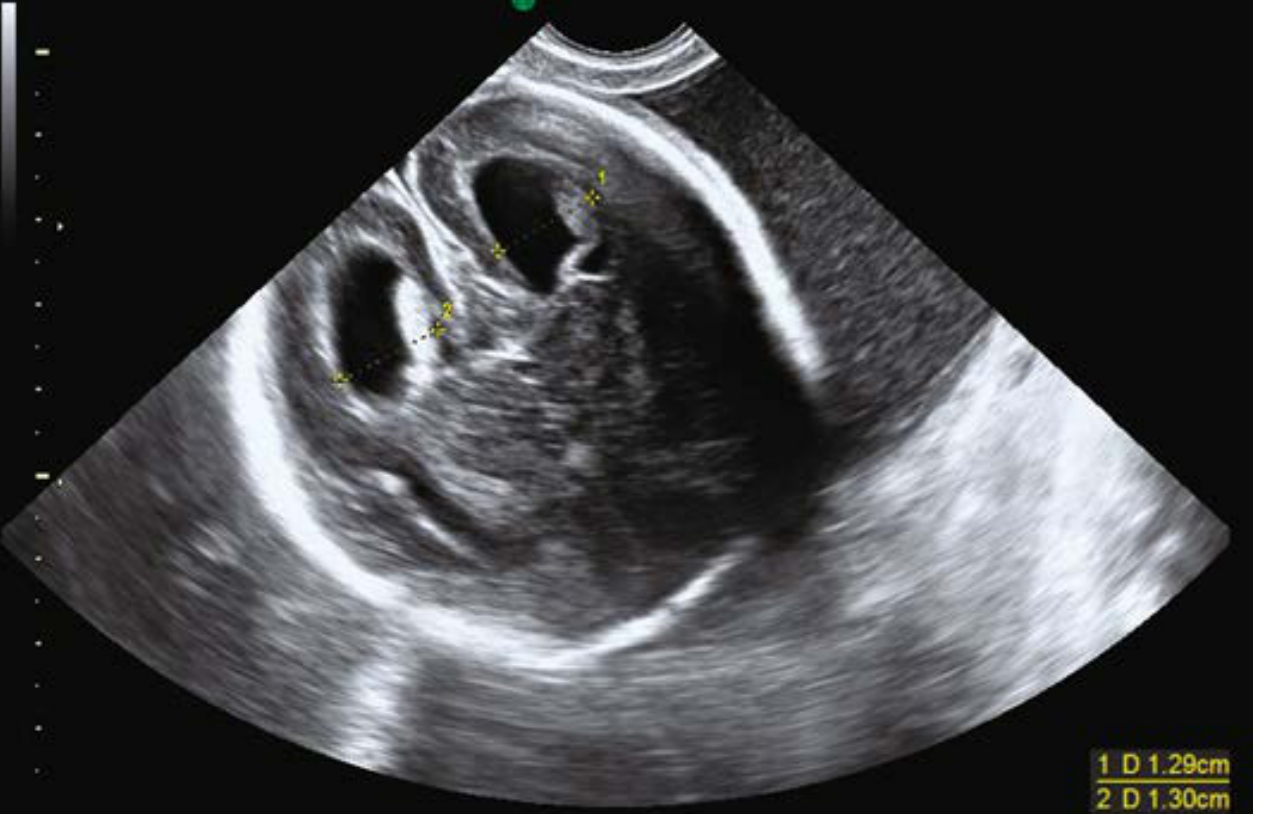
Ventriculomegaly (VM) is defined as dilation of one or both lateral ventricles measuring ≥10 mm at the atrial width on ultrasound. It is classified by severity:
| Grade | Atrial Width |
|---|---|
| Mild (borderline) | 10-12 mm |
| Moderate | 12.1-14.9 mm |
| Severe (hydrocephaly) | ≥15 mm |
Note: VM is a sign, not a diagnosis - it reflects an underlying pathology. Bilateral symmetric VM at 33 weeks is a significant finding requiring systematic evaluation.
Ultrasound Appearance
Here is what bilateral moderate ventriculomegaly looks like on ultrasound - both ventricles measuring 12.9 mm and 13 mm respectively:
Epidemiology
- Overall incidence: 1-2 per 1,000 births
- Mild VM: 1.4/1,000 (low-risk) to 22/1,000 (high-risk populations)
- Males are more commonly affected than females (especially idiopathic mild VM >20 weeks)
- Aqueductal stenosis is the most common single cause, accounting for 30-40% of cases
Differential Diagnosis (Causes of Bilateral VM)
The differential is broad. Key categories from Box 19.2 of Creasy & Resnik's MFM:
Obstructive (most common)
- Aqueductal stenosis (most common cause overall; typically severe bilateral VM with dilated 3rd ventricle, normal posterior fossa)
- Chiari II malformation (associated with open spina bifida)
- Dandy-Walker malformation
- Tumor/mass effect
Structural Brain Malformations
- Agenesis of the corpus callosum (classic: teardrop-shaped dilated atria / colpocephaly; absent CSP)
- Septo-optic dysplasia
- Holoprosencephaly
- Schizencephaly
- Cortical dysplasias (lissencephaly, pachygyria, polymicrogyria, gray matter heterotopia)
Chromosomal/Genetic
- Trisomy 21, 18, 13 (~11% of mild-moderate VM cases)
- X-linked hydrocephaly (L1CAM/LICAM mutation at Xq28 - seen in ~1:30,000 males; associated with bilateral abducted thumbs)
- MASA syndrome
Acquired/Infectious
- CMV, toxoplasmosis, Zika virus (look for periventricular calcifications)
- Intracranial hemorrhage / hypoxic-ischemic injury (especially in monochorionic twins after co-twin demise)
- Porencephaly / encephalomalacia
Idiopathic
- Diagnosis of exclusion; more common in males at >20 weeks
Why 33 Weeks is Significant
Finding bilateral VM late in the third trimester (33 weeks) carries specific implications:
- New-onset VM may be progressive - Hypoxic-ischemic injury and hemorrhage often present with mild VM that becomes progressive with advancing gestation. Serial measurements are mandatory.
- MRI advantage: Third-trimester MRI has superior diagnostic performance for cortical, white matter, and hemorrhagic abnormalities compared to earlier imaging. It is not limited by bony skull artifact and clearly differentiates lethal hydranencephaly from shuntable severe hydrocephalus.
- Congenital VM may develop late - a normal mid-trimester scan does not exclude this condition.
- Delivery planning is imminent - neonatal neurosurgical coordination must begin.
Investigations (Antenatal Workup)
- Detailed anatomic survey - assess for associated structural anomalies
- Fetal neurosonography - dedicated brain scan; transvaginal approach if vertex in pelvis
- Fetal echocardiogram - cardiac defects common with aneuploidy
- Fetal MRI - strongly recommended; the SMFM recommends consideration of MRI to detect additional CNS anomalies missed on ultrasound. A 2019 meta-analysis confirmed MRI adds value even after dedicated neurosonography (particularly third-trimester MRI for cortical/white matter/hemorrhagic lesions)
- Genetic counseling + amniocentesis:
- Chromosomal microarray (karyotype alone insufficient)
- If X-linked hydrocephaly suspected: LICAM gene mutation at Xq28
- Aneuploidy rate ~3% in isolated mild VM; ~11% in mild-moderate VM with other anomalies
- Infection workup (amniotic fluid PCR):
- CMV
- Toxoplasmosis
- Zika virus (if relevant exposure history)
- Serial ultrasound - monitor progression of ventricular size
Obstetric Management
- Delivery mode: In the absence of macrocephaly, trial of labor is indicated in vertex presentation. Vaginal delivery is not contraindicated in mild VM.
- Cesarean section reserved for standard obstetric indications.
- Each case must be individualized, especially when associated malformations are present.
- Cephalocentesis for cephalopelvic disproportion is controversial - may worsen neurologic prognosis.
Neonatal Management
- Evaluation by neonatology + pediatric neurology + neurosurgery (for moderate/severe VM)
- Repeat head ultrasound and/or MRI postnatally to reassess
- Serial head circumference measurements
- Surgical management (e.g., ventriculo-peritoneal shunt or endoscopic third ventriculostomy) for progressive VM
- Chromosomal microarray if neonate appears dysmorphic and prenatal studies not done
Prognosis
Prognosis depends heavily on whether VM is isolated and on severity:
| Finding | Prognosis |
|---|---|
| Isolated mild VM, normal karyotype | >90% normal postnatal evaluation |
| Isolated mild VM (pooled) | 4.9% neurodevelopmental delay (RR 3.5 vs. general population) |
| Mild VM + other anomaly | Determined by the associated anomaly (e.g., trisomy 21, ACC) |
| Progression in utero | Significantly increased neurologic sequelae |
| Severe VM (>15 mm) - aqueductal stenosis | Shuntable; outcome depends on cortical mantle thickness |
| Hydranencephaly | Lethal |
Key prognostic factors at 33 weeks:
- Isolated vs. associated: Associated structural/chromosomal/infectious causes carry much worse prognosis
- Progression: Progressive VM (increasing atrial width on serial scans) is a poor prognostic sign
- Cortical mantle thickness: Thin cortex on MRI worsens neurodevelopmental outlook
- Severity: Moderate-severe bilateral VM warrants guarded prognosis and full multidisciplinary counseling
Summary Algorithm at 33 Weeks
Bilateral VM identified on U/S at 33 weeks
        ↓
Measure atrial width (mild/moderate/severe?)
        ↓
Detailed neurosonography + fetal echo
        ↓
Fetal MRI (especially for cortical/white matter assessment)
        ↓
Amniocentesis: microarray + CMV/Toxo PCR
(+/- LICAM if male + abducted thumbs)
        ↓
Serial U/S q2-4 weeks to assess progression
        ↓
Multidisciplinary counseling (MFM, genetics, pediatric neurology, neurosurgery)
        ↓
Delivery planning: vaginal if no macrocephaly; neonatal team present
        ↓
Postnatal: head U/S / MRI + neurosurgery referral if progressive
Sources: Creasy & Resnik's Maternal-Fetal Medicine: Principles and Practice (Chapter 19 - CNS Imaging; Chapter 20 - Ventriculomegaly sections including Aqueductal Stenosis and Borderline Lateral Cerebral Ventriculomegaly). Recent literature (PMID 37217456 - natural history of mild VM in second half of pregnancy; PMID 41526847 - 983-case cohort on prenatal VM and neurodevelopmental outcomes, BMC Pregnancy Childbirth 2026) is consistent with these textbook principles.
This is a shared conversation. Sign in to Orris to start your own chat.