
Why do iugr babies have time be delivered early
Reading File
IUGR (intrauterine growth restriction) babies sometimes need early delivery because staying in a compromised uterine environment becomes more dangerous than being born prematurely. The core issue is placental insufficiency - when the placenta can't deliver enough oxygen and nutrients, the baby is essentially being "starved" in the womb.
Searching sources...
Finding Sources
Finding Sources
Searching PubMed
intrauterine growth restriction delivery timing
Finding Sources
Finding Sources
Finding Sources
Reading File
Finding Sources
Reading File
Reading File
I now have excellent textbook content to give a thorough answer. Let me fetch the Doppler deterioration image for visual clarity.
Loading Image
Loading Image
Here is a thorough explanation based on Creasy & Resnik's Maternal-Fetal Medicine and Harrison's Principles of Internal Medicine.
Why IUGR Babies Sometimes Need Early Delivery
The core reason is a risk-benefit calculation: at some point, the dangers of staying in a failing uterine environment outweigh the risks of being born premature.
1. The Root Problem - Placental Insufficiency
IUGR (now more commonly called Fetal Growth Restriction, or FGR) is most often caused by a placenta that cannot deliver enough oxygen and nutrients to the fetus. As the placenta progressively fails - often due to placental infarcts, hypertension, or preeclampsia - blood flow through the umbilical artery becomes increasingly abnormal.
2. Progressive Fetal Deterioration
The deterioration follows a recognizable pattern tracked by Doppler ultrasound:
| Stage | What Happens | Doppler Finding |
|---|---|---|
| Early | Placental resistance rises | Elevated umbilical artery S/D ratio |
| Middle | Fetal brain prioritizes its own blood supply ("brain sparing") | Cerebroplacental ratio shifts; MCA shows higher diastolic flow |
| Late | Placental flow nearly stops | Absent end-diastolic velocity (AEDV) in umbilical artery |
| Critical | Blood actually flows backward in diastole | Reversed end-diastolic velocity (REDV) |
| Terminal | Venous return to fetal heart is compromised | Retrograde ductus venosus a-wave; BPP score falls, fetal movements disappear |
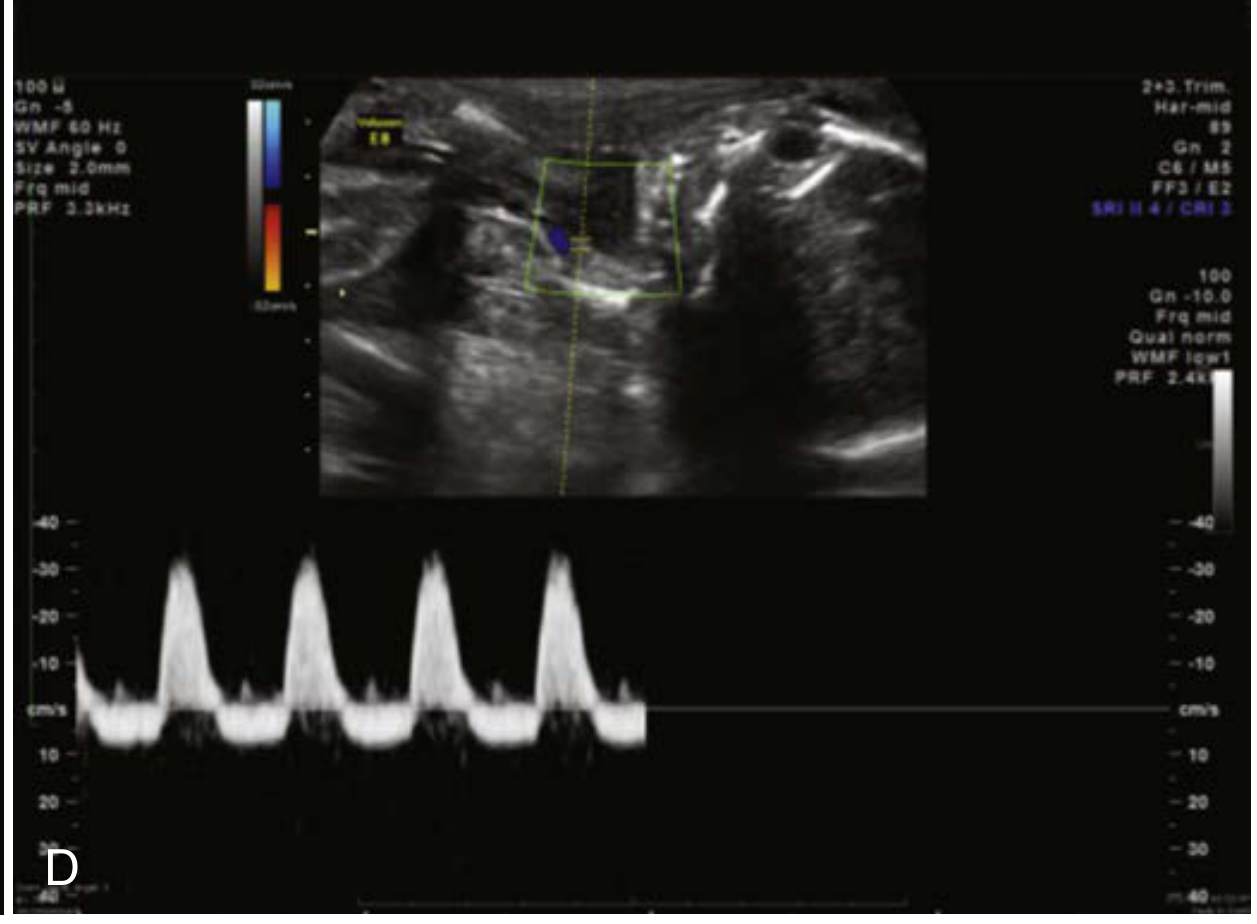
The image below shows this progression on Doppler - when the umbilical artery waveform drops below the baseline, blood is flowing backward toward the fetus during diastole, a sign of extreme placental failure:
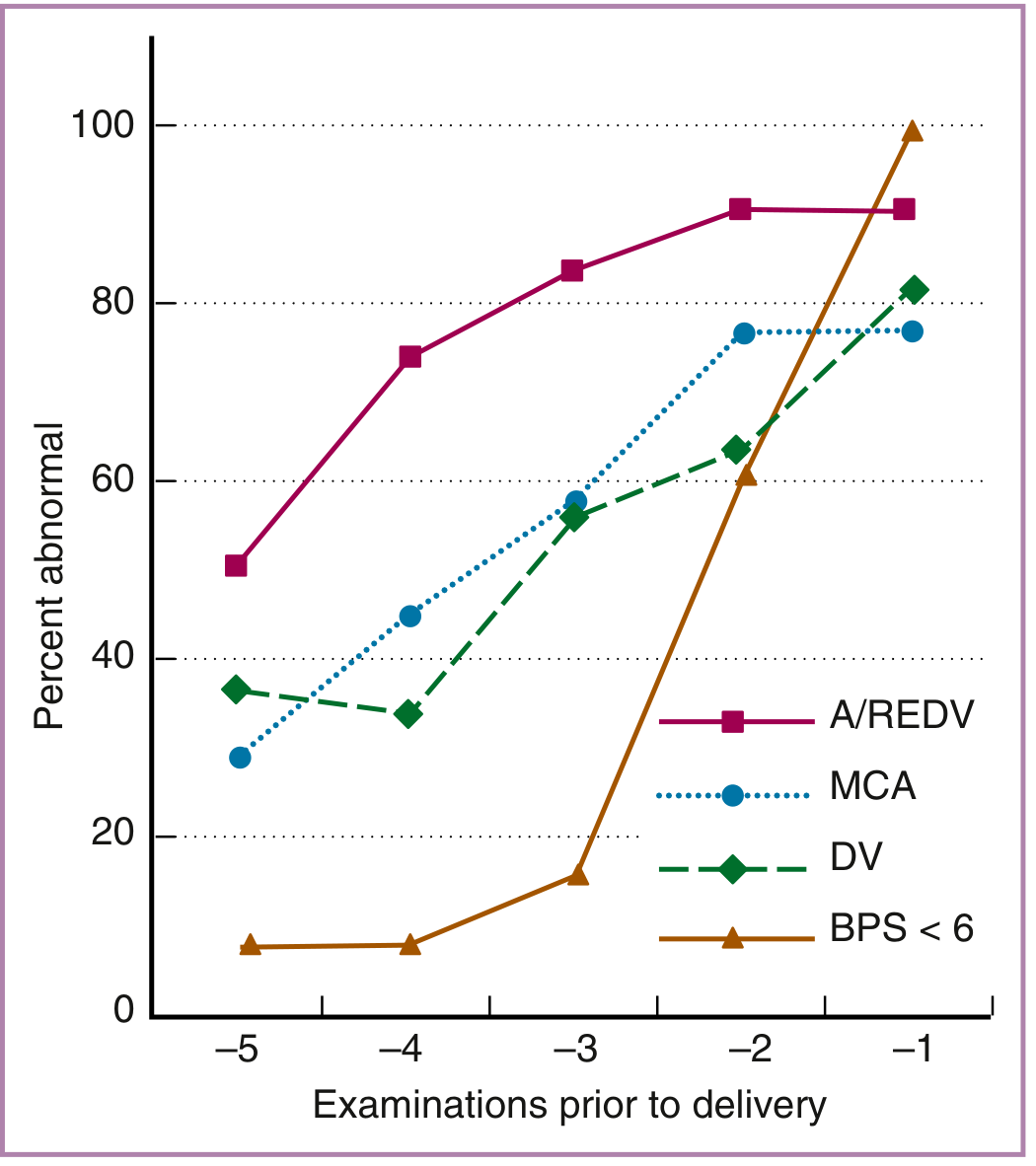
The chart below shows how multiple abnormal Doppler parameters cluster just before delivery is required - by the last exam, 100% of fetuses had an abnormal biophysical profile score (BPS <6):
3. The Risk If You Don't Deliver - Stillbirth
If the fetus stays in this deteriorating environment, the risk of stillbirth rises sharply. The fetus is chronically hypoxic (low oxygen), acidotic, and at risk of sudden decompensation. A growth-restricted fetus has higher perinatal morbidity and mortality, and the risk increases with the severity of restriction. - Creasy & Resnik's Maternal-Fetal Medicine
4. When Exactly to Deliver - The Gestational Age Equation
Doctors don't deliver early just because the baby is small. The timing depends on how severe the Doppler/biophysical findings are, balanced against gestational age:
- Absent umbilical artery flow at 33-34 weeks or beyond → deliver
- Reversed umbilical artery flow at 30-32 weeks → deliver
- Very preterm (<30 weeks) with absent/reversed flow → daily monitoring (NST + BPP) while trying to gain more maturity
- 37 weeks with estimated fetal weight <3rd percentile → delivery is considered
- 37 weeks with abnormal umbilical artery pulsatility index (>95th percentile) → delivery is indicated
- Normal Doppler findings → may wait until 39 weeks
The overriding principle, as stated by Creasy & Resnik: "gestational age determines outcome over a wide range" - meaning at very early gestations, the complications of prematurity may still outweigh fetal compromise, so doctors must individualize the decision.
5. Why Not Just Wait Until Term?
Because the placenta doesn't recover - it continues to deteriorate. Waiting risks:
- Stillbirth (sudden fetal death in utero)
- Severe hypoxic-ischemic injury to the fetal brain
- Meconium aspiration (stressed fetuses pass meconium into amniotic fluid)
- Metabolic acidosis
Betamethasone (a steroid) is given to help mature the fetal lungs when delivery is anticipated between 24-34 weeks, reducing the complications of premature birth.
In summary: IUGR babies need early delivery when the placenta is failing badly enough that the fetal blood flow is critically impaired. At that point, the risk of stillbirth or severe organ damage from staying in the womb exceeds the risks of prematurity outside it. Doctors use serial Doppler ultrasound and biophysical profiles to track the deterioration and time delivery as accurately as possible.
This is a shared conversation. Sign in to Orris to start your own chat.