
Pain assessment of pediatrics
Reading File
Finding Sources
Finding Sources
Searching PubMed
pediatric pain assessment
Searching the Web
pediatric pain assessment scales FLACC Wong-Baker FACES AAP
Reading File
Reading File
Reading File
Reading File
Pediatric pain assessment
Pain in children should be assessed at triage and repeatedly after any intervention. The best tool depends on the child's developmental ability, not age alone. Self-report is preferred whenever possible; behavioral tools are used when a child cannot reliably self-report.
Core principles
- Believe the child’s report of pain. Ask the child directly first, in language they understand.
- Use the same validated scale for serial measurements when possible.
- Assess more than intensity:
- Site, onset, duration, quality, triggers and relieving factors
- Functional effect: sleep, feeding, play, walking, consolability
- Associated distress, anxiety, and procedure-related fear
- Include parent/caregiver input, especially for nonverbal children or those with developmental disability. They often recognize the child’s usual behavior and pain cues.
- Do not use heart rate, blood pressure, oxygen saturation, or crying alone to determine pain severity. They can support assessment but are nonspecific.
- Document the score, scale used, intervention, and reassessment result.
Tintinalli emphasizes that pain assessment should begin at initial triage, with reassessment timed to the expected onset and peak effect of treatment. - Tintinalli’s Emergency Medicine, p. 765
Recommended tools by developmental stage
| Child group | Preferred scale | How it works |
|---|---|---|
| Neonate | NIPS | Observational neonatal tool assessing facial expression, cry, breathing pattern, arm/leg position, and arousal. |
| Infant/toddler, about 0-3 years | FLACC | Observer scores Face, Legs, Activity, Cry, Consolability. Total 0-10. |
| Young child, about 4-8 years | Faces Pain Scale-Revised (FPS-R) | Child selects a face representing current pain; scored 0-10. |
| Older child/adolescent | Numeric Rating Scale (NRS) or Visual Analog Scale (VAS) | Child rates pain from 0 to 10, or marks a point on a 100-mm line from “no pain” to “worst pain.” |
| Nonverbal/developmentally delayed child | FLACC, often individualized with caregiver input | Compare behavior with baseline and use caregiver-described pain behaviors. |
Tintinalli lists FLACC or NIPS for ages 0-3 years, FPS-R for 4-8 years, and VAS or verbal numeric ratings for older children. - Tintinalli’s Emergency Medicine, p. 765
FLACC scale
Each domain is scored 0, 1, or 2, for a total score of 0-10:
- Face: relaxed to frequent grimacing
- Legs: normal to kicking/drawn up
- Activity: calm to rigid/arching/jerking
- Cry: none to screaming/sobbing
- Consolability: content to difficult or impossible to console
FLACC is especially useful for infants, toddlers, sedated children, and children unable to communicate verbally. A FLACC score above 6 is generally associated with a need for analgesia, but treatment should always be based on the whole clinical picture. - Tintinalli’s Emergency Medicine, p. 765
Practical assessment sequence
- Observe before touching the child: posture, facial expression, guarding, movement, interaction, and breathing.
- Ask: “Do you hurt?” and “Show me where it hurts.”
- Select an age- and developmentally appropriate validated scale.
- Assess pain at rest and with movement, when relevant, such as after trauma or surgery.
- Record the baseline score and provide analgesia or non-drug comfort measures without delaying necessary care.
- Reassess using the same scale after the expected effect of treatment.
- Escalate if pain remains significant, is worsening, or is accompanied by red flags such as altered consciousness, respiratory difficulty, shock, or a concerning abdominal, neurologic, or traumatic presentation.
Sample documentation
“Pain assessed at 10:00 using FPS-R: 8/10, right forearm, worse with movement. Child guarding limb; parent present. Analgesia administered and splint applied. Reassessed at 10:30 using FPS-R: 3/10; child calmer and tolerating examination.”
Important cautions
- A quiet child may still have severe pain.
- Crying may represent pain, fear, hunger, or separation distress.
- Never assume a child with cognitive impairment feels less pain. Use an individualized behavioral scale and caregiver knowledge.
- Repeated scores and improvement in function are often more informative than a single score.
For children able to report pain, VAS, NRS, and Wong-Baker Faces tools are commonly used; for children who cannot self-report, FLACC assesses facial expression, leg movement, activity, crying, and consolability. - Barash, Cullen, and Stoelting’s Clinical Anesthesia, p. 3781
Recent systematic reviews show that pediatric pain-scale validity can vary by setting, culture, language, and child population, so use a locally validated tool and avoid interpreting a number without clinical context. See the 2025 systematic review on pediatric self-report scales.
Wong baker faces pain scale
Reading File
Finding Sources
Searching PubMed
Wong-Baker Faces pain scale children
Searching the Web
Wong-Baker FACES Pain Rating Scale official instructions scoring 0 2 4 6 8 10
Wong-Baker FACES Pain Rating Scale
The Wong-Baker FACES scale is a self-report tool used to help children and others communicate the intensity of their physical pain. It is generally suitable for people aged 3 years and older who can understand the instructions.
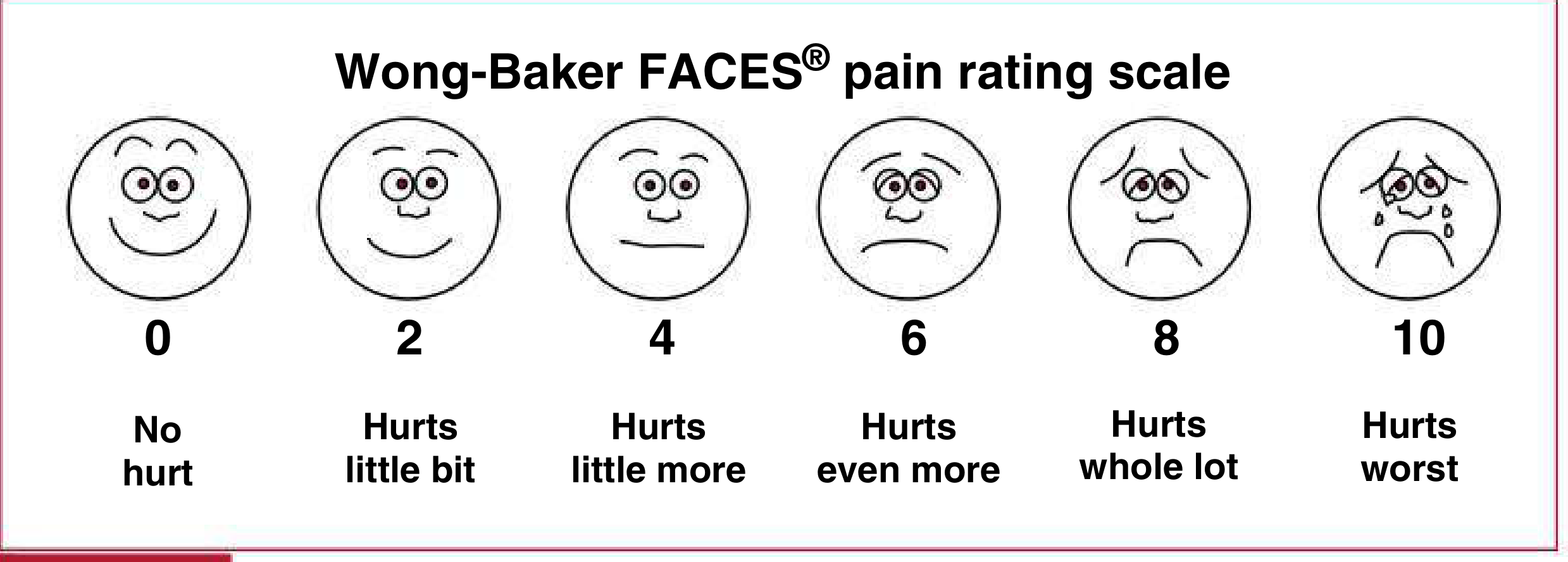
Scores
| Face | Score | Meaning |
|---|---|---|
| Happy face | 0 | No hurt |
| Slight discomfort | 2 | Hurts a little bit |
| Mild distress | 4 | Hurts a little more |
| Moderate distress | 6 | Hurts even more |
| Severe distress | 8 | Hurts a whole lot |
| Crying face | 10 | Hurts worst |
How to use it
Say to the child:
“These faces show how much something can hurt. This face means no hurt. These faces show more and more hurt. This face means the worst hurt you can imagine. Point to the face that shows how much you hurt right now.”
Record the corresponding number, then reassess with the same scale after comfort measures or analgesia.
Key points
- It measures the child’s own pain, not anxiety, fear, mood, or how distressed the child appears.
- Ask the child to choose a face. Do not select a score by matching the child’s facial expression to the pictures.
- Tears in the final face mean severe pain can be felt internally; the child does not need to be visibly crying.
- For infants, unconscious children, or children unable to self-report, use an observational tool such as FLACC instead.
The scale’s 0, 2, 4, 6, 8, and 10 format aligns it with a 0-10 numeric pain score, as explained by the Wong-Baker FACES Foundation. The Harriet Lane Handbook reproduces the Wong-Baker FACES scale in its pediatric pain-assessment material. - The Harriet Lane Handbook, p. 97
Visual analogue pain scale
Reading File
Finding Sources
Searching PubMed
visual analog scale pediatric pain
Searching the Web
visual analogue scale pain assessment 100 mm line pediatric official clinical guidance
Visual Analogue Scale (VAS) for pain
The Visual Analogue Scale is a self-report pain-assessment tool, usually used in children aged 8 years and older who can understand an abstract rating scale.
Format
It is a 10-cm (100-mm) horizontal line with two endpoints:
No pain  |------------------------------------------------|  Worst pain imaginable
          0 mm                                             100 mm
Method
- Ask the child:
“Please put a mark on this line to show how much pain you have right now.” - Measure the distance in millimetres from the “no pain” end to the child’s mark.
- Record it as 0-100 mm, or convert to a 0-10 score by dividing by 10.
Example: A mark at 65 mm = VAS pain score 65/100, or 6.5/10.
Interpretation
| VAS score | Usual interpretation |
|---|---|
| 0 | No pain |
| 1-30 mm | Mild pain |
| 31-69 mm | Moderate pain |
| 70-100 mm | Severe pain |
These cutoffs are practical guides, not a substitute for clinical judgment. Compare repeated scores using the same scale to judge response to treatment.
Advantages
- Simple and sensitive to changes in pain over time
- Useful for monitoring analgesic response
- Gives a continuous score rather than limited categories
Limitations
- Requires adequate cognitive and motor ability
- Not suitable for infants, most preschool children, unconscious children, or children unable to understand the concept
- Use a behavioral scale such as FLACC when the child cannot self-report
Tintinalli’s Emergency Medicine describes the VAS as a 100-mm line anchored by “no pain” and “most pain,” with the mark’s distance from the left endpoint representing pain severity; it is valid and sensitive to change with analgesia. - Tintinalli’s Emergency Medicine, p. 765
The Royal Children’s Hospital pain guideline similarly lists VAS as a self-report option for children aged 8 years and older.
Stress response and anaesthesia for anesthesia resident for 5 marks
Reading File
Finding Sources
Finding Sources
Searching PubMed
surgical stress response anesthesia
Searching the Web
surgical stress response anaesthesia sympathetic endocrine metabolic inflammatory response review
Reading File
Reading Web Page
https://pmc.ncbi.nlm.nih.gov/articles/PMC7807970/
Surgical stress response and anaesthesia
Definition: Surgical stress response is the integrated neuroendocrine, metabolic, and inflammatory response to tissue injury, pain, blood loss, hypothermia, and psychological stress during surgery. It is adaptive initially, but excessive or prolonged activation increases perioperative morbidity.
1. Mechanism and mediators
Surgical nociceptive input reaches the hypothalamus and activates:
- Sympathetic-adrenal system: catecholamines, adrenaline and noradrenaline
- Hypothalamic-pituitary-adrenal axis: CRH → ACTH → cortisol
- Other hormones: glucagon, growth hormone, ADH, renin-angiotensin-aldosterone system
- Inflammatory mediators: IL-1, IL-6, TNF-alpha, acute-phase proteins
2. Effects of the stress response
| System | Main effects |
|---|---|
| Cardiovascular | Tachycardia, hypertension, increased myocardial oxygen demand, vasoconstriction |
| Metabolic | Hyperglycaemia, insulin resistance, glycogenolysis, gluconeogenesis, lipolysis, protein catabolism |
| Renal | Sodium and water retention due to ADH and aldosterone, reduced urine output |
| Inflammatory | Cytokine release, fever, leukocytosis, increased CRP and fibrinogen, procoagulant state |
| Clinical consequences | Impaired immunity and wound healing, ileus, muscle wasting, thrombotic risk, increased postoperative complications if excessive |
The magnitude of the response is proportional to the extent of tissue trauma. - Fischer’s Mastery of Surgery, p. 170
3. Effect of anaesthesia
- General anaesthesia reduces awareness, anxiety, and some autonomic responses, but does not completely abolish the stress response, especially the inflammatory response caused by direct surgical tissue injury.
- Adequate anaesthetic depth, analgesia, normothermia, and maintenance of oxygenation, perfusion, and euvolaemia reduce the response.
- Opioids blunt sympathetic responses to laryngoscopy, incision, and surgical stimulation.
- Regional and neuraxial anaesthesia such as epidural/spinal blockade most effectively attenuate the neuroendocrine-metabolic response by blocking afferent nociceptive input and sympathetic efferent output.
- Epidural analgesia can reduce ACTH, cortisol, catecholamine release, hyperglycaemia, and protein catabolism, particularly in thoracoabdominal, pelvic, and lower-limb surgery.
- Regional techniques should be part of multimodal analgesia with paracetamol, NSAIDs where appropriate, local infiltration/nerve blocks, and opioid-sparing drugs.
Central neuraxial blockade and minimally invasive surgery produce the greatest attenuation; general anaesthesia alone has little effect on cytokine release from tissue trauma, according to this anaesthesia review.
4. Conclusion
The surgical stress response is characterized by sympathetic, endocrine, metabolic, and inflammatory activation. Anaesthesia aims to limit it through adequate analgesia, regional blockade where appropriate, minimally invasive surgery, maintenance of physiological homeostasis, and enhanced recovery measures.
This is a shared conversation. Sign in to Orris to start your own chat.