
Explain me Lords p location procedure
Reading File
Lord's procedure is a surgical technique for managing haemorrhoids - it involves anal dilation (stretching of the anal sphincter) to relieve internal haemorrhoidal congestion. It was described by P.H. Lord in the 1960s-70s.
Searching sources...
Finding Sources
Finding Sources
Finding Sources
Finding Sources
Searching the Web
Lord's procedure haemorrhoids anal dilation technique steps
Here is a detailed explanation of Lord's procedure (Manual Anal Dilatation):
Lord's Procedure (Manual Anal Dilatation / Lord's Operation)
Background & Rationale
Introduced by Peter Lord in 1968 in Great Britain, this procedure was based on the observation that patients with haemorrhoidal disease tend to have higher resting pressures in the anal canal. The theory was that outlet obstruction leads to straining, which in turn causes haemorrhoidal disease. By manually dilating the anal canal, the pressure is relieved, reducing haemorrhoidal congestion and symptoms.
Indications
- 1st and 2nd degree internal haemorrhoids (best results)
- Anal fissure (acute or chronic)
- 3rd degree haemorrhoids (less satisfactory results - about half become symptom-free)
- Patients with a tight, high-pressure anal sphincter respond better
Note: If the anus is found to be loose on examination, proceed to haemorrhoidectomy instead.
Pre-operative Assessment
- Digital Rectal Examination (DRE) - performed before the procedure to:
- Feel for the constricting band of muscle (usually at the level of the anorectal line)
- Assess anal tone - a tight anus predicts better outcome
- Proctoscopy and sigmoidoscopy/colonoscopy as indicated
- Informed consent
Anaesthesia
- General anaesthesia (preferred) or intravenous sedation
- Care is taken to avoid laryngeal spasm
Step-by-Step Technique
-
Positioning: Patient placed in lithotomy position (standard for anorectal procedures)
-
Lubrication: Lubricate the index and middle fingers of both hands with 2% xylocaine (lignocaine) jelly
-
Initial digital examination: Confirm findings under anaesthesia
-
Finger insertion - gradual and sequential:
- Insert index finger of one hand gently
- Then insert index finger of the other hand
- Then middle finger of one hand
- Finally, middle finger of the other hand (crossing hands)
- End point: four fingers total (two from each hand) inserted into the anal canal
- Dilation target: up to 40 mm
-
Technique of stretching:
- All fingers must be kept straight - bending fingers like a claw is avoided
- Pressure is applied only from the distal and intermediate phalanges; proximal digits remain outside the anus
- Fingers are pronated and distracted in opposite directions
- Strain is applied at the 3 o'clock and 9 o'clock positions
- 6 o'clock and 12 o'clock positions are avoided because the sphincter is weaker there (higher risk of tear)
- Sphincters are gradually allowed to relax, then fingers are advanced further
- Positions are then changed to 12 and 6 o'clock as well once relaxation is achieved
-
Duration: Stretching is maintained for exactly 4 minutes by clock
-
End of procedure:
- A gauze soaked in povidone-iodine and anaesthetic jelly is placed in the anal canal
- Antiseptic dressing is applied
- A small sponge/gauze pack may be inserted to reduce haematoma/blood clot formation
Post-operative Care
- Patients are instructed to intermittently self-insert an anal dilator at home for 6 months - this prevents re-stenosis and maintains the effect of the stretch
- Follow-up is arranged
Results
- 1st and 2nd degree haemorrhoids: Excellent long-term results
- 3rd degree haemorrhoids: Only ~50% become symptom-free
- Anal pressure is significantly reduced by the dilation and remains reduced over 5 years
- Patients with the most active internal sphincter (highest resting pressures) tend to have the best clinical results
Complications & Downfall
Lord's procedure has largely fallen out of favor due to:
| Complication | Notes |
|---|---|
| Faecal incontinence | Unacceptably high incidence - the main reason for abandonment |
| Flatus incontinence | Increased rate |
| Muscle fiber tearing | If stretching is done too rapidly or aggressively |
| Recurrence | ~10% symptomatic recurrence at 1-5 years |
The high rate of incontinence is due to uncontrolled tearing of the internal (and sometimes external) sphincter. This has led to it being largely replaced by more controlled procedures such as lateral internal sphincterotomy for anal fissures, and rubber band ligation / haemorrhoidectomy for haemorrhoids.
Summary
Lord's procedure = Manual Anal Dilatation (MAD) - a 4-finger, 4-minute, controlled stretch of the anal sphincter under GA, targeting the 3 and 9 o'clock positions, followed by 6 months of home anal dilator use. It works best for tight sphincters with 1st/2nd degree haemorrhoids but carries a significant risk of incontinence.
Lords, plication in hydrocele
Lord's procedure in the context of hydrocele is completely different from the anal dilation procedure - it is a surgical technique for hydrocele repair where the tunica vaginalis is everted and plicated (bunched/gathered) around the testis without excision.
Searching sources...
Finding Sources
Finding Sources
Searching the Web
Lord's procedure plication hydrocele surgical technique steps Jaboulay
Good - found results in both Bailey & Love and Campbell-Walsh. Let me read those sections now.
Reading File
Reading File
Excellent - rich content from both textbooks. Let me also fetch the diagrams.
Loading Image
Loading Image
Here is a complete explanation of Lord's plication procedure for hydrocele, with the surgical diagrams from Bailey & Love:
Lord's Procedure (Plication) for Hydrocele
What is a Hydrocele?
A hydrocele is a collection of fluid between the parietal and visceral layers of the tunica vaginalis surrounding the testis. Acquired hydroceles in adult men result from an imbalance between fluid production and reabsorption by the tunica vaginalis. Small, asymptomatic hydroceles need no treatment. Surgical correction is indicated when the hydrocele causes discomfort or cosmetic concern.
Surgical Options for Hydrocele - Overview
There are three main surgical approaches:
| Technique | Principle | Best For |
|---|---|---|
| Lord's Plication | Plicate (bunch/gather) the sac with sutures - no excision | Thin-walled, small-to-moderate hydroceles |
| Jaboulay's Eversion | Open sac, evert it behind testis, oversew edges | Moderate to large hydroceles |
| Excision (Bottleneck/Window) | Excise excess tunica, oversew edges | Chronic, large, thick-walled, multiloculated hydroceles |
Lord's Plication - Indication
- Thin-walled tunica vaginalis sac
- Smaller volume hydrocele (not massive)
- Teenage boys with non-communicating hydrocele
- Preferred when minimal dissection is desired (e.g., to reduce haematoma risk)
If the sac is chronic and thick-walled, Lord's is not suitable - prefer Jaboulay's or excision.
Lord's Plication - Step-by-Step Technique
1. Anaesthesia & Position
- General or spinal/regional anaesthesia
- Patient in supine position
- Scrotal approach
2. Scrotal Incision
- A transverse or vertical scrotal incision is made through skin and dartos muscle
- The hydrocele sac is delivered into the wound by gentle dissection through fascial layers (dartos, cremaster, tunica vaginalis)
3. Minimal Dissection
- Unlike other techniques, there is minimal dissection of the sac from surrounding tissues
- The sac is NOT fully mobilized - it remains largely attached to surrounding scrotal structures
- This is the key advantage - it greatly reduces the risk of haematoma
4. Open the Sac
- The hydrocele sac (parietal tunica vaginalis) is opened along its anterior surface
- Hydrocele fluid is drained
5. Extrude the Testis
- The testis is delivered (extruded) through the aperture in the opened sac
- The testis now sits outside the sac
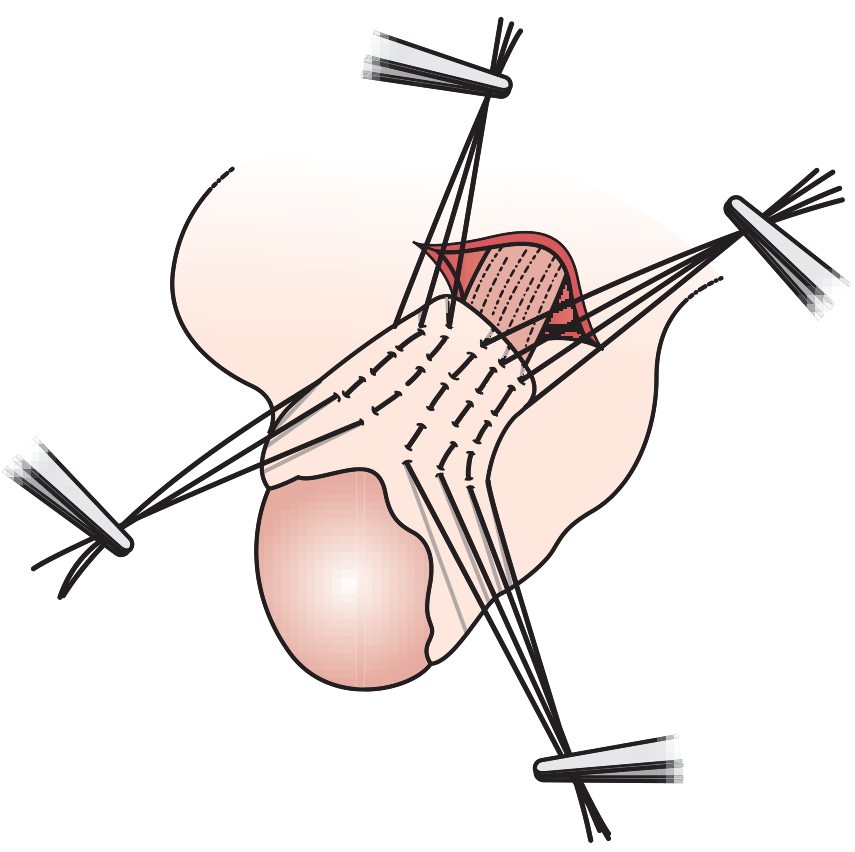
6. Plication - The Key Step
- Multiple interrupted absorbable sutures (e.g., chromic catgut or Vicryl) are placed in the redundant tunica vaginalis
- Sutures are placed radially (like spokes of a wheel) in a circumferential fashion around the sac
- When these sutures are tied, the tunica bunches/gathers at its attachment to the testis
- The redundant sac is thus pleated/gathered up rather than excised
This is what the plication looks like - the sutures gathering the redundant sac:
7. Replace Testis
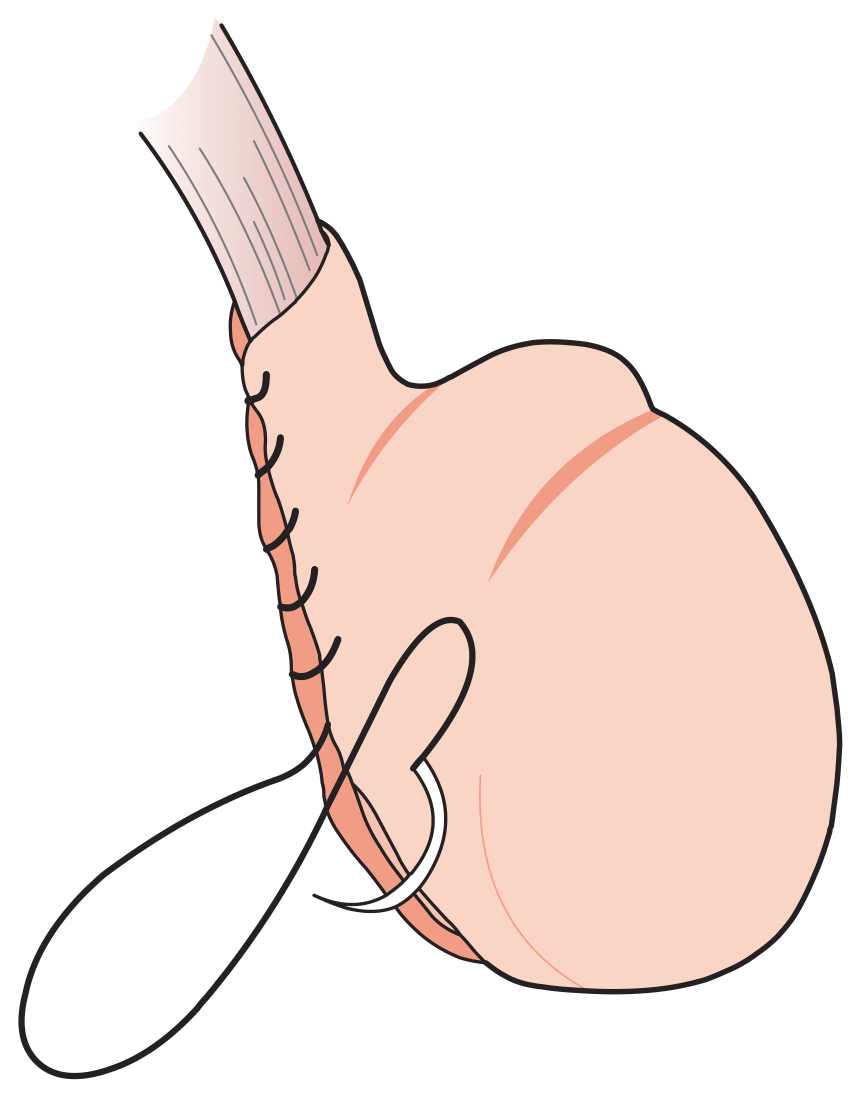
- The testis is replaced back into the scrotum
- The bunched-up, plicated tunica sits around the testis
After plication is complete and the testis is returned:
8. No Drain Required
- Because no excision is performed and dissection is minimal, no drain is needed
- This contrasts with excisional techniques, which often need a drain due to higher haematoma risk
9. Wound Closure
- Dartos and skin are closed in layers
- Dissolvable sutures are typically used
Why Lord's Works
By plicating the tunica vaginalis, the space that previously held fluid is obliterated. The bunched tunica can no longer accumulate fluid in a large cavity. The reduced fluid-containing space means the hydrocele cannot reform easily.
Advantages of Lord's Plication
- Minimal dissection - the sac is not fully mobilized
- Lowest risk of haematoma among all hydrocele operations - because scrotal wall vessels are not disturbed
- No drain needed
- Quick and technically straightforward
- Low recurrence rate (comparable to excisional techniques in appropriate cases)
Disadvantages / Limitations
- Not suitable for thick-walled sacs - the thick wall cannot be neatly plicated; it remains bulky and may cause discomfort or recurrence
- Not ideal for very large hydroceles - excessive redundant tissue makes plication unwieldy
- Higher complication rate compared to Jaboulay's in some studies (particularly for large hydroceles where it is used inappropriately)
Comparison: Lord's vs Jaboulay's
| Feature | Lord's Plication | Jaboulay's Eversion |
|---|---|---|
| Sac handling | Plicated (gathered), not excised | Everted behind testis, edges oversewn |
| Dissection | Minimal | More extensive |
| Haematoma risk | Lowest | Higher |
| Drain needed | No | Sometimes |
| Best for | Thin, small sac | Moderate/large sac |
| Recurrence | Comparable | Comparable |
| Complications | Higher if used for wrong sac type | Lower for large/thick sacs |
Key Takeaway
Lord's plication = open the sac anteriorly → extrude the testis → plicate the redundant tunica with radially placed interrupted absorbable sutures circumferentially → replace testis → no excision, no drain. It is the operation of choice for thin-walled, smaller hydroceles because of its minimal dissection and lowest haematoma risk.
- Bailey and Love's Short Practice of Surgery, 28th Ed., p. 1587
- Campbell-Walsh-Wein Urology, p. 83.5
This is a shared conversation. Sign in to Orris to start your own chat.