
Hi I need a note for community medicine exam,I checked chatgpt for pyq questions on diarrhea.can you make a pdf based on my chat interaction with chatgpt and prepare a pdf note so that I can study all diarrhea in common and please prepare a flowchart on outbreak investigation,ors ,plan a bc ,zinc etc , prepare a common note just mention exceptions in note so that I can study easily.see my attached chatgpt Yes. I checked the KUHS 3rd MBBS Community Medicine archive specifically for diarrhoea/acute gastroenteritis questions. The pattern is quite clear: KUHS repeatedly asks case-based diarrhoea + outbreak investigation + prevention/control, rather than only theoretical definitions. The archive contains 34 KUHS 3rd-year Community Medicine papers. 🔥 KUHS 3rd MBBS — DIARRHOEA PYQs 1. 🔥🔥🔥 Acute diarrhoea with dehydration — 10 marks December 2021 A family-visit case: > A 4-year-old child has diarrhoea since morning. His 20-month-old sister has diarrhoea for 3 days, passing loose stools 10 times/day. She has sunken eyes, dry mouth and tongue, and is eager to drink water. The mother has withheld food and water due to a misconception. Question: How will you manage this situation? 10 marks. What you need to write Assessment of dehydration Classification: No dehydration Some dehydration Severe dehydration Plan A Plan B Plan C ORS Continued feeding/breastfeeding Zinc Antibiotics — only when indicated Danger signs Advice to mother Prevention 🔥 Priority: 5/5 --- 2. 🔥🔥🔥 Watery diarrhoea + dehydration + outbreak investigation — 10 marks February 2025 > As a PHC medical officer, field workers report 3 cases of watery diarrhoea and dehydration, one severe case being referred. Asked: > How will you investigate and control the situation? Comment on the bacterial indicators of drinking-water quality. 10 marks. This is a particularly important combination because it joins: Diarrhoea + outbreak investigation + water quality. Prepare: A. Investigation 1. Verify diagnosis 2. Confirm existence of outbreak 3. Define a case 4. Search for cases 5. Describe by time/place/person 6. Construct epidemic curve 7. Identify source/mode of transmission 8. Collect specimens 9. Environmental investigation 10. Laboratory investigation B. Control Safe drinking water Chlorination Sanitary disposal of excreta Food hygiene Handwashing ORS Early treatment Health education Surveillance C. Bacterial indicators E. coli Coliform organisms Faecal coliforms Enterococci 🔥 Priority: 5/5 --- 3. 🔥🔥🔥 Acute gastroenteritis outbreak — 10 marks A previous KUHS question asks: > You are the medical officer of a PHC. Many cases of acute gastroenteritis have been reported from villages under your administrative jurisdiction. List the steps that you would take to investigate this problem. 10 marks. This is essentially an epidemic investigation question using diarrhoea as the clinical scenario. 🔥 Priority: 5/5 --- 4. 🔥🔥🔥 Vomiting + diarrhoea outbreak — 10 marks March 2025 > In a sub-centre village, more than 75 people of different ages and both sexes developed repeated vomiting and diarrhoea since the previous night. Severe cases were admitted to a CHC. Asked: a) Objectives of investigating the incident b) Preventive measures to prevent recurrence c) Steps in investigation of an outbreak 10 marks. This is an extremely useful PYQ because the same framework can be used for food poisoning, cholera, gastroenteritis and contaminated-water outbreaks. 🔥 Priority: 5/5 --- 5. 🔥🔥 Vomiting + diarrhoea among pilgrims — 5 marks August 2022 > An outbreak of vomiting and diarrhoea was reported among pilgrims returning from pilgrimage at a quarantine seaport. 100 patients were admitted within 3 hours. Asked: > Enumerate the outbreak investigation plan, its implementation and briefly write prevention and control measures. 5 marks. 🔥 Priority: 4/5 --- 6. 🔥🔥 Vomiting + diarrhoea after marriage party — 5 marks December 2021 > 23 adults and 2 children developed sudden vomiting and abdominal colic within 12 hours after consuming food at a marriage party. Asked: > Describe the steps of investigation and control. 5 marks. This is essentially food poisoning/outbreak investigation. 🔥 Priority: 4/5 --- 7. 🔥 Epidemiological determinants of diarrhoeal diseases — 15 marks An older KUHS question asks: > What are the epidemiological factors contributing to acute diarrhoeal diseases? 15 marks. This is a very important long-answer theory question. Prepare under: Agent Bacteria Viruses Protozoa Helminths Host Infants and young children Malnutrition Immunocompromised individuals Lack of breastfeeding Poor immunity Environment Unsafe water Poor sanitation Improper sewage disposal Food contamination Flies Poor personal hygiene Overcrowding --- 🔥 Diarrhoea PYQ pattern Question type Marks Priority Acute diarrhoea + dehydration + management 10 🔥🔥🔥🔥🔥 Watery diarrhoea + outbreak + water quality 10 🔥🔥🔥🔥🔥 Acute gastroenteritis outbreak investigation 10 🔥🔥🔥🔥🔥 Large vomiting + diarrhoea outbreak 10 🔥🔥🔥🔥🔥 Pilgrims + vomiting/diarrhoea outbreak 5 🔥🔥🔥🔥 Food poisoning after marriage 5 🔥🔥🔥🔥 Epidemiological determinants of diarrhoea 15 🔥🔥🔥🔥🔥 --- 🎯 The 5 questions you MUST prepare If you're studying for your KUHS 3rd MBBS Community Medicine exam, I would make these your diarrhoea checklist: 🔥 1. Acute diarrhoea with dehydration in a child Assessment → classification → Plan A/B/C → ORS → zinc → feeding → prevention 🔥 2. Outbreak of acute gastroenteritis Case definition → confirmation → descriptive epidemiology → epidemic curve → source → specimens → control 🔥 3. Diarrhoea outbreak + contaminated water Investigation + water sampling + chlorination + bacterial indicators 🔥 4. Food poisoning outbreak Marriage party/pilgrims scenario → investigation → food history → attack rates → food samples → control 🔥 5. Epidemiology of acute diarrhoeal diseases Agent–host–environment + faeco-oral transmission + prevention/control --- ⭐ One important observation for KUHS The same core topic is being recycled with different clinical stories: Child with diarrhoea ↓ Family outbreak ↓ Food poisoning ↓ Pilgrim outbreak ↓ Village outbreak ↓ Water contamination So don't memorize each PYQ separately. Learn one excellent outbreak-investigation answer and adapt it to the scenario. For your exam, I would especially learn the 10-mark "Acute gastroenteritis outbreak investigation" answer word-for-word, because KUHS has repeatedly tested essentially this framework. If you want, I can next give you “Diarrhoea — KUHS 10-mark perfect answer” in MBBS exam-writing format, including a flowchart for outbreak investigation + Plan A/B/C + ORS + zinc, so you can directly study it.
- Acute diarrhoea in children: assessment of dehydration and classification
- Treatment: Plan A, Plan B, Plan C, low-osmolarity ORS, zinc, feeding and referral
- Exceptions: when antibiotics, IV fluids, special investigations, or modified management are needed
- Acute gastroenteritis and cholera-like outbreak investigation: objectives, steps and flowchart
- Outbreak control: case management, surveillance, water, sanitation, food hygiene and health education
- Drinking-water bacteriological indicators and chlorination
- Food-borne outbreak adaptation: marriage party/pilgrims scenarios, food history and attack rates
- Epidemiology and prevention: agent-host-environment determinants and faeco-oral transmission
- KUHS-focused 5-, 10-, and 15-mark answer templates and quick revision tables
Choose the first detailed section for your KUHS diarrhoea note.
- Acute diarrhoea in children: assessment of dehydration and classification
- Treatment: Plan A, Plan B, Plan C, low-osmolarity ORS, zinc, feeding and referral
- Exceptions: when antibiotics, IV fluids, special investigations, or modified management are needed
- Acute gastroenteritis and cholera-like outbreak investigation: objectives, steps and flowchart
- Outbreak control: case management, surveillance, water, sanitation, food hygiene and health education
- Drinking-water bacteriological indicators and chlorination
- Food-borne outbreak adaptation: marriage party/pilgrims scenarios, food history and attack rates
- Epidemiology and prevention: agent-host-environment determinants and faeco-oral transmission
- KUHS-focused 5-, 10-, and 15-mark answer templates and quick revision tables
WHO diarrhoea treatment plan A plan B plan C ORS zinc child guidance outbreak investigation water quality bacterial indicators
acute diarrhea children ORS zinc
https://cdn.who.int/media/docs/default-source/2021-dha-docs/…
CDC steps investigating outbreak establish case definition descriptive epidemiology epidemic curve control measures
~/
~/
mkdir -p "/tmp/workspace/diarrhoea-kuhs-note/src" "/tmp/workspace/diarrhoea-kuhs-note/output" && python - <<'PY' from reportlab.lib.pagesizes import A4 from reportlab.lib import colors from reportlab.lib.styles import getSampleStyleSheet, ParagraphStyle from reportlab.lib.enums import TA_CENTER, TA_LEFT from reportlab.lib.units import cm from reportlab.platypus import SimpleDocTemplate, Paragraph, Spacer, Table, TableStyle, PageBreak, KeepTogether from reportlab.pdfbase import pdfmetrics from reportlab.pdfbase.ttfonts import TTFont from reportlab.lib.colors import HexColor from reportlab.pdfbase.pdfmetrics import stringWidth from pathlib import Path out=Path('/tmp/workspace/diarrhoea-kuhs-note/output/KUHS_Community_Medicine_Diarrhoea_Study_Note.pdf') # Fonts font='/usr/share/fonts/truetype/dejavu/DejaVuSans.ttf' bold='/usr/share/fonts/truetype/dejavu/DejaVuSans-Bold.ttf' pdfmetrics.registerFont(TTFont('DV','%s'%font)) pdfmetrics.registerFont(TTFont('DVB','%s'%bold)) navy=HexColor('#103B5B'); teal=HexColor('#007F7A'); pale=HexColor('#EAF4F3'); orange=HexColor('#E88B24'); red=HexColor('#B53838'); gray=HexColor('#F2F4F5'); dark=HexColor('#1E2A33') styles=getSampleStyleSheet() styles.add(ParagraphStyle(name='TitleX',fontName='DVB',fontSize=22,leading=27,textColor=navy,alignment=TA_CENTER,spaceAfter=10)) styles.add(ParagraphStyle(name='SubX',fontName='DV',fontSize=11,leading=15,textColor=dark,alignment=TA_CENTER,spaceAfter=10)) styles.add(ParagraphStyle(name='H1X',fontName='DVB',fontSize=15,leading=19,textColor=navy,spaceBefore=10,spaceAfter=7)) styles.add(ParagraphStyle(name='H2X',fontName='DVB',fontSize=11.5,leading=14,textColor=teal,spaceBefore=8,spaceAfter=4)) styles.add(ParagraphStyle(name='BodyX',fontName='DV',fontSize=9,leading=12,textColor=dark,spaceAfter=4)) styles.add(ParagraphStyle(name='SmallX',fontName='DV',fontSize=7.6,leading=9.5,textColor=dark)) styles.add(ParagraphStyle(name='BoxHead',fontName='DVB',fontSize=10,leading=12,textColor=colors.white,alignment=TA_LEFT)) styles.add(ParagraphStyle(name='Flow',fontName='DVB',fontSize=8.5,leading=10.5,textColor=navy,alignment=TA_CENTER)) P=lambda x,style='BodyX': Paragraph(x,styles[style]) def bullet(txt): return P('• '+txt) def box(title, content, color=teal): return Table([[P(title,'BoxHead')],[P(content,'BodyX')]], colWidths=[17.2*cm], style=TableStyle([ ('BACKGROUND',(0,0),(0,0),color),('BACKGROUND',(0,1),(0,1),pale),('BOX',(0,0),(-1,-1),0.5,color),('LEFTPADDING',(0,0),(-1,-1),8),('RIGHTPADDING',(0,0),(-1,-1),8),('TOPPADDING',(0,0),(0,0),5),('BOTTOMPADDING',(0,0),(0,0),5),('TOPPADDING',(0,1),(0,1),6),('BOTTOMPADDING',(0,1),(0,1),6) ])) def tbl(data,widths,header=True,font=8): converted=[] for r,row in enumerate(data): converted.append([P(str(c),'BodyX' if r else 'BoxHead') for c in row]) st=[('GRID',(0,0),(-1,-1),0.35,HexColor('#9AA9B1')),('VALIGN',(0,0),(-1,-1),'TOP'),('LEFTPADDING',(0,0),(-1,-1),5),('RIGHTPADDING',(0,0),(-1,-1),5),('TOPPADDING',(0,0),(-1,-1),4),('BOTTOMPADDING',(0,0),(-1,-1),4)] if header: st += [('BACKGROUND',(0,0),(-1,0),navy)] for i in range(1,len(data)): if i%2: st.append(('BACKGROUND',(0,i),(-1,i),HexColor('#F7FAFA'))) return Table(converted,colWidths=widths,repeatRows=1 if header else 0,style=TableStyle(st)) def flow(labels, widths=None): n=len(labels); widths=widths or [17.2*cm/n]*n return Table([[P(x,'Flow') for x in labels]],colWidths=widths,style=TableStyle([('BACKGROUND',(0,0),(-1,-1),pale),('BOX',(0,0),(-1,-1),0.6,teal),('INNERGRID',(0,0),(-1,-1),0.6,teal),('VALIGN',(0,0),(-1,-1),'MIDDLE'),('TOPPADDING',(0,0),(-1,-1),7),('BOTTOMPADDING',(0,0),(-1,-1),7)])) def footer(canvas,doc): canvas.saveState(); canvas.setStrokeColor(HexColor('#B8C5CA')); canvas.line(1.4*cm,1.25*cm,19.6*cm,1.25*cm) canvas.setFont('DV',7.5); canvas.setFillColor(HexColor('#52636D')) canvas.drawString(1.4*cm,0.78*cm,'KUHS Community Medicine | Diarrhoea: exam-focused study note') canvas.drawRightString(19.6*cm,0.78*cm,f'Page {doc.page}') canvas.restoreState() doc=SimpleDocTemplate(str(out),pagesize=A4,rightMargin=1.4*cm,leftMargin=1.4*cm,topMargin=1.3*cm,bottomMargin=1.55*cm) story=[] story += [Spacer(1,1.3*cm),P('DIARRHOEA', 'TitleX'),P('KUHS 3rd MBBS Community Medicine | One integrated note for child case management, outbreak investigation, water quality and food-borne outbreaks','SubX'),box('HOW TO USE THIS NOTE','Read Sections 1-3 for the <b>10-mark child diarrhoea case</b>. Memorise the flowchart in Section 5 for any <b>acute gastroenteritis outbreak</b>. The orange boxes are <b>exceptions / common mistakes</b> worth writing separately in the exam.',orange),Spacer(1,10),P('<b>PYQ CORE:</b> dehydration assessment → Plan A/B/C → ORS + zinc + continued feeding → outbreak investigation → water/food control → bacterial indicators.','BodyX'),Spacer(1,10),P('Rapid exam map','H1X'),tbl([['Question pattern','Write these headings'],['Child with acute diarrhoea','Assess dehydration; classify; Plan A/B/C; ORS; zinc; feeding; danger signs; prevention'],['Village watery diarrhoea / AGE outbreak','Objectives; verify; case definition; case search; time-place-person; samples; control; surveillance'],['Marriage / pilgrims vomiting and diarrhoea','Outbreak steps + food history + attack rates + food handlers / samples + control'],['Epidemiological determinants','Agent-host-environment, faeco-oral transmission and prevention'],['Water quality','E. coli / thermotolerant coliform; coliform test / MPN; source protection, chlorination and surveillance']], [5.3*cm,11.9*cm]),PageBreak()] story += [P('1. Acute diarrhoea: the high-yield framework','H1X'),P('<b>Definition:</b> passage of three or more loose/watery stools in 24 hours. Acute diarrhoea is usually <14 days; persistent diarrhoea is ≥14 days. The immediate danger is dehydration.','BodyX'),P('Step 1: Assess dehydration','H2X'),tbl([['Classification','Use 2 or more signs','Management'],['Severe dehydration','Lethargic/unconscious; sunken eyes; not able to drink or drinks poorly; skin pinch returns <b>very slowly</b>.','<b>Plan C</b> - urgent IV rehydration / referral.'],['Some dehydration','Restless/irritable; sunken eyes; drinks eagerly, thirsty; skin pinch returns <b>slowly</b>.','<b>Plan B</b> - ORS 75 mL/kg over 4 hours, then reassess.'],['No dehydration','Not enough signs for some or severe dehydration.','<b>Plan A</b> at home: extra fluid, zinc, feeding, return advice.']], [3.2*cm,8.2*cm,5.8*cm]),Spacer(1,7),box('EXAM PEARL','Use the IMCI wording: <b>two or more signs</b>. A child cannot be classified as both some and severe dehydration. If severe signs are present, write Plan C first.',orange),P('Step 2: Plan A - no dehydration (home treatment)','H2X'),tbl([['Action','What to write'],['Give extra fluid','Breastfeed more often and longer. Give ORS after each loose stool: <b>under 2 years 50-100 mL</b>; <b>2 years or more 100-200 mL</b>, or as much as the child wants. Give frequent small sips.'],['If vomiting','Wait 10 minutes, then resume more slowly.'],['Give zinc','<b>Under 6 months: 10 mg once daily.</b> <b>6 months or older: 20 mg once daily.</b> Continue for <b>14 days</b>.'],['Continue feeding','Do not withhold food or breast milk. Give age-appropriate usual foods, frequent small feeds; extra meal daily for about 2 weeks after recovery.'],['Return immediately','Unable to drink/breastfeed, becomes sicker, repeated vomiting, blood in stool, fever, drinks poorly, or diarrhoea persists / dehydration develops.']], [4.1*cm,13.1*cm]),PageBreak()] story += [P('2. ORS, Plan B and Plan C','H1X'),P('Plan B - some dehydration','H2X'),tbl([['Rule','Exam answer'],['Dose','Give <b>75 mL/kg low-osmolarity ORS over 4 hours</b>. If weight unknown, use age-based chart.'],['How','Cup and spoon, frequent small sips; continue breastfeeding. If child vomits, pause 10 minutes and restart slowly.'],['After 4 hours','Reassess dehydration, select Plan A/B/C, begin feeding and give zinc.'],['If unable to complete','Teach caregiver preparation and administration; give packets and clear return/referral instructions.']], [4.2*cm,13*cm]),P('Plan C - severe dehydration','H2X'),tbl([['Route / child','Fluid schedule'],['IV preferred','Use <b>Ringer lactate</b>; if unavailable, normal saline. Give total <b>100 mL/kg</b>.'],['Infant <12 months','30 mL/kg in <b>1 hour</b>, then 70 mL/kg in <b>5 hours</b>. Reassess frequently.'],['Child ≥12 months','30 mL/kg in <b>30 minutes</b>, then 70 mL/kg in <b>2.5 hours</b>. Reassess frequently.'],['While IV is running','As soon as the child can drink, give ORS about <b>5 mL/kg/hour</b>. Continue breastfeeding.'],['No IV facility','Refer urgently. Give ORS during transfer if able to drink. If referral is not feasible and trained staff can use NG/oral route, give ORS 20 mL/kg/hour for 6 hours with frequent reassessment.']], [4.2*cm,13*cm]),Spacer(1,7),box('EXCEPTIONS THAT FETCH MARKS','<b>Blood in stool (dysentery):</b> treat dehydration and zinc, send stool sample when feasible, and give an antimicrobial effective against Shigella according to local/national guideline. <br/><br/><b>Persistent diarrhoea (≥14 days), severe malnutrition, infant under 2 months, altered sensorium, shock, abdominal distension, or failure to improve:</b> needs assessment/referral, not routine home-only advice. <br/><br/><b>Antibiotics:</b> do <b>not</b> prescribe routinely for uncomplicated acute watery diarrhoea. Consider only for specific indications such as cholera with severe dehydration in an outbreak/endemic setting, dysentery, or proven/suspected invasive bacterial disease, following local policy.',orange),P('Low-osmolarity ORS: short note','H2X'),tbl([['Point','Write'],['Principle','Glucose-facilitated sodium absorption across the intestine permits water absorption even in secretory diarrhoea.'],['WHO low-osmolarity formula','Approximate composition per litre: sodium 75 mmol, glucose 75 mmol, potassium 20 mmol, chloride 65 mmol, citrate 10 mmol; total osmolarity 245 mOsm/L.'],['Preparation','Dissolve the whole packet in the <b>exact volume of safe water stated on the packet</b>. Do not add extra sugar/salt. Use prepared solution within 24 hours; discard the remainder.']], [4.2*cm,13*cm]),PageBreak()] story += [P('3. The 10-mark child case: ready-to-write answer','H1X'),P('<b>Case:</b> young child with frequent loose stools, sunken eyes, dry mouth and thirst; caregiver has withheld food and water.','BodyX'),flow(['1. Rapid assessment','2. Classify dehydration','3. Start Plan A/B/C','4. Zinc + feeding','5. Safety net + prevention'],[3.44*cm]*5),Spacer(1,7),P('<b>Suggested answer:</b> I will assess general condition, ability to drink, sunken eyes, skin pinch, frequency of stools/vomiting, urine output, fever, blood in stools, duration, nutritional status and danger signs. I will classify dehydration using IMCI. In this case, eager drinking, sunken eyes and dry mouth suggest some dehydration; if at least two IMCI signs are present, I will give Plan B: low-osmolarity ORS 75 mL/kg over 4 hours, by frequent small sips, continue breastfeeding, reassess after 4 hours and shift to Plan A/B/C accordingly. I will give zinc for 14 days, continue normal age-appropriate feeding, correct the misconception that food and fluids must be withheld, and explain danger signs and prevention.','BodyX'),P('Advice to caregiver: 4 rules of home treatment','H2X'),tbl([['1','Give extra fluid / ORS after every loose stool.'],['2','Give zinc daily for 14 days.'],['3','Continue breastfeeding and feeding.'],['4','Return immediately for danger signs or deterioration.']], [1.0*cm,16.2*cm],header=False),P('Prevention at household level','H2X'),tbl([['Break the faeco-oral cycle','Key actions'],['Water','Protected source, safe storage, boil/chlorinate when indicated, use a ladle/pour rather than dipping hands.'],['Sanitation','Use sanitary latrine; safely dispose child faeces; prevent open defecation.'],['Hygiene','Handwashing with soap after defecation/cleaning child and before food preparation/feeding.'],['Food','Exclusive breastfeeding for first 6 months; safe complementary food; cook thoroughly, serve hot, protect from flies, reheat leftovers.'],['Immunization','Ensure routine immunization, including rotavirus vaccine according to the national schedule.']], [5.2*cm,12*cm]),PageBreak()] story += [P('4. Epidemiology of acute diarrhoeal diseases','H1X'),tbl([['Epidemiological triad','Important determinants'],['Agent','Viruses: rotavirus, norovirus, adenovirus. Bacteria: diarrhoeagenic E. coli, Vibrio cholerae, Shigella, Salmonella, Campylobacter. Protozoa: Giardia, Entamoeba, Cryptosporidium. Food poisoning may involve preformed toxins or organisms such as S. aureus, B. cereus and C. perfringens.'],['Host','Infants and under-fives; lack of exclusive breastfeeding; malnutrition; micronutrient deficiency; incomplete immunity; immunocompromise; low gastric acidity.'],['Environment','Unsafe water, poor sanitation and sewage disposal, open defecation, contaminated food, flies, crowding, poor hand hygiene, flooding and weak water distribution systems.'],['Transmission','Predominantly faeco-oral: contaminated water, food, fingers, flies and fomites.']], [4*cm,13.2*cm]),P('Clinical pattern helps form a hypothesis','H2X'),tbl([['Pattern','Think of / action'],['Abrupt profuse watery diarrhoea with rapid dehydration','Cholera-like illness or enterotoxigenic infection. Start rehydration and investigate water source.'],['Vomiting predominant with several persons ill soon after same meal','Food-borne toxin / common-source food outbreak. Obtain food history, onset time and attack rates.'],['Fever, cramps, tenesmus, mucus or blood','Invasive intestinal infection. Stool evaluation and targeted antimicrobial treatment where indicated.'],['Long duration, weight loss','Persistent diarrhoea, parasitic causes or other pathology: assess nutrition and refer/evaluate.']], [5.2*cm,12*cm]),box('COMMON EXAM ERROR','Do not call every community cluster “cholera.” In an answer, write “acute gastroenteritis / suspected water-borne or food-borne outbreak,” collect specimens and confirm aetiology while controlling transmission.',orange),PageBreak()] story += [P('5. Acute gastroenteritis outbreak investigation','H1X'),P('<b>Objectives:</b> confirm and describe the event; identify source, vehicle and mode of transmission; institute immediate control; prevent recurrence; and communicate findings. Control measures begin early and do not wait for complete laboratory confirmation.','BodyX'),P('Master flowchart: use for village, pilgrims, marriage party or water-contamination questions','H2X'),flow(['Prepare team<br/>and supplies','Verify diagnosis<br/>and outbreak','Case definition<br/>+ line list','Search cases<br/>actively','Time-place-person<br/>+ epi curve','Hypothesis + samples<br/>environment/lab','Control immediately<br/>+ surveillance/report'],[2.46*cm]*7),Spacer(1,8),tbl([['Step','What to write in an exam'],['1. Prepare / notify','Inform health authorities; constitute team; take case sheets, line-list forms, specimen containers, transport media, water-sampling bottles, chlorine-testing kit and ORS supplies.'],['2. Verify diagnosis and establish outbreak','Clinical assessment; review records; stool/vomitus culture or other tests as appropriate. Compare observed cases with expected baseline.'],['3. Define a case','Specify clinical features, person, place and time. Example: “Any resident of X village with ≥3 loose stools in 24 h, with onset from [date] onwards.” Classify suspected/probable/confirmed if required.'],['4. Find and line-list cases','Active house-to-house search, facility records and key informants. Record name, age/sex, address, onset time, symptoms, exposures, dehydration, treatment and outcome.'],['5. Describe by time, place and person','Draw epidemic curve by time of onset; spot map/area distribution; calculate attack rate by age, sex, locality or food exposure. This generates the hypothesis.'],['6. Test hypothesis','Interview cases and non-cases if needed; compare exposures; calculate food-specific attack rates in a shared-meal event.'],['7. Laboratory / environmental study','Collect stool/rectal swabs before antibiotics when possible; test water source and distribution points; inspect chlorination, pipelines, sewage leaks, food handling and leftover food.'],['8. Control, prevent, communicate','Treat cases, stop unsafe source/food, chlorinate/disinfect, improve sanitation and hygiene, maintain surveillance, evaluate response and submit report.']], [3.1*cm,14.1*cm]),PageBreak()] story += [P('6. Control measures in a diarrhoea outbreak','H1X'),tbl([['Control domain','Immediate actions'],['Case management','Establish ORS corners / treatment centre; triage dehydration; Plan A/B/C; refer severe cases; give zinc to children; maintain records and daily reporting.'],['Water safety','Stop or restrict suspected source; provide safe alternative water; repair leaks/cross-connections; superchlorinate as directed locally; maintain residual chlorine and recheck at consumer end.'],['Sanitation','Safe disposal of faeces/vomit; disinfect contaminated surfaces; ensure toilets/temporary latrines; prevent contamination of wells and surface water.'],['Food safety','Stop distribution of suspected food; retain samples if available; inspect food preparation, storage, reheating and handlers; exclude symptomatic food handlers until cleared according to local policy.'],['Hygiene and communication','Handwashing with soap, safe household water storage, ORS preparation, continued feeding, early care-seeking; communicate clearly without causing panic.'],['Surveillance','Daily line list and epidemic curve; monitor admissions/deaths, water residual chlorine and new geographic spread until outbreak is controlled.']], [4.2*cm,13*cm]),P('Water-borne outbreak: environmental checklist','H2X'),flow(['Source','Treatment','Distribution','Household'],[4.3*cm]*4),Spacer(1,5),tbl([['Site','Inspect / test'],['Source','Well protection, flooding, nearby latrines, sewage entry, surface runoff, pump condition.'],['Treatment','Chlorine stock, dosing, contact time, turbidity, operator records.'],['Distribution','Leaks, negative pressure, intermittent supply, cross-connections, damaged pipes; sample at source and distal points.'],['Household','Storage container, covered mouth, dipping hands/cups, water treatment, handwashing and sanitation practices.']], [4.2*cm,13*cm]),box('CHLORINATION - SAFE EXAM WORDING','Ensure adequate chlorination and contact time; check free residual chlorine at consumer end. A commonly used field target is <b>about 0.5 mg/L free residual chlorine after 30 minutes contact time</b> (operational requirements vary with turbidity, pH and local guideline). If water is visibly turbid, clarify/filter first because chlorine demand is higher.',orange),PageBreak()] story += [P('7. Drinking-water bacteriological indicators','H1X'),P('A potable supply should not contain pathogens or evidence of faecal contamination. Testing indicator organisms is practical because pathogens may be intermittent and difficult to detect directly.','BodyX'),tbl([['Indicator / test','Significance'],['<b>E. coli / thermotolerant coliform</b>','Best routine indicator of recent faecal contamination. For drinking water, it should be <b>not detectable in 100 mL</b>.'],['Total coliform','Includes faecal and environmental coliforms. Indicates possible contamination or treatment/distribution failure, but is less specific for faecal pollution than E. coli.'],['Faecal streptococci / enterococci','Supplementary indicator: survives relatively well and can help assess origin/persistence of faecal pollution.'],['Sulphite-reducing clostridia / C. perfringens spores','Supplementary indicator of remote/intermittent contamination and treatment efficiency; spores are resistant.'],['Coliform test / MPN','Presumptive coliform testing estimates the <b>most probable number (MPN) per 100 mL</b>. Membrane filtration is another method.']], [5.5*cm,11.7*cm]),P('Exam line','H2X'),box('ONE-SENTENCE ANSWER','“E. coli or thermotolerant coliform should be absent in 100 mL of drinking water; coliforms, enterococci and sulphite-reducing clostridia are used as bacterial indicators, with coliform counts commonly estimated by MPN or membrane filtration.”',teal),P('Sampling during an outbreak','H2X'),[bullet('Collect from suspected source, storage tank, distribution point and household container in sterile labelled bottles, preferably before corrective chlorination where feasible.'),bullet('Send promptly under appropriate transport conditions; document site, date/time, residual chlorine and recent rainfall/flooding.'),bullet('Collect clinical specimens early and before antibiotics when possible. Never delay case rehydration to collect samples.')],PageBreak()] story += [P('8. Food-borne outbreak: marriage party / pilgrims','H1X'),P('Adapt the same master framework, but emphasis shifts to a <b>common meal, onset time, food history and attack rates</b>.','BodyX'),tbl([['Extra question to ask','Why it matters'],['Who ate which item?','Make a food-exposure table.'],['Time of eating and onset of symptoms?','Incubation pattern helps distinguish toxin-mediated from infective causes.'],['How many ate / became ill for each item?','Calculate food-specific attack rate and compare.'],['Food preparation, storage, reheating, handlers?','Identifies temperature abuse, cross-contamination or an ill handler.'],['Leftover food, water, vomitus/stool available?','Collect samples through public-health/laboratory protocol.']], [7*cm,10.2*cm]),P('Attack rate formula','H2X'),box('FORMULA','Attack rate among exposed = (number who became ill among persons who ate a particular food ÷ total who ate that food) × 100.<br/><br/>Compare with attack rate among unexposed. The food with the largest meaningful difference is a suspected vehicle, but confirm with epidemiology, laboratory and environmental inspection.',teal),P('Short 5-mark answer structure','H2X'),tbl([['1','Notify and provide immediate case management / referral.'],['2','Verify diagnosis and make case definition; line list cases.'],['3','Take food, travel and water history; describe time-place-person and plot epi curve.'],['4','Calculate attack rates; inspect kitchen/food handlers; collect leftover food, stool/vomitus and water samples.'],['5','Stop suspected food, ensure safe water/sanitation, educate, continue surveillance and report.']], [1*cm,16.2*cm],header=False),PageBreak()] story += [P('9. Revision page: what not to mix up','H1X'),tbl([['Do this','Not this'],['Give ORS and continue feeding even when diarrhoea is frequent.','Do not withhold food and water.'],['Use Plan B for some dehydration: 75 mL/kg over 4 h.','Do not give Plan C IV schedule to a child with only some dehydration.'],['Use Plan C for severe dehydration and refer/monitor closely.','Do not delay fluid therapy while waiting for stool results.'],['Give zinc to children with acute diarrhoea for 14 days.','Do not use routine antibiotics for simple acute watery diarrhoea.'],['Mention time-place-person, epi curve and line listing in outbreaks.','Do not list only “collect samples” without case definition and case search.'],['Start control measures as early as source/mode is suspected.','Do not wait for final lab confirmation before rehydration, safe water and hygiene measures.'],['Specify E. coli / thermotolerant coliform absent in 100 mL.','Do not write that “all bacteria must be absent” without indicator terminology.']], [8.6*cm,8.6*cm]),P('Ready-made conclusion for any 10-mark outbreak answer','H2X'),box('CONCLUSION','“Thus, I will treat cases promptly, confirm and describe the outbreak, identify the source and mode of transmission through epidemiological, laboratory and environmental investigation, and institute safe water, sanitation, food hygiene, health education and surveillance measures to interrupt faeco-oral transmission and prevent recurrence.”',teal),P('Sources used for this study note','H1X'),[bullet('<b>Park’s Textbook of Preventive and Social Medicine</b>, sections on epidemiological investigation and bacteriological quality/surveillance of drinking water, including coliform indicators and MPN testing (library text, pp. 136 and 821+).'),bullet('<b>WHO Diarrhoea Treatment Guidelines</b>: IMCI classification, Plan A/B/C, ORS, continued feeding and zinc.'),bullet('<b>WHO diarrhoeal disease fact sheet</b>: prevention, aetiology and 10-14 day zinc course.'),bullet('<b>CDC Principles of Epidemiology</b>, outbreak investigation sequence and early implementation of control measures.'),bullet('<b>Goldman-Cecil Medicine</b>, acute diarrhoea hydration and continued breastfeeding/early refeeding.')],Spacer(1,5),P('<b>Study caution:</b> This is an exam revision note, not a replacement for patient-specific clinical assessment. In practice, follow current national/state protocols, local antimicrobial resistance guidance and senior supervision.','SmallX')] doc.build(story,onFirstPage=footer,onLaterPages=footer) print(out) PY python - <<'PY' from pypdf import PdfReader p='/tmp/workspace/diarrhoea-kuhs-note/output/KUHS_Community_Medicine_Diarrhoea_Study_Note.pdf' r=PdfReader(p) print('pages=',len(r.pages),'size=',__import__('os').path.getsize(p)) for i,page in enumerate(r.pages): t=page.extract_text() or '' print(i+1, len(t), t[:55].replace('\n',' | ')) PY
python - <<'PY' from reportlab.lib.pagesizes import A4 from reportlab.lib import colors from reportlab.lib.styles import getSampleStyleSheet, ParagraphStyle from reportlab.lib.enums import TA_CENTER from reportlab.lib.units import cm from reportlab.platypus import SimpleDocTemplate, Paragraph, Spacer, Table, TableStyle, PageBreak from reportlab.lib.colors import HexColor from pathlib import Path from pypdf import PdfReader p=Path('/tmp/workspace/diarrhoea-kuhs-note/output/KUHS_Community_Medicine_Diarrhoea_Study_Note.pdf') N=HexColor('#123B5D'); T=HexColor('#007B76'); P=HexColor('#EAF5F3'); O=HexColor('#D97813'); G=HexColor('#F5F7F8'); D=HexColor('#1D2830') s=getSampleStyleSheet(); s.add(ParagraphStyle(name='title',fontName='Helvetica-Bold',fontSize=22,leading=27,textColor=N,alignment=TA_CENTER,spaceAfter=8));s.add(ParagraphStyle(name='sub',fontName='Helvetica',fontSize=10.5,leading=14,textColor=D,alignment=TA_CENTER));s.add(ParagraphStyle(name='h1',fontName='Helvetica-Bold',fontSize=15,leading=19,textColor=N,spaceBefore=9,spaceAfter=6));s.add(ParagraphStyle(name='h2',fontName='Helvetica-Bold',fontSize=11.5,leading=14,textColor=T,spaceBefore=7,spaceAfter=4));s.add(ParagraphStyle(name='b',fontName='Helvetica',fontSize=8.7,leading=11.5,textColor=D,spaceAfter=4));s.add(ParagraphStyle(name='bh',fontName='Helvetica-Bold',fontSize=8.4,leading=10.5,textColor=colors.white));s.add(ParagraphStyle(name='flow',fontName='Helvetica-Bold',fontSize=8.2,leading=10,textColor=N,alignment=TA_CENTER)) def q(x,sty='b'): return Paragraph(x,s[sty]) def table(rows,widths,header=True): data=[[q(c,'bh' if i==0 and header else 'b') for c in r] for i,r in enumerate(rows)] st=[('GRID',(0,0),(-1,-1),.35,HexColor('#A6B3B8')),('VALIGN',(0,0),(-1,-1),'TOP'),('LEFTPADDING',(0,0),(-1,-1),5),('RIGHTPADDING',(0,0),(-1,-1),5),('TOPPADDING',(0,0),(-1,-1),4),('BOTTOMPADDING',(0,0),(-1,-1),4)] if header: st += [('BACKGROUND',(0,0),(-1,0),N)] for i in range(1 if header else 0,len(rows)): if i%2: st.append(('BACKGROUND',(0,i),(-1,i),G)) return Table(data,colWidths=widths,repeatRows=1 if header else 0,style=TableStyle(st)) def box(head,text,c=T): return Table([[q(head,'bh')],[q(text)]],colWidths=[17.2*cm],style=TableStyle([('BACKGROUND',(0,0),(0,0),c),('BACKGROUND',(0,1),(0,1),P),('BOX',(0,0),(-1,-1),.5,c),('LEFTPADDING',(0,0),(-1,-1),8),('RIGHTPADDING',(0,0),(-1,-1),8),('TOPPADDING',(0,0),(-1,-1),5),('BOTTOMPADDING',(0,0),(-1,-1),5)])) def flow(items): return Table([[q(x,'flow') for x in items]],colWidths=[17.2*cm/len(items)]*len(items),style=TableStyle([('BACKGROUND',(0,0),(-1,-1),P),('BOX',(0,0),(-1,-1),.5,T),('INNERGRID',(0,0),(-1,-1),.5,T),('VALIGN',(0,0),(-1,-1),'MIDDLE'),('TOPPADDING',(0,0),(-1,-1),7),('BOTTOMPADDING',(0,0),(-1,-1),7)])) def foot(can,doc): can.saveState();can.setStrokeColor(HexColor('#B8C5CA'));can.line(1.4*cm,1.2*cm,19.6*cm,1.2*cm);can.setFont('Helvetica',7.5);can.setFillColor(HexColor('#53636D'));can.drawString(1.4*cm,.75*cm,'KUHS Community Medicine | Diarrhoea exam note');can.drawRightString(19.6*cm,.75*cm,'Page %d'%doc.page);can.restoreState() st=[] st += [Spacer(1,1.2*cm),q('DIARRHOEA','title'),q('KUHS 3rd MBBS Community Medicine | Integrated PYQ Study Note','sub'),Spacer(1,8),box('WHAT THIS PDF COVERS','Child with acute diarrhoea and dehydration; Plan A, B and C; ORS, zinc and feeding; acute gastroenteritis outbreak investigation; food-borne outbreaks; water quality; prevention. Orange boxes are exceptions and common exam mistakes.',O),Spacer(1,9),q('<b>PYQ pattern:</b> one core answer is reused for child case, village outbreak, contaminated water, marriage party and pilgrims: assess dehydration, rehydrate, then investigate and control the source.','b'),q('Rapid exam map','h1'),table([['Question','Headings to write'],['Child diarrhoea','Dehydration classification; Plan A/B/C; ORS; zinc; feeding; return advice; prevention'],['AGE outbreak','Objectives; verify; case definition; line list; time-place-person; samples; control; surveillance'],['Food poisoning','Same outbreak steps plus meal history, incubation period and food-specific attack rates'],['Water quality','E. coli / thermotolerant coliform; MPN; source protection; chlorination; surveillance']], [5*cm,12.2*cm]),PageBreak()] st += [q('1. Acute diarrhoea: assess first','h1'),q('<b>Definition:</b> passage of 3 or more loose/watery stools in 24 hours. Acute diarrhoea is usually under 14 days; persistent diarrhoea is 14 days or more. The immediate danger is <b>dehydration</b>.','b'),q('IMCI classification of dehydration','h2'),table([['Class','Two or more signs','Plan'],['Severe dehydration','Lethargic/unconscious; sunken eyes; not able to drink or drinks poorly; skin pinch returns <b>very slowly</b>.','<b>Plan C</b>: urgent IV rehydration/referral.'],['Some dehydration','Restless/irritable; sunken eyes; drinks eagerly/thirsty; skin pinch returns <b>slowly</b>.','<b>Plan B</b>: ORS 75 mL/kg over 4 hours.'],['No dehydration','Insufficient signs for some or severe dehydration.','<b>Plan A</b>: home treatment.']], [3.3*cm,8.3*cm,5.6*cm]),Spacer(1,7),box('EXAM PEARL','Write “two or more signs” and use the exact terms <i>slowly</i> versus <i>very slowly</i>. If severe signs exist, classify as severe dehydration and start Plan C.',O),q('Plan A: no dehydration - four rules','h2'),table([['Rule','What to write'],['Extra fluid','Breastfeed more often and longer. ORS after each loose stool: <b>under 2 years: 50-100 mL</b>; <b>2 years or more: 100-200 mL</b>, or as much as wanted. Frequent small sips.'],['Zinc','<b>Under 6 months: 10 mg once daily.</b> <b>6 months or older: 20 mg once daily.</b> Continue for <b>14 days</b>.'],['Feeding','Do not stop food or breast milk. Give usual age-appropriate food in frequent small feeds; extra meal after recovery.'],['Return immediately','Unable to drink/breastfeed, becomes sicker, repeated vomiting, blood in stool, fever, poor drinking, or dehydration.']], [4.1*cm,13.1*cm]),PageBreak()] st += [q('2. ORS, Plan B and Plan C','h1'),q('Plan B: some dehydration','h2'),table([['Item','Answer'],['Dose','<b>Low-osmolarity ORS 75 mL/kg over 4 hours.</b>'],['Method','Cup and spoon; frequent small sips; continue breastfeeding. If vomiting, wait 10 minutes and restart slower.'],['After 4 hours','Reassess dehydration, shift to Plan A/B/C, give zinc and begin feeding.']], [4.2*cm,13*cm]),q('Plan C: severe dehydration','h2'),table([['Patient','Fluid schedule'],['Preferred fluid','Use Ringer lactate; if unavailable, normal saline. Total <b>100 mL/kg</b>.'],['Infant under 12 months','30 mL/kg in <b>1 hour</b>, then 70 mL/kg in <b>5 hours</b>.'],['Child 12 months or older','30 mL/kg in <b>30 minutes</b>, then 70 mL/kg in <b>2.5 hours</b>.'],['During IV therapy','Once able to drink, give ORS about 5 mL/kg/hour; continue breastfeeding.'],['No IV facility','Urgent referral, with frequent ORS sips during transfer if able. If trained staff and no feasible referral, NG/oral ORS 20 mL/kg/hour for 6 hours with frequent reassessment.']], [4.2*cm,13*cm]),q('Low-osmolarity ORS','h2'),table([['Point','Write'],['Mechanism','Glucose-facilitated sodium absorption permits water absorption even in secretory diarrhoea.'],['Formula','Approximate per litre: Na 75 mmol, glucose 75 mmol, K 20 mmol, chloride 65 mmol, citrate 10 mmol; total osmolarity 245 mOsm/L.'],['Preparation','Dissolve the whole packet in the exact stated volume of safe water. Do not add extra sugar/salt. Use within 24 hours.']], [4.2*cm,13*cm]),box('EXCEPTIONS','Do <b>not</b> use antibiotics routinely in uncomplicated acute watery diarrhoea. Give targeted antimicrobial therapy only for clear indications, such as dysentery/Shigella, cholera in an appropriate severe/outbreak setting, or invasive bacterial disease, following local policy. Persistent diarrhoea, severe malnutrition, young infant, shock, altered sensorium or non-response requires referral/evaluation.',O),PageBreak()] st += [q('3. 10-mark child case: ready-to-write answer','h1'),flow(['Assess','Classify','Plan A/B/C','Zinc + feeding','Return advice + prevention']),Spacer(1,7),q('“I will assess general condition, ability to drink, sunken eyes, skin pinch, stool/vomiting frequency, urine output, fever, blood in stool, duration, nutritional status and danger signs. I will classify dehydration. If the child has two or more signs of some dehydration, I will give low-osmolarity ORS 75 mL/kg over 4 hours, continue breastfeeding, reassess and select Plan A/B/C. I will give zinc for 14 days, continue age-appropriate food, correct the misconception that food and water should be withheld, and explain danger signs and prevention.”','b'),q('Special situations','h2'),table([['Finding','What to add'],['Blood in stool','Treat dehydration and give zinc; collect stool when feasible; give locally recommended antimicrobial for Shigella/dysentery.'],['Persistent diarrhoea (14 days or more)','Assess nutrition and feeding; investigate/refer, particularly if severe or with dehydration.'],['Repeated vomiting','ORS still works: give tiny frequent sips; pause 10 minutes after vomit and resume slower.'],['Cholera-like profuse watery stools','Aggressive rehydration, urgent referral if severe dehydration, notify/investigate water source and follow local antibiotic policy.']], [5.1*cm,12.1*cm]),q('Household prevention: break faeco-oral transmission','h2'),table([['Water','Protected source; safe storage; boil/chlorinate when indicated; avoid dipping hands/cups.'],['Sanitation','Use sanitary latrine; safely dispose child faeces; prevent open defecation.'],['Hygiene','Handwashing with soap after defecation/cleaning child and before cooking/feeding.'],['Food','Exclusive breastfeeding for first 6 months; safe complementary food; cook, serve hot, protect from flies and reheat leftovers.'],['Immunization','Ensure routine immunization including rotavirus vaccine as per national schedule.']], [4*cm,13.2*cm],False),PageBreak()] st += [q('4. Epidemiology of acute diarrhoeal diseases','h1'),table([['Triad','Determinants'],['Agent','Viruses: rotavirus, norovirus, adenovirus. Bacteria: diarrhoeagenic E. coli, Vibrio cholerae, Shigella, Salmonella, Campylobacter. Protozoa: Giardia, Entamoeba, Cryptosporidium. Food poisoning may be toxin-mediated.'],['Host','Infants/under-fives, lack of exclusive breastfeeding, malnutrition, micronutrient deficiency, incomplete immunity, immunocompromise, low gastric acidity.'],['Environment','Unsafe water, poor sanitation/sewage disposal, open defecation, contaminated food, flies, crowding, poor hygiene, flooding and faulty water systems.'],['Transmission','Predominantly faeco-oral: water, food, fingers, flies and fomites.']], [3.5*cm,13.7*cm]),q('Pattern suggests the hypothesis','h2'),table([['Pattern','Likely approach'],['Profuse watery diarrhoea and rapid dehydration','Cholera-like/water-borne illness: rehydrate and inspect water source/distribution.'],['Many people vomiting after common meal','Food-borne common-source event: meal history, onset times, attack rates, food samples.'],['Fever, cramps, tenesmus, mucus/blood','Invasive intestinal disease: stool evaluation, targeted therapy where indicated.'],['Long duration/weight loss','Persistent diarrhoea/parasitic or other pathology: assess nutrition and refer/evaluate.']], [6.2*cm,11*cm]),box('COMMON EXAM ERROR','Do not label every diarrhoea cluster “cholera.” Write “suspected acute gastroenteritis outbreak, possibly water-borne/food-borne”; confirm aetiology while immediately controlling transmission.',O),PageBreak()] st += [q('5. Acute gastroenteritis outbreak investigation','h1'),q('<b>Objectives:</b> confirm and describe the event; identify source, vehicle and mode of transmission; control it early; prevent recurrence; report findings. Control does not wait for final laboratory confirmation.','b'),q('Master flowchart','h2'),flow(['Prepare & notify','Verify diagnosis/outbreak','Case definition + line list','Active case search','Time-place-person + epi curve','Hypothesis + samples','Immediate control + surveillance']),Spacer(1,7),table([['Step','What to write'],['1. Prepare and notify','Inform health authority; form team; take forms, sterile specimen/water bottles, chlorine kit and ORS supplies.'],['2. Verify','Clinical review and appropriate stool/vomitus testing; compare observed with expected cases.'],['3. Case definition','Clinical features + person + place + time. Example: “Resident of X village with 3 or more loose stools in 24 h since [date].”'],['4. Find cases','House-to-house and facility record search; line list age/sex, address, onset, symptoms, exposures, dehydration, treatment and outcome.'],['5. Describe','Time: epidemic curve. Place: spot map/localities. Person: age, sex, exposure. Calculate attack rates.'],['6. Hypothesis and tests','Interview exposures; inspect water/food/sanitation; collect clinical and environmental samples; conduct analytical study if required.'],['7. Control and report','Treat cases, stop unsafe source/food, chlorinate/disinfect, hygiene education, ongoing surveillance, evaluate and submit report.']], [3.2*cm,14*cm]),PageBreak()] st += [q('6. Control of a diarrhoea outbreak','h1'),table([['Domain','Immediate measures'],['Case management','ORS corner/treatment centre; triage dehydration; Plans A/B/C; refer severe cases; zinc for children; daily records.'],['Water safety','Stop/restrict suspected source; safe alternative water; repair leaks; chlorinate and check residual chlorine; sample source, distribution and household storage.'],['Sanitation','Safe disposal of faeces/vomit; disinfect surfaces; ensure toilets/temporary latrines; protect wells/surface water.'],['Food safety','Stop suspected food; retain samples; inspect preparation, storage/reheating and handlers; exclude symptomatic handlers under local policy.'],['Communication','Handwashing with soap, safe storage, ORS use, continued feeding, early care-seeking.'],['Surveillance','Daily line list and epi curve; new cases/deaths, residual chlorine and geographic spread until control achieved.']], [4.1*cm,13.1*cm]),q('Water-borne outbreak environmental checklist','h2'),flow(['Source','Treatment','Distribution','Household']),Spacer(1,5),table([['Site','Inspect'],['Source','Flooding, latrines, sewage entry, runoff, well/pump condition.'],['Treatment','Chlorine stock/dosing, contact time, turbidity and operator record.'],['Distribution','Leaks, cross-connections, intermittent supply, damaged pipes; sample distal points.'],['Household','Covered storage, dipping practice, water treatment, handwashing and sanitation.']], [4.2*cm,13*cm]),box('CHLORINATION: SAFE EXAM WORDING','Ensure adequate chlorination and contact time and check free residual chlorine at consumer end. A commonly used field target is about <b>0.5 mg/L after 30 minutes</b> contact, but requirements vary with turbidity, pH and local guideline. Clarify visibly turbid water first.',O),PageBreak()] st += [q('7. Bacterial indicators of drinking-water quality','h1'),q('Drinking water should contain neither pathogens nor evidence of faecal pollution. Indicator organisms are used because direct detection of every pathogen is impractical.','b'),table([['Indicator/test','Significance'],['<b>E. coli / thermotolerant coliform</b>','Best routine indicator of recent faecal contamination. In drinking water: <b>not detectable in 100 mL</b>.'],['Total coliform','Includes faecal and environmental organisms; indicates possible contamination/treatment or distribution failure, but less specific for faeces.'],['Faecal streptococci / enterococci','Supplementary indicator; helps assess origin/persistence of faecal pollution.'],['Sulphite-reducing clostridia / C. perfringens spores','Supplementary indicator of remote/intermittent contamination and treatment efficiency.'],['MPN / membrane filtration','Coliform test can estimate <b>most probable number per 100 mL</b>; membrane filtration is another method.']], [5.6*cm,11.6*cm]),box('ONE-LINE EXAM ANSWER','“E. coli or thermotolerant coliform must be absent in 100 mL of drinking water. Coliforms, enterococci and sulphite-reducing clostridia are bacterial indicators; MPN and membrane filtration are commonly used tests.”',T),q('Sampling points in an outbreak','h2'),q('Collect labelled sterile samples from source, storage tank, distribution point and household container. Record site, time, rainfall/flooding and residual chlorine. Collect stool/rectal swab early, ideally before antibiotics when feasible. Never delay rehydration for samples.','b'),PageBreak()] st += [q('8. Food-borne outbreak: marriage party / pilgrims','h1'),q('Use the same outbreak framework, but focus on common meal, incubation period, food handling and attack rates.','b'),table([['Ask','Reason'],['Who ate each item?','Construct food exposure table.'],['Time eaten and time of onset?','Incubation pattern helps distinguish toxin-mediated and infective illness.'],['How many ate and how many became ill?','Calculate food-specific attack rates.'],['How prepared/stored/reheated? Any ill food handler?','Find temperature abuse or cross-contamination.'],['Leftover food, water, stool/vomit available?','Collect via public-health laboratory procedure.']], [7*cm,10.2*cm]),box('ATTACK RATE','Attack rate among exposed = (ill among persons who ate a food / total who ate that food) x 100. Compare it with the attack rate among unexposed. The item with the largest meaningful difference is a suspected vehicle, to be confirmed by epidemiology, laboratory and inspection.',T),q('Five-mark answer','h2'),table([['1','Notify and manage cases/urgent referrals.'],['2','Verify diagnosis; define and line-list cases.'],['3','Obtain food, travel and water history; time-place-person; epidemic curve.'],['4','Calculate attack rates; inspect kitchen/handlers; collect food, stool/vomit and water samples.'],['5','Withdraw suspected food; safe water/sanitation; health education; surveillance and report.']], [1*cm,16.2*cm],False),q('Final revision: do not mix these up','h1'),table([['Correct','Wrong'],['ORS + feeding are continued during diarrhoea.','Withholding food/water.'],['Plan B = 75 mL/kg ORS over 4 h.','Giving Plan C schedule for some dehydration.'],['Plan C for severe dehydration.','Waiting for stool report before rehydration.'],['Routine zinc for child acute diarrhoea for 14 days.','Routine antibiotics for watery diarrhoea.'],['Outbreak = case definition, line list, T-P-P, epi curve, control.','Only writing “collect samples.”']], [8.6*cm,8.6*cm]),q('Sources','h2'),q('Park’s Textbook of Preventive and Social Medicine, epidemiological investigation and bacteriological quality of water (library text, pp. 136 and 821+); WHO Diarrhoea Treatment Guidelines and WHO diarrhoeal disease fact sheet; CDC Principles of Epidemiology, outbreak investigation; Goldman-Cecil Medicine, hydration and feeding. This is an exam revision note: use current national/state protocols and local antimicrobial policy for patient care.','b')] doc=SimpleDocTemplate(str(p),pagesize=A4,rightMargin=1.4*cm,leftMargin=1.4*cm,topMargin=1.25*cm,bottomMargin=1.5*cm) doc.build(st,onFirstPage=foot,onLaterPages=foot) r=PdfReader(str(p));print('PDF',p,'pages',len(r.pages),'bytes',p.stat().st_size);print('first', (r.pages[0].extract_text() or '')[:120].replace('\n',' | ')) PY
python - <<'PY' from reportlab.lib.pagesizes import A4 from reportlab.lib import colors from reportlab.lib.styles import getSampleStyleSheet, ParagraphStyle from reportlab.lib.enums import TA_CENTER from reportlab.lib.units import cm from reportlab.platypus import SimpleDocTemplate, Paragraph, Spacer, Table, TableStyle, PageBreak from reportlab.lib.colors import HexColor from pypdf import PdfReader from pathlib import Path out=Path('/tmp/workspace/diarrhoea-kuhs-note/output/KUHS_Community_Medicine_Diarrhoea_Study_Note.pdf') N=HexColor('#123B5D'); T=HexColor('#007B76'); PA=HexColor('#EAF5F3'); OR=HexColor('#D97813'); GR=HexColor('#F5F7F8'); D=HexColor('#1D2830') s=getSampleStyleSheet() for name,fn,fs,ld,col,align in [('XTitle','Helvetica-Bold',22,27,N,TA_CENTER),('XSub','Helvetica',10.5,14,D,TA_CENTER),('XH1','Helvetica-Bold',15,19,N,0),('XH2','Helvetica-Bold',11.5,14,T,0),('XB','Helvetica',8.7,11.5,D,0),('XBH','Helvetica-Bold',8.4,10.5,colors.white,0),('XFlow','Helvetica-Bold',8.2,10,N,TA_CENTER)]: s.add(ParagraphStyle(name=name,fontName=fn,fontSize=fs,leading=ld,textColor=col,alignment=align,spaceAfter=4)) def p(x,sty='XB'):return Paragraph(x,s[sty]) def tab(rows,widths,header=True): d=[[p(x,'XBH' if i==0 and header else 'XB') for x in r] for i,r in enumerate(rows)]; st=[('GRID',(0,0),(-1,-1),.35,HexColor('#A6B3B8')),('VALIGN',(0,0),(-1,-1),'TOP'),('LEFTPADDING',(0,0),(-1,-1),5),('RIGHTPADDING',(0,0),(-1,-1),5),('TOPPADDING',(0,0),(-1,-1),4),('BOTTOMPADDING',(0,0),(-1,-1),4)] if header:st += [('BACKGROUND',(0,0),(-1,0),N)] for i in range(1 if header else 0,len(rows)): if i%2:st.append(('BACKGROUND',(0,i),(-1,i),GR)) return Table(d,colWidths=widths,repeatRows=1 if header else 0,style=TableStyle(st)) def bx(h,t,c=T):return Table([[p(h,'XBH')],[p(t)]],colWidths=[17.2*cm],style=TableStyle([('BACKGROUND',(0,0),(0,0),c),('BACKGROUND',(0,1),(0,1),PA),('BOX',(0,0),(-1,-1),.5,c),('LEFTPADDING',(0,0),(-1,-1),8),('RIGHTPADDING',(0,0),(-1,-1),8),('TOPPADDING',(0,0),(-1,-1),5),('BOTTOMPADDING',(0,0),(-1,-1),5)])) def fl(items):return Table([[p(x,'XFlow') for x in items]],colWidths=[17.2*cm/len(items)]*len(items),style=TableStyle([('BACKGROUND',(0,0),(-1,-1),PA),('BOX',(0,0),(-1,-1),.5,T),('INNERGRID',(0,0),(-1,-1),.5,T),('VALIGN',(0,0),(-1,-1),'MIDDLE'),('TOPPADDING',(0,0),(-1,-1),7),('BOTTOMPADDING',(0,0),(-1,-1),7)])) def h(x,l=1):return p(x,'XH1' if l==1 else 'XH2') def foot(c,d): c.saveState();c.setStrokeColor(HexColor('#B8C5CA'));c.line(1.4*cm,1.2*cm,19.6*cm,1.2*cm);c.setFont('Helvetica',7.5);c.setFillColor(HexColor('#53636D'));c.drawString(1.4*cm,.75*cm,'KUHS Community Medicine | Diarrhoea exam note');c.drawRightString(19.6*cm,.75*cm,'Page %d'%d.page);c.restoreState() a=[] a += [Spacer(1,1.2*cm),p('DIARRHOEA','XTitle'),p('KUHS 3rd MBBS Community Medicine | Integrated PYQ Study Note','XSub'),Spacer(1,8),bx('WHAT THIS PDF COVERS','Child with acute diarrhoea and dehydration; Plan A, B and C; ORS, zinc and feeding; acute gastroenteritis outbreak investigation; food-borne outbreaks; water quality; prevention. Orange boxes are exceptions and common exam mistakes.',OR),Spacer(1,8),p('<b>PYQ core:</b> one adaptable answer: assess dehydration, rehydrate, then investigate and control the source.'),h('Rapid exam map'),tab([['Question','Headings to write'],['Child diarrhoea','Dehydration classification; Plan A/B/C; ORS; zinc; feeding; return advice; prevention'],['AGE outbreak','Objectives; verify; case definition; line list; time-place-person; samples; control; surveillance'],['Food poisoning','Same outbreak steps plus meal history, incubation period and food-specific attack rates'],['Water quality','E. coli / thermotolerant coliform; MPN; source protection; chlorination; surveillance']], [5*cm,12.2*cm]),PageBreak()] a += [h('1. Acute diarrhoea: assess first'),p('<b>Definition:</b> passage of 3 or more loose/watery stools in 24 hours. Acute diarrhoea is usually under 14 days; persistent diarrhoea is 14 days or more. The immediate danger is <b>dehydration</b>.'),h('IMCI classification of dehydration',2),tab([['Class','Two or more signs','Plan'],['Severe dehydration','Lethargic/unconscious; sunken eyes; not able to drink or drinks poorly; skin pinch returns <b>very slowly</b>.','<b>Plan C</b>: urgent IV rehydration/referral.'],['Some dehydration','Restless/irritable; sunken eyes; drinks eagerly/thirsty; skin pinch returns <b>slowly</b>.','<b>Plan B</b>: ORS 75 mL/kg over 4 hours.'],['No dehydration','Insufficient signs for some or severe dehydration.','<b>Plan A</b>: home treatment.']], [3.3*cm,8.3*cm,5.6*cm]),Spacer(1,7),bx('EXAM PEARL','Write “two or more signs” and use the exact terms <i>slowly</i> versus <i>very slowly</i>. If severe signs exist, classify as severe dehydration and start Plan C.',OR),h('Plan A: no dehydration - four rules',2),tab([['Rule','What to write'],['Extra fluid','Breastfeed more often and longer. ORS after each loose stool: <b>under 2 years: 50-100 mL</b>; <b>2 years or more: 100-200 mL</b>, or as much as wanted. Frequent small sips.'],['Zinc','<b>Under 6 months: 10 mg once daily.</b> <b>6 months or older: 20 mg once daily.</b> Continue for <b>14 days</b>.'],['Feeding','Do not stop food or breast milk. Give usual age-appropriate food in frequent small feeds; extra meal after recovery.'],['Return immediately','Unable to drink/breastfeed, becomes sicker, repeated vomiting, blood in stool, fever, poor drinking, or dehydration.']], [4.1*cm,13.1*cm]),PageBreak()] a += [h('2. ORS, Plan B and Plan C'),h('Plan B: some dehydration',2),tab([['Item','Answer'],['Dose','<b>Low-osmolarity ORS 75 mL/kg over 4 hours.</b>'],['Method','Cup and spoon; frequent small sips; continue breastfeeding. If vomiting, wait 10 minutes and restart slower.'],['After 4 hours','Reassess dehydration, shift to Plan A/B/C, give zinc and begin feeding.']], [4.2*cm,13*cm]),h('Plan C: severe dehydration',2),tab([['Patient','Fluid schedule'],['Preferred fluid','Use Ringer lactate; if unavailable, normal saline. Total <b>100 mL/kg</b>.'],['Infant under 12 months','30 mL/kg in <b>1 hour</b>, then 70 mL/kg in <b>5 hours</b>.'],['Child 12 months or older','30 mL/kg in <b>30 minutes</b>, then 70 mL/kg in <b>2.5 hours</b>.'],['During IV therapy','Once able to drink, give ORS about 5 mL/kg/hour; continue breastfeeding.'],['No IV facility','Urgent referral, with frequent ORS sips during transfer if able. If trained staff and no feasible referral, NG/oral ORS 20 mL/kg/hour for 6 hours with frequent reassessment.']], [4.2*cm,13*cm]),h('Low-osmolarity ORS',2),tab([['Point','Write'],['Mechanism','Glucose-facilitated sodium absorption permits water absorption even in secretory diarrhoea.'],['Formula','Approximate per litre: Na 75 mmol, glucose 75 mmol, K 20 mmol, chloride 65 mmol, citrate 10 mmol; total osmolarity 245 mOsm/L.'],['Preparation','Dissolve the whole packet in the exact stated volume of safe water. Do not add extra sugar/salt. Use within 24 hours.']], [4.2*cm,13*cm]),bx('EXCEPTIONS','Do <b>not</b> use antibiotics routinely in uncomplicated acute watery diarrhoea. Give targeted antimicrobial therapy only for clear indications such as dysentery/Shigella, cholera in an appropriate severe/outbreak setting, or invasive bacterial disease, following local policy. Persistent diarrhoea, severe malnutrition, young infant, shock, altered sensorium or non-response requires referral/evaluation.',OR),PageBreak()] a += [h('3. 10-mark child case: ready-to-write answer'),fl(['Assess','Classify','Plan A/B/C','Zinc + feeding','Return advice + prevention']),Spacer(1,7),p('“I will assess general condition, ability to drink, sunken eyes, skin pinch, stool/vomiting frequency, urine output, fever, blood in stool, duration, nutritional status and danger signs. I will classify dehydration. If the child has two or more signs of some dehydration, I will give low-osmolarity ORS 75 mL/kg over 4 hours, continue breastfeeding, reassess and select Plan A/B/C. I will give zinc for 14 days, continue age-appropriate food, correct the misconception that food and water should be withheld, and explain danger signs and prevention.”'),h('Special situations',2),tab([['Finding','What to add'],['Blood in stool','Treat dehydration and give zinc; collect stool when feasible; give locally recommended antimicrobial for Shigella/dysentery.'],['Persistent diarrhoea (14 days or more)','Assess nutrition and feeding; investigate/refer, particularly if severe or with dehydration.'],['Repeated vomiting','ORS still works: give tiny frequent sips; pause 10 minutes after vomit and resume slower.'],['Cholera-like profuse watery stools','Aggressive rehydration, urgent referral if severe dehydration, notify/investigate water source and follow local antibiotic policy.']], [5.1*cm,12.1*cm]),h('Household prevention: break faeco-oral transmission',2),tab([['Water','Protected source; safe storage; boil/chlorinate when indicated; avoid dipping hands/cups.'],['Sanitation','Use sanitary latrine; safely dispose child faeces; prevent open defecation.'],['Hygiene','Handwashing with soap after defecation/cleaning child and before cooking/feeding.'],['Food','Exclusive breastfeeding for first 6 months; safe complementary food; cook, serve hot, protect from flies and reheat leftovers.'],['Immunization','Ensure routine immunization including rotavirus vaccine as per national schedule.']], [4*cm,13.2*cm],False),PageBreak()] a += [h('4. Epidemiology of acute diarrhoeal diseases'),tab([['Triad','Determinants'],['Agent','Viruses: rotavirus, norovirus, adenovirus. Bacteria: diarrhoeagenic E. coli, Vibrio cholerae, Shigella, Salmonella, Campylobacter. Protozoa: Giardia, Entamoeba, Cryptosporidium. Food poisoning may be toxin-mediated.'],['Host','Infants/under-fives, lack of exclusive breastfeeding, malnutrition, micronutrient deficiency, incomplete immunity, immunocompromise, low gastric acidity.'],['Environment','Unsafe water, poor sanitation/sewage disposal, open defecation, contaminated food, flies, crowding, poor hygiene, flooding and faulty water systems.'],['Transmission','Predominantly faeco-oral: water, food, fingers, flies and fomites.']], [3.5*cm,13.7*cm]),h('Pattern suggests the hypothesis',2),tab([['Pattern','Likely approach'],['Profuse watery diarrhoea and rapid dehydration','Cholera-like/water-borne illness: rehydrate and inspect water source/distribution.'],['Many people vomiting after common meal','Food-borne common-source event: meal history, onset times, attack rates, food samples.'],['Fever, cramps, tenesmus, mucus/blood','Invasive intestinal disease: stool evaluation, targeted therapy where indicated.'],['Long duration/weight loss','Persistent diarrhoea/parasitic or other pathology: assess nutrition and refer/evaluate.']], [6.2*cm,11*cm]),bx('COMMON EXAM ERROR','Do not label every diarrhoea cluster “cholera.” Write “suspected acute gastroenteritis outbreak, possibly water-borne/food-borne”; confirm aetiology while immediately controlling transmission.',OR),PageBreak()] a += [h('5. Acute gastroenteritis outbreak investigation'),p('<b>Objectives:</b> confirm and describe the event; identify source, vehicle and mode of transmission; control it early; prevent recurrence; report findings. Control does not wait for final laboratory confirmation.'),h('Master flowchart',2),fl(['Prepare & notify','Verify diagnosis/outbreak','Case definition + line list','Active case search','Time-place-person + epi curve','Hypothesis + samples','Immediate control + surveillance']),Spacer(1,7),tab([['Step','What to write'],['1. Prepare and notify','Inform health authority; form team; take forms, sterile specimen/water bottles, chlorine kit and ORS supplies.'],['2. Verify','Clinical review and appropriate stool/vomitus testing; compare observed with expected cases.'],['3. Case definition','Clinical features + person + place + time. Example: “Resident of X village with 3 or more loose stools in 24 h since [date].”'],['4. Find cases','House-to-house and facility record search; line list age/sex, address, onset, symptoms, exposures, dehydration, treatment and outcome.'],['5. Describe','Time: epidemic curve. Place: spot map/localities. Person: age, sex, exposure. Calculate attack rates.'],['6. Hypothesis and tests','Interview exposures; inspect water/food/sanitation; collect clinical and environmental samples; conduct analytical study if required.'],['7. Control and report','Treat cases, stop unsafe source/food, chlorinate/disinfect, hygiene education, ongoing surveillance, evaluate and submit report.']], [3.2*cm,14*cm]),PageBreak()] a += [h('6. Control of a diarrhoea outbreak'),tab([['Domain','Immediate measures'],['Case management','ORS corner/treatment centre; triage dehydration; Plans A/B/C; refer severe cases; zinc for children; daily records.'],['Water safety','Stop/restrict suspected source; safe alternative water; repair leaks; chlorinate and check residual chlorine; sample source, distribution and household storage.'],['Sanitation','Safe disposal of faeces/vomit; disinfect surfaces; ensure toilets/temporary latrines; protect wells/surface water.'],['Food safety','Stop suspected food; retain samples; inspect preparation, storage/reheating and handlers; exclude symptomatic handlers under local policy.'],['Communication','Handwashing with soap, safe storage, ORS use, continued feeding, early care-seeking.'],['Surveillance','Daily line list and epi curve; new cases/deaths, residual chlorine and geographic spread until control achieved.']], [4.1*cm,13.1*cm]),h('Water-borne outbreak environmental checklist',2),fl(['Source','Treatment','Distribution','Household']),Spacer(1,5),tab([['Site','Inspect'],['Source','Flooding, latrines, sewage entry, runoff, well/pump condition.'],['Treatment','Chlorine stock/dosing, contact time, turbidity and operator record.'],['Distribution','Leaks, cross-connections, intermittent supply, damaged pipes; sample distal points.'],['Household','Covered storage, dipping practice, water treatment, handwashing and sanitation.']], [4.2*cm,13*cm]),bx('CHLORINATION: SAFE EXAM WORDING','Ensure adequate chlorination and contact time and check free residual chlorine at consumer end. A commonly used field target is about <b>0.5 mg/L after 30 minutes</b> contact, but requirements vary with turbidity, pH and local guideline. Clarify visibly turbid water first.',OR),PageBreak()] a += [h('7. Bacterial indicators of drinking-water quality'),p('Drinking water should contain neither pathogens nor evidence of faecal pollution. Indicator organisms are used because direct detection of every pathogen is impractical.'),tab([['Indicator/test','Significance'],['<b>E. coli / thermotolerant coliform</b>','Best routine indicator of recent faecal contamination. In drinking water: <b>not detectable in 100 mL</b>.'],['Total coliform','Includes faecal and environmental organisms; indicates possible contamination/treatment or distribution failure, but less specific for faeces.'],['Faecal streptococci / enterococci','Supplementary indicator; helps assess origin/persistence of faecal pollution.'],['Sulphite-reducing clostridia / C. perfringens spores','Supplementary indicator of remote/intermittent contamination and treatment efficiency.'],['MPN / membrane filtration','Coliform test can estimate <b>most probable number per 100 mL</b>; membrane filtration is another method.']], [5.6*cm,11.6*cm]),bx('ONE-LINE EXAM ANSWER','“E. coli or thermotolerant coliform must be absent in 100 mL of drinking water. Coliforms, enterococci and sulphite-reducing clostridia are bacterial indicators; MPN and membrane filtration are commonly used tests.”',T),h('Sampling points in an outbreak',2),p('Collect labelled sterile samples from source, storage tank, distribution point and household container. Record site, time, rainfall/flooding and residual chlorine. Collect stool/rectal swab early, ideally before antibiotics when feasible. Never delay rehydration for samples.'),PageBreak()] a += [h('8. Food-borne outbreak: marriage party / pilgrims'),p('Use the same outbreak framework, but focus on common meal, incubation period, food handling and attack rates.'),tab([['Ask','Reason'],['Who ate each item?','Construct food exposure table.'],['Time eaten and time of onset?','Incubation pattern helps distinguish toxin-mediated and infective illness.'],['How many ate and how many became ill?','Calculate food-specific attack rates.'],['How prepared/stored/reheated? Any ill food handler?','Find temperature abuse or cross-contamination.'],['Leftover food, water, stool/vomit available?','Collect via public-health laboratory procedure.']], [7*cm,10.2*cm]),bx('ATTACK RATE','Attack rate among exposed = (ill among persons who ate a food / total who ate that food) x 100. Compare it with the attack rate among unexposed. The item with the largest meaningful difference is a suspected vehicle, to be confirmed by epidemiology, laboratory and inspection.',T),h('Five-mark answer',2),tab([['1','Notify and manage cases/urgent referrals.'],['2','Verify diagnosis; define and line-list cases.'],['3','Obtain food, travel and water history; time-place-person; epidemic curve.'],['4','Calculate attack rates; inspect kitchen/handlers; collect food, stool/vomit and water samples.'],['5','Withdraw suspected food; safe water/sanitation; health education; surveillance and report.']], [1*cm,16.2*cm],False),h('Final revision: do not mix these up'),tab([['Correct','Wrong'],['ORS + feeding are continued during diarrhoea.','Withholding food/water.'],['Plan B = 75 mL/kg ORS over 4 h.','Giving Plan C schedule for some dehydration.'],['Plan C for severe dehydration.','Waiting for stool report before rehydration.'],['Routine zinc for child acute diarrhoea for 14 days.','Routine antibiotics for watery diarrhoea.'],['Outbreak = case definition, line list, T-P-P, epi curve, control.','Only writing “collect samples.”']], [8.6*cm,8.6*cm]),h('Sources',2),p('Park’s Textbook of Preventive and Social Medicine, epidemiological investigation and bacteriological quality of water (library text, pp. 136 and 821+); WHO Diarrhoea Treatment Guidelines and WHO diarrhoeal disease fact sheet; CDC Principles of Epidemiology, outbreak investigation; Goldman-Cecil Medicine, hydration and feeding. This is an exam revision note: use current national/state protocols and local antimicrobial policy for patient care.')] d=SimpleDocTemplate(str(out),pagesize=A4,rightMargin=1.4*cm,leftMargin=1.4*cm,topMargin=1.25*cm,bottomMargin=1.5*cm);d.build(a,onFirstPage=foot,onLaterPages=foot) r=PdfReader(str(out));print('PDF',out,'pages',len(r.pages),'bytes',out.stat().st_size);print((r.pages[0].extract_text() or '')[:100].replace('\n',' | ')) PY
~/diarrhoea-kuhs-note/output
PMID: 39641338
- Dehydration classification and Plan A, B, C
- ORS preparation, doses, zinc, feeding and referral advice
- Clearly separated exceptions, including dysentery, persistent diarrhoea and when antibiotics are indicated
- A ready-to-write 10-mark child diarrhoea answer
- Acute gastroenteritis outbreak-investigation flowchart
- Water-borne and food-borne outbreak control
- Drinking-water bacterial indicators, MPN and chlorination
- Food-specific attack-rate formula and 5-mark answer framework
- Final quick-revision comparison table
KUHS Community Medicine Diarrhoea Study Note
PDF Document · PDF
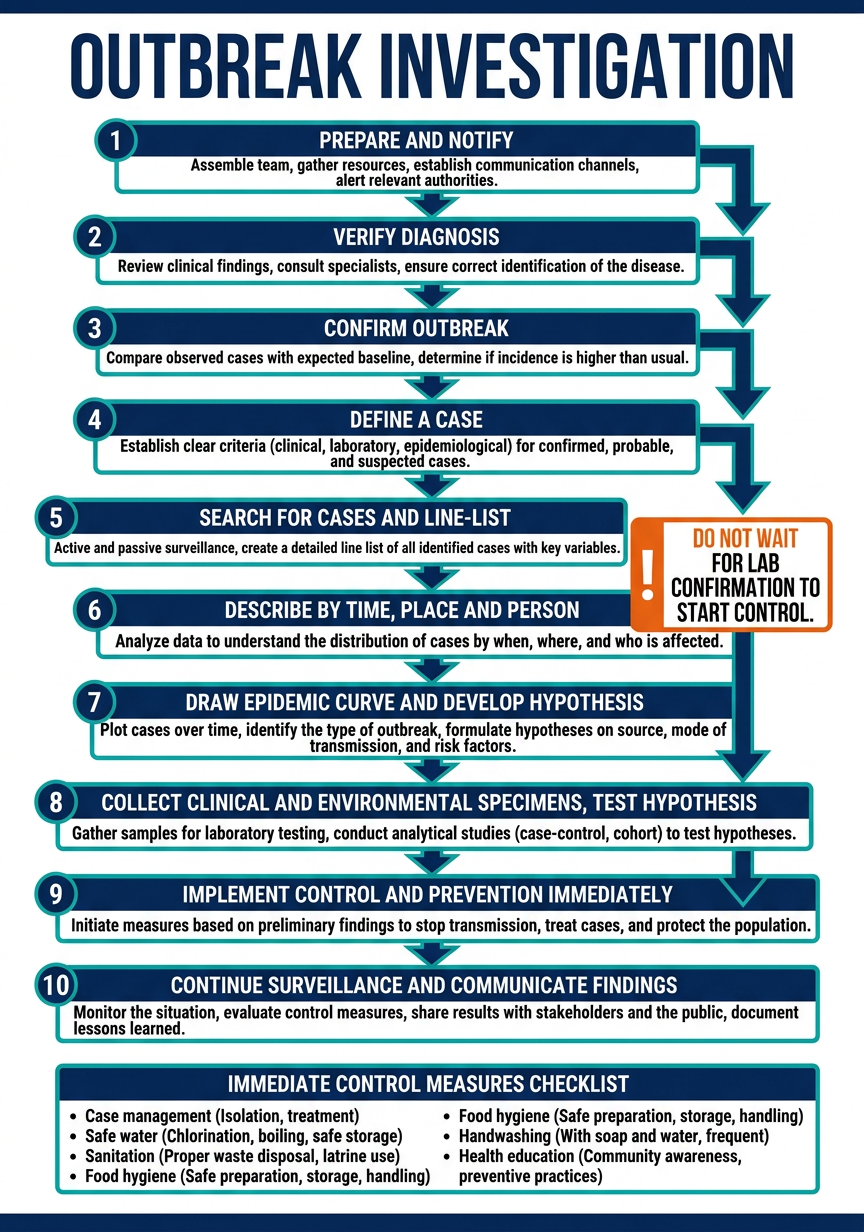
Make a flowchart poster for outbreak investigation
A portrait A4 exam revision poster titled “OUTBREAK INVESTIGATION”. Create a clear vertical medical-public-health flowchart with 10 numbered rectangular stages connected by large downward arrows: 1 Prepare and notify. 2 Verify diagnosis. 3 Confirm outbreak. 4 Define a case. 5 Search for cases and line-list. 6 Describe by time, place and person. 7 Draw epidemic curve and develop hypothesis. 8 Collect clinical and environmental specimens, test hypothesis. 9 Implement control and prevention immediately. 10 Continue surveillance and communicate findings. Include a prominent side callout: “DO NOT WAIT FOR LAB CONFIRMATION TO START CONTROL.” Add a bottom checklist: Case management • Safe water • Sanitation • Food hygiene • Handwashing • Health education. Use clean readable typography, high contrast, white background, navy blue and teal with orange highlight. Designed for 3rd MBBS Community Medicine exam revision.
CDC outbreak investigation steps case definition surveillance control measures
Have you done
Not seen
~/
mkdir -p "/tmp/workspace/outbreak-poster/output" && python - <<'PY' from reportlab.lib.pagesizes import A4 from reportlab.lib.colors import HexColor, white from reportlab.pdfgen import canvas from reportlab.lib.units import cm from pathlib import Path p=Path('/tmp/workspace/outbreak-poster/output/Outbreak_Investigation_Flowchart_Poster.pdf') w,h=A4 c=canvas.Canvas(str(p),pagesize=A4) navy=HexColor('#103B5B'); teal=HexColor('#007D78'); pale=HexColor('#EAF6F4'); orange=HexColor('#E77F20'); ink=HexColor('#1C2B32'); light=HexColor('#F5F8F8') # bg c.setFillColor(white);c.rect(0,0,w,h,fill=1,stroke=0) # header c.setFillColor(navy);c.rect(0,h-4.0*cm,w,4.0*cm,fill=1,stroke=0) c.setFillColor(white);c.setFont('Helvetica-Bold',25);c.drawCentredString(w/2,h-1.55*cm,'OUTBREAK INVESTIGATION') c.setFont('Helvetica',10.5);c.drawCentredString(w/2,h-2.28*cm,'Community Medicine • 3rd MBBS • Master Flowchart') c.setFillColor(orange);c.roundRect(2.15*cm,h-3.28*cm,w-4.3*cm,.55*cm,.14*cm,fill=1,stroke=0) c.setFillColor(white);c.setFont('Helvetica-Bold',8.8);c.drawCentredString(w/2,h-3.08*cm,'CONTROL MEASURES START EARLY - DO NOT WAIT FOR LAB CONFIRMATION') # helpers def wrap(text,font,size,maxw): words=text.split(); lines=[];line='' for z in words: test=(line+' '+z).strip() if c.stringWidth(test,font,size)<=maxw: line=test else:lines.append(line);line=z lines.append(line);return lines def box(y,num,title,desc,color=teal): x=1.55*cm; bw=w-3.1*cm; bh=1.68*cm c.setFillColor(light);c.setStrokeColor(HexColor('#A9B9BC'));c.setLineWidth(.8);c.roundRect(x,y,bw,bh,.22*cm,fill=1,stroke=1) c.setFillColor(color);c.circle(x+.67*cm,y+bh/2,.43*cm,fill=1,stroke=0) c.setFillColor(white);c.setFont('Helvetica-Bold',13);c.drawCentredString(x+.67*cm,y+bh/2-.16*cm,str(num)) tx=x+1.4*cm;c.setFillColor(navy);c.setFont('Helvetica-Bold',11.2);c.drawString(tx,y+bh-.52*cm,title) c.setFillColor(ink);c.setFont('Helvetica',8.3) yy=y+bh-.91*cm for line in wrap(desc,'Helvetica',8.3,bw-1.75*cm):c.drawString(tx,yy,line);yy-=.30*cm return y def arrow(y): cx=w/2;c.setStrokeColor(orange);c.setFillColor(orange);c.setLineWidth(2.2);c.line(cx,y,cx,y-.35*cm);c.line(cx,y-.35*cm,cx-.14*cm,y-.17*cm);c.line(cx,y-.35*cm,cx+.14*cm,y-.17*cm) y=h-6.0*cm items=[ ('PREPARE AND NOTIFY','Notify health authority; form field team; arrange forms, transport, specimens and supplies.'), ('VERIFY DIAGNOSIS','Review clinical features and records; collect appropriate clinical samples.'), ('CONFIRM AN OUTBREAK','Compare observed cases with expected baseline; define the affected area and period.'), ('DEFINE A CASE','Use clinical criteria plus person, place and time. Classify suspected, probable and confirmed cases if required.'), ('FIND CASES AND LINE-LIST','Active case search in facilities and community. Record onset, demographics, symptoms, exposure, outcome.'), ('DESCRIBE BY TIME, PLACE, PERSON','Draw epidemic curve, spot map and attack rates. Identify groups and locations at risk.'), ('DEVELOP AND TEST HYPOTHESIS','Interview cases/non-cases; inspect water, food, sanitation and other likely vehicles.'), ('COLLECT ENVIRONMENTAL SAMPLES','Stool/vomitus, water, food and relevant environmental specimens. Link results with field findings.'), ('IMPLEMENT CONTROL AND PREVENTION','Case management, safe water, sanitation, food safety, hand hygiene, risk communication.'), ('MAINTAIN SURVEILLANCE AND REPORT','Monitor new cases and effectiveness; modify action; document and communicate findings.')] for i,(t,d) in enumerate(items,1): box(y,i,t,d, orange if i in (9,10) else teal) if i<10: arrow(y-.08*cm) y-=2.08*cm # Bottom note c.setFillColor(navy);c.roundRect(1.55*cm,.85*cm,w-3.1*cm,1.22*cm,.18*cm,fill=1,stroke=0) c.setFillColor(white);c.setFont('Helvetica-Bold',9.5);c.drawCentredString(w/2,1.62*cm,'CORE CONTROL CHECKLIST') c.setFont('Helvetica',8.5);c.drawCentredString(w/2,1.22*cm,'Case management • Safe water • Sanitation • Food hygiene • Handwashing • Health education') c.save();print(p, p.stat().st_size) PY python - <<'PY' from pypdf import PdfReader p='/tmp/workspace/outbreak-poster/output/Outbreak_Investigation_Flowchart_Poster.pdf';r=PdfReader(p);print('pages',len(r.pages),'text',len(r.pages[0].extract_text() or '')) PY
Outbreak Investigation Flowchart Poster
PDF Document · PDF