
Explain aspirin related to bvsc
Reading File
Aspirin is an NSAID and antiplatelet agent widely used in veterinary medicine. It inhibits COX-1 and COX-2 enzymes, blocking prostaglandin synthesis. In BVSc (Bachelor of Veterinary Science), aspirin is covered under pharmacology - specifically NSAIDs and analgesics.
Searching sources...
Finding Sources
Finding Sources
The library has human medical textbooks, not veterinary-specific ones. Let me pull the best pharmacology content on aspirin from Lippincott Pharmacology and Goodman & Gilman's, which are standard references used in BVSc pharmacology courses too.
Reading File
Finding Sources
Reading File
Finding Sources
Finding Sources
Finding Sources
Reading File
Reading File
Reading File
Searching the Web
aspirin pharmacology BVSc veterinary uses doses cats dogs species sensitivity
Now I have comprehensive data from the pharmacology textbooks and veterinary context. Let me compile a thorough, BVSc-oriented answer.
Loading Image
Loading Image
Loading Image
I have all the information needed. Here is the full BVSc-oriented explanation of Aspirin.
Aspirin (Acetylsalicylic Acid) - BVSc Pharmacology
Drug Classification
Aspirin belongs to the Salicylate group of NSAIDs (Non-Steroidal Anti-Inflammatory Drugs). It is the prototype and most studied member of this class.
- Chemical name: Acetylsalicylic acid (ASA)
- Drug class: NSAID - Salicylate derivative
- Nature: Weak organic acid
Mechanism of Action
Aspirin works by irreversibly inhibiting cyclooxygenase (COX) enzymes through acetylation.
The Arachidonic Acid Pathway:
- Cell membrane phospholipids are cleaved by phospholipase A2 to release arachidonic acid
- COX-1 converts arachidonic acid to Prostaglandin H2 (PGH2)
- PGH2 is further converted to:
- Thromboxane A2 (TXA2) - promotes platelet aggregation and vasoconstriction
- Prostacyclin (PGI2) - inhibits platelet aggregation, causes vasodilation
- Prostaglandins (PGE2, PGF2) - mediate inflammation, pain, fever
How Aspirin Acts:
Aspirin acetylates a serine residue on the active site of COX-1 (and to a lesser extent COX-2), thereby irreversibly inactivating the enzyme. This is a key distinction - while other NSAIDs are reversible, competitive inhibitors, aspirin's inhibition is permanent and irreversible.
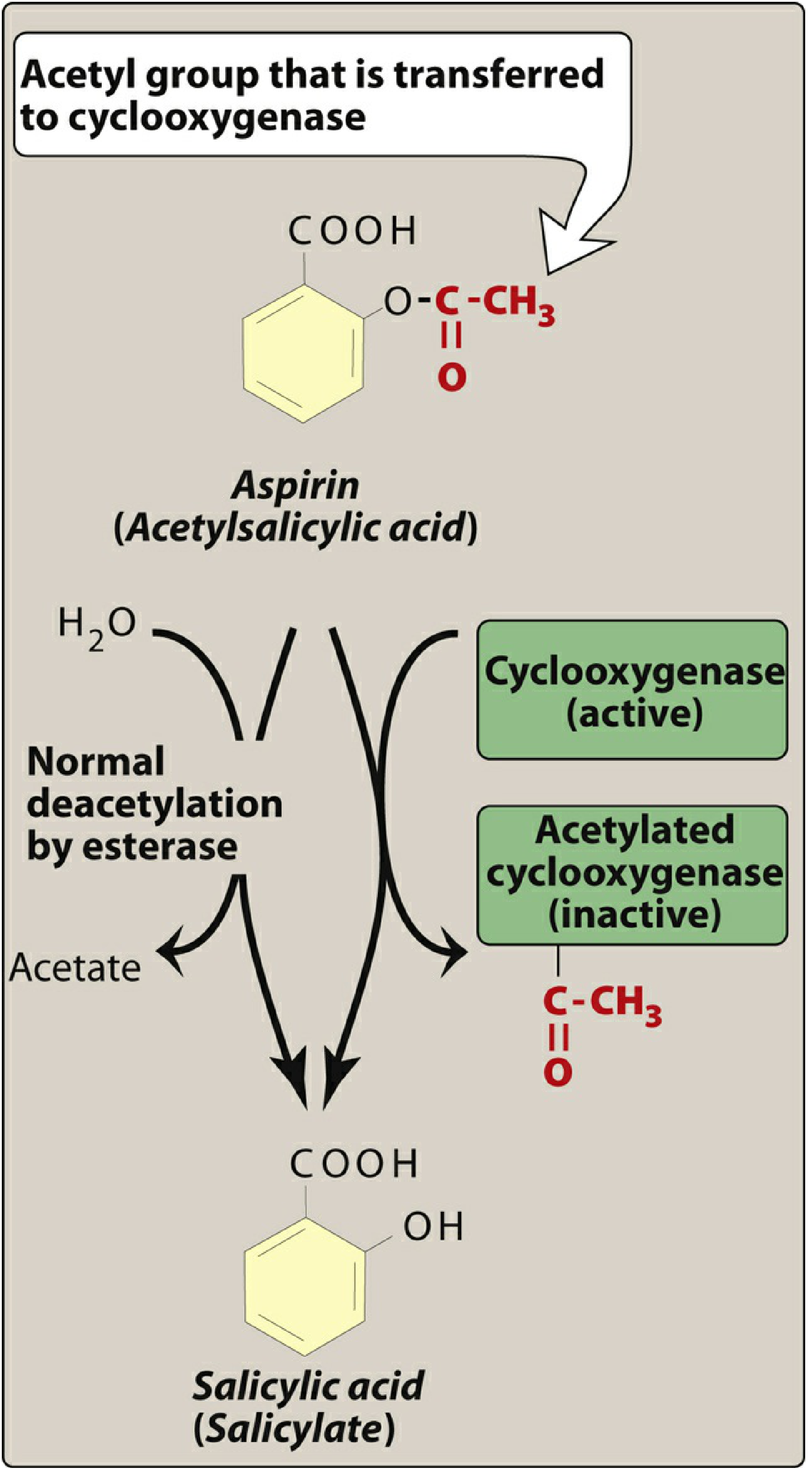
Figure: Aspirin transfers its acetyl group to COX, inactivating it, and is itself converted to salicylic acid - Lippincott Illustrated Reviews: Pharmacology
Pharmacological Actions (The "3 A's")
| Action | Mechanism | Dose Required |
|---|---|---|
| Analgesic | Reduces PGE2, which sensitizes nerve endings to bradykinin/histamine | Low-moderate dose |
| Antipyretic | Inhibits PGE2 synthesis in hypothalamus, resets thermostat | Low-moderate dose |
| Anti-inflammatory | Reduces prostaglandin and thromboxane production at inflamed sites | High dose only |
| Antiplatelet | Irreversibly inhibits TXA2 synthesis in platelets | Very low dose (75-325 mg) |
Key BVSc point: Anti-inflammatory activity requires high doses (equivalent to 12-20 tablets/day in humans), while analgesia and antipyresis occur at lower doses. - Lippincott Illustrated Reviews: Pharmacology
Pharmacokinetics (ADME)
| Parameter | Detail |
|---|---|
| Absorption | Oral; passive diffusion; well absorbed from GI tract |
| Distribution | Widely distributed; crosses placenta and blood-brain barrier |
| Metabolism | Rapidly hydrolyzed to salicylic acid in liver and plasma by esterases |
| Excretion | Urine; rate depends on urinary pH (alkaline urine increases excretion) |
| Half-life (aspirin) | 15-20 minutes (very short - quickly converted to salicylate) |
| Half-life (salicylate) | 3-12 hours (dose-dependent, increases at high doses due to enzyme saturation) |
Veterinary Uses (BVSc Focus)
In Dogs:
- Treatment of mild to moderate pain (arthritis, musculoskeletal pain)
- Anti-inflammatory use in chronic joint disease
- Antithrombotic therapy in conditions like heartworm disease, DIC
- Dose: typically 10-25 mg/kg every 12 hours (with food)
In Cats - SPECIAL SPECIES SENSITIVITY:
Cats are highly sensitive to aspirin toxicity due to a deficiency in glucuronyl transferase enzyme, which impairs hepatic metabolism of salicylates. Cats cannot metabolize aspirin efficiently.
- The dosing interval in cats is every 48-72 hours (compared to every 12 hours in dogs)
- Use is very restricted; safer alternatives are preferred
- Cats can develop severe toxicity even at "therapeutic" doses
Other Species:
- Horses: Used for anti-inflammatory and antithrombotic purposes
- Cattle: Less common; GI irritation risk
Adverse Effects
Common:
- GI irritation - dyspepsia, gastritis, peptic ulceration (due to inhibition of cytoprotective prostaglandins - PGE2 and PGI2 in the gastric mucosa)
- Prolonged bleeding time - due to irreversible platelet COX inhibition; effects last for the entire platelet lifespan (~7-10 days)
- Renal effects - at high doses; reduces renal prostaglandins important for blood flow
Serious/Toxic Effects:
Acute Salicylate Toxicity (Overdose):
- Initial: Respiratory alkalosis - direct stimulation of the respiratory center in the medulla causes hyperventilation
- Later: Metabolic acidosis - uncoupling of oxidative phosphorylation, inhibition of Krebs cycle, accumulation of pyruvate and lactate
- Fatal doses: as low as 3 g in children (relevant to small animals proportionally)
Chronic Salicylism (at doses ~100 mg/kg/day):
- Tinnitus (ringing in ears)
- Headache, dizziness
- Mental confusion, drowsiness
- Nausea, vomiting, diarrhea
- Can progress to convulsions and coma
Reye's Syndrome: In young animals/children given aspirin during viral infections - rare but serious hepatic encephalopathy. Aspirin should be avoided in young animals with suspected viral illness.
Analgesic Nephropathy: Long-term use with acetaminophen can cause tubulointerstitial nephritis with renal papillary necrosis. - Robbins & Kumar Basic Pathology
Drug Interactions
| Interacting Drug | Effect |
|---|---|
| Anticoagulants (heparin, warfarin) | Increased bleeding risk |
| Other NSAIDs (ibuprofen) | Ibuprofen taken 2 hours before aspirin can block aspirin's antiplatelet effect by competing at the COX active site |
| Methotrexate | Increased methotrexate toxicity |
| Probenecid | Aspirin reduces uricosuric effect |
| Corticosteroids | Increased GI ulceration risk |
Contraindications
- Known aspirin hypersensitivity (can cause bronchospasm)
- Active GI ulceration or bleeding
- Bleeding disorders / coagulopathies
- Cats - with extreme caution only
- Young animals with viral infections (Reye's syndrome risk)
- Renal or hepatic insufficiency
- Third trimester pregnancy (premature closure of ductus arteriosus)
Aspirin Resistance
All forms of treatment failure with aspirin are collectively called "aspirin resistance," but true pharmacological resistance is rare. Pseudo-resistance - reflecting delayed and reduced drug absorption - is more common (e.g., with enteric-coated formulations). - Goodman & Gilman's Pharmacological Basis of Therapeutics
Summary - Key BVSc Exam Points
- Aspirin = irreversible COX inhibitor (unique among NSAIDs)
- Acts by acetylating serine on COX active site
- Triple action: analgesic, antipyretic, anti-inflammatory (+ antiplatelet at low dose)
- Anti-inflammatory requires high doses; analgesia/antipyresis at lower doses
- Cats are highly sensitive - deficient glucuronyl transferase = slow metabolism = narrow safety margin
- Antiplatelet effect lasts 7-10 days (platelet lifespan) - irreversible effect
- Toxicity sequence: respiratory alkalosis first, then metabolic acidosis
- Chronic toxicity = salicylism (tinnitus, confusion, GI bleeding)
- Avoid in viral infections in young animals (Reye's syndrome)
- Ibuprofen can antagonize aspirin's antiplatelet effect if given 2 hours before aspirin
Sources: Lippincott Illustrated Reviews: Pharmacology; Robbins & Kumar Basic Pathology; Goodman & Gilman's The Pharmacological Basis of Therapeutics; Katzung's Basic and Clinical Pharmacology
This is a shared conversation. Sign in to Orris to start your own chat.