
Draw a detailed flowchart of biomedical waste management from generation to final disposal mentioning the treatment of each categories.
biomedical waste management categories treatment disposal flowchart India
A detailed professional flowchart of Biomedical Waste Management from generation to final disposal, following India's BMW Rules 2016 and WHO guidelines. The flowchart should show: TOP: "BIOMEDICAL WASTE GENERATION" (Healthcare facility - hospital, clinic, lab, blood bank) Then flow down to "SEGREGATION AT SOURCE" with color-coded bins in a row: - Yellow bin: Human anatomical waste, animal waste, soiled waste (dressings, bandages), expired medicines, chemical waste, microbiology waste - Red bin: Contaminated recyclable waste (plastic IV tubes, catheters, syringes without needles, gloves) - White/Translucent Puncture-proof container: Sharps (needles, syringes with needles, blades, broken glass with blood) - Blue/Black bin: Glassware, metallic implants - Black bin: General/non-infectious solid waste (paper, kitchen waste, packaging) Then flow to "COLLECTION & LABELING" - biohazard symbol, proper labeling with date, quantity, category Then flow to "TRANSPORTATION" - within facility (trolleys, dumbwaiters) and offsite (authorized vehicles with GPS tracking, not mixed with municipal waste) Then flow to "TREATMENT METHODS" - a wide box splitting into 5 treatment branches: 1. Incineration (Yellow waste: anatomical, pathological, soiled) - Temperature 850-1050°C, dual chamber 2. Autoclaving/Hydroclave (Red waste: contaminated plastics) - Steam sterilization 134°C, 18 min - then shredding/recycling 3. Chemical Disinfection (Sharps in White container) - 1% hypochlorite solution 30 min, then encapsulation/cement concrete 4. Microwave Treatment (Red + Yellow categories) - 2450 MHz, alternative to autoclave 5. Deep Burial/Encapsulation (pathological waste in remote areas) - 2m deep pit, lime disinfection Then flow to "FINAL DISPOSAL": - Ash from incineration → secured landfill - Treated plastics → recycling facility - Treated sharps → encapsulation/landfill - Ash residue → sanitary landfill - General waste → municipal landfill BOTTOM: "RECORD KEEPING & MONITORING" - manifests, logbooks, annual reports to PCB Color scheme: clean medical whites, blues, with category colors matching bin colors. Professional clean design with arrows and boxes.
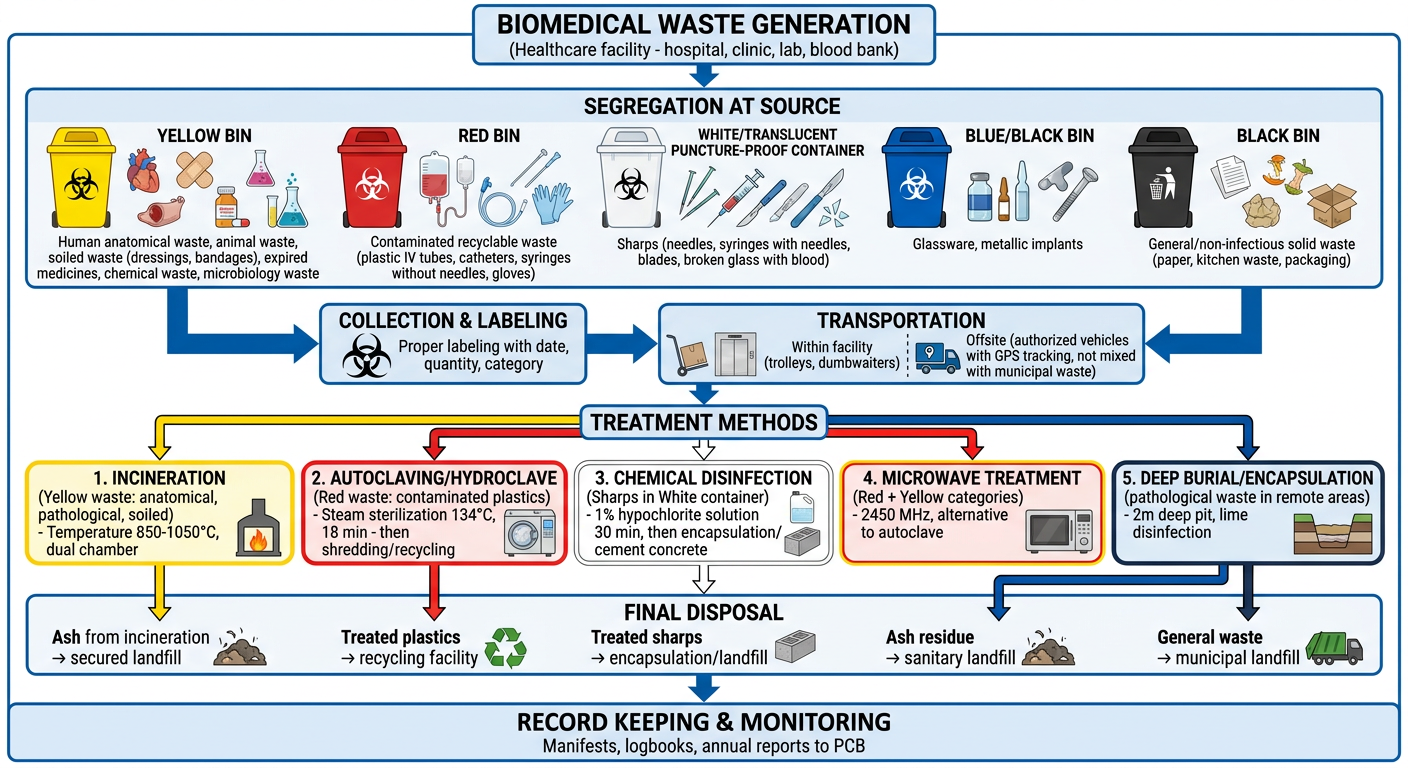
Biomedical Waste Management - Generation to Final Disposal
STEP 1 - WASTE GENERATION
STEP 2 - SEGREGATION AT SOURCE (Most Critical Step)
| Container | Color | Category & Contents |
|---|---|---|
| Bag/Bin | Yellow | Human anatomical waste (body parts, organs, tissues), animal waste, soiled waste (blood-soaked dressings, bandages, cotton, plaster casts), expired/discarded medicines, chemical/cytotoxic waste, microbiology cultures |
| Bag/Bin | Red | Contaminated recyclable plastic waste - IV sets, catheters, urine bags, syringes (WITHOUT needles), gloves, blood bags after use |
| Container | White (Translucent, puncture-proof) | Sharps - needles, syringes WITH fixed needles, lancets, scalpels, blades, broken contaminated glass |
| Bin | Blue | Glassware (bottles, slides, cover slips), metallic implants (non-contaminated) |
| Bin | Black | General solid waste - paper, packaging, food waste, non-infectious waste |
STEP 3 - COLLECTION & LABELING
- Bags must not be filled beyond 3/4 capacity
- Each container labeled with: biohazard symbol, date, type of waste, quantity, source
- Collection frequency: at least once in 24 hours
STEP 4 - STORAGE
- On-site storage: max 48 hours (in small facilities)
- Cold storage mandatory for pathological waste if >48 hour delay
- Storage area: separate, locked, ventilated, labeled
STEP 5 - TRANSPORTATION
- Within facility: Covered trolleys/carts - dedicated routes, not through patient areas
- Offsite: Only through authorized Common Biomedical Waste Treatment Facilities (CBWTFs)
- Vehicles must have GPS tracking, be leak-proof, labeled with biohazard symbol
- Never mixed with municipal solid waste
STEP 6 - TREATMENT METHODS (by category)
| Treatment | Applicable Waste | Parameters |
|---|---|---|
| Incineration | Yellow (anatomical, pathological, soiled, cytotoxic) | Dual chamber, primary temp 800°C, secondary 1050°C; residence time >1 sec |
| Autoclaving / Hydroclave | Red (contaminated plastics) + some Yellow | Steam at 134°C for 18 min (gravity) or 121°C for 30 min; followed by shredding |
| Microwave Treatment | Red + Yellow (alternative to autoclave) | 2450 MHz frequency; moisture >50% required; followed by shredding |
| Chemical Disinfection | Sharps (White container), liquid waste | 1% sodium hypochlorite for 30 min; glutaraldehyde 2% for instruments |
| Encapsulation | Treated sharps (White) | Filled container sealed with cement/plastic resin; landfill disposal |
| Plasma Pyrolysis | High-risk/cytotoxic waste | Temperatures up to 5000°C; converts to vitrified slag |
| Deep Burial | Pathological waste (remote/inaccessible areas only) | 2 m deep pit, lined with lime, covered; away from water table |
STEP 7 - FINAL DISPOSAL
| After Treatment | Final Destination |
|---|---|
| Incinerator ash | Secured/sanitary landfill |
| Treated & shredded plastics (Red) | Sent to authorized recyclers (NOT reused in healthcare) |
| Encapsulated sharps | Municipal solid waste landfill or secured landfill |
| General waste (Black) | Municipal solid waste stream |
| Treated liquid waste | Effluent treatment plant (ETP) → sewer |
STEP 8 - RECORD KEEPING & MONITORING
- Manifest system: every transfer documented (Form 2/3/4 under BMW Rules)
- Annual report submitted to State Pollution Control Board (SPCB)
- Accident reporting: any spillage, injury, or non-compliance reported within 24 hours
- Barcode/RFID tracking at CBWTFs
Key Regulatory Framework
- BMW Management Rules, 2016 (India) - superseded 1998 rules
- Amended 2018/2019 - added pre-treatment requirements for labs, stricter ETP norms
- WHO Safe Management of Wastes from Healthcare Activities (Prüss-Üstün et al.)
- Oversight: Central Pollution Control Board (CPCB) + State PCBs
Important note: Segregation at source is the single most impactful step - improper segregation contaminates non-hazardous waste, increases treatment volume and cost, and creates occupational hazard for healthcare workers.