
Normal schuller view x-ray mastoid
Reading File
This is a visual/radiology query. Let me search the library for Schuller view content and images in parallel.
Finding Sources
Finding Sources
Searching the Web
normal Schuller view mastoid X-ray anatomy landmarks
Let me search the library more broadly and fetch the relevant images simultaneously.
Finding Sources
Loading Image
Loading Image
Reading Web Page
https://epomedicine.com/medical-students/x-ray-of-mastoids
Let me get the textbook content on mastoid radiology and fetch the Schuller's view SVG diagram.
Finding Sources
Loading Image
Finding Sources
Let me read the Cummings block for the mastoid X-ray image and content.
Reading File
Loading Image
That image is from otoendoscopy, not Schuller's view. The epomedicine image I already fetched is the relevant one. Now I have all the information needed to give a comprehensive answer. Let me compile it.
Schuller's View - Normal Mastoid X-ray
Positioning & Technique
Schuller's view is a lateral oblique radiographic projection of the temporal bone/mastoid. It is the most commonly used plain X-ray for mastoid assessment.
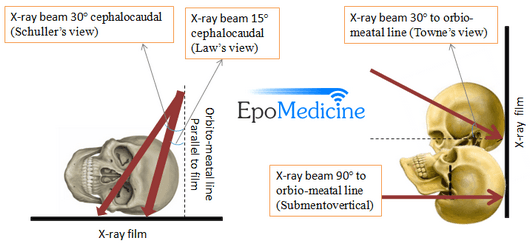
- Patient lies lateral with the side being examined against the film
- X-ray beam is directed 30 degrees cephalocaudal (compared to 15 degrees in Law's view)
- The orbito-meatal line is kept parallel to the film
- The 30-degree angulation separates right and left mastoids and displaces the arcuate eminence of the petrous bone downward
Structures Visible on Normal Schuller's View
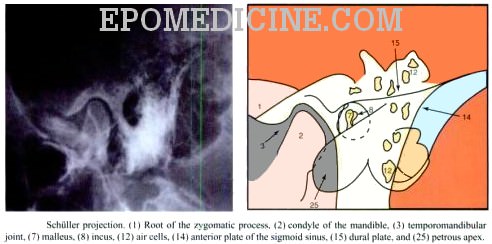
The key numbered landmarks (as seen in the diagram above) include:
| No. | Structure |
|---|---|
| 1 | Root of the zygomatic process |
| 2 | Condyle of the mandible |
| 3 | Temporomandibular joint |
| 7 | Malleus |
| 8 | Incus |
| 12 | Mastoid air cells |
| 14 | Anterior plate of the sigmoid sinus (lateral sinus plate) |
| 15 | Dural plate (tegmen) |
| 25 | Petrous apex |
Key feature of Schuller's view: The EAC (External Acoustic Meatus) is superimposed on the IAC (Internal Acoustic Meatus) due to the 30-degree beam angulation. This is a hallmark of a correctly positioned Schuller's view.
What to Look For on a Normal Schuller's View
When reporting a mastoid X-ray, comment on the following:
- Type of mastoid - Normal adult mastoid is cellular (pneumatized) in ~80% of individuals. Bilaterally acellular mastoid is normal in ~20%.
- Air cells - Well-defined, thin-walled air cells with a uniform honeycomb pattern, extending beyond the sinus plate and tegmen
- Tegmen (dural plate) - The roof of the mastoid antrum/epitympanum; seen as a thin bony line superiorly
- Lateral sinus plate - The plate overlying the sigmoid sinus; seen posteriorly
- Sino-dural (Citelli's) angle - The angle between the sinus plate and dural plate; normally acute in a well-pneumatized mastoid
- Attico-antral (key) region - The area around the mastoid antrum and upper attic; well visualized in Schuller's view (better than Law's view)
- Condyle of mandible and temporomandibular joint
Clinical Applications
| Finding | Implication |
|---|---|
| Well-pneumatized air cells | Normal |
| Diffuse haziness/clouding of cells | Acute mastoiditis |
| Destruction of intercellular septa | Coalescent mastoiditis |
| Diffuse sclerosis | Chronic mastoiditis |
| Area of translucency in sclerotic mastoid | Cholesteatoma (eroding antrum) |
| Obtuse Citelli's angle | Secondary sclerosis (CSOM) |
| Longitudinal temporal bone fracture | Trauma |
How Schuller's View Differs from Law's View
| Feature | Law's View | Schuller's View |
|---|---|---|
| Beam angle | 15° cephalocaudal | 30° cephalocaudal |
| EAC/IAC relationship | Separated | Superimposed |
| Attico-antral visibility | Less clear | Better (key advantage) |
The increased angulation in Schuller's view pushes the arcuate eminence of the petrous bone downward, allowing better visualization of the antrum and upper attic - the region most commonly affected in acquired cholesteatoma.
Give me normal x-ray pic of mastiod schullers view
Searching the Web
normal Schuller view mastoid X-ray image
Loading Image
Loading Image
Reading Web Page
https://www.jaypeedigital.com/eReader/chapter/9789385891908/…
The second image (diagnopein) is a lateral neck X-ray, not a Schuller's view. The Shutterstock image shows a proper bilateral Schuller's view comparison. Let me also get the annotated diagram from the previous session.
Here are the best available normal Schuller's view mastoid X-ray images:
Normal Schuller's View - Mastoid X-ray
Bilateral Schuller's View (Right & Left mastoid comparison):

Normal bilateral Schuller's view - both mastoids are taken separately and compared. Well-pneumatized (cellular) honeycomb air cell pattern is visible.
Labeled Schuller's view with anatomical annotations:
What You're Seeing in a Normal Schuller's View
| Structure | Appearance |
|---|---|
| Mastoid air cells | Honeycomb-like radiolucent spaces with thin white bony septa |
| EAC superimposed on IAC | Single round/oval lucent canal shadow (hallmark of correct positioning) |
| Sinus plate | Dense vertical white line posterior to the EAC |
| Dural plate (tegmen) | Dense horizontal white line superior to the air cells |
| Sinodural (Citelli's) angle | Acute angle at junction of sinus plate and dural plate |
| TMJ condyle | Visible anteriorly |
| Zygomatic root | Bony ridge projecting anterosuperiorly |
Normal pneumatization pattern: Cellular mastoid with air cells extending beyond both the sinus plate and tegmen (dural plate). This is seen in ~80% of normal adults.
This is a shared conversation. Sign in to Orris to start your own chat.