
TCA cycle
Reading File
The TCA (tricarboxylic acid) cycle, also called the Krebs cycle or citric acid cycle, is the central metabolic hub for energy production in aerobic organisms - it oxidizes acetyl-CoA to CO2 while capturing energy as NADH, FADH2, and GTP.
Searching sources...
Finding Sources
Searching the Web
TCA cycle steps enzymes NADH FADH2 summary
Reading File
Reading File
Reading File
Loading Image
Reading File
Loading Image
Reading File
Here is a complete, textbook-based overview of the TCA cycle.
The TCA (Citric Acid / Krebs) Cycle
Location: Mitochondrial matrix (enzymes free or attached to the inner mitochondrial membrane)
Function: Oxidizes acetyl-CoA (2C) to CO2, capturing energy as reducing equivalents (NADH, FADH2) and GTP. It is the central hub of metabolism - both catabolic and synthetic - making it amphibolic.
The Cycle Diagram
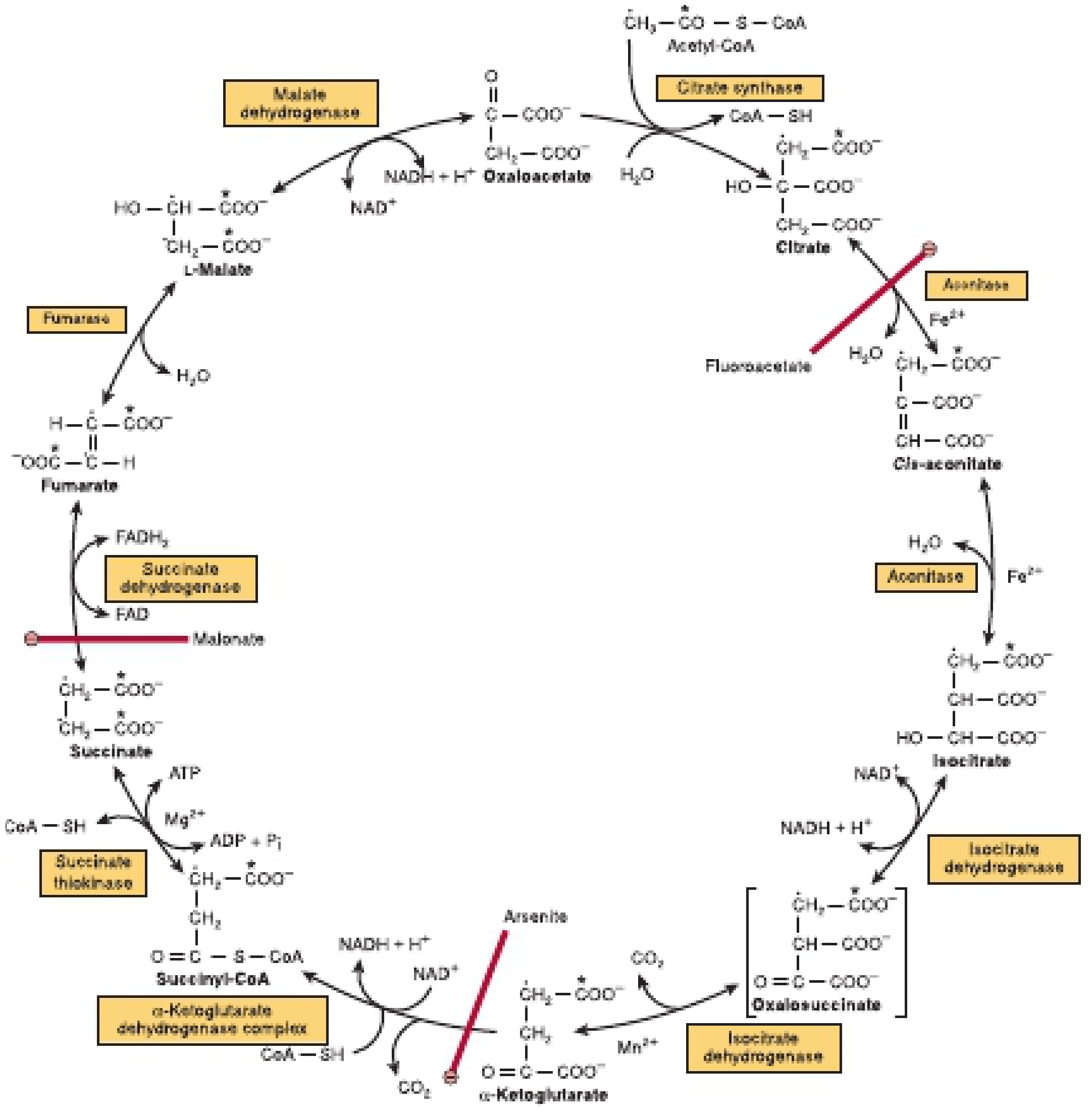
Harper's Illustrated Biochemistry, 32nd Ed - Fig 16-3: Full TCA cycle with enzymes, cofactors, and sites of inhibition
Entry Point: Pyruvate to Acetyl-CoA
Before entering the cycle, pyruvate (from glycolysis) is decarboxylated to acetyl-CoA by the pyruvate dehydrogenase complex, releasing one CO2 and producing one NADH. Acetyl-CoA (C2) is then the substrate that enters the TCA cycle.
The 8 Steps
| Step | Reaction | Enzyme | Cofactors / Products |
|---|---|---|---|
| 1 | Oxaloacetate (C4) + Acetyl-CoA (C2) → Citrate (C6) | Citrate synthase | H2O consumed; CoA released |
| 2 | Citrate → cis-Aconitate → Isocitrate (C6) | Aconitase (aconitate hydratase) | Fe2+ required; inhibited by fluoroacetate |
| 3 | Isocitrate → Oxalosuccinate → α-Ketoglutarate (C5) | Isocitrate dehydrogenase | NAD+ → NADH; CO2 released; Mg2+/Mn2+ required |
| 4 | α-Ketoglutarate (C5) → Succinyl-CoA (C4) | α-Ketoglutarate dehydrogenase complex | NAD+ → NADH; CO2 released; thiamin-PP, lipoate, FAD, CoA; inhibited by arsenite |
| 5 | Succinyl-CoA → Succinate (C4) | Succinate thiokinase (succinyl-CoA synthetase) | ADP/GDP → ATP/GTP (substrate-level phosphorylation - the only one in the cycle) |
| 6 | Succinate → Fumarate (C4) | Succinate dehydrogenase | FAD → FADH2; inhibited by malonate; Fe-S protein; directly reduces ubiquinone |
| 7 | Fumarate + H2O → L-Malate (C4) | Fumarase (fumarate hydratase) | H2O added |
| 8 | L-Malate → Oxaloacetate (C4) | Malate dehydrogenase | NAD+ → NADH; cycle regenerates OAA |
Net Yield Per Turn (per acetyl-CoA)
| Product | Number | ATP equivalent (via ox. phosphorylation) |
|---|---|---|
| NADH | 3 | 3 × 2.5 = 7.5 ATP |
| FADH2 | 1 | 1 × 1.5 = 1.5 ATP |
| GTP/ATP | 1 | 1 ATP |
| Total | ~10 ATP per acetyl-CoA |
Since one glucose yields 2 acetyl-CoA, the cycle contributes ~20 ATP per glucose (before accounting for pyruvate dehydrogenase). NADH and FADH2 are reoxidized by the respiratory chain - this process requires oxygen, making the TCA cycle strictly aerobic.
- Harper's Illustrated Biochemistry, 32nd Ed, p. 168-170
Vitamins Required as Cofactors
Four B-vitamins are indispensable:
| Vitamin | Active Form | Role in TCA |
|---|---|---|
| Niacin (B3) | NAD+ | Electron acceptor for isocitrate DH, α-KG DH, malate DH |
| Riboflavin (B2) | FAD | Cofactor for succinate dehydrogenase |
| Thiamin (B1) | Thiamin diphosphate | Decarboxylation at α-KG dehydrogenase (and pyruvate DH) |
| Pantothenic acid (B5) | Coenzyme A | Forms acetyl-CoA and succinyl-CoA |
- Harper's Illustrated Biochemistry, 32nd Ed, p. 171
Regulation
The cycle is controlled at three main points - all three regulated by the energy charge of the cell (high NADH, ATP inhibit; ADP, Ca2+ activate):
- Citrate synthase - inhibited by ATP, NADH, succinyl-CoA, and citrate itself
- Isocitrate dehydrogenase - activated by ADP and Ca2+; inhibited by ATP, NADH
- α-Ketoglutarate dehydrogenase complex - inhibited by succinyl-CoA, NADH, ATP; activated by Ca2+
Anaplerosis and Cataplerosis
The cycle needs OAA replenishment when intermediates are drained for biosynthesis. Key anaplerotic reactions:
- Pyruvate carboxylase (pyruvate + CO2 → OAA) - the main anaplerotic enzyme, activated by acetyl-CoA
- Glutamate → α-ketoglutarate (via transamination)
Conversely, cycle intermediates leave (cataplerosis) as precursors for:
- Gluconeogenesis - OAA → phosphoenolpyruvate
- Fatty acid synthesis - citrate exported to cytosol → acetyl-CoA
- Amino acid synthesis - α-KG → glutamate, OAA → aspartate
- Porphyrin/heme synthesis - succinyl-CoA + glycine → δ-aminolevulinic acid
Clinical Connections
| Poison/Drug | Target | Effect |
|---|---|---|
| Fluoroacetate | Aconitase (via fluorocitrate) | Citrate accumulates; lethal in animals |
| Arsenite | α-Ketoglutarate DH (lipoate) | α-KG accumulates |
| Malonate | Succinate dehydrogenase | Competitive inhibition; succinate accumulates |
Thiamin (B1) deficiency impairs both pyruvate DH and α-KG DH, causing lactic acidosis and neurological damage (beriberi, Wernicke's encephalopathy) because the cycle cannot process pyruvate or α-KG normally.
The TCA cycle sits at the intersection of carbohydrate, fat, and protein catabolism - all three macronutrients ultimately converge on acetyl-CoA or cycle intermediates, making this pathway the central axis of aerobic energy metabolism.
- Harper's Illustrated Biochemistry, 32nd Ed (primary source)
- Guyton and Hall Textbook of Medical Physiology
- Ganong's Review of Medical Physiology, 26th Ed
This is a shared conversation. Sign in to Orris to start your own chat.