

image.jpg
Answer above scenario
I can see this is a bone scan (scintigraphy) of both hands showing a patient with pain and swelling in the wrists and fingers.
Searching sources...
Reading File
Finding Sources
Finding Sources
Finding Sources
Finding Sources
Finding Sources
Reading File
Finding Sources
Reading File
Reading File
Now I have excellent source material. Let me fetch the key RA hand radiograph image and compile the full answer.
Loading Image
Here is the full model answer:
Question 5 - Bone Scan of the Hands: Full Answer
1. Abnormality Shown on the Bone Scan (2 marks)
The bone scan shows bilaterally symmetrical, increased periarticular radionuclide uptake at:
- The wrists (carpal bones)
- The metacarpophalangeal (MCP) joints
This pattern - hot spots at the wrists and MCP joints bilaterally in a symmetrical distribution - indicates active synovitis with increased blood flow and bone turnover at these sites. Bone scans detect increased radionuclide uptake before morphological changes are visible on plain radiographs, making them highly sensitive for early inflammatory joint disease.
2. Diagnosis (2 marks)
Rheumatoid Arthritis (RA)
The key diagnostic features supporting this:
- Symmetrical distribution of joint involvement
- Proximal hand involvement (wrists and MCPs), which is the characteristic pattern of RA
- Presentation with pain and swelling in wrists and fingers
This is in contrast to:
- Sero-negative arthritis / psoriatic arthritis: tend to involve distal interphalangeal (DIP) joints
- Osteoarthritis: also involves distal joints, typically asymmetrical early on
- Gout: asymmetrical, often monoarticular initially
As confirmed by Grainger & Allison's Diagnostic Radiology: "Symmetrical proximal disease involving the carpal bones and metacarpophalangeal (MCP) joints is typical in RA."
3. Typical Findings on Plain Radiographs in RA - List 3 (2 marks, any 3)
The following are classic radiographic features of rheumatoid arthritis of the hands:
-
Periarticular osteopenia - loss of bone density immediately around the affected joints (especially at MCPs and wrists); this is one of the earliest radiographic signs
-
Marginal bone erosions - erosions at the bare area (exposed bone between articular cartilage and joint capsule), classically affecting the metacarpal heads and carpal bones, with no associated new bone formation (unlike sero-negative arthritis)
-
Symmetrical joint space narrowing - uniform loss of cartilage at affected joints due to pannus formation
Additional features you could cite:
- Soft tissue swelling around affected joints
- Subluxation / joint malalignment (ulnar deviation of fingers at MCPs)
- Bony ankylosis (late-stage disease)
For reference, here is the PA radiograph of RA hands from Grainger & Allison's:
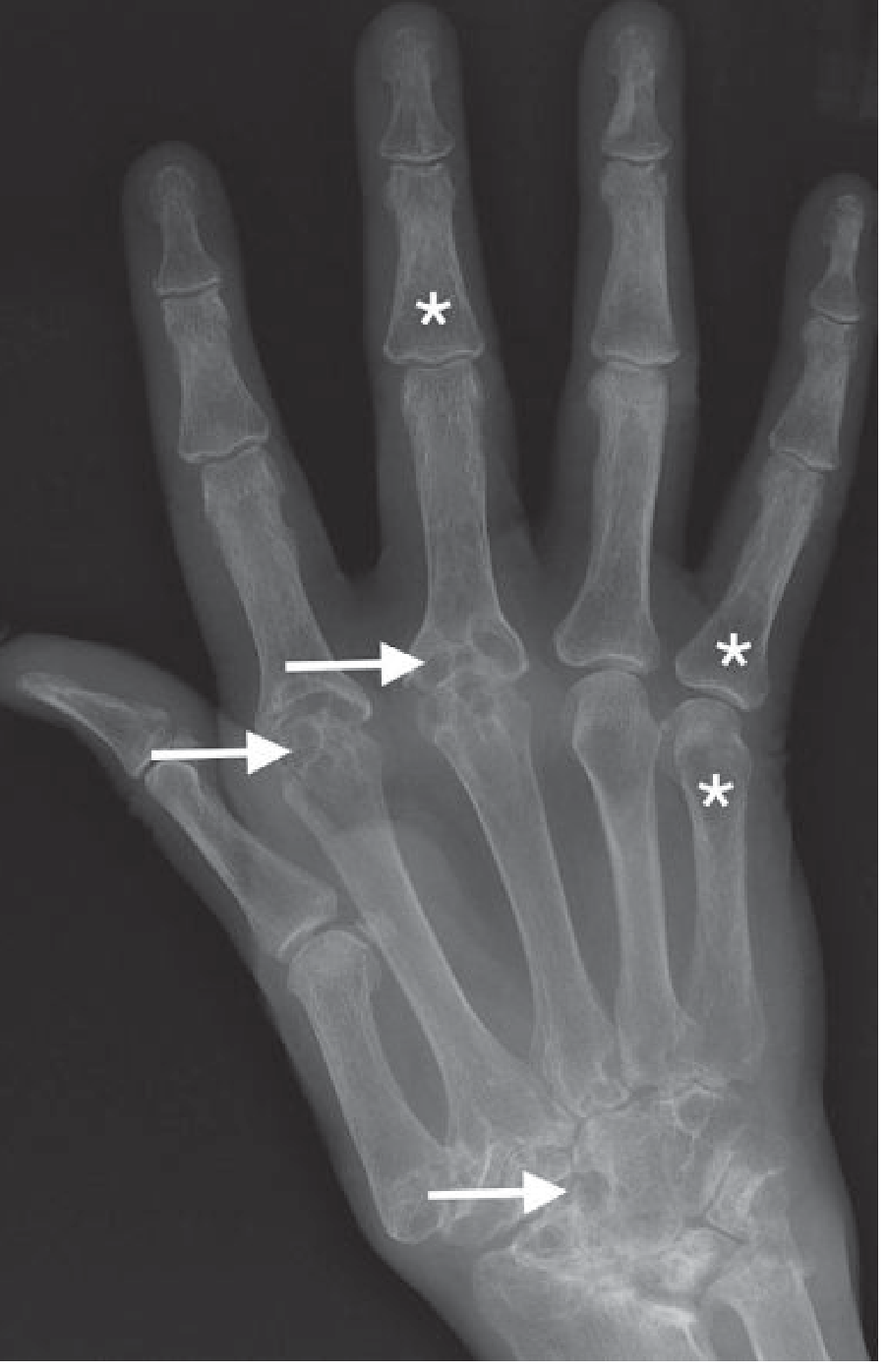
Fig. 44.3 - Rheumatoid Arthritis hand radiograph: periarticular osteopaenia () with widespread erosive change (arrows) affecting the metacarpal heads and carpal bones.*
Sources:
- Grainger & Allison's Diagnostic Radiology - Distribution of Joint Involvement; Bone Changes (p. 1111-1112)
- Firestein & Kelley's Textbook of Rheumatology - Imaging section

image.jpg
What’s stated
This is a classic post-splenectomy infection scenario with a blood film. Let me search the medical library for a thorough answer.
Searching sources...
Finding Sources
Finding Sources
Finding Sources
Finding Sources
Finding Sources
Reading File
Finding Sources
Finding Sources
Finding Sources
Reading File
Reading File
Reading File
Excellent - I now have all the information needed for a complete, well-sourced answer.
Question 6 - 36-Year-Old Post-Splenectomy Man: Full Answer
1. What Does the Slide Show? (2 marks)
The peripheral blood film shows:
- Howell-Jolly bodies - small dark nuclear remnants within red blood cells (normally removed by the spleen)
- Target cells (codocytes) - RBCs with a central dense spot and peripheral ring of haemoglobin
- These two findings together are the hallmark of hyposplenism / functional asplenia following splenectomy
Goldman-Cecil Medicine (Table 143-4) explicitly states: "Howell-Jolly bodies, target cells, and acanthocytes → Hyposplenism (congenital, previous splenectomy, celiac disease, amyloidosis)."
The elevated WCC and low Hb (10 g/dL) indicate an active infection driving anaemia of inflammation, and the negative MPS (malaria parasite screen) is a key clue pointing away from malaria toward another cause.
2. What Is the Diagnosis? (3 marks)
Overwhelming Post-Splenectomy Infection (OPSI)
The classic causative organisms are encapsulated bacteria, which the spleen normally clears via opsonisation:
| Organism | Proportion of OPSI |
|---|---|
| Streptococcus pneumoniae | >50% |
| Haemophilus influenzae type B | ~15% |
| Neisseria meningitidis | ~10% |
Why this patient is at risk:
- Splenectomy 7 years ago - the risk of OPSI is greatest in the first 2 years but persists lifelong
- Loss of splenic macrophages, diminished tuftsin production, and loss of reticuloendothelial screening means encapsulated bacteria cannot be adequately cleared from the bloodstream
- With MPS negative, malaria is excluded; the fever + nausea + abdominal pain + elevated WCC in an asplenic patient = OPSI until proven otherwise
Schwartz's Principles of Surgery states: "OPSI is uniformly fatal without treatment, and thus sepsis in a splenectomized patient is a medical emergency."
3. What Is the Specific Treatment? (6 marks)
Treatment addresses immediate management and long-term prevention:
A. Immediate / Acute Treatment (treat as a medical emergency)
- Blood cultures - collect BEFORE starting antibiotics, but do not delay treatment waiting for results
- IV broad-spectrum antibiotics immediately:
- Vancomycin - broad Gram-positive cover including penicillin-resistant S. pneumoniae
- Ceftriaxone - added for Gram-negative cover (N. meningitidis, H. influenzae)
- Sepsis resuscitation - IV fluids, goal-directed therapy, ICU if required
B. Long-Term Prevention
- Vaccination against encapsulated bacteria (ideally given 2 weeks before elective splenectomy, or given after emergency splenectomy):
- Pneumococcal vaccine (S. pneumoniae)
- Haemophilus influenzae type B vaccine
- Meningococcal vaccine
- Annual influenza vaccine
- Prophylactic antibiotics - lifelong daily penicillin (or amoxicillin) prophylaxis, especially for the first 5 years post-splenectomy and in children until at least age 5
- Patient education:
- Wear a medical alert bracelet
- Carry a laminated medical alert card and a letter with empiric antibiotic instructions
- Keep a 5-day standby antibiotic supply, especially when travelling
- Present to hospital immediately at the first sign of fever or infection
Sources:
- Schwartz's Principles of Surgery, 11th Ed - "Antibiotics and the Asplenic Patient"; "OPSI Clinical Features"
- Current Surgical Therapy, 14th Ed - "Vaccination" (post-splenectomy section)
- Goldman-Cecil Medicine - Table 143-4: Incidental but Clinically Relevant Blood Smear Observations
Extra GI manifestations of Crohns
Searching sources...
Finding Sources
Finding Sources
Reading File
Reading File
Reading File
Reading File
Reading File
Reading File
Excellent - I now have comprehensive source material. Here is the complete answer:
Extra-GI Manifestations of Crohn's Disease
Extra-GI manifestations (EIMs) occur in approximately 35% of Crohn's disease patients - higher than in UC (27%). The occurrence of one EIM predisposes to others. They are usefully divided into those that track bowel activity vs. those that run an independent course.
Key Concept: Activity-Dependent vs. Independent EIMs
| Tracks bowel disease activity | Independent of bowel activity |
|---|---|
| Episcleritis | Uveitis / anterior iritis |
| Erythema nodosum | Pyoderma gangrenosum |
| Oral aphthous ulcers | Primary sclerosing cholangitis |
| Type 1 (pauciarticular) peripheral arthritis | Ankylosing spondylitis |
| Type 2 (polyarticular) peripheral arthritis |
1. Musculoskeletal (most common EIM category)
Peripheral arthritis - two distinct types:
- Type 1 - Pauciarticular (<5 joints): parallels bowel disease activity; typically large joints (knees, ankles); nondeforming; rheumatoid factor negative
- Type 2 - Polyarticular (>5 joints): independent of bowel activity; often small joints (MCP, PIP); may persist for years
Axial arthropathy:
- Sacroiliitis - prevalence ~10%; bilateral and symmetrical; most common axial manifestation; may be asymptomatic
- Ankylosing spondylitis - prevalence ~3%; insidious low back pain + morning stiffness, improves with exercise; HLA-B27 positive in up to 75% of Crohn's patients with spondylitis; runs a course independent of bowel disease
Metabolic bone disease:
- Osteopenia / osteoporosis (fracture risk 40% higher than controls) - multifactorial: steroid use, calcium/vitamin D malabsorption, proinflammatory cytokines (TNF), low BMI
- Sarcopenia - reduced muscle mass, seen in up to 60% of CD patients
Other: Clubbing of the fingertips (common, innocuous); avascular necrosis of hip/shoulder (steroid-related); amyloidosis (rare)
2. Mucocutaneous
- Erythema nodosum (EN) - tender erythematous/dusky subcutaneous nodules, classically on the pretibial region; more common in women; tracks bowel activity; heals without scarring if not biopsied; strongly associated with arthropathy
- Pyoderma gangrenosum (PG) - starts as papule/pustule, progresses to deep ulcer with violaceous (purple) undermined borders and cribriform scarring; most often on the leg or periostomal; shows pathergy (enlarges with minor trauma); often occurs without a bowel flare in CD
- Oral aphthous stomatitis - most cephalad GI manifestation; can progress to labial swelling, angular cheilitis, mucosal cobblestoning (direct granulomatous involvement)
- Metastatic Crohn's (rare) - granulomatous skin lesions remote from the GI tract, histologically identical to the intestinal lesion
- Rare: leukocytoclastic vasculitis, Sweet syndrome (neutrophilic dermatosis), cutaneous polyarteritis nodosa, epidermolysis bullosa acquisita, psoriasis
3. Ocular
- Episcleritis - injection of the sclera/conjunctiva; more common in CD than UC; tracks bowel activity; relatively mild, usually self-limiting
- Anterior uveitis (iritis) - pain, photophobia, blurred vision; more serious; can occur independent of bowel activity; associated with HLA-B27 and spondylitis
- Rare: scleritis, keratopathy, night blindness (vitamin A malabsorption)
4. Hepatobiliary
- Cholelithiasis - prevalence 11-34%; ~twice the general population rate; ileal disease/resection impairs bile salt absorption → cholesterol stone formation; pigment stones also occur
- Primary sclerosing cholangitis (PSC) - prevalence 1.2-3.4% in CD; affects small biliary radicals; presents with abnormal LFTs; independent of bowel activity; major risk factor for cholangiocarcinoma
- Fatty liver (NAFLD) - ~23% of IBD patients
- Also: autoimmune hepatitis, pericholangitis, hepatic amyloidosis (<1%), pyogenic liver abscess, pancreatitis (idiopathic, autoimmune, or drug-induced e.g. thiopurines)
5. Renal / Genitourinary
- Nephrolithiasis - two types:
- Calcium oxalate stones - fat malabsorption → free fatty acids bind luminal calcium → oxalate not cleared → hyperoxaluria (most common in CD with ileal disease)
- Uric acid stones - from volume depletion and hypermetabolic state
- Rare: membranous nephropathy, glomerulonephritis, renal amyloidosis, interstitial nephritis (mesalamine-related)
6. Vascular / Haematologic
- Venous thromboembolism (VTE) - significantly increased risk; due to prothrombotic state (thrombocytosis, elevated fibrinogen, factor V/VIII, reduced antithrombin III and protein S)
- Arterial thrombosis (rare)
- Anaemia - multifactorial: iron deficiency (blood loss), B12 deficiency (terminal ileal disease/resection), anaemia of chronic disease
- Amyloidosis (systemic AA amyloidosis, rare)
7. Respiratory / Cardiac (rare)
- Asthma, COPD association (shared inflammatory pathways)
- Pericarditis, pleuritis
Growth Retardation (Paediatric)
- Nearly half of children with CD show subnormal height velocity; ~25% develop short stature; results from malnutrition + systemic inflammation; surgical resection often improves growth
Sources:
- Sleisenger & Fordtran's Gastrointestinal and Liver Disease - Table 115.2 + EIM sections (pp. 2309-2311)
- Fischer's Mastery of Surgery, 8th Ed - Extraintestinal Manifestations of Crohn Disease
- Sabiston Textbook of Surgery - Clinical Presentation (p. 2087)
- Robbins & Kumar Basic Pathology
This is a shared conversation. Sign in to Orris to start your own chat.