
Syndromic approach for std
Reading File
The syndromic approach for STDs is a WHO-recommended strategy that treats patients based on presenting symptoms and signs rather than waiting for laboratory confirmation. Common syndromes include urethral discharge, vaginal discharge, genital ulcer disease, lower abdominal pain, scrotal swelling, and inguinal bubo.
Searching sources...
Finding Sources
Finding Sources
Finding Sources
Reading File
Reading File
Reading File
Reading File
Reading File
Reading File
Loading Image
Reading File
Finding Sources
Reading File
Now I have comprehensive information to write a thorough answer. Let me compile everything.
Syndromic Approach for STDs
What is the Syndromic Approach?
Since 1990, WHO has recommended syndromic management of STDs for patients presenting with consistently recognized signs and symptoms. The syndromic approach is a scientifically derived strategy that offers accessible, immediate treatment without waiting for laboratory confirmation. Management is guided by flowcharts based on the clinical syndrome - this is more cost-effective than laboratory-based diagnosis, especially in resource-limited settings.
- Park's Textbook of Preventive and Social Medicine, p. 381
Major STD Syndromes and Their Etiologies
| Syndrome | Key Causative Organisms |
|---|---|
| Urethral discharge (male) | N. gonorrhoeae, C. trachomatis, M. genitalium, Ureaplasma, T. vaginalis, HSV |
| Vaginal discharge - Vaginitis | T. vaginalis, Candida albicans, Gardnerella vaginalis (BV) |
| Vaginal discharge - Cervicitis | N. gonorrhoeae, C. trachomatis, T. vaginalis, HSV |
| Genital ulcer disease | HSV-1/2, T. pallidum (syphilis), H. ducreyi (chancroid), C. trachomatis LGV strains |
| Lower abdominal pain (PID) | N. gonorrhoeae, C. trachomatis, BV-associated bacteria, M. genitalium |
| Scrotal swelling (epididymitis) | N. gonorrhoeae, C. trachomatis |
| Inguinal bubo | C. trachomatis (LGV), H. ducreyi (chancroid) |
| Proctitis | C. trachomatis, N. gonorrhoeae, HSV, T. pallidum |
- Harrison's Principles of Internal Medicine 22E, Table 141-2, p. 1141
Syndrome 1: Urethral Discharge (Male)
Flowchart:
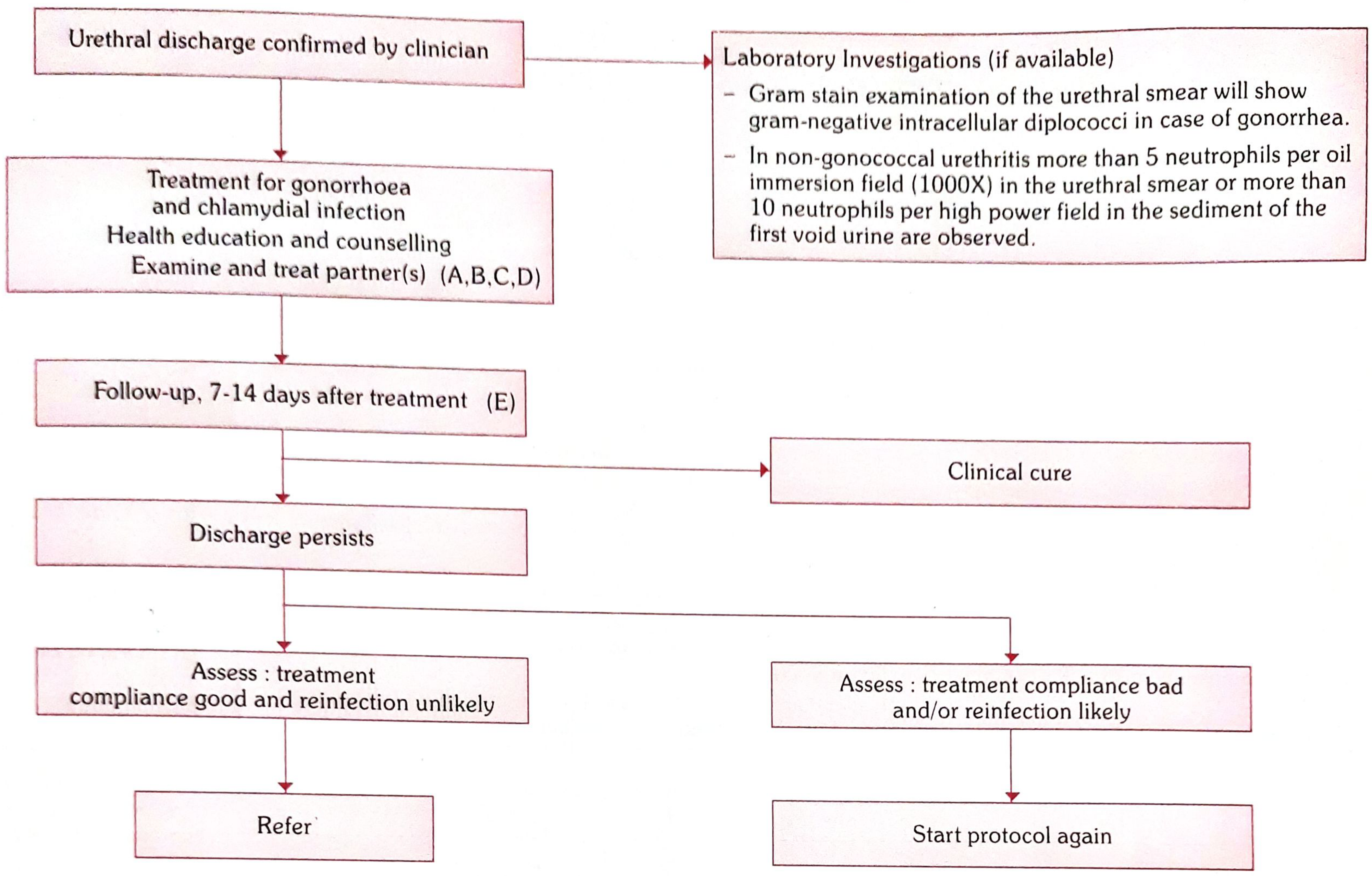
History: Urethral discharge, dysuria, painful urination.
Lab (if available):
- Gram stain: gram-negative intracellular diplococci = gonorrhea
-
5 neutrophils/oil immersion field = NGU
Treatment (dual coverage for gonorrhea + chlamydia):
- Tab. Cefixime 400 mg orally, single dose
- + Tab. Azithromycin 1 g orally, single dose (supervised)
- If symptoms persist after 7 days → add Tab. Secnidazole 2 g single dose (for T. vaginalis)
- If allergic to azithromycin → Erythromycin 500 mg QID x 7 days
- Follow up after 7 days
Partner management: Treat all recent partners for gonorrhea + chlamydia; advise abstinence; provide condoms; refer for HIV/syphilis/HBV testing.
- Park's Textbook of Preventive and Social Medicine, p. 381-382
Syndrome 2: Vaginal Discharge
Causative organisms:
- Vaginitis: T. vaginalis (frothy green), Candida (curdy white), BV/Gardnerella (adherent, fishy smell)
- Cervicitis: N. gonorrhoeae, C. trachomatis
Examination:
- Per speculum to differentiate vaginitis vs. cervicitis
- Bimanual exam to rule out PID
Lab (if available): Wet mount (Trichomonas, clue cells), 10% KOH (Candida), Gram stain (gonococci)
Treatment:
For Vaginitis (TV + BV + Candida):
- Tab. Secnidazole 2 g single dose OR Tinidazole 500 mg BD x 5 days
- + Tab. Fluconazole 150 mg single dose OR Clotrimazole 500 mg vaginal pessary
For Cervicitis (gonorrhea + chlamydia):
- Tab. Cefixime 400 mg single dose
- + Tab. Azithromycin 1 g (1 hour before lunch)
- If both present, treat for both.
In pregnancy:
- 1st trimester: local Clotrimazole only (oral fluconazole contraindicated)
- 2nd/3rd trimester: oral Secnidazole/Tinidazole allowed
- Quinolones, doxycycline, sulfonamides are contraindicated in pregnancy
Syndrome 3: Genital Ulcer Disease
Causes: Syphilis (T. pallidum), Chancroid (H. ducreyi), Herpes (HSV)
History & Examination: Single painless ulcer (syphilis), multiple painful ulcers (herpes/chancroid), vesicles (herpes), lymphadenopathy.
Lab: RPR test for syphilis.
Treatment:
- If vesicles or multiple painful ulcers → treat for Herpes: Acyclovir 400 mg TID x 7 days
- If non-vesicular ulcer → treat for both syphilis and chancroid:
- Inj. Benzathine penicillin 2.4 million IU IM (after test dose, with emergency tray ready)
- + Tab. Azithromycin 1 g single dose OR Tab. Ciprofloxacin 500 mg BD x 3 days (for chancroid)
- Penicillin allergy → Doxycycline 100 mg BD x 14 days
Refer to higher center if: Not responding to treatment, genital ulcer + HIV co-infection, recurrent lesions.
- Park's Textbook of Preventive and Social Medicine, p. 384-385
Syndrome 4: Lower Abdominal Pain (PID)
Causes: N. gonorrhoeae, C. trachomatis, anaerobes, M. genitalium
Differential diagnosis (must exclude): Ectopic pregnancy (always do urine pregnancy test), twisted ovarian cyst, appendicitis, abdominal TB.
Symptoms: Lower abdominal pain, fever, vaginal discharge, dyspareunia, menstrual irregularities, IUD use.
Examination: Cervical motion tenderness, uterine/adnexal tenderness, lower abdominal guarding.
Treatment (outpatient/mild-moderate):
- Tab. Cefixime 400 mg BD x 7 days
- + Tab. Metronidazole 400 mg BD x 14 days
- + Cap. Doxycycline 100 mg BD x 2 weeks
- Tab. Ibuprofen 400 mg TID x 3-5 days (pain relief)
- Remove IUD under antibiotic cover (24-48 hr)
- Observe for 3 days; refer if no improvement
Syndrome 5: Scrotal Swelling (Epididymitis)
Causes: N. gonorrhoeae, C. trachomatis (in young men); coliforms, Pseudomonas (in older men or MSM)
Non-STI differential: Testicular torsion (emergency), trauma, hydrocele, tumor, TB, filariasis, mumps
Examination: Transillumination test (rules out hydrocele); check for urethral discharge, genital ulcer.
Treatment:
- Tab. Cefixime 400 mg BD x 7 days
- + Cap. Doxycycline 100 mg BD x 14 days
- Refer early (complicated gonorrhea needs parenteral therapy)
- Supportive: bed rest, scrotal elevation with T-bandage, analgesics
Note: Delayed treatment can cause testicular scarring and sub-fertility.
Syndrome 6: Inguinal Bubo
Causes: C. trachomatis (LGV) and H. ducreyi (chancroid)
- Bubo + ulcer → most likely chancroid
- Bubo without ulcer → most likely LGV
Treatment:
- Doxycycline 100 mg BD x 21 days (LGV)
- Azithromycin 1 g single dose OR Erythromycin 500 mg QID x 21 days (alternative for LGV)
- For chancroid: Azithromycin 1 g single dose OR Ciprofloxacin 500 mg BD x 3 days
Key Principles of the Syndromic Approach
| Principle | Detail |
|---|---|
| Treat empirically | No lab confirmation needed; treat for all likely organisms causing that syndrome |
| Dual coverage | Always cover both gonorrhea AND chlamydia for discharge syndromes |
| Partner management | Treat all recent partners (last 3 months for ulcers; all recent contacts for discharge) |
| Prevent complications | Provide condoms; advise abstinence during treatment |
| HIV/STI co-screening | Refer for voluntary counseling and testing for HIV, syphilis, and Hepatitis B |
| Follow-up | Return visit at 7 days for most syndromes |
| Pregnancy precautions | Avoid quinolones, doxycycline, sulfonamides; prefer cephalosporins + erythromycin |
Advantages and Limitations
Advantages:
- Immediate treatment - no waiting for lab results
- Cost-effective in resource-limited settings
- Reduces transmission by early treatment
- Accessible at primary care level
Limitations:
-
Over-treatment (treating for organisms not present)
-
Cannot detect asymptomatic infections
-
May miss mixed or atypical presentations
-
Increasing antimicrobial resistance (especially gonorrhea) reduces effectiveness of standard regimens
-
Park's Textbook of Preventive and Social Medicine, p. 381; Harrison's Principles of Internal Medicine 22E, p. 1141
Kits in std
In the context of STD syndromic management (especially under India's NACP/NVHCP program), color-coded drug kits are used at peripheral health facilities to provide immediate treatment without lab support. Each kit corresponds to a specific syndrome.
Searching sources...
Finding Sources
Finding Sources
Reading File
Reading File
Now let me look up the actual drug contents of each kit:
Finding Sources
Searching the Web
NACO pre-packed STI RTI colour coded kits drug contents Kit 1 Kit 2 Kit 3 syndromic management India
Reading Web Page
https://naco.mohfw.gov.in/files/National%20Technical%20Guide…
Excellent - I now have the complete, updated (2024 NACO guidelines) information on all 8 kits. Here is the comprehensive answer:
Pre-Packed STI/RTI Colour-Coded Kits (NACO / NACP)
Under India's National AIDS Control Programme (NACP), NACO provides pre-packed, colour-coded STI/RTI drug kits to all designated Suraksha Clinics (DSRCs). These kits are part of the syndromic case management approach - they standardize treatment, prevent omissions, and allow peripheral health workers to prescribe the correct drug combination without laboratory support.
Kits are procured centrally and distributed free through State AIDS Control Societies (SACS).
The 8 Colour-Coded STI Kits (Updated 2024 NACO Guidelines)
| Kit | Colour | Drug Contents | Target Syndrome |
|---|---|---|---|
| Kit 1 | Grey | Tab. Azithromycin 1000 mg + Tab. Cefixime 800 mg (single dose) | Urethral discharge, Vaginal discharge (cervicitis), Painful scrotal swelling, Presumptive Treatment (PT) |
| Kit 2 | Green | Tab. Secnidazole 2000 mg + Tab. Fluconazole 150 mg (single dose) | Vaginal discharge syndrome (vaginitis) |
| Kit 3 | White | Inj. Benzathine Penicillin G 2.4 MU + Tab. Azithromycin 1000 mg (single dose) + Disposable syringe 10 mL (21G needle) + Sterile water 10 mL | Genital ulcer disease - Syphilis + Chancroid (1st line) |
| Kit 4 | Blue | Tab. Doxycycline 100 mg x 28 caps (BD x 14 days) + Tab. Azithromycin 1 g (single dose) | Genital ulcer disease - Syphilis + Chancroid (when BPG unavailable or allergy to penicillin) |
| Kit 5 | Red | Tab. Acyclovir 400 mg x 21 tabs (TID x 7 days) | Genital ulcer disease - Herpetic ulcers |
| Kit 6 | Yellow | Tab. Cefixime 800 mg (single dose) + Tab. Metronidazole 400 mg x 28 tabs (BD x 14 days) + Cap. Doxycycline 100 mg x 28 caps (BD x 14 days) | Lower abdominal pain / PID |
| Kit 7 | Black | Cap. Doxycycline 100 mg x 42 caps (BD x 21 days) | Inguinal bubo (LGV), LGV proctitis / Anorectal discharge |
| Kit 8 | Brown | Tab. Cefixime 800 mg STAT + Tab. Doxycycline 100 mg x 14 caps (BD x 7 days) | Anorectal discharge syndrome |
Note: Kit 8 (Brown) is a newer addition in the 2024 guidelines. Older texts (including Park's) list only 7 kits.
- NACO National Technical Guidelines on STI & RTI, 2024, Table 3.9
- Park's Textbook of Preventive and Social Medicine, p. 495-496
Memory Aid (Colour → Syndrome)
| Colour | Mnemonic hint | Syndrome |
|---|---|---|
| Grey | "Drip/drop" - urethral | Urethral/vaginal discharge, cervicitis |
| Green | Vag"in"itis = Green | Vaginitis (TV, BV, Candida) |
| White | "White discharge" of syphilitic background | GUD - Syphilis + Chancroid (1st line) |
| Blue | Backup/alternative (penicillin allergy) | GUD - Syphilis + Chancroid (2nd line) |
| Red | Red = Herpes blisters | GUD - Herpetic ulcers |
| Yellow | Below the belt - abdominal | Lower abdominal pain / PID |
| Black | Black = Blackened lymph nodes/bubo | Inguinal bubo / LGV |
| Brown | Bowel/rectal | Anorectal discharge |
Key Points
- Kit 1 is the most versatile - covers gonorrhea and chlamydia across multiple syndromes (urethral discharge, cervicitis, scrotal swelling) and is also used for presumptive treatment in high-risk individuals.
- Genital ulcer disease uses THREE kits (3, 4, 5) based on the type: syphilis/chancroid (BPG line) vs. penicillin allergy (doxycycline line) vs. herpes (acyclovir).
- Kit 6 covers PID with triple therapy: cefixime (gonorrhea) + metronidazole (anaerobes) + doxycycline (chlamydia).
- Kits 2 + 1 are often used together when both vaginitis and cervicitis are present simultaneously.
- All kits include condoms and counseling as standard adjuncts.
This is a shared conversation. Sign in to Orris to start your own chat.