
Introduction of anatomy and physiology
Reading File
Now let me search the medical library for introductory anatomy and physiology content, along with a web search in parallel.
Finding Sources
Finding Sources
Searching the Web
introduction to anatomy and physiology overview key concepts
Now let me pull content from the key anatomy and physiology textbooks in the library.
Finding Sources
Finding Sources
Finding Sources
Finding Sources
I found great content in Guyton and Hall. Let me read those sections now.
Reading File
Reading File
I now have rich content from Guyton and Hall. Let me fetch a key diagram image and compile a thorough answer.
Loading Image
I now have everything needed for a thorough, well-structured introduction to anatomy and physiology. Here is the full answer:
Introduction to Anatomy and Physiology
1. Definitions
Anatomy is the study of the structure of body parts and their relationships to one another. It answers the question: "What does it look like, and where is it?"
Physiology is the study of the function of body parts and how they work to sustain life. It answers the question: "How does it work, and why?"
The two disciplines are inseparable - as stated in Guyton and Hall, "the coordinated functions of the human body are much more than the sum of its parts." Structure always dictates function (the principle of complementarity of structure and function).
2. Branches of Anatomy
| Branch | What it studies |
|---|---|
| Gross (Macroscopic) Anatomy | Structures visible to the naked eye |
| Microscopic Anatomy (Histology) | Tissues and cells under a microscope |
| Developmental Anatomy | Changes from fertilization through life |
| Regional Anatomy | All structures in a specific body region |
| Systemic Anatomy | One organ system at a time |
| Surface Anatomy | External form and markings |
| Radiographic Anatomy | Structures seen with imaging |
| Pathological Anatomy | Structural changes due to disease |
3. Branches of Physiology
| Branch | What it studies |
|---|---|
| Cellular Physiology | Functions at the cell level |
| Neurophysiology | Functions of the nervous system |
| Cardiovascular Physiology | Heart and blood vessels |
| Renal Physiology | Kidney function |
| Respiratory Physiology | Lungs and gas exchange |
| Endocrine Physiology | Hormones and glands |
| Reproductive Physiology | Reproductive organs |
| Pathophysiology | Disordered body function (basis of clinical medicine) |
4. Levels of Structural Organization
From simplest to most complex:
- Chemical level - Atoms (C, H, O, N) → molecules (proteins, lipids, DNA)
- Cellular level - The basic living unit; ~35-40 trillion cells in the human body
- Tissue level - Groups of similar cells performing a common function (4 types: epithelial, connective, muscle, nervous)
- Organ level - Two or more tissue types working together (e.g., heart, lungs, stomach)
- Organ system level - Related organs with a common purpose (e.g., cardiovascular system)
- Organism level - All organ systems functioning as one living human being
5. The Cell: Basic Living Unit of the Body
As Guyton and Hall puts it, "Each tissue or organ is an aggregate of many different cells held together by intercellular supporting structures." Every cell shares these basic characteristics:
- Uses oxygen + nutrients (carbohydrates, fats, proteins) to produce energy
- Performs chemical reactions and releases waste products into surrounding fluids
- Has the ability to reproduce
- Responds to its environment
The body also harbors trillions of microorganisms (the microbiota) - the gastrointestinal tract alone contains 400-1000 species of microorganisms that outnumber human cells and are essential for survival.
6. The Internal Environment: Extracellular Fluid
Body fluids are distributed in two major compartments:
- Intracellular fluid (ICF) - fluid inside the ~35-40 trillion cells (~28 liters in a 70 kg adult)
- Extracellular fluid (ECF) - fluid outside the cells (~14 liters), subdivided into:
- Interstitial fluid - fluid between cells (~11 liters)
- Plasma (blood plasma) - fluid portion of blood (~3 liters)
The ECF is the body's "internal environment" - the "sea" that bathes every cell. It supplies nutrients (oxygen, glucose, amino acids, fatty acids, ions) and removes waste products. Nutrients reach cells by diffusing through capillary walls into the interstitial fluid, and from there into individual cells.
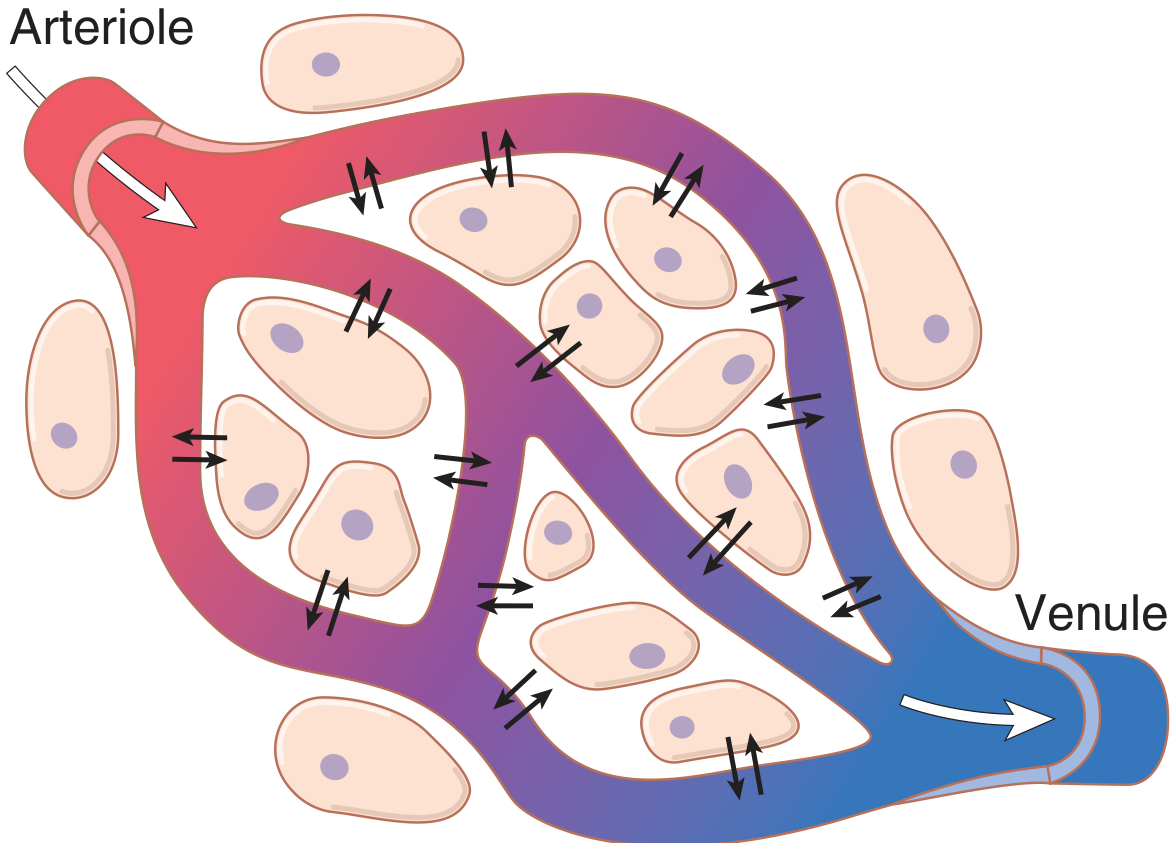
7. Homeostasis - The Central Concept
Homeostasis is the maintenance of a stable, relatively constant internal environment despite constant external changes. It is a dynamic (not static) process that continuously adjusts body functions to maintain internal stability.
Homeostasis occurs at all levels of organization - from the cell membrane to whole-organ systems. Examples:
- Body temperature maintained at ~37°C
- Blood glucose kept at ~70-100 mg/dL
- Arterial pH kept at ~7.35-7.45
- Blood pressure maintained in a normal range
Feedback Mechanisms
Negative feedback (most common) - A change in a variable triggers a response that reverses the change (e.g., rising body temperature triggers sweating and vasodilation to cool the body back down).
Positive feedback (less common) - A change triggers a response that amplifies the original change (e.g., childbirth contractions, blood clotting).
8. How Body Systems Maintain Homeostasis
Transport Systems
- Cardiovascular system: The heart pumps blood continuously through the circulation. Blood passes through the lungs (to pick up O₂ and release CO₂), through the GI tract (to absorb nutrients), and through every tissue (to deliver O₂/nutrients and pick up wastes).
- Respiratory system: Lungs exchange O₂ and CO₂ across the alveolar membrane (only 0.4-2.0 micrometers thick).
- Gastrointestinal tract: Absorbs carbohydrates, fatty acids, and amino acids from ingested food.
Waste Removal
- Lungs: Remove CO₂ (the most abundant metabolic product)
- Kidneys: Filter plasma through glomeruli; excrete urea, uric acid, creatinine, and excess ions in urine while reabsorbing needed substances (glucose, amino acids, water, ions)
- Liver: Detoxifies drugs and chemicals; secretes wastes into bile → excreted in feces
- GI tract: Eliminates undigested material in feces
Regulatory Systems
- Nervous system: Three parts - sensory input, central nervous system (CNS), and motor output. Regulates most body functions through rapid electrical signals (milliseconds).
- Endocrine (hormonal) system: Glands secrete hormones into the blood. Hormones travel to target organs and regulate functions over minutes to hours (e.g., insulin regulating blood glucose).
Support and Protection
- Musculoskeletal system: Provides structure, enables movement to obtain food, and protects internal organs.
- Immune/Lymphatic system: Defends against infection and disease.
- Integumentary system (skin): First barrier against the environment.
9. Anatomical Terminology
Standard reference position is the anatomical position: body erect, facing forward, arms at sides with palms facing forward.
Body planes:
- Sagittal - divides body into left/right
- Frontal (coronal) - divides body into anterior/posterior
- Transverse - divides body into superior/inferior
Directional terms:
| Term | Meaning |
|---|---|
| Superior / Inferior | Toward head / toward feet |
| Anterior (ventral) / Posterior (dorsal) | Front / back |
| Medial / Lateral | Toward midline / away from midline |
| Proximal / Distal | Closer to / farther from point of origin |
| Superficial / Deep | Toward surface / toward interior |
10. Why Study Anatomy and Physiology?
- It is the foundation for all health professions (medicine, nursing, dentistry, physiotherapy, pharmacy)
- Understanding normal structure and function is required before understanding disease (pathophysiology)
- It underpins clinical reasoning - why a drug works, why a symptom occurs, why a surgical approach is chosen
Sources:
- Guyton and Hall Textbook of Medical Physiology, Chapter 1 - Functional Organization of the Human Body and Control of the Internal Environment (pp. 20-126)
- OpenStax Anatomy and Physiology 2e, Ch. 1
- Pearson A&P Core Concepts Overview
For a visual overview, this video is an excellent supplement:
Definition of anatomy
Anatomy comes from the Greek word "anatomē" meaning "to cut up" or "to dissect." It is the branch of biology and medicine that studies the structure of living organisms - their parts, how those parts are arranged, and how they relate to one another.
Searching sources...
Finding Sources
Finding Sources
Searching the Web
definition of anatomy etymology branches medical
Finding Sources
Finding Sources
Finding Sources
Reading File
Excellent - Gray's Anatomy for Students gives the perfect authoritative definition. Here is the complete answer:
Definition of Anatomy
Core Definition
Anatomy is the branch of science concerned with the study of the structure of living organisms and their parts - including the position, form, size, and relationships of body structures to one another.
The word comes from the Greek "temnein" meaning "to cut", reflecting its historical roots in dissection. The full Greek term "anatomē" means "a cutting up" (ana- = up; tomē = a cutting).
"Anatomy includes those structures that can be seen grossly (without the aid of magnification) and microscopically (with the aid of magnification)."
- Gray's Anatomy for Students
Key Point: Anatomy vs. Physiology
| Anatomy | Physiology | |
|---|---|---|
| Focuses on | Structure | Function |
| Asks | "What is it and where?" | "How and why does it work?" |
| Example | Location of the heart in the thorax | How the heart pumps blood |
The two are always studied together - structure dictates function (principle of complementarity).
Major Divisions of Anatomy
1. Gross (Macroscopic) Anatomy
The study of structures large enough to be seen with the naked eye without a microscope. This is what is typically meant when the word "anatomy" is used alone.
- Regional Anatomy - Studies all structures (bones, muscles, nerves, vessels) within a specific body region (e.g., thorax, abdomen, upper limb) at the same time. Best suited for cadaver dissection.
- Systemic Anatomy - Follows one system throughout the entire body (e.g., the entire cardiovascular system - heart + all blood vessels). Best for understanding whole-body continuity of a system.
- Surface (Topographical) Anatomy - Study of external body features and the underlying structures they indicate; essential for clinical examination.
2. Microscopic Anatomy (Histology)
The study of cells and tissues using a microscope. Includes:
- Cytology - study of individual cells
- Histology - study of tissues
3. Developmental Anatomy (Embryology)
Study of structural changes from fertilization through birth and into adulthood.
4. Pathological Anatomy
Study of structural changes caused by disease.
5. Radiographic / Imaging Anatomy
Study of body structures as seen through X-rays, CT scans, MRI, and ultrasound.
6. Clinical Anatomy
The application of anatomical knowledge directly to clinical practice - physical examination, surgical procedures, and interpretation of imaging.
Importance of Anatomy
As Gray's Anatomy for Students states:
"Anatomy forms the basis for the practice of medicine. Anatomy leads the physician toward an understanding of a patient's disease, whether he or she is carrying out a physical examination or using the most advanced imaging techniques."
It is equally fundamental for dentists, physiotherapists, nurses, chiropractors, and all health professionals - because every clinical observation ultimately depends on understanding the underlying structure.
How Anatomy is Studied
Historically through dissection of cadavers, anatomy is now also studied through:
- Prosected (pre-dissected) specimens and plastic models
- Computer teaching modules
- Virtual and augmented reality
- Medical imaging (CT, MRI, ultrasound)
"Observation and visualization are the primary techniques a student should use to learn anatomy. Anatomy is much more than just memorization of lists of names."
- Gray's Anatomy for Students
Source: Gray's Anatomy for Students - "What is anatomy?" (p. 17) and Wikipedia - Anatomy
Definition of physiology
Physiology comes from the Greek "physis" (nature) + "logos" (study/word), meaning the study of the nature of living things - specifically how they function. It is the branch of biology and medicine that explains how living organisms and their parts work.
Searching sources...
Reading File
Finding Sources
Searching the Web
definition of physiology etymology branches subdivisions medical
Finding Sources
Reading File
I now have rich content from both Guyton & Hall and Costanzo Physiology, plus web sources. Here is the full answer:
Definition of Physiology
Core Definition
Physiology is the branch of biology that seeks to explain the function of living organisms and their parts, including the physical and chemical mechanisms responsible for the origin, development, and progression of life.
Etymology: From the Ancient Greek:
- physis (φύσις) = "nature" or "origin"
- -logia (-λογία) = "the study of"
Together: "the study of nature" - i.e., how living things naturally work.
"Physiology is a branch of biology that seeks to explain the function of living organisms and their parts, including the physical and chemical mechanisms that are responsible for the origin, development, and progression of life."
- Guyton and Hall Textbook of Medical Physiology
Anatomy vs. Physiology
| Anatomy | Physiology | |
|---|---|---|
| Focuses on | Structure - what parts exist | Function - how those parts work |
| Asks | "What is it? Where is it?" | "How does it work? Why?" |
| Example | The heart has four chambers | The heart pumps blood by contracting rhythmically |
| Methods | Dissection, imaging, microscopy | Experiments, measurements, biochemical analysis |
The two are inseparable - structure always dictates function. You cannot fully understand physiology without anatomy, and anatomy becomes meaningful only through physiology.
Human Physiology - Specific Definition
"The science of human physiology attempts to explain the specific characteristics and mechanisms of the human body that make it a living being."
- Guyton and Hall
Human physiology:
- Links the basic life sciences with clinical medicine
- Integrates functions of cells, tissues, and organs into the function of the whole living person
- Requires understanding of control systems operating at every level - from genes and molecules up to the nervous and hormonal systems
- The coordinated functions of the human body are more than the sum of its parts
Branches / Subdivisions of Physiology
Since every type of life has its own functional characteristics, physiology is a vast field with many subdivisions:
By Organism Type
| Branch | Studies |
|---|---|
| Human Physiology | Functions specific to the human body |
| Animal Physiology | Functions in non-human animals |
| Plant Physiology | Functions in plants |
| Cellular Physiology | Functions at the individual cell level |
| Comparative Physiology | Compares functions across different species |
| Bacterial / Viral Physiology | Functions in microorganisms |
By Organ System (Human)
| Branch | Studies |
|---|---|
| Neurophysiology | Functions of the nervous system |
| Cardiovascular Physiology | Heart and blood vessel function |
| Renal Physiology | Kidney function and fluid regulation |
| Respiratory Physiology | Lung function and gas exchange |
| Endocrine Physiology | Hormones and glandular functions |
| Gastrointestinal Physiology | Digestion and absorption |
| Reproductive Physiology | Functions of reproductive organs |
| Musculoskeletal Physiology | Muscle contraction and bone mechanics |
| Immunophysiology | How immune defenses function |
Special Branches
| Branch | Studies |
|---|---|
| Pathophysiology | Disordered body function - the basis of clinical medicine and disease understanding |
| Cell / Molecular Physiology | Functions at the cellular and molecular level (ion channels, membrane potentials, receptor signaling) |
| Exercise Physiology | How the body functions and adapts during physical activity |
What Physiology Studies in Practice
As Costanzo Physiology explains, understanding organ system functions requires knowledge of basic cellular mechanisms. Key physiological principles include:
- Body fluids - distribution of water in intracellular and extracellular compartments
- Cell membrane transport - how substances move in and out of cells
- Membrane potentials - the electrical potential difference across cell membranes
- Action potentials - how excitable cells (nerves, muscles) generate and propagate electrical signals
- Synaptic transmission - how cells communicate across synapses using neurotransmitters
- Muscle contraction - how electrical signals couple to physical movement
- Homeostasis - how the body maintains a stable internal environment
These cellular principles are recurring, interlocking themes that apply to every organ system throughout the body.
Importance of Physiology
- It is the scientific foundation of medicine - understanding normal function is required before understanding disease
- Pathophysiology (disordered physiology) directly explains why symptoms occur and guides treatment
- It informs pharmacology - drugs work by modifying physiological mechanisms
- It supports every health profession: medicine, nursing, physiotherapy, pharmacy, sports science
Sources:
- Guyton and Hall Textbook of Medical Physiology - Chapter 1: Functional Organization of the Human Body (p. 20)
- Costanzo Physiology, 7th Edition - Chapter 1: Cellular Physiology (p. 8)
- Wikipedia - Physiology
- Dictionary.com - Physiology
This is a shared conversation. Sign in to Orris to start your own chat.