
For this research explain in detail for paper presentation in detail in detail explanation literature review helpful me to explain properly
cd /home/daytona/workspace/attachments/ca89c744-656d-4ee6-9cf4-110e5af48d0f && pandoc --track-changes=all "Lit Review Updated.docx" -o lit_review.md && pandoc --track-changes=all "Abstract updated-1.docx" -o abstract.md && echo "DONE"
cd /home/daytona/workspace/attachments/ca89c744-656d-4ee6-9cf4-110e5af48d0f && python3 -c " from docx import Document doc = Document('Lit Review Updated.docx') for i, table in enumerate(doc.tables): print(f'=== TABLE {i+1} ===') for row in table.rows: cells = [cell.text.strip() for cell in row.cells] print(' | '.join(cells)) print('---') "
cd /home/daytona/workspace/attachments/ca89c744-656d-4ee6-9cf4-110e5af48d0f && python3 /home/daytona/skills/docx/scripts/office/unpack.py "Lit Review Updated.docx" lit_review_unpacked/ && echo "DONE"
cd /home/daytona/workspace/attachments/ca89c744-656d-4ee6-9cf4-110e5af48d0f && python3 -c " import xml.etree.ElementTree as ET ns = {'w': 'http://schemas.openxmlformats.org/wordprocessingml/2006/main'} tree = ET.parse('lit_review_unpacked/word/document.xml') root = tree.getroot() body = root.find('.//w:body', ns) for elem in body: tag = elem.tag.split('}')[-1] if tag == 'tbl': print('=== TABLE ROW ===') for row in elem.findall('.//w:tr', ns): cells = [] for cell in row.findall('.//w:tc', ns): text = ''.join(t.text or '' for t in cell.findall('.//w:t', ns)) cells.append(text.strip()) print(' | '.join(cells)) print() elif tag == 'p': text = ''.join(t.text or '' for t in elem.findall('.//w:t', ns)) if text.strip(): print(text.strip()) "
Detailed Paper Presentation: Literature Review Explanation
Research Title
How to Introduce Your Paper (Opening Slide / Opening Statement)
"Motor development in children is not just about muscles and reflexes - it depends heavily on how well the two sides of the brain talk to each other. That communication channel is called inter-hemispheric connection, and the main physical bridge that enables it is a structure called the corpus callosum. Our review focused on a specific but underexplored question: Can we assess how well this brain communication works using simple, low-cost behavioural tasks - things children can do without a brain scanner? We reviewed 9 published studies from 1971 to 2014 to answer that."
Background - What You Need to Explain
1. What is Inter-hemispheric Connection (IHC)?
- The brain has two hemispheres - left and right.
- These two sides must constantly share information to coordinate movement, especially bilateral (both-side) tasks like clapping, tying shoes, riding a bicycle, or playing an instrument.
- The corpus callosum (CC) is the largest white matter structure in the brain - a thick band of nerve fibres connecting both hemispheres.
- IHC works in two modes:
- Facilitation - one hemisphere helps the other to do a task better.
- Inhibition - one hemisphere suppresses the other to avoid interference (important in skilled hand tasks).
2. Why Does This Matter in Children?
- The corpus callosum matures gradually throughout childhood and into early adulthood (full maturation around age 20-25).
- Children with incomplete or disrupted IHC show motor coordination problems.
- Conditions linked to poor IHC include:
- Autism Spectrum Disorder (ASD)
- ADHD
- Developmental Coordination Disorder (DCD)
- Cerebral Palsy (CP)
3. The Gap This Review Addresses
- Most research on IHC uses neuroimaging (MRI, DTI, fMRI) - expensive, requires specialist equipment, not available in most clinics.
- Behavioural task-based assessments (simple movement tests children can perform) are cheap, non-invasive, and clinically practical.
- Your review argues: We need to shift focus toward standardised behavioural measures that physiotherapists and clinicians can use in everyday practice.
Methods - How to Explain It
- Type of review: Literature review (not a systematic review with meta-analysis, but a structured narrative review with a table).
- Number of studies: 9 articles.
- Time span: 1971 to 2014.
- Study types included:
- Narrative reviews (3 studies)
- Cross-sectional observational study (1 study)
- Experimental studies (2 studies)
- Developmental/behavioural observational studies (3 studies)
- Sample sizes across included studies: ranged from 22 to 326 participants (where applicable; 3 were narrative reviews with no direct participants).
- Key focus areas: interhemispheric interaction, corpus callosum function, handedness, bimanual coordination.
Literature Review - Study-by-Study Explanation
Study 1 - Takeuchi, Ouachita, Izumi (2012)
- The corpus callosum is not just a passive bridge - it actively regulates motor coordination.
- Two types of interaction exist: when one hand helps the other (facilitation), and when one side suppresses the other to allow skilled, independent hand movement (inhibition).
- Importantly, they highlighted neural plasticity - meaning the brain's inter-hemispheric connections can change and adapt based on experience and training.
Study 2 - Bergert, Windmann, Güntürkün (2006)
- Task 1: A face-matching task that required IHC (information crossed hemispheres).
- Task 2: An interference face/word discrimination task performed at the same time.
- They compared conditions where IHC transfer was needed versus conditions where it was not.
- When the brain had to transfer information across hemispheres while simultaneously performing a second task, reaction time increased and accuracy decreased.
- Performing a second task reduced the efficiency of IHC.
Study 3 - Gooijers & Swinnen (2014)
- Better structural connectivity in the corpus callosum (measured by DTI) was consistently linked with better bimanual coordination and timing between hands.
- Children and older adults, who have less mature or declining CC connectivity, show more difficulty with bimanual coordination tasks.
- Bimanual tasks used: finger tapping, rhythmic bimanual coordination, timing tasks.
Study 4 - Oldfield, R. C. (1971)
- EHI reliably classified individuals as right-handed, left-handed, or ambidextrous.
- Provides a quantitative, standardised measure of handedness.
Study 5 - Knecht et al. (2000)
- Left hemisphere language dominance is most common (as expected).
- The degree of right hemisphere language dominance increased progressively with degree of left-handedness.
- Only 4% of strongly right-handed individuals showed right hemisphere dominance, compared to 27% of strongly left-handed individuals.
Study 6 - Fabri et al. (2001)
- The posterior part of the CC (splenium region) specifically handles transfer of tactile sensory information between hemispheres.
- Patients with posterior CC lesions showed impaired intermanual transfer - they could feel an object with one hand but could not recognise it when the same object was presented to the other hand (because the information could not cross hemispheres).
Study 7 - Church, Petersen & Schlaggar (2010)
- Differences in brain activation between children and adults in neuroimaging studies may not always reflect true neural maturation - they might just reflect differences in task difficulty or performance variability.
- Proper task design and behavioural performance matching are essential before making conclusions about brain development.
Study 8 - Swinnen, S. P. (2002)
- IHC via the corpus callosum is critical for coordinating bimanual movements.
- Multiple brain regions contribute: Supplementary Motor Area (SMA), premotor cortex, primary motor cortex, cerebellum, and basal ganglia.
- Task complexity and timing requirements determine how much IHC is needed - more complex, asynchronous bimanual tasks demand greater IHC.
Study 9 - Njiokiktjien, Stenneken et al. (1997)
- Unimanual finger tapping (right hand, then left hand separately)
- Bimanual simultaneous finger tapping (both hands at the same time) Handedness was also assessed.
- Bimanual coordination improves with age - directly indicating maturation of IHC via the corpus callosum.
- Right-handed children showed stronger performance asymmetry (dominant hand was noticeably better than non-dominant).
- Finger tapping tasks are valid, practical behavioural indicators for studying IHC and motor lateralisation in children.
Results Summary - What the 9 Studies Together Tell You
| Finding | Evidence from studies |
|---|---|
| CC is structurally essential for IHC and bimanual coordination | Studies 1, 3, 6, 8 |
| Behavioural tasks (finger tapping, tactile tasks) can detect IHC quality | Studies 2, 6, 9 |
| Handedness is a valid behavioural proxy for hemispheric dominance | Studies 4, 5 |
| IHC and bimanual coordination improve with age in children | Study 9 |
| Neuroimaging has limitations in child studies - behavioural tasks are more practical | Study 7 |
| Task complexity influences how much IHC is demanded | Studies 2, 8 |
Conclusion - How to Deliver It
"The existing literature is dominated by neuroimaging-based approaches to studying IHC - MRI, DTI, fMRI. These are valuable but they are expensive, not accessible in most clinics, and difficult to use with young children. Our review shows that behavioural tasks - finger tapping, bimanual coordination tests, tactile transfer tasks, and handedness inventories - can reliably reflect the quality of inter-hemispheric connection. There is a clear gap in research on standardised, validated, age-appropriate behavioural assessments specifically for school-aged children. We call for future research to develop and test such tools so that physiotherapists can assess IHC in children in any clinical setting, without a brain scanner."
Common Questions You May Face in Presentation
"This is a literature review, not a systematic review. Our aim was to select studies that specifically addressed behavioural task-based methods for IHC in children. The limited number reflects the gap in this specific area - most IHC research uses neuroimaging, not behavioural tasks. That gap is exactly what our review highlights."
"The Edinburgh Handedness Inventory (1971) is the gold standard for handedness assessment and is still used globally. The Njiokiktjien study (1997) on finger tapping in children is a foundational developmental study. These older studies are foundational - they established the tools and concepts that later research builds on."
"Physiotherapists work with children who have conditions like Cerebral Palsy, DCD, and ASD, all of which involve IHC deficits. Currently, there is no simple, standardised tool a physiotherapist can use at bedside or in a school to assess IHC quality. This review argues that tasks like finger tapping and bimanual coordination tests could fill that role - practically, cheaply, and effectively."
"The review includes heterogeneous study designs - narrative reviews, experimental studies, and observational studies cannot be directly compared. Most studies included adults, not children. The age range and populations were not standardised. These are reasons why future primary research specifically in school-aged children is needed."
Quick Slide-by-Slide Summary (for 10-minute presentation)
| Slide | Content |
|---|---|
| 1 | Title, Authors, Institution |
| 2 | Background - Brain, CC, IHC in children |
| 3 | Why it matters - ASD, ADHD, DCD, CP |
| 4 | Gap - Neuroimaging vs Behavioural tasks |
| 5 | Objective & Methods |
| 6 | Studies 1-3 (Takeuchi, Bergert, Gooijers) |
| 7 | Studies 4-5 (Oldfield EHI, Knecht Handedness) |
| 8 | Studies 6-7 (Fabri Tactile CC, Church Task B) |
| 9 | Studies 8-9 (Swinnen Bimanual, Njiokiktjien Tapping) |
| 10 | Results Summary Table |
| 11 | Conclusion & Clinical Relevance |
| 12 | Q&A / Thank You |
Create a PowerPoint presentation summarizing your literature review with these slides and key findings
mkdir -p /home/daytona/workspace/lit-review-pptx && ls /home/daytona/workspace/lit-review-pptx
~/lit-review-pptx/build.js
const pptxgen = require("pptxgenjs");

const pres = new pptxgen();
pres.layout = "LAYOUT_16x9";
pres.title = "Inter-hemispheric Connection and Motor Coordination in Children";
pres.author = "Poojitha N.G. | Pavankumar B.N. | Dr Ranjith Anumasa";

// ─── COLOUR PALETTE ───────────────────────────────────────────────────────────
const C = {
  navy:    "0D1B2A",  // dominant dark background
  teal:    "1B6CA8",  // accent blue
  tealLt:  "2A9D8F",  // second accent
  white:   "FFFFFF",
  offWhite:"F0F4F8",
  amber:   "E9C46A",  // highlight
  darkGray:"2D3748",
  midGray: "4A5568",
  lightGray:"CBD5E0",
  cardBg:  "1A2A3A",  // dark card
  cardBg2: "132030",
};

// ─── HELPER: dark slide background ──────────────────────────────────────────
function darkBg(slide) {
  slide.addShape(pres.ShapeType.rect, { x:0, y:0, w:10, h:5.625, fill:{color: C.navy}, line:{color: C.navy} });
}
function lightBg(slide) {
  slide.addShape(pres.ShapeType.rect, { x:0, y:0, w:10, h:5.625, fill:{color: C.offWhite}, line:{color: C.offWhite} });
}

// accent bar top
function accentBar(slide, color) {
  slide.addShape(pres.ShapeType.rect, { x:0, y:0, w:10, h:0.08, fill:{color: color || C.tealLt}, line:{color: color || C.tealLt} });
}

// section label pill
function sectionLabel(slide, text, x, y, bg) {
  slide.addShape(pres.ShapeType.roundRect, { x, y, w:2.4, h:0.32, rectRadius:0.15, fill:{color: bg||C.teal}, line:{color: bg||C.teal} });
  slide.addText(text, { x, y, w:2.4, h:0.32, fontSize:9, bold:true, color:C.white, align:"center", valign:"middle", margin:0 });
}

// slide heading
function heading(slide, text, y, color, sz) {
  slide.addText(text, { x:0.45, y: y||0.18, w:9.1, h:0.6, fontSize: sz||22, bold:true, color: color||C.white, valign:"middle" });
}

// divider line
function divider(slide, y, color) {
  slide.addShape(pres.ShapeType.line, { x:0.45, y, w:9.1, h:0, line:{color: color||C.tealLt, width:1.2} });
}


// ══════════════════════════════════════════════════════════════════════════════
// SLIDE 1 — TITLE
// ══════════════════════════════════════════════════════════════════════════════
{
  const s = pres.addSlide();
  darkBg(s);

  // large teal left bar
  s.addShape(pres.ShapeType.rect, { x:0, y:0, w:0.18, h:5.625, fill:{color: C.tealLt}, line:{color: C.tealLt} });

  // top pill label
  sectionLabel(s, "LITERATURE REVIEW", 0.45, 0.28, C.tealLt);

  // main title
  s.addText("Inter-hemispheric Connection\n& Motor Coordination in Children", {
    x:0.45, y:0.72, w:9.0, h:1.9,
    fontSize:32, bold:true, color:C.white,
    align:"left", valign:"top",
  });

  // subtitle
  s.addText("A Behavioural Task-Based Literature Review", {
    x:0.45, y:2.62, w:9.0, h:0.5,
    fontSize:15, color:C.amber, bold:false, align:"left",
  });

  divider(s, 3.22, C.teal);

  // authors block
  s.addText([
    { text: "Ms Poojitha N.G.", options:{ bold:true, color:C.white } },
    { text: "  |  4th Year BPT", options:{ color:C.lightGray } },
    { text: "\nMr Pavankumar B.N.", options:{ bold:true, color:C.white, breakLine:false } },
    { text: "  |  Guide & Lecturer", options:{ color:C.lightGray } },
    { text: "\nDr Ranjith Anumasa", options:{ bold:true, color:C.white, breakLine:false } },
    { text: "  |  Co-guide & Associate Professor", options:{ color:C.lightGray } },
  ], { x:0.45, y:3.35, w:9.0, h:1.4, fontSize:11.5, lineSpacingMultiple:1.5 });

  s.addText("RL Jalappa College of Physiotherapy, SDUAHER, Kolar, Karnataka", {
    x:0.45, y:4.85, w:9.0, h:0.4, fontSize:10, color:C.lightGray, italic:true,
  });
}


// ══════════════════════════════════════════════════════════════════════════════
// SLIDE 2 — BACKGROUND
// ══════════════════════════════════════════════════════════════════════════════
{
  const s = pres.addSlide();
  lightBg(s);
  accentBar(s, C.teal);

  sectionLabel(s, "BACKGROUND", 0.45, 0.18);
  heading(s, "Understanding Inter-hemispheric Connection", 0.6, C.navy, 20);
  divider(s, 1.3, C.teal);

  // 3 info cards
  const cards = [
    { icon:"🧠", title:"Corpus Callosum", body:"The largest white-matter structure in the brain — a thick band of nerve fibres bridging the left and right hemispheres, enabling constant information exchange." },
    { icon:"🔄", title:"Two Modes of IHC", body:"Facilitation: one hemisphere assists the other.\nInhibition: one hemisphere suppresses the other to allow skilled, independent hand movement." },
    { icon:"👶", title:"Why Children?", body:"The CC matures gradually through childhood into early adulthood. Incomplete maturation underlies motor problems seen in ASD, ADHD, DCD, and Cerebral Palsy." },
  ];

  cards.forEach((c, i) => {
    const x = 0.25 + i * 3.2;
    s.addShape(pres.ShapeType.roundRect, { x, y:1.42, w:3.0, h:3.7, rectRadius:0.18, fill:{color:C.navy}, line:{color:C.teal, width:1} });
    s.addText(c.icon, { x, y:1.5, w:3.0, h:0.55, fontSize:24, align:"center" });
    s.addText(c.title, { x, y:2.08, w:3.0, h:0.42, fontSize:13, bold:true, color:C.amber, align:"center" });
    s.addText(c.body, { x:x+0.12, y:2.52, w:2.76, h:2.5, fontSize:9.8, color:C.offWhite, align:"left", valign:"top", lineSpacingMultiple:1.45 });
  });
}


// ══════════════════════════════════════════════════════════════════════════════
// SLIDE 3 — CLINICAL RELEVANCE
// ══════════════════════════════════════════════════════════════════════════════
{
  const s = pres.addSlide();
  lightBg(s);
  accentBar(s, C.tealLt);

  sectionLabel(s, "CLINICAL RELEVANCE", 0.45, 0.18, C.tealLt);
  heading(s, "Why IHC Matters in Paediatric Practice", 0.6, C.navy, 20);
  divider(s, 1.3, C.tealLt);

  // 4 condition tiles
  const conds = [
    { label:"Autism Spectrum\nDisorder (ASD)",   color:C.teal,   detail:"Reduced CC volume & connectivity impairs bilateral motor & social coordination" },
    { label:"ADHD",                               color:"7B2D8B", detail:"Abnormal IHC linked to response inhibition deficits and poor motor timing" },
    { label:"Developmental\nCoordination\nDisorder (DCD)", color:"C0392B", detail:"Poor bimanual coordination reflects immature IHC and CC maturation delays" },
    { label:"Cerebral Palsy\n(CP)",               color:"D35400", detail:"Structural CC damage directly reduces motor signal transfer between hemispheres" },
  ];

  conds.forEach((c, i) => {
    const x = 0.25 + i * 2.38;
    s.addShape(pres.ShapeType.roundRect, { x, y:1.45, w:2.15, h:1.2, rectRadius:0.14, fill:{color:c.color}, line:{color:c.color} });
    s.addText(c.label, { x, y:1.45, w:2.15, h:1.2, fontSize:11, bold:true, color:C.white, align:"center", valign:"middle" });
    s.addShape(pres.ShapeType.rect, { x, y:2.72, w:2.15, h:1.95, fill:{color:C.cardBg2}, line:{color:c.color, width:1} });
    s.addText(c.detail, { x:x+0.1, y:2.8, w:1.95, h:1.8, fontSize:9.5, color:C.offWhite, align:"left", valign:"top", lineSpacingMultiple:1.4 });
  });

  // bottom note
  s.addText("Physiotherapists need simple, accessible tools to assess IHC without neuroimaging equipment.", {
    x:0.45, y:4.85, w:9.1, h:0.45, fontSize:10.5, italic:true, color:C.midGray, align:"center",
  });
}


// ══════════════════════════════════════════════════════════════════════════════
// SLIDE 4 — RESEARCH GAP & OBJECTIVE
// ══════════════════════════════════════════════════════════════════════════════
{
  const s = pres.addSlide();
  darkBg(s);
  accentBar(s, C.amber);

  sectionLabel(s, "OBJECTIVE", 0.45, 0.18, C.amber);
  heading(s, "The Gap & Research Objective", 0.62, C.white, 20);
  divider(s, 1.32, C.amber);

  // left — gap
  s.addShape(pres.ShapeType.roundRect, { x:0.3, y:1.46, w:4.4, h:3.6, rectRadius:0.18, fill:{color:C.cardBg}, line:{color:"C0392B", width:1.5} });
  s.addText("❌  The Current Gap", { x:0.45, y:1.58, w:4.1, h:0.45, fontSize:13, bold:true, color:"E74C3C" });
  s.addText([
    { text: "• ", options:{bold:true} }, { text:"Most IHC research relies on MRI, DTI and fMRI\n", options:{} },
    { text: "• ", options:{bold:true} }, { text:"Neuroimaging is expensive & requires specialist labs\n", options:{} },
    { text: "• ", options:{bold:true} }, { text:"Not practical in schools or clinics in low-resource settings\n", options:{} },
    { text: "• ", options:{bold:true} }, { text:"Difficult to use with young, uncooperative children", options:{} },
  ], { x:0.45, y:2.06, w:4.0, h:2.8, fontSize:10.5, color:C.offWhite, lineSpacingMultiple:1.6 });

  // right — objective
  s.addShape(pres.ShapeType.roundRect, { x:5.2, y:1.46, w:4.4, h:3.6, rectRadius:0.18, fill:{color:C.cardBg}, line:{color:C.tealLt, width:1.5} });
  s.addText("✅  Study Objective", { x:5.35, y:1.58, w:4.1, h:0.45, fontSize:13, bold:true, color:C.tealLt });
  s.addText([
    { text: "• ", options:{bold:true} }, { text:"Evaluate behavioural task-based measures for assessing IHC\n", options:{} },
    { text: "• ", options:{bold:true} }, { text:"Focus on school-aged children\n", options:{} },
    { text: "• ", options:{bold:true} }, { text:"Summarise findings on motor coordination, handedness & neural maturation\n", options:{} },
    { text: "• ", options:{bold:true} }, { text:"Highlight simple, low-cost, non-invasive clinical methods", options:{} },
  ], { x:5.35, y:2.06, w:4.05, h:2.8, fontSize:10.5, color:C.offWhite, lineSpacingMultiple:1.6 });
}


// ══════════════════════════════════════════════════════════════════════════════
// SLIDE 5 — METHODS
// ══════════════════════════════════════════════════════════════════════════════
{
  const s = pres.addSlide();
  lightBg(s);
  accentBar(s, C.teal);

  sectionLabel(s, "METHODS", 0.45, 0.18);
  heading(s, "Review Methodology", 0.62, C.navy, 20);
  divider(s, 1.3, C.teal);

  const stats = [
    { n:"9", label:"Studies\nReviewed" },
    { n:"1971–\n2014", label:"Publication\nPeriod" },
    { n:"22–326", label:"Participant\nRange" },
    { n:"6", label:"Study\nDesign Types" },
  ];

  stats.forEach((st, i) => {
    const x = 0.3 + i * 2.35;
    s.addShape(pres.ShapeType.roundRect, { x, y:1.44, w:2.1, h:1.5, rectRadius:0.16, fill:{color:C.teal}, line:{color:C.teal} });
    s.addText(st.n, { x, y:1.5, w:2.1, h:0.75, fontSize:26, bold:true, color:C.white, align:"center", valign:"middle" });
    s.addText(st.label, { x, y:2.22, w:2.1, h:0.65, fontSize:9.5, color:C.offWhite, align:"center", valign:"top", lineSpacingMultiple:1.2 });
  });

  // study type breakdown
  const types = [
    { label:"Narrative Reviews",                    n:"3", color:C.tealLt },
    { label:"Experimental Studies",                 n:"2", color:C.teal },
    { label:"Developmental / Behavioural Obs.",     n:"3", color:"7B68EE" },
    { label:"Cross-sectional Observational",        n:"1", color:C.amber },
  ];

  s.addText("Study Design Breakdown", { x:0.45, y:3.1, w:9.1, h:0.38, fontSize:12, bold:true, color:C.navy });
  types.forEach((t, i) => {
    const col = i < 2 ? i : i;
    const x = 0.45 + (i % 2) * 4.65;
    const y = 3.52 + Math.floor(i / 2) * 0.56;
    s.addShape(pres.ShapeType.roundRect, { x, y, w:0.35, h:0.35, rectRadius:0.08, fill:{color:t.color}, line:{color:t.color} });
    s.addText(t.n, { x, y, w:0.35, h:0.35, fontSize:11, bold:true, color:C.white, align:"center", valign:"middle", margin:0 });
    s.addText(t.label, { x:x+0.42, y:y+0.03, w:3.9, h:0.32, fontSize:10.5, color:C.darkGray });
  });
}


// ══════════════════════════════════════════════════════════════════════════════
// SLIDE 6 — STUDIES 1–3
// ══════════════════════════════════════════════════════════════════════════════
{
  const s = pres.addSlide();
  lightBg(s);
  accentBar(s, C.tealLt);

  sectionLabel(s, "STUDIES 1–3", 0.45, 0.18, C.tealLt);
  heading(s, "Motor Control, IHC Communication & Bimanual Coordination", 0.62, C.navy, 18);
  divider(s, 1.28, C.tealLt);

  const studies = [
    {
      num:"01", year:"2012", type:"Narrative Review",
      authors:"Takeuchi, Ouachita, Izumi",
      title:"Motor Control & Neural Plasticity through Interhemispheric Interactions",
      finding:"CC plays a dynamic role — both inhibitory and facilitatory IHC occur depending on task demands. Neural plasticity means these connections can be trained.",
    },
    {
      num:"02", year:"2006", type:"Experimental (n=22)",
      authors:"Bergert, Windmann, Güntürkün",
      title:"Is IHC disturbed when both hemispheres perform separate tasks?",
      finding:"Dual-task design showed: reaction time increased and accuracy decreased when IHC transfer was required. Performing a second task reduces IHC efficiency — measurable in behaviour.",
    },
    {
      num:"03", year:"2014", type:"Literature Review",
      authors:"Gooijers & Swinnen",
      title:"Corpus Callosum & Bimanual Coordination",
      finding:"DTI studies show better CC structural connectivity = better bimanual timing & coordination. Children and older adults with lower CC integrity show greater bimanual difficulty.",
    },
  ];

  studies.forEach((st, i) => {
    const y = 1.4 + i * 1.36;
    s.addShape(pres.ShapeType.roundRect, { x:0.28, y, w:9.44, h:1.25, rectRadius:0.14, fill:{color:C.navy}, line:{color:C.tealLt, width:0.8} });
    // number badge
    s.addShape(pres.ShapeType.roundRect, { x:0.38, y:y+0.18, w:0.42, h:0.42, rectRadius:0.1, fill:{color:C.tealLt}, line:{color:C.tealLt} });
    s.addText(st.num, { x:0.38, y:y+0.18, w:0.42, h:0.42, fontSize:11, bold:true, color:C.white, align:"center", valign:"middle", margin:0 });
    // year / type tag
    s.addText(`${st.year}  •  ${st.type}`, { x:0.9, y:y+0.12, w:4.0, h:0.28, fontSize:9, color:C.amber });
    // title
    s.addText(st.title, { x:0.9, y:y+0.36, w:4.6, h:0.38, fontSize:10, bold:true, color:C.white });
    // authors
    s.addText(st.authors, { x:0.9, y:y+0.74, w:4.5, h:0.26, fontSize:8.5, color:C.lightGray, italic:true });
    // finding
    s.addShape(pres.ShapeType.rect, { x:5.6, y:y+0.1, w:0.04, h:1.05, fill:{color:C.tealLt}, line:{color:C.tealLt} });
    s.addText(st.finding, { x:5.72, y:y+0.1, w:3.85, h:1.05, fontSize:9.5, color:C.offWhite, valign:"middle", lineSpacingMultiple:1.45 });
  });
}


// ══════════════════════════════════════════════════════════════════════════════
// SLIDE 7 — STUDIES 4–5
// ══════════════════════════════════════════════════════════════════════════════
{
  const s = pres.addSlide();
  lightBg(s);
  accentBar(s, C.amber);

  sectionLabel(s, "STUDIES 4–5", 0.45, 0.18, C.amber.replace ? C.amber : "E9C46A");
  heading(s, "Handedness as a Behavioural Window into Hemispheric Dominance", 0.62, C.navy, 18);
  divider(s, 1.28, C.amber);

  // Study 4 — large card left
  s.addShape(pres.ShapeType.roundRect, { x:0.28, y:1.42, w:4.6, h:3.75, rectRadius:0.18, fill:{color:C.navy}, line:{color:C.amber, width:1.5} });
  s.addText("04", { x:0.38, y:1.54, w:0.5, h:0.5, fontSize:18, bold:true, color:C.amber, align:"center" });
  s.addText("Edinburgh Handedness\nInventory (EHI)", { x:0.38, y:1.58, w:4.3, h:0.7, fontSize:13.5, bold:true, color:C.white, align:"center", valign:"bottom" });
  s.addText("Oldfield, R.C. (1971)  •  n = 80 adults  •  Cross-sectional", { x:0.38, y:2.32, w:4.3, h:0.3, fontSize:9, color:C.amber, align:"center" });
  s.addText("AIM: Develop a standardised questionnaire to assess hand dominance.", { x:0.45, y:2.7, w:4.3, h:0.42, fontSize:10, bold:true, color:C.offWhite });
  s.addText([
    { text:"METHOD: ", options:{bold:true, color:C.tealLt} }, { text:"10 daily hand-preference tasks (writing, throwing, scissors, brushing teeth…) → Laterality Quotient (LQ) calculated.\n\n", options:{color:C.offWhite} },
    { text:"KEY FINDING: ", options:{bold:true, color:C.tealLt} }, { text:"EHI reliably classifies individuals as right-handed, left-handed, or ambidextrous. Provides a quantitative measure of hemispheric dominance. Still the gold standard 50+ years later.", options:{color:C.offWhite} },
  ], { x:0.45, y:3.14, w:4.3, h:1.85, fontSize:9.8, lineSpacingMultiple:1.4 });

  // Study 5 — large card right
  s.addShape(pres.ShapeType.roundRect, { x:5.15, y:1.42, w:4.6, h:3.75, rectRadius:0.18, fill:{color:C.navy}, line:{color:C.tealLt, width:1.5} });
  s.addText("05", { x:5.25, y:1.54, w:0.5, h:0.5, fontSize:18, bold:true, color:C.tealLt, align:"center" });
  s.addText("Handedness & Hemispheric\nLanguage Dominance", { x:5.25, y:1.58, w:4.3, h:0.7, fontSize:13.5, bold:true, color:C.white, align:"center", valign:"bottom" });
  s.addText("Knecht et al. (2000)  •  n = 326 healthy adults  •  Observational", { x:5.25, y:2.32, w:4.3, h:0.3, fontSize:9, color:C.tealLt, align:"center" });
  s.addText("AIM: Investigate relationship between handedness and hemispheric language dominance.", { x:5.3, y:2.7, w:4.3, h:0.42, fontSize:10, bold:true, color:C.offWhite });
  s.addText([
    { text:"METHOD: ", options:{bold:true, color:C.amber} }, { text:"fTCD measured language lateralisation; EHI classified handedness (n=326).\n\n", options:{color:C.offWhite} },
    { text:"KEY FINDING: ", options:{bold:true, color:C.amber} }, { text:"Right hemisphere language dominance increases with degree of left-handedness.\nOnly 4% of strong right-handers showed right dominance vs. 27% of strong left-handers.\n→ Handedness is a valid behavioural proxy for hemispheric organisation.", options:{color:C.offWhite} },
  ], { x:5.3, y:3.14, w:4.3, h:1.85, fontSize:9.8, lineSpacingMultiple:1.4 });
}


// ══════════════════════════════════════════════════════════════════════════════
// SLIDE 8 — STUDIES 6–7
// ══════════════════════════════════════════════════════════════════════════════
{
  const s = pres.addSlide();
  lightBg(s);
  accentBar(s, "9B59B6");

  sectionLabel(s, "STUDIES 6–7", 0.45, 0.18, "9B59B6");
  heading(s, "Tactile Transfer via CC & Methodological Considerations", 0.62, C.navy, 18);
  divider(s, 1.28, "9B59B6");

  const studies = [
    {
      num:"06", year:"2001", type:"Lesion Study",
      authors:"Fabri et al.",
      title:"Posterior Corpus Callosum & Interhemispheric Transfer of Tactile Information",
      aim:"Investigate the role of posterior CC in transferring tactile sensory information between hemispheres.",
      method:"Tactile naming, same-different recognition, finger cross-localisation tasks in patients with posterior CC lesions vs. healthy controls.",
      finding:"Posterior CC (splenium) is critical for intermanual tactile transfer. Patients with posterior CC lesions could NOT transfer tactile learning from one hand to the other — detectable through simple bedside tasks.",
      highlight:true,
    },
    {
      num:"07", year:"2010", type:"Methodological Review",
      authors:"Church, Petersen & Schlaggar",
      title:"The 'Task B Problem' in Developmental Functional Neuroimaging",
      aim:"Discuss methodological challenges in developmental fMRI studies, especially difficulty-matching between children and adults.",
      method:"Analysis of brain activation differences, task difficulty, and performance variability in child vs. adult neuroimaging studies.",
      finding:"Brain activation differences may NOT reflect true neural differences — they may arise from task difficulty variations. This limitation strengthens the argument for standardised, behaviourally-controlled task designs.",
      highlight:false,
    },
  ];

  studies.forEach((st, i) => {
    const y = 1.42 + i * 2.0;
    const borderCol = i === 0 ? "9B59B6" : C.teal;
    s.addShape(pres.ShapeType.roundRect, { x:0.28, y, w:9.44, h:1.78, rectRadius:0.15, fill:{color:C.navy}, line:{color:borderCol, width:1} });

    s.addShape(pres.ShapeType.roundRect, { x:0.38, y:y+0.16, w:0.42, h:0.42, rectRadius:0.1, fill:{color:borderCol}, line:{color:borderCol} });
    s.addText(st.num, { x:0.38, y:y+0.16, w:0.42, h:0.42, fontSize:11, bold:true, color:C.white, align:"center", valign:"middle", margin:0 });
    s.addText(`${st.year}  •  ${st.type}  |  ${st.authors}`, { x:0.9, y:y+0.1, w:8.6, h:0.28, fontSize:9, color:C.amber });
    s.addText(st.title, { x:0.9, y:y+0.36, w:8.6, h:0.38, fontSize:10.5, bold:true, color:C.white });

    s.addText([
      { text:"AIM: ", options:{bold:true, color:borderCol} }, { text:st.aim+"   ", options:{color:C.offWhite} },
      { text:"METHOD: ", options:{bold:true, color:borderCol} }, { text:st.method, options:{color:C.offWhite} },
    ], { x:0.9, y:y+0.76, w:4.55, h:0.9, fontSize:9, lineSpacingMultiple:1.35 });

    s.addShape(pres.ShapeType.rect, { x:5.55, y:y+0.7, w:0.04, h:1.0, fill:{color:borderCol}, line:{color:borderCol} });
    s.addText([
      { text:"KEY FINDING  ", options:{bold:true, color:borderCol} },
      { text:st.finding, options:{color:C.offWhite} },
    ], { x:5.66, y:y+0.7, w:3.9, h:1.0, fontSize:9.2, lineSpacingMultiple:1.4, valign:"top" });
  });
}


// ══════════════════════════════════════════════════════════════════════════════
// SLIDE 9 — STUDIES 8–9
// ══════════════════════════════════════════════════════════════════════════════
{
  const s = pres.addSlide();
  lightBg(s);
  accentBar(s, C.tealLt);

  sectionLabel(s, "STUDIES 8–9", 0.45, 0.18, C.tealLt);
  heading(s, "Bimanual Principles & Finger Tapping in School-Aged Children", 0.62, C.navy, 18);
  divider(s, 1.28, C.tealLt);

  // Study 8
  s.addShape(pres.ShapeType.roundRect, { x:0.28, y:1.42, w:4.6, h:3.75, rectRadius:0.18, fill:{color:C.navy}, line:{color:C.tealLt, width:1.5} });
  s.addText("08", { x:0.38, y:1.52, w:0.5, h:0.5, fontSize:18, bold:true, color:C.tealLt, align:"center" });
  s.addText("Intermanual Coordination:\nBehavioural to Neural Networks", { x:0.38, y:1.56, w:4.3, h:0.72, fontSize:13, bold:true, color:C.white, align:"center", valign:"bottom" });
  s.addText("Swinnen (2002)  •  Narrative Review", { x:0.38, y:2.32, w:4.3, h:0.28, fontSize:9, color:C.tealLt, align:"center" });
  s.addText([
    { text:"KEY FINDING: ", options:{bold:true, color:C.amber} },
    { text:"IHC via CC is critical for bimanual coordination. Multiple brain regions contribute:\n", options:{color:C.offWhite} },
    { text:"SMA  •  Premotor Cortex  •  Primary Motor Cortex  •  Cerebellum  •  Basal Ganglia", options:{bold:true, color:C.tealLt} },
    { text:"\n\nTask complexity & timing requirements directly determine how much IHC is needed — more asynchronous bimanual tasks demand greater IHC.", options:{color:C.offWhite} },
  ], { x:0.45, y:2.66, w:4.3, h:2.36, fontSize:9.8, lineSpacingMultiple:1.45 });

  // Study 9
  s.addShape(pres.ShapeType.roundRect, { x:5.15, y:1.42, w:4.6, h:3.75, rectRadius:0.18, fill:{color:C.navy}, line:{color:C.amber, width:1.5} });
  s.addText("09", { x:5.25, y:1.52, w:0.5, h:0.5, fontSize:18, bold:true, color:C.amber, align:"center" });
  s.addText("Unimanual & Bimanual Finger\nTapping in Schoolchildren", { x:5.25, y:1.56, w:4.3, h:0.72, fontSize:13, bold:true, color:C.white, align:"center", valign:"bottom" });
  s.addText("Njiokiktjien, Stenneken et al. (1997)  •  Observational Dev. Study", { x:5.25, y:2.32, w:4.3, h:0.28, fontSize:9, color:C.amber, align:"center" });
  s.addText([
    { text:"SAMPLE & TASK: ", options:{bold:true, color:C.tealLt} },
    { text:"School-aged children performed: (1) unimanual tapping R then L; (2) bimanual simultaneous tapping. Handedness also assessed.\n\n", options:{color:C.offWhite} },
    { text:"KEY FINDINGS: ", options:{bold:true, color:C.amber} },
    { text:"Bimanual coordination improves with age → directly maps onto CC maturation.\nRight-handed children showed stronger performance asymmetry.\n", options:{color:C.offWhite} },
    { text:"→ Finger tapping is a valid, practical, low-cost behavioural indicator for IHC in children.", options:{bold:true, color:C.tealLt} },
  ], { x:5.3, y:2.66, w:4.3, h:2.36, fontSize:9.8, lineSpacingMultiple:1.45 });
}


// ══════════════════════════════════════════════════════════════════════════════
// SLIDE 10 — RESULTS SUMMARY TABLE
// ══════════════════════════════════════════════════════════════════════════════
{
  const s = pres.addSlide();
  darkBg(s);
  accentBar(s, C.teal);

  sectionLabel(s, "RESULTS", 0.45, 0.18, C.teal);
  heading(s, "Results Summary", 0.62, C.white, 20);
  divider(s, 1.28, C.teal);

  // table header
  const headers = ["#", "Author & Year", "Design", "Sample", "Key Finding"];
  const colW = [0.3, 2.2, 1.45, 1.35, 4.4];
  const colX = [0.28];
  colW.forEach((w, i) => { if (i > 0) colX.push(colX[i-1] + colW[i-1] + 0.04); });

  headers.forEach((h, i) => {
    s.addShape(pres.ShapeType.rect, { x:colX[i], y:1.4, w:colW[i], h:0.32, fill:{color:C.teal}, line:{color:C.teal} });
    s.addText(h, { x:colX[i]+0.04, y:1.4, w:colW[i]-0.04, h:0.32, fontSize:9, bold:true, color:C.white, valign:"middle" });
  });

  const rows = [
    ["01","Takeuchi et al. 2012","Narrative Rev.","N/A","CC drives both inhibitory & facilitatory IHC in motor control"],
    ["02","Bergert et al. 2006","Experimental","n=22","Dual-task IHC transfer → ↑ reaction time, ↓ accuracy"],
    ["03","Gooijers & Swinnen 2014","Lit. Review","Mixed","Better CC integrity = better bimanual coordination (DTI)"],
    ["04","Oldfield 1971","Observational","n=80","EHI reliably quantifies handedness — gold standard"],
    ["05","Knecht et al. 2000","Observational","n=326","4% R-handers vs 27% L-handers show R-hemisphere language dominance"],
    ["06","Fabri et al. 2001","Lesion Study","Patients","Posterior CC lesions impair intermanual tactile transfer"],
    ["07","Church et al. 2010","Method. Review","N/A","Task B problem: imaging differences may reflect task difficulty, not neural change"],
    ["08","Swinnen 2002","Narrative Rev.","N/A","SMA, PMC, M1, cerebellum & basal ganglia all contribute to IHC"],
    ["09","Njiokiktjien et al. 1997","Dev. Observ.","Children","Bimanual tapping improves with age — reflects CC maturation"],
  ];

  rows.forEach((row, ri) => {
    const rowY = 1.76 + ri * 0.41;
    const rowBg = ri % 2 === 0 ? C.cardBg : C.cardBg2;
    row.forEach((cell, ci) => {
      s.addShape(pres.ShapeType.rect, { x:colX[ci], y:rowY, w:colW[ci], h:0.38, fill:{color:rowBg}, line:{color:"1E3A4F", width:0.5} });
      s.addText(cell, { x:colX[ci]+0.04, y:rowY, w:colW[ci]-0.05, h:0.38, fontSize:ci === 4 ? 8.5 : 9, color: ci===0 ? C.amber : C.offWhite, valign:"middle" });
    });
  });
}


// ══════════════════════════════════════════════════════════════════════════════
// SLIDE 11 — CONCLUSION & CLINICAL RELEVANCE
// ══════════════════════════════════════════════════════════════════════════════
{
  const s = pres.addSlide();
  darkBg(s);
  accentBar(s, C.tealLt);

  sectionLabel(s, "CONCLUSION", 0.45, 0.18, C.tealLt);
  heading(s, "Conclusions & Clinical Implications", 0.62, C.white, 20);
  divider(s, 1.28, C.tealLt);

  // 3 conclusion panels
  const panels = [
    {
      icon:"🔬", color:C.teal,
      title:"What the Evidence Shows",
      points:["Behavioural tasks (finger tapping, bimanual coordination, tactile transfer, EHI) reliably reflect IHC quality","IHC performance improves with age, consistent with CC maturation","Handedness is a valid, simple proxy for hemispheric dominance"],
    },
    {
      icon:"⚠️", color:"E67E22",
      title:"The Gap That Remains",
      points:["Literature dominated by neuroimaging (MRI, DTI, fMRI)","Very few studies use standardised behavioural tasks specifically in school-aged children","No widely adopted clinical battery for bedside IHC assessment"],
    },
    {
      icon:"🏥", color:C.tealLt,
      title:"Call for Future Research",
      points:["Develop & validate standardised task-based assessments for children","Focus on age-appropriate, normative data for school-aged populations","Enable physiotherapists to assess IHC in any clinical or school setting"],
    },
  ];

  panels.forEach((p, i) => {
    const x = 0.25 + i * 3.2;
    s.addShape(pres.ShapeType.roundRect, { x, y:1.4, w:3.05, h:3.85, rectRadius:0.18, fill:{color:C.cardBg}, line:{color:p.color, width:1.5} });
    s.addText(p.icon, { x, y:1.5, w:3.05, h:0.5, fontSize:22, align:"center" });
    s.addText(p.title, { x:x+0.1, y:2.04, w:2.85, h:0.48, fontSize:11, bold:true, color:p.color, align:"center" });
    s.addShape(pres.ShapeType.line, { x:x+0.2, y:2.54, w:2.65, h:0, line:{color:p.color, width:0.8} });
    p.points.forEach((pt, pi) => {
      s.addText("→  " + pt, { x:x+0.14, y:2.62 + pi*0.82, w:2.77, h:0.78, fontSize:9.2, color:C.offWhite, lineSpacingMultiple:1.35, valign:"top" });
    });
  });
}


// ══════════════════════════════════════════════════════════════════════════════
// SLIDE 12 — THANK YOU
// ══════════════════════════════════════════════════════════════════════════════
{
  const s = pres.addSlide();
  darkBg(s);

  s.addShape(pres.ShapeType.rect, { x:0, y:0, w:0.18, h:5.625, fill:{color:C.tealLt}, line:{color:C.tealLt} });
  s.addShape(pres.ShapeType.rect, { x:9.82, y:0, w:0.18, h:5.625, fill:{color:C.amber}, line:{color:C.amber} });

  s.addText("Thank You", { x:0.5, y:1.1, w:9.0, h:1.0, fontSize:46, bold:true, color:C.white, align:"center" });
  s.addText("Questions & Discussion", { x:0.5, y:2.15, w:9.0, h:0.5, fontSize:17, color:C.tealLt, align:"center" });

  divider(s, 2.82, C.teal);

  s.addText([
    { text:"Ms Poojitha N.G.  |  ", options:{bold:true, color:C.white} },
    { text:"Mr Pavankumar B.N.  |  ", options:{bold:true, color:C.white} },
    { text:"Dr Ranjith Anumasa", options:{bold:true, color:C.white} },
  ], { x:0.5, y:3.0, w:9.0, h:0.38, fontSize:11, align:"center" });

  s.addText("RL Jalappa College of Physiotherapy, SDUAHER, Kolar, Karnataka", {
    x:0.5, y:3.4, w:9.0, h:0.32, fontSize:10, color:C.lightGray, italic:true, align:"center",
  });

  s.addText([
    { text:"Key Message:  ", options:{bold:true, color:C.amber} },
    { text:"Behavioural task-based assessments offer a practical, accessible pathway to evaluate inter-hemispheric connection in children — bridging the gap between neuroscience and clinical physiotherapy.", options:{color:C.offWhite} },
  ], { x:1.0, y:4.12, w:8.0, h:1.1, fontSize:10.5, lineSpacingMultiple:1.55, align:"center", valign:"middle" });
}


// ──────────────────────────────────────────────────────────────────────────────
pres.writeFile({ fileName: "/home/daytona/workspace/lit-review-pptx/IHC_Literature_Review.pptx" })
  .then(() => console.log("DONE: IHC_Literature_Review.pptx written"))
  .catch(e => { console.error(e); process.exit(1); });
cd /home/daytona/workspace/lit-review-pptx && node build.js 2>&1
For this authors affiliation and email how to add in pot
cd /home/daytona/workspace/attachments/ca89c744-656d-4ee6-9cf4-110e5af48d0f && pandoc --track-changes=all "Abstract updated-1.docx" -o abstract2.md && cat abstract2.md
Please provide the email addresses for each author so I can add them to the title slide.
No u just say how to add in ppt to look good for paper presentation
Best Layout for Title Slide — Author Info
What to include (in order):
- Paper Title (largest text, top)
- Author names (medium, bold)
- Designations (smaller, below names)
- Affiliation (institution name, italic or regular)
- Email (smallest, at the very bottom)
Step-by-Step in PowerPoint
Step 1 — Author Names with Superscript numbering
Ms Poojitha N.G.¹ | Mr Pavankumar B.N.²* | Dr Ranjith Anumasa³
- Use bold for names
- Use superscript numbers to link each author to their affiliation
- The * (asterisk) marks the corresponding/guide author
Step 2 — Designation & Affiliation block
¹ 4th Year BPT Student ² Guide & Lecturer ³ Co-guide & Associate Professor RL Jalappa College of Physiotherapy, SDUAHER, Kolar, Karnataka
- Font size: 10–11 pt
- Colour: slightly lighter than the main text (grey or off-white if dark background)
- Use italic for the institution name to make it stand out from the designations
Step 3 — Email at the bottom
- Font size: 9–10 pt
- Use the envelope symbol (✉) before the email — looks clean and professional
- If you have the presenting author's email only, just add that one
- Place it at the very bottom of the slide, aligned left or center
Step 4 — Conference / Journal logo (optional but impressive)
- Bottom right corner: add the conference name or journal logo as a small image
- This instantly makes the slide look like a real paper presentation
Example Layout (Visual Structure)
┌─────────────────────────────────────────────────┐
│                                                 │
│   INTER-HEMISPHERIC CONNECTION AND MOTOR        │
│   COORDINATION IN CHILDREN                      │
│   A Behavioural Task-Based Literature Review    │
│                                                 │
│   Ms Poojitha N.G.¹  |  Mr Pavankumar B.N.²*   │
│   Dr Ranjith Anumasa³                           │
│                                                 │
│   ¹4th Year BPT  ²Guide & Lecturer              │
│   ³Co-guide & Associate Professor               │
│   RL Jalappa College of Physiotherapy,          │
│   SDUAHER, Kolar, Karnataka                     │
│ ─────────────────────────────────────────────── │
│   ✉ youremail@sduaher.ac.in                     │
└─────────────────────────────────────────────────┘
Quick Tips for Clean Look
| Do | Avoid |
|---|---|
| Keep all author info in one neat block | Spreading names across random spots |
| Use 2-3 font sizes max | Using too many different sizes |
| Align everything left or center consistently | Mixing alignments |
| Use a divider line before the email | Cramming email in between names |
| Use superscript for affiliation numbers | Writing full affiliation after each name |
No like any reference image
A professional academic conference PowerPoint title slide design for a physiotherapy research paper presentation. Dark navy blue background. Top section shows the paper title "Inter-hemispheric Connection and Motor Coordination in Children: A Behavioural Task-Based Literature Review" in large white bold text. Below the title a teal green horizontal accent line. Then author names in medium white bold text: "Ms Poojitha N.G.¹ | Mr Pavankumar B.N.²* | Dr Ranjith Anumasa³" with superscript numbers. Below that in smaller light grey italic text the designations: "¹4th Year BPT ²Guide & Lecturer ³Co-guide & Associate Professor". Then institution name in italic teal text: "RL Jalappa College of Physiotherapy, SDUAHER, Kolar, Karnataka". A thin white divider line near the bottom. At the very bottom small white text with envelope icon: "✉ corresponding@sduaher.ac.in". A small university logo placeholder in bottom right corner. Left side has a thin teal vertical accent bar. Clean, modern, academic style.
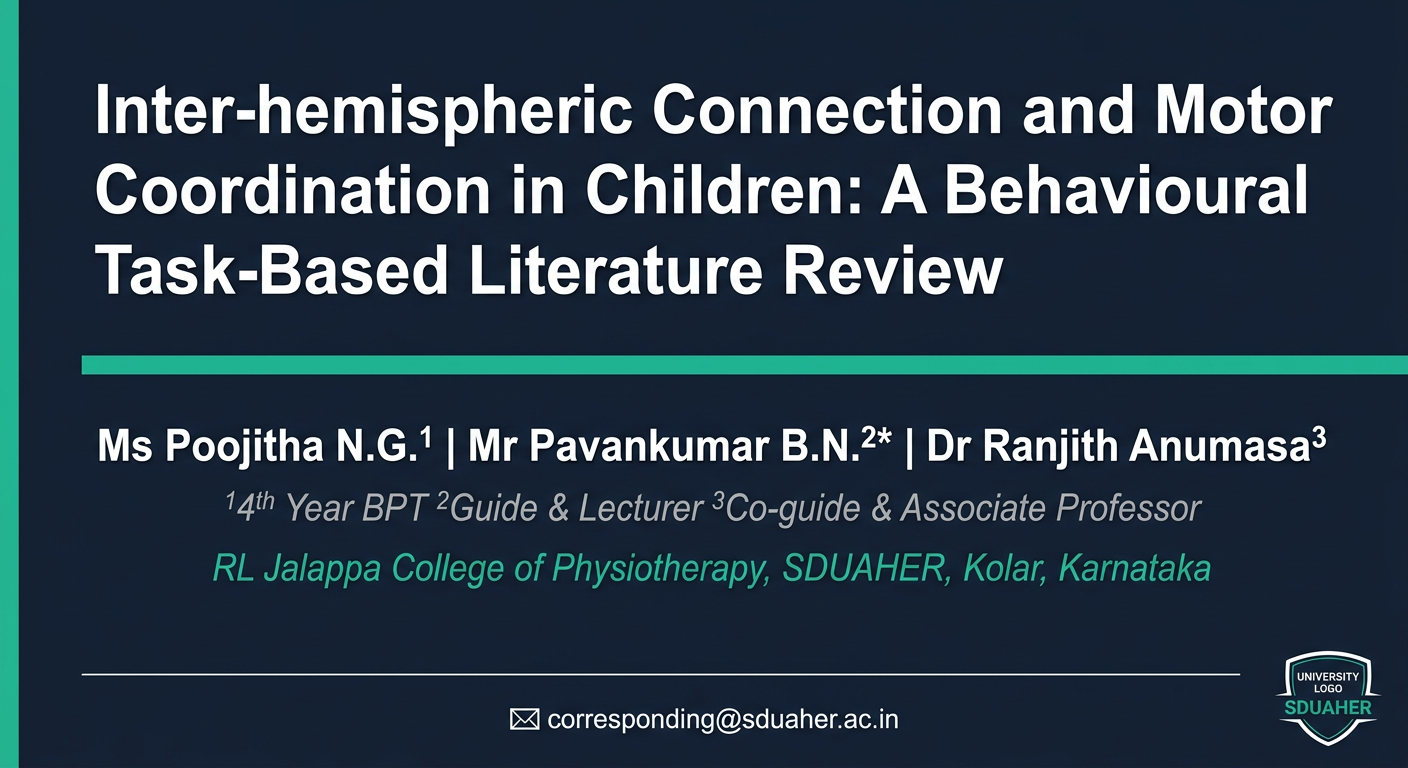
Key Elements to Copy:
| Element | How to do it in PPT |
|---|---|
| Dark navy background | Slide background → Fill → Solid colour → Dark navy (#0D1B2A) |
| Teal left vertical bar | Insert → Shape → Rectangle → narrow, full height left side, fill teal |
| Teal accent line | Insert → Shape → Line → under the title, colour teal |
| Paper title | Large text box, white, bold, 28–32pt |
| Author names with ¹²³ | Text box, white bold 14pt — type superscript using Format → Font → Superscript |
| Designation line | Smaller text box, light grey, italic, 10–11pt |
| Institution name | Italic teal text, 11pt |
| Bottom divider + email | Insert → Line shape → then small text box with ✉ symbol + email, 9pt |
| Logo (bottom right) | Insert → Image → your college/conference logo, resize small |