
What is the best treatment of indigestion?
Reading File
Now let me search the medical library and PubMed in parallel.
Finding Sources
Searching PubMed
"functional dyspepsia"[MeSH Terms] AND treatment
Searching the Web
best treatment for indigestion dyspepsia 2025 guidelines
Finding Sources
Searching PubMed
dyspepsia treatment management
Reading File
Reading File
Reading File
Reading File
Reading File
I now have enough content from the medical textbooks and guidelines. Let me compile a thorough answer.
Loading Image
Here is a comprehensive, evidence-based answer on the treatment of indigestion (dyspepsia):
Treatment of Indigestion (Dyspepsia)
"Indigestion" is the lay term for dyspepsia - a group of symptoms (upper abdominal pain or discomfort, bloating, early satiety, nausea) arising from the upper GI tract. Treatment is guided by whether an underlying cause is found.
Step 1 - Rule Out Organic Causes & Alarm Features
Before treating, consider whether the patient needs investigation:
- Alarm features (weight loss, anemia, dysphagia, vomiting blood, age >45-55 with new-onset symptoms) - prompt upper GI endoscopy is required.
- No alarm features in a young patient - empirical treatment is acceptable.
- Always stop NSAIDs if possible, as they are a common culprit. If NSAIDs cannot be stopped, add a PPI.
Step 2 - Test & Treat for H. pylori
The first-line strategy for uninvestigated dyspepsia (no alarm features, age <45) is the "test and treat" approach:
- Test non-invasively for H. pylori (urea breath test or stool antigen test)
- If positive, eradicate with PPI + two antibiotics for 10-14 days (standard triple or bismuth quadruple therapy per ACG 2024 guidelines, PMID: 39626064)
- H. pylori eradication achieves sustained remission in a subset ("Hp-associated dyspepsia"), and also reduces peptic ulcer disease and gastric cancer risk (NNT ~12.5 for dyspepsia symptom benefit)
Step 3 - Pharmacological Treatment of Functional Dyspepsia (FD)
About 70% of dyspeptic patients have functional dyspepsia (FD) - no structural cause found on endoscopy. Treatment is symptom-subtype driven per Rome IV:
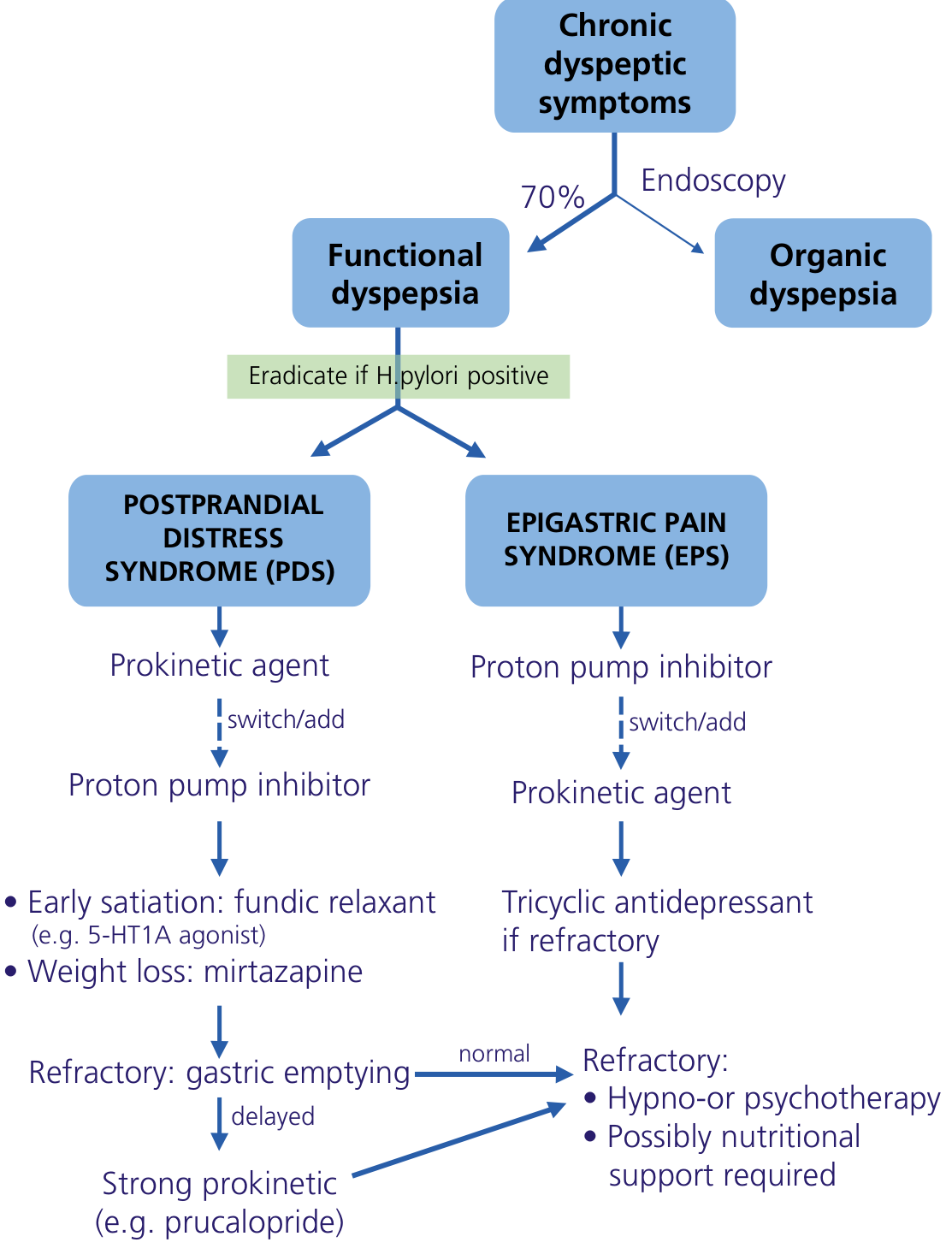
A. Epigastric Pain Syndrome (EPS) - burning/pain, not meal-related
| Drug Class | Details |
|---|---|
| PPIs (first line) | Omeprazole, lansoprazole, pantoprazole; NNT ~10 vs placebo; standard dose, 4-8 weeks |
| H2-receptor antagonists | Famotidine, ranitidine; NNT ~7; useful alternative, though most trials predated Rome criteria |
| Tricyclic antidepressants | Amitriptyline (low dose) for refractory EPS - works via central pain modulation |
B. Postprandial Distress Syndrome (PDS) - meal-induced fullness, early satiety
| Drug Class | Details |
|---|---|
| Prokinetics (first line) | Metoclopramide, domperidone, itopride, acotiamide; improve gastric emptying and accommodation |
| PPIs | Add or switch if prokinetic alone insufficient |
| 5-HT1A agonists | Buspirone - reduces fundic accommodation abnormalities; for prominent early satiation |
| Mirtazapine 15 mg | For early satiation with weight loss (BSG 2025 guideline; evidence still limited) |
Step 4 - General & Lifestyle Measures
These apply to all patients with dyspepsia:
- Dietary changes: Eat smaller, more frequent meals; avoid fatty/spicy foods, alcohol, caffeine, carbonated drinks
- Weight management: Obesity worsens symptoms
- Smoking cessation: Smoking impairs gastric motility
- Stress reduction: Dyspepsia is closely linked to psychological stress; relaxation techniques help
- Reassurance: Explaining the benign nature of functional dyspepsia is itself therapeutic
Step 5 - Refractory Functional Dyspepsia
If symptoms persist despite the above:
- Low-dose tricyclic antidepressants (amitriptyline, nortriptyline) - well-supported by evidence
- SNRIs (duloxetine) - emerging evidence
- Cognitive behavioral therapy (CBT) or gut-directed hypnotherapy - effective for the gut-brain axis component; recommended for refractory cases
- Gastric emptying study - if delayed, consider a stronger prokinetic (e.g., prucalopride)
- Psychological/psychiatric referral - for long-standing refractory or debilitating symptoms
Quick Reference by Cause
| Cause | Treatment |
|---|---|
| H. pylori infection | PPI + antibiotics (triple/quadruple therapy) |
| NSAID-induced | Stop NSAID; PPI for protection |
| GERD overlap | PPI |
| Peptic ulcer disease | PPI + H. pylori eradication if positive |
| Functional (EPS) | PPI or H2RA |
| Functional (PDS) | Prokinetic; add PPI if needed |
| Refractory FD | TCA, CBT, hypnotherapy |
Key takeaway: The best treatment depends on the underlying cause. For most patients without alarm features, start with H. pylori test-and-treat plus acid suppression (PPI), lifestyle modification, and reassurance. Refractory cases benefit from low-dose antidepressants and gut-directed psychological therapy.
- Sources: Sleisenger & Fordtran's Gastrointestinal and Liver Disease; Yamada's Textbook of Gastroenterology, 7th ed.; ACG H. pylori Guidelines 2024; BSG Functional Dyspepsia Guidelines 2025
Just till me drugs
Here are the drugs used for indigestion/dyspepsia:
Antacids (mild/occasional symptoms)
- Aluminium hydroxide
- Magnesium hydroxide
- Calcium carbonate (Tums)
- Sodium bicarbonate
Proton Pump Inhibitors - PPIs (acid suppression, first line for EPS)
- Omeprazole
- Pantoprazole
- Lansoprazole
- Esomeprazole
- Rabeprazole
H2-Receptor Antagonists (acid suppression, alternative to PPIs)
- Famotidine
- Ranitidine
- Cimetidine
Prokinetics (first line for PDS - bloating, fullness, early satiety)
- Metoclopramide
- Domperidone
- Itopride
- Acotiamide
- Prucalopride (refractory, delayed gastric emptying)
H. pylori Eradication (if H. pylori positive)
- PPI + Amoxicillin + Clarithromycin (standard triple therapy)
- PPI + Bismuth + Metronidazole + Tetracycline (quadruple therapy)
Neuromodulators (refractory/functional dyspepsia)
- Amitriptyline (low dose TCA)
- Nortriptyline (low dose TCA)
- Mirtazapine 15 mg (especially with weight loss + early satiation)
- Duloxetine (SNRI)
- Buspirone (5-HT1A agonist - impaired fundic accommodation)
Cytoprotective
- Sucralfate (limited evidence)
Combinations
Here are the standard drug combinations used in indigestion/dyspepsia:
H. pylori Eradication Regimens
Standard Triple Therapy (14 days)
- PPI + Amoxicillin 1g + Clarithromycin 500mg (all BD)
Bismuth Quadruple Therapy (14 days)
- PPI + Bismuth subcitrate + Metronidazole + Tetracycline (all QID)
Concomitant Therapy
- PPI + Amoxicillin + Clarithromycin + Metronidazole (all BD)
Hybrid Therapy
- PPI + Amoxicillin (7 days) → then PPI + Amoxicillin + Clarithromycin + Metronidazole (7 days)
Functional Dyspepsia Combinations
EPS not responding to PPI alone
- PPI + Prokinetic (e.g., Pantoprazole + Domperidone)
PDS not responding to prokinetic alone
- Prokinetic + PPI (e.g., Itopride + Omeprazole)
Refractory FD
- PPI + Low-dose TCA (e.g., Omeprazole + Amitriptyline)
Overlap with GERD
- PPI (double dose) + Prokinetic
Overlap with IBS
- PPI + Antispasmodic (e.g., Mebeverine or Dicyclomine)
Common Fixed-Dose Commercial Combinations
- Pantoprazole + Domperidone (very widely used)
- Omeprazole + Domperidone
- Rabeprazole + Domperidone
- Lansoprazole + Domperidone
- Esomeprazole + Itopride
Note: Fixed-dose PPI + prokinetic combinations are popular in clinical practice (especially in South Asia) for mixed EPS/PDS presentations, though guidelines generally recommend tailoring by symptom subtype.
This is a shared conversation. Sign in to Orris to start your own chat.