
Cytokinin
Searching the Web
cytokinin plant hormone function structure
Cytokinin
Cytokinins are a class of plant hormones (phytohormones) that promote cell division (cytokinesis) in plant roots and shoots. They are adenine-derived compounds, with a side chain attached at the N6 position of the purine ring, which determines the type and potency of the specific cytokinin.
Structure and Types
- Structurally, cytokinins are derivatives of adenine.
- Natural types include zeatin (named after Zea mays, corn, where it was first isolated), kinetin, and isopentenyladenine (iP).
- Synthetic cytokinins (e.g., 6-benzylaminopurine/BAP, thidiazuron) are widely used in tissue culture and horticulture.
Where They're Made and How They Move
- Primarily synthesized in the root tips (root apical meristem), and also in developing seeds, fruits, and young leaves.
- Transported upward via the xylem to shoots, leaves, and fruits.
Functions
- Cell division - stimulate mitosis in meristematic tissue; central to the plant cell cycle.
- Cell differentiation - work with auxin to control organogenesis. The classic principle from tissue culture: high cytokinin:auxin ratio promotes shoot formation, while high auxin:cytokinin ratio promotes root formation.
- Delay of senescence - inhibit leaf yellowing and aging (the "Richmond-Lansing effect"); cytokinin-treated detached leaves stay green longer.
- **Apical dominance and ax
Cytokinine role in immunity
The spelling "cytokinine" is close to two very different things, and which one determines where I look:
Asking for Preferences
Are you asking about cytokinin (the plant hormone from our last message) and its role in plant immune defense, or about cytokines (immune signaling proteins like interleukins/interferons) and their role in human immunity?
Reading File
This is a broad topic (cytokines in immunity) - I'll search the textbook library across the immune-related sections and supplement with recent evidence.
Finding Sources
Finding Sources
Searching PubMed
"cytokines"[MeSH Terms] AND "immunity"[MeSH Terms]
Cytokines and Their Role in Immunity
Cytokines are small, soluble signaling proteins that act as the primary "language" immune cells use to communicate with each other and with other tissues. They regulate essentially every aspect of the immune response - inflammation, host defense, and hematopoiesis (Scott-Brown's Otorhinolaryngology, p. 3580).
What They Are
Cytokines are intercellular messengers, secreted mainly by leukocytes (though many other cell types produce them too), that bind specific receptors on target cells to trigger changes in gene expression, proliferation, differentiation, or effector function (Roitt's Essential Immunology, p. 2445).
Major Families
- Interleukins (ILs) - a large group mediating communication between leukocytes (e.g., IL-1, IL-2, IL-6, IL-17)
- Interferons (IFNs) - type I (IFN-α/β, antiviral) and type II (IFN-γ, activates macrophages and promotes Th1 responses)
- Tumor necrosis factor (TNF) family - drives inflammation and can trigger apoptosis
- Chemokines - a specialized subfamily that directs leukocyte migration/trafficking to sites of infection or injury
- Colony-stimulating factors and growth factors - regulate hematopoiesis
Role in Innate Immunity
During the innate response, cytokines (IL-1, IL-6, TNF-α, type I interferons) are released rapidly by macrophages, dendritic cells, and epithelial cells after pathogen recognition via pattern-recognition receptors (e.g., toll-like receptors). These cytokines:
- Induce local inflammation (vasodilation, increased vascular permeability, recruitment of neutrophils and monocytes)
- Trigger the acute-phase response in the liver (fever, CRP production)
- Establish an early antiviral state via type I interferons (Jawetz, Melnick & Adelberg's Medical Microbiology, p. 4584-4586; Janeway's Immunobiology, p. 141-159)
Role in Adaptive Immunity
Cytokines are essential in shaping and directing the adaptive response:
- CD4+ helper T cells are the principal regulators of adaptive immunity, differentiating into subsets (Th1, Th2, Th17, Treg) largely determined by the cytokine milieu present during activation, and each subset in turn produces a characteristic cytokine profile that governs the type of immune response mounted (Rheumatology, 2-Vol Set, p. 7495-7497):
- Th1 (driven by IL-12, IFN-γ) - cell-mediated immunity against intracellular pathogens, macrophage activation
- Th2 (driven by IL-4) - humoral immunity, antibody class switching, defense against helminths
- Th17 (driven by IL-6, IL-23, TGF-β) - defense against extracellular bacteria/fungi, mucosal immunity
- Treg (IL-10, TGF-β) - immune tolerance and suppression of excessive responses
- Cytokines also drive B-cell proliferation, antibody isotype switching, and cytotoxic T-cell/NK-cell activation (Kaplan & Sadock's Comprehensive Textbook of Psychiatry, p. 337-340; Cellular and Molecular Immunology, p. 512-518)
Clinical Relevance
- Cytokine storm - dysregulated, excessive cytokine release (IL-6, TNF-α, IL-1) causing systemic inflammation, hypotension, and organ failure - seen in sepsis, CAR-T therapy, and severe viral infections.
- Therapeutics: recombinant cytokines (e.g., IFN-α for hepatitis, IL-2 for renal cell carcinoma) and cytokine blockers (anti-TNF agents, IL-6 receptor antagonists like tocilizumab, IL-17 inhibitors) are used across autoimmune disease, cancer, and inflammatory conditions.
- Immunocytokines (cytokines fused to antibodies to target them to tumors) are an active area of cancer immunotherapy research - a 2025 systematic review found this remains a promising but still-maturing therapeutic approach (PMID: 40554920).
- Circulating cytokine levels are also being explored as drug targets for immune-related diseases via genomic/Mendelian randomization approaches (PMID: 39794498).
Here is a diagram showing how cytokines mediate innate and adaptive immunity against intracellular pathogens:
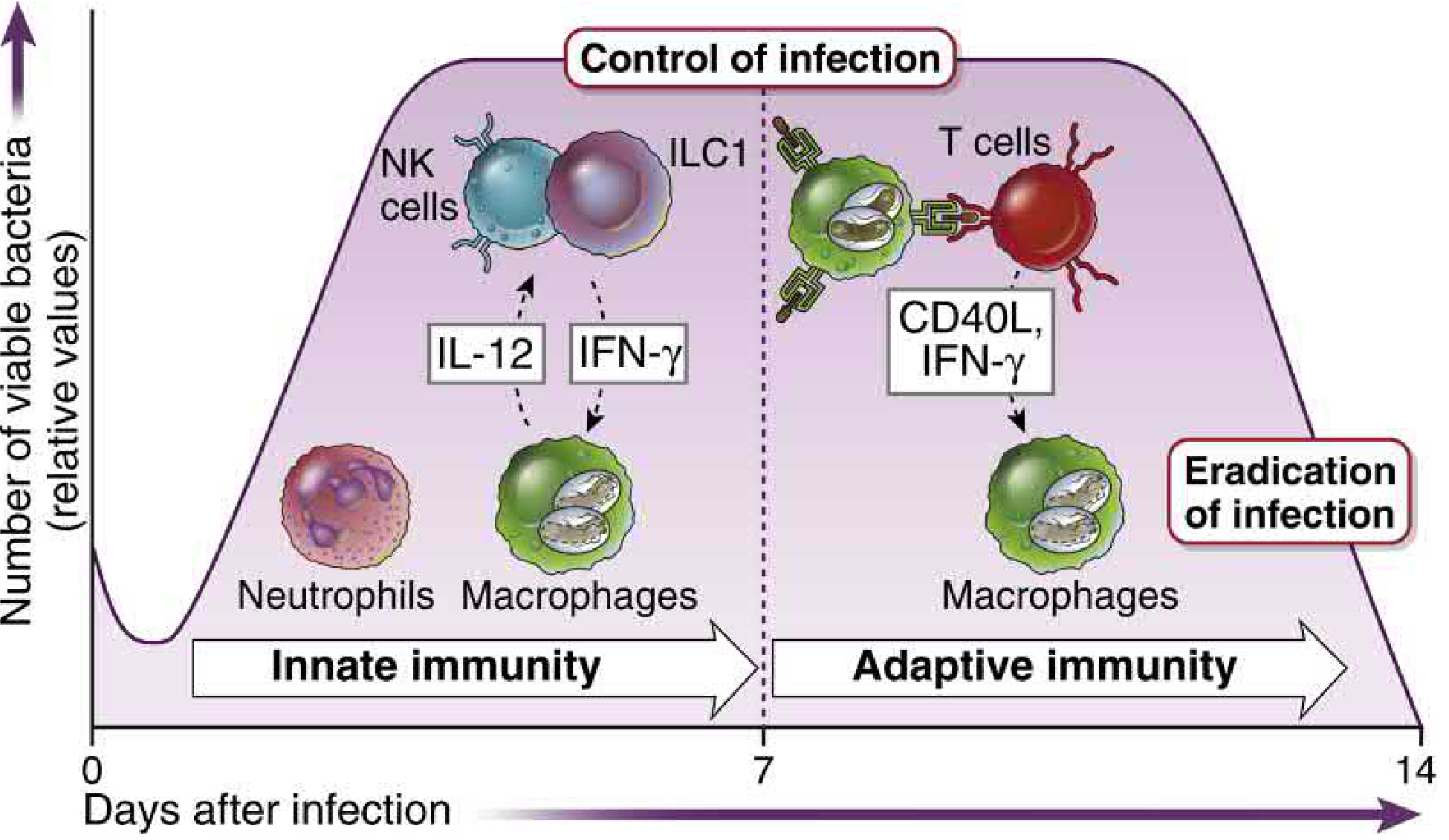
Sources: Janeway's Immunobiology 10e; Roitt's Essential Immunology; Cellular and Molecular Immunology; Jawetz, Melnick & Adelberg's Medical Microbiology 28E; Rheumatology (Elsevier); Kaplan & Sadock's Comprehensive Textbook of Psychiatry; Scott-Brown's Otorhinolaryngology.
This is a shared conversation. Sign in to Orris to start your own chat.