
Benzodiazipines
benzodiazepine GABA receptor mechanism of action diagram
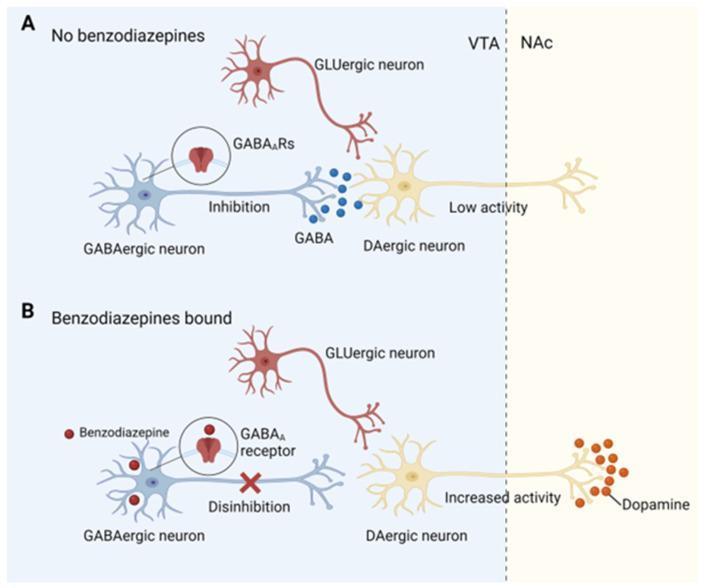
This pathophysiology diagram illustrates the neurobiological mechanism of benzodiazepine addiction through disinhibition of dopaminergic neurons in the mesolimbic reward system. The illustration is divided into two comparative panels. Panel A (No benzodiazepines) shows a baseline state in the Ventral Tegmental Area (VTA), where a blue GABAergic interneuron releases GABA molecules to inhibit a yellow dopaminergic (DAergic) neuron via GABAA receptors, resulting in 'Low activity' and minimal dopamine release in the Nucleus Accumbens (NAc). A GLUergic neuron is also shown nearby. Panel B (Benzodiazepines bound) depicts the introduction of red benzodiazepine molecules, which bind to GABAA receptors on the GABAergic interneuron. This binding induces 'Disinhibition' of the downstream DAergic neuron (indicated by an 'X' over the inhibitory synapse). Consequently, the DAergic neuron exhibits 'Increased activity,' leading to a significant rise in dopamine release (red molecules) within the NAc. The diagram highlights how benzodiazepines modulate neuronal signaling to trigger the brain's reward circuitry.
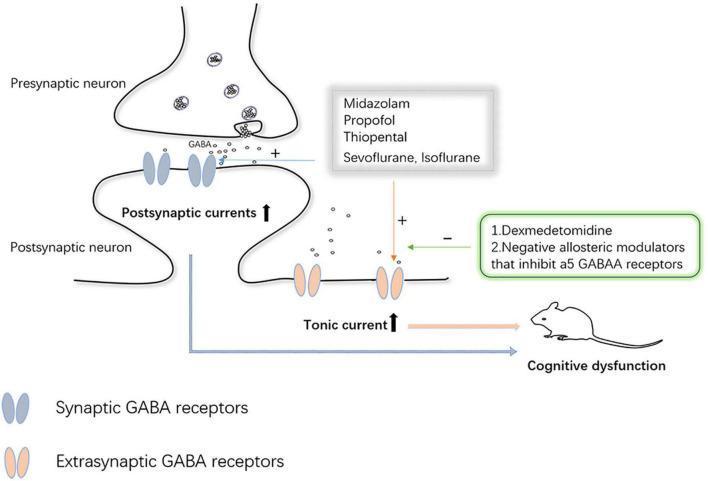
This pathophysiology diagram illustrates the mechanism of GABA receptor-mediated inhibition in neurons and the modulatory effects of anesthetic agents. The illustration depicts a synaptic cleft between a presynaptic neuron, which releases GABA from vesicles, and a postsynaptic neuron. GABA binds to two types of receptors: synaptic GABA receptors, which increase postsynaptic currents, and extrasynaptic GABA receptors, which increase tonic current. The diagram highlights how specific anesthetics—Midazolam, Propofol, Thiopental, Sevoflurane, and Isoflurane—act as positive modulators (+) on both receptor types, particularly enhancing tonic current. Conversely, Dexmedetomidine and negative allosteric modulators of α5 GABAA receptors exert inhibitory effects (-) on these extrasynaptic pathways. The net increase in GABAergic inhibition and tonic current is linked via arrows to a mouse model labeled 'Cognitive dysfunction,' suggesting a clinical correlation between excessive GABAergic tonic signaling and impaired cognitive outcomes. This diagram serves as an educational tool for neuropharmacology and anesthesiology, focusing on GABA receptor distribution and drug-induced neurotoxicity.
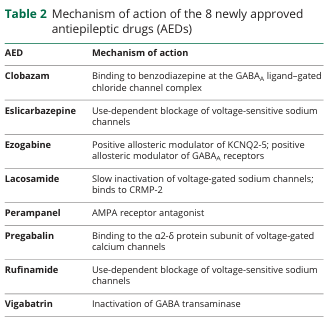
Table 2 Mechanism of action of the 8 newly approved antiepileptic drugs (AEDs) <table><thead><tr><th>AED</th><th>Mechanism of action</th></tr></thead><tbody><tr><td>Clobazam</td><td>Binding to benzodiazepine at the GABA<sub>A</sub> ligand-gated chloride channel complex</td></tr><tr><td>Eslicarbazepine</td><td>Use-dependent blockage of voltage-sensitive sodium channels</td></tr><tr><td>Ezogabine</td><td>Positive allosteric modulator of KCNQ2-5; positive allosteric modulator of GABA<sub>A</sub> receptors</td></tr><tr><td>Lacosamide</td><td>Slow inactivation of voltage-gated sodium channels; binds to CRMP-2</td></tr><tr><td>Perampanel</td><td>AMPA receptor antagonist</td></tr><tr><td>Pregabalin</td><td>Binding to the α2-δ protein subunit of voltage-gated calcium channels</td></tr><tr><td>Rufinamide</td><td>Use-dependent blockage of voltage-sensitive sodium channels</td></tr><tr><td>Vigabatrin</td><td>Inactivation of GABA transaminase</td></tr></tbody></table>
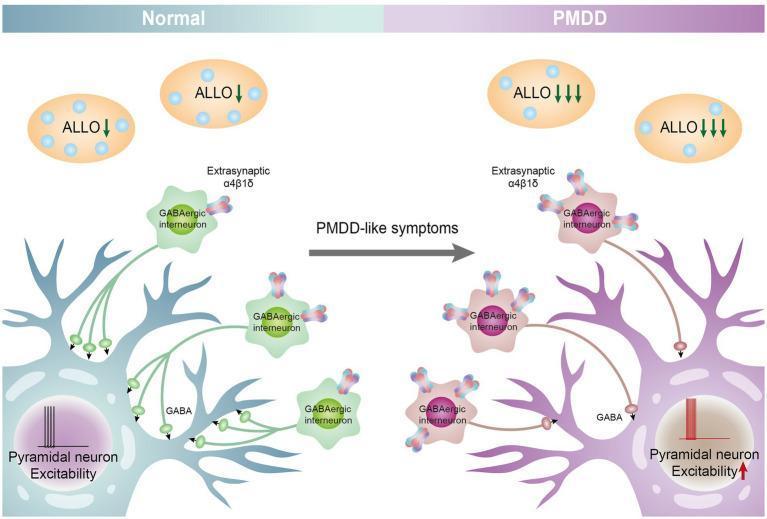
This pathophysiology diagram illustrates the neurobiological mechanism of Premenstrual Dysphoric Disorder (PMDD) focusing on allopregnanolone (ALLO) and GABAA receptor signaling. The diagram is divided into 'Normal' (left) and 'PMDD' (right) physiological states. In the 'Normal' state, higher ALLO levels maintain the function of extrasynaptic alpha-4 beta-delta GABAA receptors on GABAergic interneurons, leading to robust GABA release and effective tonic inhibition of pyramidal neurons, shown with low excitability. In the 'PMDD' state, a rapid decline in ALLO (indicated by multiple downward arrows) is shown alongside altered GABAergic interneurons. This leads to reduced GABA release and a subsequent 'disinhibition' of the postsynaptic pyramidal neuron. The clinical consequence is visualized as increased pyramidal neuron excitability, labeled as 'PMDD-like symptoms.' Key components include labeled GABAergic interneurons, pyramidal neurons with electrophysiological excitability inserts, and extrasynaptic receptor subunits. This content is intended for advanced medical education in psychiatry and neuroendocrinology.
Benzodiazepines - Complete Overview
1. Classification & Chemistry
| Drug | Brand | Onset | Duration | Dose Equivalent (mg) | Typical Daily Dose |
|---|---|---|---|---|---|
| Alprazolam | Xanax | Rapid | Short | 0.5 | 0.25-4 mg |
| Triazolam | Halcion | Rapid | Short | 0.25 | 0.125-0.5 mg |
| Midazolam | Versed | Rapid | Short | - | IV/IM procedural |
| Lorazepam | Ativan | Intermediate | Intermediate | 1 | 1-4 mg |
| Clonazepam | Klonopin | Intermediate | Intermediate | 0.25 | 0.5-4 mg |
| Diazepam | Valium | Rapid | Long | 5 | 2-40 mg |
| Chlordiazepoxide | Librium | Intermediate | Long | 25 | 10-100 mg |
| Flurazepam | Dalmane | - | Long | 15 | 15-30 mg (sleep) |
2. Mechanism of Action
- The result is Cl⁻ influx → membrane hyperpolarization → increased threshold for action potential firing
- This is an indirect mechanism, which is why BZDs have a much safer respiratory profile than barbiturates (which increase duration of channel opening and can act independently of GABA)
- The BZD site is allosterically linked to barbiturate, ethanol, and neurosteroid binding sites - explaining synergistic toxicity (e.g., BZDs + alcohol)
- BZDs are selective for alpha-1, 2, 3, and 5 GABA-A subunits; different subunit combinations mediate different clinical effects (sedation via alpha-1; anxiolysis via alpha-2/3)
3. Clinical Indications
- Anxiety disorders - generalized anxiety, panic disorder, social anxiety (short-term; SSRIs preferred long-term)
- Insomnia - short-term use; higher-potency/short-acting (triazolam, temazepam)
- Seizure disorders - clonazepam (absence, myoclonic), diazepam/lorazepam (status epilepticus), clobazam
- Alcohol withdrawal - chlordiazepoxide, diazepam, lorazepam (CIWA-based protocols)
- Procedural sedation / anesthesia - midazolam (pre-op), diazepam
- Muscle relaxation - diazepam (spasticity, tetanus)
- Acute agitation - lorazepam IM
- Akathisia - clonazepam or lorazepam adjunctively
4. Pharmacokinetics
- Lipid solubility - determines speed of onset (diazepam = very rapid; lorazepam = intermediate)
- Protein binding - highly protein-bound; important in hepatic disease
- Metabolism - most undergo hepatic CYP3A4 oxidation to active metabolites; exceptions are lorazepam, oxazepam, temazepam (LOT) which undergo direct glucuronidation - safe in liver disease/elderly
- Active metabolites - Diazepam → desmethyldiazepam (t½ > 100 h); Flurazepam → desalkylflurazepam (t½ > 100 h). These cause prolonged effects, especially in elderly
- Age/gender - do not significantly affect BZD pharmacokinetics, but liver disease prolongs half-life
- Volume of distribution - large (highly lipophilic), contributing to redistribution-based termination of effect for short-acting agents
5. Adverse Effects
| System | Effects |
|---|---|
| CNS | Sedation, drowsiness, cognitive impairment, anterograde amnesia, psychomotor slowing |
| Respiratory | Mild respiratory depression (less than barbiturates); significant in combination with opioids/alcohol |
| Cardiovascular | Minimal at therapeutic doses; hypotension possible IV |
| Psychomotor | Impaired driving - 60-80% increased risk of traffic accident; independent of half-life when taken during the day |
| Paradoxical | Disinhibition, aggression, agitation (especially in elderly, children, personality disorders) |
| Falls/fractures | Major risk in elderly (hip fractures) |
| Cognition/Dementia | Long-term use is associated with cognitive impairment; evidence on dementia risk is conflicting across large registry studies |
6. Tolerance & Dependence
- Tolerance develops to sedative and anticonvulsant effects via a mechanism involving prolonged BZD receptor occupation triggering intracellular calcium signaling downstream of GABA-A, leading to receptor downregulation
- Physical dependence can develop after 4-8 weeks of regular therapeutic use, or sooner with higher doses
- Addiction risk is partly mediated by disinhibition of dopaminergic neurons in the VTA via GABAergic interneurons, increasing dopamine release in the nucleus accumbens (mesolimbic reward pathway)
7. Discontinuation Syndromes
- Relapse - return of the original anxiety/insomnia over weeks-months (not true withdrawal)
- Rebound - more intense re-emergence of target symptoms, worse than baseline, typically within days-weeks, lasting up to 3 weeks; common with short-acting agents (interdose rebound anxiety with alprazolam)
- Withdrawal - new autonomic/neurological symptoms:
- Minor: sweating, tachycardia, nausea, tremor, myoclonus, restlessness, visual changes, confusion
- Major: seizures, psychosis, delirium
- Onset: within hours-days for short-acting agents; 1-2 weeks for long-acting agents
- Duration: typically 2-4 weeks; can persist 6-12 months (rarely years) with long-term use
- Risk factors for seizures: abnormal EEG, brain damage, co-medications lowering seizure threshold
8. Overdose & Reversal
- BZDs alone are relatively safe in overdose - supportive care is the mainstay
- Flumazenil (Anexate) is the competitive BZD receptor antagonist:
- IV; short half-life (~1 hour) - resedation can occur
- Indicated for: confirmed BZD overdose, reversal of procedural sedation
- Contraindicated/use with caution in: known/suspected BZD dependence (precipitates acute withdrawal/seizures), co-ingestion with TCAs (may unmask seizures), raised ICP
- Does NOT reverse barbiturates, alcohol, or opioids
- Liver disease prolongs its half-life
9. Drug Interactions
- CNS depressants (alcohol, opioids, barbiturates, antihistamines): additive/synergistic CNS/respiratory depression - the BZD + opioid combination is a major cause of overdose deaths
- CYP3A4 inhibitors (azole antifungals, macrolides, grapefruit juice): increase BZD levels
- CYP3A4 inducers (rifampin, carbamazepine): decrease BZD levels
- Note: LOT drugs (lorazepam, oxazepam, temazepam) are not affected by CYP interactions
10. Special Populations
| Population | Consideration |
|---|---|
| Elderly | Use LOT drugs (glucuronidation only); avoid long-acting agents; high fall/fracture risk |
| Liver disease | Avoid oxidized BZDs; LOT drugs are safe |
| Pregnancy | Category D; associated with cleft palate (older data); neonatal withdrawal; avoid especially in 1st trimester |
| Renal disease | Minimal impact on most BZDs |
| Neonates | GABA-A activation can paradoxically depolarize (high intracellular Cl⁻) - BZDs may worsen neonatal seizures |