
Anatomy basics
Asking for Preferences
What aspect of anatomy are you interested in? · What level are you studying at?
Reading File
Now let me search the library for cell and tissue basics at the medical student level.
Finding Sources
Finding Sources
Finding Sources
Finding Sources
Good - I have Histology: A Text and Atlas (9781975181512) and Junqueira's (9781264930395). Let me read the core sections in parallel.
Reading File
Reading File
Reading File
Loading Image
Reading File
Loading Image
I now have rich textbook content from Histology: A Text and Atlas to build a thorough answer. Let me also grab the muscle tissue image and histogenesis section.
Finding Sources
Reading File
I now have everything I need for a thorough, medical-student-level overview of cell and tissue basics. Let me compile the answer.
Cell & Tissue Basics - Medical Student Overview
Source: Histology: A Text and Atlas with Correlated Cell and Molecular Biology, 9th ed.
What Is a Tissue?
A tissue is an organized aggregate of cells that functions collectively. While individual cells are the structural units, it is through the cooperative behavior of cells within tissues that the body's functions are actually maintained. Cells are connected by specialized junctions (cell-to-cell adhesions, gap junctions) and respond to shared stimuli (hormonal, neural, mechanical) to operate as a unified unit.
The Four Basic Tissue Types
All organs - regardless of their structure or physiology - are composed of exactly four basic tissue types:
| Tissue | Core Feature | Primary Role |
|---|---|---|
| Epithelium | Cells in close apposition; always at a free surface | Covers, lines, secretes |
| Connective tissue | Cells widely separated; ECM-dominant | Supports and connects other tissues |
| Muscle tissue | Contractile cells (actin + myosin) | Movement |
| Nerve tissue | Neurons + supporting cells | Information transmission and integration |
1. Epithelium
Epithelial cells are always contiguous with one another and always face a free surface (external, luminal, or cavity-lining). The intercellular space is minimal except where junctions are present.
Classification is based on two features:
- Cell shape: squamous (flat), cuboidal, columnar
- Layering: simple (single layer) vs. stratified (multiple layers)
A third special category exists - pseudostratified - where all cells touch the basement membrane but not all reach the surface, creating a false appearance of multiple layers (classic example: respiratory epithelium).
Key examples:
- Simple cuboidal - pancreatic ducts
- Simple columnar - gallbladder lining
- Stratified squamous - esophagus, skin (when keratinized)
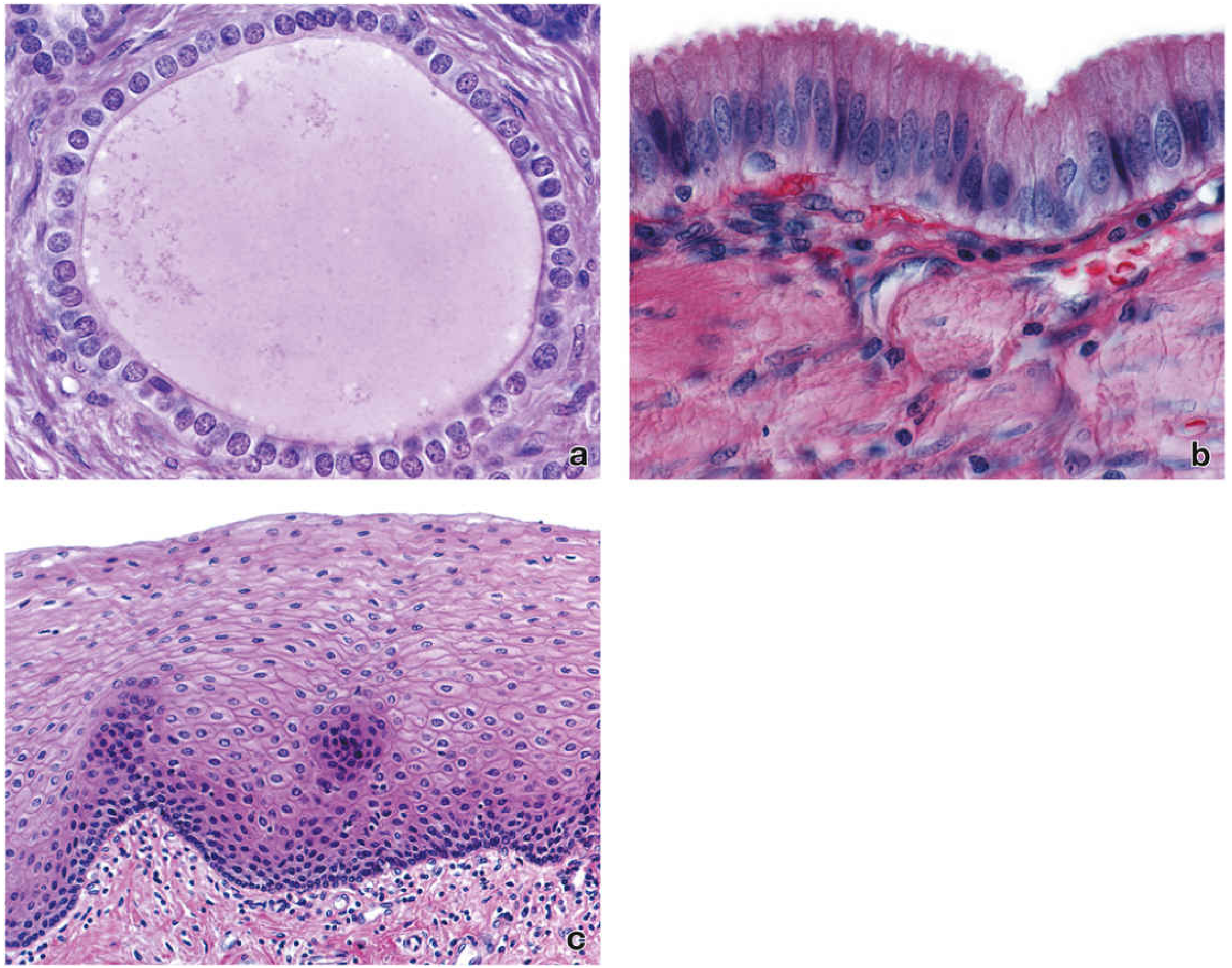
Epithelia also form glands - exocrine glands secrete onto surfaces or into ducts; endocrine glands secrete into the bloodstream.
2. Connective Tissue
Unlike epithelium, connective tissue cells are conspicuously separated from each other. The space between them is filled by the extracellular matrix (ECM), which the cells themselves produce. Classification is based primarily on the nature of the ECM and the cell types present.
Major subtypes:
| Subtype | ECM Character | Key Cells | Example Locations |
|---|---|---|---|
| Loose (areolar) | Loosely arranged collagen fibers, abundant cells | Fibroblasts, macrophages, mast cells, plasma cells | Beneath epithelia, around vessels |
| Dense irregular | Densely packed collagen; fewer cells | Fibroblasts (mainly) | Dermis, organ capsules |
| Dense regular | Parallel collagen bundles | Fibroblasts | Tendons, ligaments |
| Cartilage | High water content; hyaluronan aggregates | Chondrocytes | Joints, trachea, ear |
| Bone | Mineralized (Ca²⁺/phosphate + collagen) | Osteocytes, osteoblasts, osteoclasts | Skeleton |
| Blood | Fluid ECM (plasma) | RBCs, WBCs, platelets | Vasculature |
| Adipose | Lipid-filled cells | Adipocytes | Subcutaneous layer, mesentery |
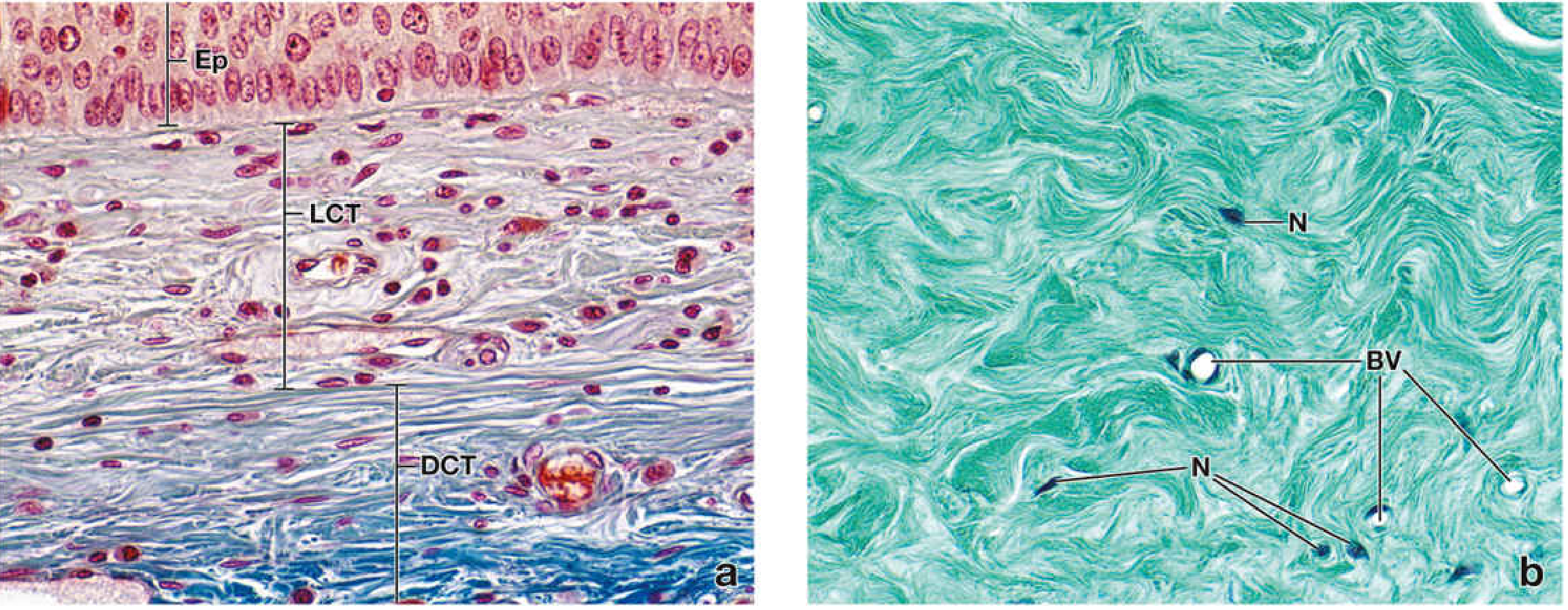
The main fiber types in connective tissue ECM:
- Type I collagen - most abundant; forms thick bundles; high tensile strength
- Type III collagen (reticular fibers) - thin; forms scaffolds in liver, lymph nodes, spleen
- Elastic fibers - contain elastin; allow stretch and recoil (lungs, aorta, skin)
- Ground substance - gel-like; contains glycosaminoglycans (GAGs: hyaluronate, chondroitin sulfate), proteoglycans, and fibronectin/laminin
3. Muscle Tissue
All three muscle types share the defining feature: bulk cytoplasm filled with contractile proteins actin (thin filaments) and myosin (thick filaments).
| Feature | Skeletal | Cardiac | Smooth |
|---|---|---|---|
| Cross-striations | Yes | Yes | No |
| Nuclei per cell | Multiple, peripheral | 1-2, central | 1, central, elongated |
| Control | Voluntary | Involuntary | Involuntary |
| Special structures | None | Intercalated discs | None |
| Location | Attached to skeleton | Heart wall | Hollow organs, vessels |
Striations in skeletal and cardiac muscle arise from the highly ordered arrangement of actin/myosin myofilaments into sarcomeres. Smooth muscle lacks this level of organization, so no striations form.
4. Nerve Tissue
Nerve tissue comprises neurons (the electrically excitable cells) plus supporting cells (neuroglia in the CNS, Schwann cells and satellite cells in the PNS).
Neuron anatomy:
- Cell body (soma) - contains the nucleus and most organelles; the metabolic center
- Axon - single; carries impulses away from the cell body; can be >1 meter long
- Dendrites - multiple; carry impulses toward the cell body
- Synapse - the axon terminal; impulses are transmitted chemically via neurotransmitters (neuromediators)
Supporting cells and their roles:
| Cell | Location | Function |
|---|---|---|
| Astrocytes | CNS | Structural support; blood-brain barrier |
| Oligodendrocytes | CNS | Myelination of CNS axons |
| Microglia | CNS | Phagocytosis; immune surveillance |
| Ependymal cells | CNS | Line ventricles; CSF circulation |
| Schwann cells | PNS | Myelination of PNS axons |
| Satellite cells | PNS ganglia | Surround neuron cell bodies |
Histogenesis: Where Do Tissues Come From?
All tissues derive from the three embryonic germ layers formed during gastrulation:
Ectoderm (outer layer):
- Surface ectoderm → epidermis and derivatives (hair, nails, glands), cornea and lens, tooth enamel, adenohypophysis, oral/anal mucosa
- Neuroectoderm → brain, spinal cord (neural tube), PNS ganglia (neural crest), melanocytes, Schwann cells, adrenal medulla
Mesoderm (middle layer) → ALL connective tissues (loose, dense, bone, cartilage, blood, adipose), skeletal and smooth muscle, heart and vessels, kidneys, gonads, mesothelium, adrenal cortex
Endoderm (inner layer) → epithelium of GI tract (except mouth/anus), liver, pancreas, gallbladder, urinary bladder, respiratory tract, thyroid, parathyroid, thymus
A helpful rule: Connective tissue and muscle are almost entirely mesodermal. The big exception is neural crest - a migratory neuroectodermal population that gives rise to head mesenchyme, peripheral glia, and melanocytes.
Histological Technique: H&E Staining
Most histology slides use hematoxylin and eosin (H&E):
- Hematoxylin (blue/purple) - stains nuclei and basophilic structures (rough ER, ribosomes)
- Eosin (pink/red) - stains cytoplasm and most ECM components (collagen, muscle)
Recognizing tissue type on H&E = recognizing ECM amount, cell spacing, and cell shape patterns. Epithelia have minimal ECM and closely packed cells; connective tissue has abundant ECM; muscle has eosinophilic striated or non-striated cytoplasm; nerve tissue shows large pale neurons with prominent nucleoli.
Histology: A Text and Atlas with Correlated Cell and Molecular Biology (9th ed.), pp. 296-310
This is a shared conversation. Sign in to Orris to start your own chat.