
Levels of Sedation details . Anesthesia
Reading File
Searching sources...
Finding Sources
Finding Sources
Reading File
Reading File
Reading File
Now let me get the rest of the Cummings Otolaryngology section and also fetch the sedation figure:
Reading File
Finding Sources
Finding Sources
Loading Image
Reading File
Finding Sources
Reading File
I now have comprehensive content. Let me compile the full answer.
Levels of Sedation and Anesthesia
The levels of sedation exist as a dose-related continuum - they are not discrete states but rather a progressive spectrum that depends on individual patient response to drugs. As depth increases, hallmark changes occur in mentation, hemodynamic stability, and respiratory competency. The transition between levels is often subtle and unpredictable, so the provider must always be prepared to manage the next level.
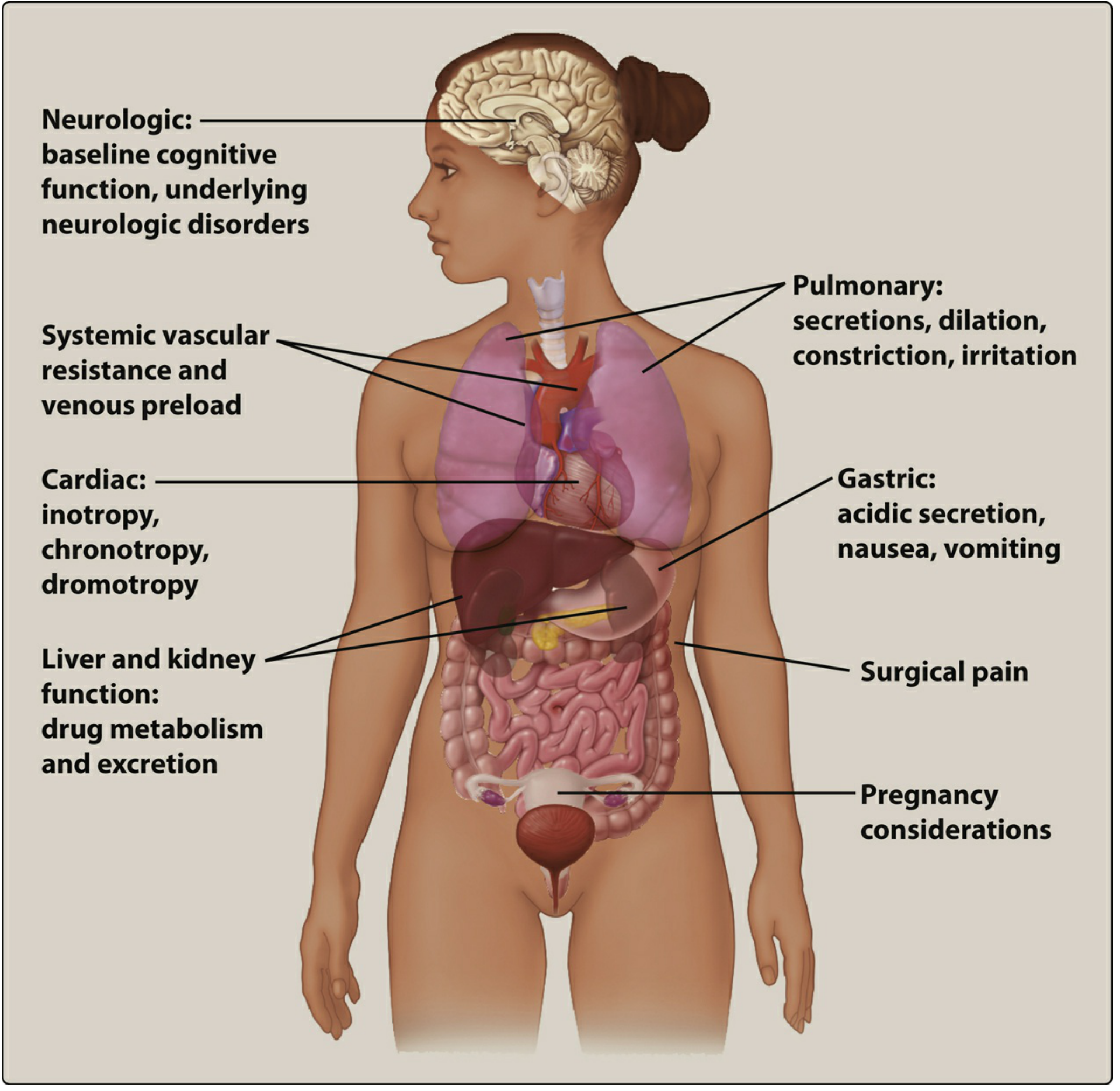
ASA Continuum of Sedation (4 Levels)
The American Society of Anesthesiologists (ASA) formally defines these four levels:
| Minimal Sedation (Anxiolysis) | Moderate Sedation (Conscious Sedation) | Deep Sedation | General Anesthesia | |
|---|---|---|---|---|
| Responsiveness | Normal response to verbal stimuli | Purposeful response to verbal or tactile stimuli | Purposeful response to repeated or painful stimuli only | Unarousable even with painful stimulus |
| Airway | Unaffected | No intervention required | Intervention may be required | Intervention frequently required |
| Spontaneous Ventilation | Unaffected | Adequate, usually maintained | May be inadequate | Frequently inadequate / may be impaired |
| Cardiovascular Function | Unaffected | Usually maintained | Usually maintained | May be impaired |
(ASA: Continuum of Depth of Sedation, last amended October 2014)
Level 1 - Minimal Sedation (Anxiolysis)
- Drug-induced state in which the patient responds normally to verbal commands
- Cognitive function and coordination may be impaired
- Airway reflexes, ventilatory function, and cardiovascular function are unaffected
- Example drugs: low-dose benzodiazepines, low-dose oral anxiolytics
Level 2 - Moderate Sedation (Conscious Sedation)
- Drug-induced depression of consciousness
- Patient responds purposefully to verbal commands alone or with light tactile stimulation
- Airway is self-maintained - no assistance needed
- Spontaneous ventilation is adequate
- Cardiovascular function is usually maintained
- Example drugs: midazolam + fentanyl, propofol infusion at low dose, ketamine at low dose
Level 3 - Deep Sedation
- Patient cannot be easily aroused but does respond purposefully to repeated or painful stimulation
- Patient may require airway assistance - manual maneuvers or adjuncts may be needed
- Spontaneous ventilation may be inadequate - requires monitoring
- Cardiovascular function usually maintained
- Example drugs: higher-dose propofol, ketamine, dexmedetomidine
Level 4 - General Anesthesia
- Patient is unarousable even with painful stimuli
- Airway reflexes are lost - intervention usually required (endotracheal tube, LMA)
- Ventilation frequently inadequate - positive-pressure ventilation often necessary
- Cardiovascular function may be impaired
- Requires trained anesthesia provider with full monitoring and resuscitation equipment
Stages of General Anesthesia (Guedel's Classification)
Within general anesthesia itself, four classic stages are described (originally described under ether, but still conceptually used):
| Stage | Name | Clinical Features |
|---|---|---|
| Stage I | Analgesia / Induction | Conscious but analgesic; amnesia begins; loss of pain without loss of consciousness |
| Stage II | Excitement / Delirium | Loss of consciousness; irregular breathing, breath-holding, vomiting risk, laryngospasm possible - a dangerous stage to linger in |
| Stage III | Surgical Anesthesia | Regular respirations; four planes based on ocular movements, eye reflexes, and pupil size indicating increasing depth; target for surgery |
| Stage IV | Medullary Depression | Cessation of breathing and cardiovascular collapse; life-threatening |
With modern IV induction agents (e.g., propofol), Stage II is passed through very rapidly, minimizing risk.
Stages of Modern General Anesthesia (Clinical/Practical)
In contemporary practice, general anesthesia is divided into three operational phases:
1. Induction
- Adults: IV propofol produces unconsciousness in 30-40 seconds; neuromuscular blockers (rocuronium, vecuronium, succinylcholine) facilitate intubation
- Children without IV access: inhalational induction with sevoflurane (sweet smell, low pungency, rapid uptake)
2. Maintenance
- Vital signs and response to stimuli are continuously monitored
- Commonly provided with volatile anesthetics (isoflurane, sevoflurane, desflurane) ± nitrous oxide
- TIVA (Total IntraVenous Anesthesia) with propofol is an alternative
- Opioids (e.g., fentanyl) are added for analgesia because volatile agents alter consciousness but do not reliably block pain perception
3. Emergence (Recovery)
- Begins at discontinuation of anesthetic; continues until return of consciousness and protective reflexes
- Recovery is primarily driven by redistribution of drug away from the brain (not metabolism) for most agents
- Neuromuscular block is reversed (e.g., neostigmine, sugammadex) unless spontaneously metabolized
- Full return of spontaneous respiration, blood pressure, heart rate, and airway reflexes must be confirmed
Key Clinical Points
- Escalation between levels is unpredictable - a patient targeted for moderate sedation may slip into deep sedation without warning
- Monitoring requirements increase with depth: moderate/deep sedation requires both qualitative and quantitative (capnography/end-tidal CO2) ventilation monitoring per ASA standards
- Airway management readiness is mandatory at all levels beyond minimal sedation
- MAC (Minimum Alveolar Concentration) is the measure of inhalational anesthetic potency - 1.0 MAC prevents movement in 50% of patients at surgical incision. Amnesia occurs reliably at just 0.2-0.4 MAC
- The bispectral index (BIS) and EEG-based monitors help detect inadequate depth of anesthesia
Sources:
- Lippincott Illustrated Reviews: Pharmacology - Chapter 20 (Levels of Sedation, Stages of General Anesthesia)
- Cummings Otolaryngology: Head and Neck Surgery - Chapter 104/184 (ASA Definitions of Sedation)
- Clinical Gastrointestinal Endoscopy, 3e - Table 7.1 (Levels of Sedation)
- Katzung's Basic and Clinical Pharmacology, 16e - Guedel's stages, MAC, consciousness
This is a shared conversation. Sign in to Orris to start your own chat.