
Imnci
IMNCI stands for Integrated Management of Neonatal and Childhood Illness - a WHO/UNICEF strategy for managing the leading causes of child mortality in developing countries (pneumonia, diarrhea, malaria, measles, malnutrition). It uses a clinical algorithm to assess, classify, and treat sick children under 5 years at primary care level.
Searching sources...
Reading File
Finding Sources
Finding Sources
Reading File
Reading File
Reading File
Reading File
Finding Sources
Loading Image
Here is a thorough overview of IMNCI (Integrated Management of Neonatal and Childhood Illness) based on Park's Textbook of Preventive and Social Medicine:
IMNCI - Integrated Management of Neonatal and Childhood Illness
Background and Origin
- IMCI (Integrated Management of Childhood Illness) was a WHO/UNICEF strategy developed to address the major causes of under-5 mortality: diarrhoea, ARI, malaria, measles, and malnutrition.
- India adapted IMCI and renamed it IMNCI to reflect the inclusion of the first 7 days of life (0-7 days) in the programme - making it specific to the neonatal period as well.
- IMNCI is the central pillar of child health interventions under the RCH-II/NRHM strategy.
Why an Integrated Approach?
Most sick children present with signs and symptoms of more than one illness simultaneously. A single diagnosis may not be possible, and treatment often needs to address several conditions at once. NFHS-III data showed:
- ARI: 17%
- Diarrhoea: 13%
- Fever: 27%
- Under-nutrition: 43%
...among children under 3 years, reinforcing the need for an integrated approach.
Indian Adaptation - Key Highlights
| Feature | Detail |
|---|---|
| Age covered | 0 days to 5 years (0-7 days is the key Indian addition) |
| Training begins with | Sick young infants up to 2 months |
| Training time distribution | Almost equal time for sick young infant and sick child |
| National guidelines incorporated | Malaria, anaemia, Vitamin A supplementation, immunization schedule |
| Skill-based approach | Yes |
The IMNCI Case Management Process
The process follows a stepwise algorithm at the outpatient health facility:
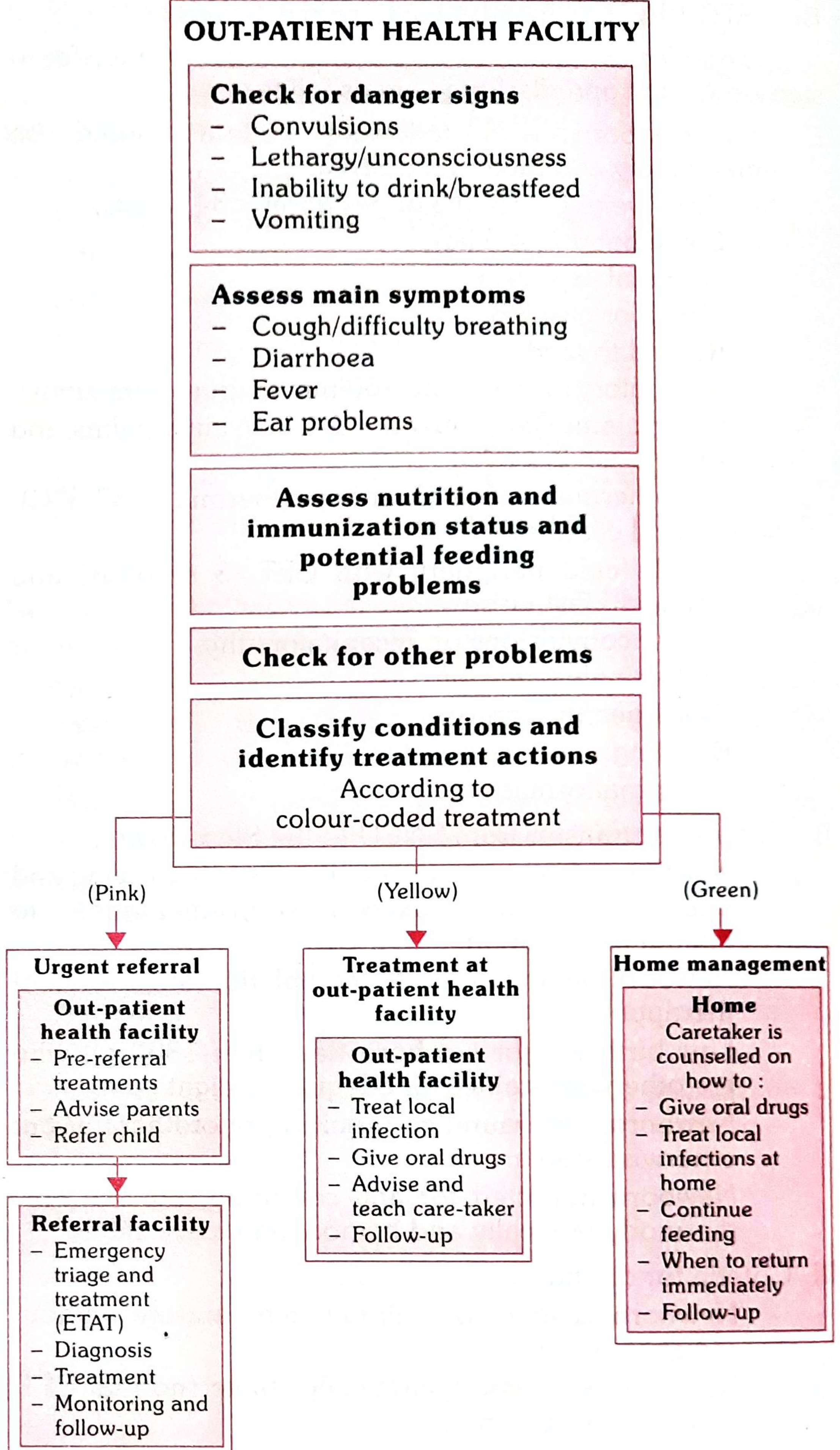
Step 1: Check for General Danger Signs
- Convulsions
- Lethargy/unconsciousness
- Inability to drink/breastfeed
- Vomiting everything
Step 2: Assess Main Symptoms
- Cough/difficulty breathing
- Diarrhoea
- Fever
- Ear problems
Step 3: Assess Nutrition, Immunization Status, and Feeding Problems
Step 4: Check for Other Problems
Step 5: Classify Conditions and Identify Treatment Actions (using colour-coded system)
Colour-Coded Classification System
| Colour | Category | Action |
|---|---|---|
| Pink | Severe / Urgent | Urgent referral to referral facility (ETAT, diagnosis, treatment, monitoring) |
| Yellow | Moderate | Treatment at outpatient health facility (oral drugs, treat local infection, advise, follow-up) |
| Green | Mild | Home management (caretaker counselled - oral drugs, local infection care, feeding, when to return) |
Implementation Levels
IMNCI is implemented at multiple levels:
- Household level - via community workers
- Sub-centre level - through ANMs
- PHC level - through medical officers, nurses, LHVs
Variants of IMNCI
1. Pre-service IMNCI
- Accepted by Government of India as a strategy to scale up IMNCI
- Being included in the curriculum of medical colleges across India
- Builds long-term trained manpower in public and private sectors
2. Facility-Based IMNCI (F-IMNCI)
- Integrates the facility-based care package with the community-level IMNCI package
- Empowers health personnel to manage newborn and childhood illness at both community and health facility levels
- Focuses on inpatient management of:
- Asphyxia, sepsis, low birth weight
- Pneumonia, diarrhoea, malaria, meningitis
- Severe malnutrition
- Master trainers = paediatricians from tertiary hospitals and medical colleges at state/district level
Limitations
- IMNCI guidelines do not cover trauma, accidents, or injuries
- HIV/AIDS is not specifically addressed (though diarrhoea and ARI in HIV-positive children are managed the same way)
- Children with chronic or uncommon illnesses may need special care beyond the algorithm
Relationship to Other Programmes
IMNCI is implemented alongside related initiatives under NRHM/RCH-II:
- NSSK (Navjat Shishu Suraksha Karyakram) - newborn care and resuscitation at birth
- RBSK (Rashtriya Bal Swasthya Karyakram) - child health screening for 4 Ds
- NRC (Nutrition Rehabilitation Centres) - severe acute malnutrition management
- SNCU/NBSU - facility-based sick newborn care
Source: Park's Textbook of Preventive and Social Medicine
This is a shared conversation. Sign in to Orris to start your own chat.