
Entomology of aedes mosquitoe
The Aedes mosquito is a genus of mosquitoes in the family Culicidae, known primarily as vectors of arboviruses like dengue, Zika, chikungunya, and yellow fever. Key species include Ae. aegypti and Ae. albopictus. They are holometabolous insects with four life stages: egg, larva, pupa, and adult.
Searching sources...
Reading File
Searching the Web
Aedes mosquito entomology biology taxonomy life cycle
Searching Images
Aedes aegypti mosquito life cycle larva pupa adult
Now let me search the medical library for textbook content on Aedes mosquito entomology:
Finding Sources
Searching Images
Aedes aegypti mosquito morphology identification
Finding Sources
Finding Sources
Good - I have strong library hits. Let me read the most detailed sections from Park's Textbook and other sources:
Reading File
Reading File
Finding Sources
Finding Sources
Reading File
Reading File
I now have comprehensive information from multiple sources. Let me compile the full detailed response on the entomology of Aedes mosquitoes.
Entomology of Aedes Mosquitoes
1. Taxonomy and Classification
Aedes belongs to the following classification:
| Rank | Taxon |
|---|---|
| Kingdom | Animalia |
| Phylum | Arthropoda |
| Class | Insecta |
| Order | Diptera |
| Family | Culicidae |
| Genus | Aedes Meigen, 1818 |
The genus contains over 950 species worldwide. The two most medically important species are:
- Aedes aegypti (Linnaeus, 1762) - the yellow fever mosquito
- Aedes albopictus (Skuse, 1894) - the Asian tiger mosquito
Ae. albopictus was first recorded in Texas (USA) in 1985 and spread throughout the southeastern United States by 1989, where it now coexists with Ae. aegypti as a secondary vector of dengue, Zika, and chikungunya. - Jawetz Melnick & Adelberg's Medical Microbiology 28e
2. Morphology (Adult)
General features:
- Small to medium-sized mosquitoes, dark brown to black in color
- Distinguished by white/silver lyre-shaped markings on the thorax (scutum) - a key identification feature of Ae. aegypti
- Legs have distinctive black-and-white banding (giving Ae. albopictus its "tiger mosquito" name)
- Body length: 4-7 mm
Head:
- Compound eyes and simple ocelli
- Proboscis - elongated, adapted for piercing skin and blood-feeding (females only)
- Antennae: 15-segmented; plumose (bushy) in males, pilose (sparse hairs) in females
- Palps: short in females (half length of proboscis); long in males (equal to proboscis length)
Thorax:
- Three segments fused (pro-, meso-, and metathorax)
- One pair of membranous wings (halteres represent reduced hindwings)
- Three pairs of legs with characteristic banding
Abdomen:
- 10 segments; segments 1-7 bear spiracles for breathing
- Terminal segments modified for reproduction
Sexual dimorphism:
- Males have feathery (plumose) antennae, live 1-2 weeks, feed only on plant nectar
- Females have sparse antennae, survive 2-4 weeks (longer under ideal conditions), and require blood meals for egg development
3. Life Cycle (Holometabolous - Complete Metamorphosis)
Aedes is holometabolous, passing through four distinct stages: Egg → Larva → Pupa → Adult.
Stage 1: Egg
- Female lays eggs singly (not in rafts, unlike Culex) on moist surfaces near the waterline - on the walls of containers, leaf axils, tree holes, or soil near water
- Eggs are black, elongated, and about 1 mm long
- Eggs are desiccation-resistant - a critical survival adaptation; they can remain viable for months to over a year in dry conditions
- Eggs require water submersion to hatch; some require multiple wetting cycles before hatching
- A female lays 100-200 eggs per batch and may lay several batches in her lifetime
- Ae. aegypti avoids oviposition in sites where her own eggs are already present (conspecific avoidance behavior)
- Ae. aegypti forms: domestic (urban, breeds in containers indoors/nearby), sylvan (rural, tree holes), peridomestic (coconut groves, farms) - IFAS/University of Florida
Stage 2: Larva (4 instars)
- Larvae are aquatic and develop through 4 instars (L1-L4)
- Characteristically hang upside-down at an angle from the water surface
- Breathe through a short, thick respiratory siphon (siphon tube) that pierces the water surface to access atmospheric oxygen - distinguishes Aedes from Anopheles (which lies horizontal)
- Filter feeders: consume algae, bacteria, protozoa, and organic debris
- Development from L1 to L4 takes approximately 7-14 days depending on temperature and food availability
- Optimal temperature range for larval development: 25-30°C
Stage 3: Pupa
- Comma-shaped, non-feeding stage
- Composed of a fused cephalothorax (head + thorax) and abdomen
- Breathes through a pair of breathing trumpets (respiratory trumpets) at the base of the cephalothorax
- Swims using paddle-like appendages (oars) at the tip of the abdomen
- Sexual dimorphism: female pupae have wider, overlapping paddles; male pupae have narrow, separated paddles
- Pupal stage lasts 1-4 days; adult emerges at the water surface via splitting of the pupal case
Stage 4: Adult
- Adults emerge at the water surface, rest briefly to harden their cuticle before taking flight
- Mating occurs within 2 days of emergence; males form swarms, copulate in flight
- Females require a blood meal to develop eggs (gonotrophic cycle)
- Biting behavior: diurnal feeders with peak activity at dawn and dusk (crepuscular); they will bite multiple hosts per meal (opportunistic)
- Adult lifespan: 2 weeks to 1 month, influenced by temperature and humidity
Total egg-to-adult development time: approximately 7-21 days under favorable conditions (25-28°C).
4. Breeding Habitats
Ae. aegypti is primarily a container breeder (synanthropic species), associated closely with human habitation:
| Artificial containers | Natural sites |
|---|---|
| Discarded tires | Tree holes |
| Flower pots and saucers | Leaf axils (e.g., bromeliads) |
| Clay pots, drums, tanks | Rock holes |
| Plastic containers, bottles | Bamboo stumps |
| Roof gutters | Animal footprints |
| Air coolers, cemetery urns | Coconut shells |
Ae. albopictus is more adaptable - breeds in both natural and artificial containers and tolerates cooler temperatures, enabling it to spread to temperate regions.
5. Feeding Behavior and Host Preference
- Only females blood-feed; males are entirely nectarivorous
- Ae. aegypti: highly anthropophilic (prefers human hosts), endophagic (bites indoors) and endophilic (rests indoors after feeding)
- Will feed on multiple hosts in one gonotrophic cycle if disturbed, increasing its vectorial capacity
- Feeding triggers: CO₂, body heat, skin odors (lactic acid, ammonia), and dark moving objects
6. Ecology and Environmental Factors
Population dynamics of Ae. aegypti are closely tied to: - Park's Textbook of Preventive and Social Medicine
- Rainfall: increases breeding sites; population peaks during and after rainy season
- Temperature: survives best at 16-30°C; even a 2°C rise shortens the extrinsic incubation period (EIP) of dengue virus (DENV), producing more infectious mosquitoes for longer periods and increasing bite frequency due to dehydration
- Humidity: optimal relative humidity 60-80%
- Urbanization: poor sanitation, water storage practices, and inadequate municipal services create ideal breeding grounds
- Flight range: typically 50-100 meters from breeding site (rarely >200 m)
7. Diseases Transmitted
| Disease | Pathogen | Primary vector |
|---|---|---|
| Dengue fever / DHF / DSS | DENV 1-4 (Flavivirus) | Ae. aegypti, Ae. albopictus |
| Zika fever | ZIKV (Flavivirus) | Ae. aegypti, Ae. albopictus |
| Chikungunya | CHIKV (Alphavirus) | Ae. aegypti, Ae. albopictus, Ae. africanus |
| Yellow fever | YFV (Flavivirus) | Ae. aegypti |
| Lymphatic filariasis | Wuchereria bancrofti | Ae. polynesiensis (Pacific) |
Ae. aegypti is described as "a mosquito that has evolved to live in proximity to humans and breeds well in manufactured throwaway containers." - Bradley & Daroff's Neurology in Clinical Practice
8. Vector Control Strategies
Control addresses all life stages: - Park's Textbook, Medical Microbiology 9e
Larval/Source control:
- Eliminate standing water (drain, empty, cover containers weekly)
- Larviciding with temephos (organophosphate) or Bacillus thuringiensis israelensis (Bti)
- Covering water storage containers
- Sand filters for large containers
Adult control:
- Targeted residual spraying (indoors)
- Space spraying / fogging with pyrethroid insecticides during outbreaks
- Insecticide-treated materials (limited utility due to daytime biting)
Biological control:
- Predatory fish (Gambusia, copepods) for larviciding
- Wolbachia-infected mosquitoes (reduces viral replication)
- Sterile insect technique (SIT)
Personal protection:
- DEET-based repellents, clothing covering limbs
- Window/door screens (endophagic behavior makes this effective)
- Bed nets have limited utility for Aedes due to its daytime biting habit
9. Key Distinguishing Features: Ae. aegypti vs Ae. albopictus
| Feature | Ae. aegypti | Ae. albopictus |
|---|---|---|
| Thorax marking | Lyre-shaped white scales | Single white dorsal stripe |
| Leg banding | Black-and-white | Black-and-white |
| Primary habitat | Urban, domestic | Suburban, peridomestic |
| Biting preference | Highly anthropophilic | Zoophilic + anthropophilic |
| Breeding sites | Indoor/outdoor containers | Wide variety (natural + artificial) |
| Geographic range | Tropical/subtropical | Tropical to temperate |
| Vectorial capacity | Higher for dengue | Secondary (but expanding) |
Sources:
- Park's Textbook of Preventive and Social Medicine (dengue section, chikungunya section)
- Britannica: Aedes
- OECD: Biology of Aedes aegypti
- UF/IFAS: Yellow Fever Mosquito fact sheet
- Bradley & Daroff's Neurology in Clinical Practice; Jawetz Melnick & Adelberg's Medical Microbiology 28e; Medical Microbiology 9e
Anopheles mosquitoe
Anopheles is the sole mosquito genus capable of transmitting human malaria, along with lymphatic filariasis and certain arboviruses. There are about 460 recognized species, of which roughly 30-40 are significant malaria vectors. They differ from Aedes and Culex in several key morphological and behavioral ways.
Searching sources...
Finding Sources
Finding Sources
Searching the Web
Anopheles mosquito entomology taxonomy morphology life cycle biology
Finding Sources
Finding Sources
Searching Images
Anopheles mosquito resting position lateral palps morphology
Reading File
Finding Sources
Finding Sources
Reading File
Finding Sources
I found the Plasmodium life cycle diagram. Let me also fetch the Park's textbook malaria section and that image:
Finding Sources
Loading Image
Excellent! I now have comprehensive information from textbooks, web sources, and the Plasmodium life cycle diagram. Let me compile the full, detailed response.
Entomology of Anopheles Mosquitoes
1. Taxonomy and Classification
| Rank | Taxon |
|---|---|
| Kingdom | Animalia |
| Phylum | Arthropoda |
| Class | Insecta |
| Order | Diptera |
| Family | Culicidae |
| Subfamily | Anophelinae |
| Genus | Anopheles Meigen, 1818 |
The subfamily Anophelinae contains three genera: Anopheles (worldwide), Bironella (Australasia), and Chagasia (Neotropics). Anopheles has approximately 460 recognized species, of which 30-40 are significant vectors of human malaria. Classification relies on morphology (wing spots, palp length, larval anatomy), chromosome structure, and increasingly on DNA sequences.
2. Medically Important Species
| Species | Primary region | Key notes |
|---|---|---|
| An. gambiae s.l. | Sub-Saharan Africa | Most efficient malaria vector globally; "gambiae complex" = 8 sibling species |
| An. arabiensis | Africa | Part of gambiae complex; more zoophilic |
| An. funestus | Africa | Major African vector; breeds in permanent, clear water |
| An. stephensi | South Asia, Middle East | Main vector in Indian cities and the Arabian Peninsula |
| An. culicifacies | Indian subcontinent | Major rural malaria vector in India |
| An. minimus | Southeast Asia | Important vector in forested areas |
| An. dirus | Southeast Asia | Forest malaria vector |
| An. darlingi | South America | Primary vector in Amazon basin |
| An. freeborni / An. quadrimaculatus | North America | Historically important; now controlled |
A. gambiae is described as the most important vector of malaria in sub-Saharan Africa. - Medical Microbiology 9e
3. Morphology
3.1 General Adult Features
Anopheles adults share features with other culicids but have several distinctive characteristics:
Key identifying features of Anopheles:
| Feature | Anopheles | Culex / Aedes |
|---|---|---|
| Palps (female) | Long - equal to proboscis length | Short (much shorter than proboscis) |
| Palps (male) | Long, with clubbed tip | Short or absent |
| Wing spots | Present (spotted/speckled appearance) | Absent (plain wings) |
| Scutellum | Evenly rounded (entire) | Trilobed |
| Resting position | Body held at 45° angle to surface (abdomen raised) | Body held parallel to surface |
Head:
- Compound eyes prominent
- Antennae: plumose in males (bushy), pilose in females
- Proboscis: long, adapted for piercing; palps equal in length to proboscis in both sexes - the single most useful adult identification character
Thorax:
- Mesonotum without lyre-shaped markings (unlike Ae. aegypti)
- Wings: long, narrow, covered with scales; spotted pattern due to alternating pale and dark scale patches (4 spots on An. quadrimaculatus)
Abdomen:
- No pale banding on abdomen (unlike many Aedes species)
Resting posture - arguably the most clinically recognizable field feature:
- Anopheles rests with its body tilted at ~45° to the surface, abdomen pointing upward away from the wall
- Culex and Aedes rest with body parallel to the surface
4. Life Cycle (Holometabolous - Complete Metamorphosis)
The four aquatic stages (egg + larva + pupa) last 5-14 days depending on species and temperature; total egg-to-adult: 10-14 days optimally.
Stage 1: Egg
- Laid singly and directly on the water surface (not on moist soil like Aedes)
- Uniquely equipped with lateral floats (air-filled structures) on either side - the diagnostic feature of Anopheles eggs
- Elongated, boat-shaped (~0.5 x 0.2 mm), dark brown to black
- NOT desiccation-resistant - eggs die if water dries up (key difference from Aedes)
- Hatch within 2-3 days (up to 2-3 weeks in cool climates)
- A female lays 50-200 eggs per oviposition bout
- Prefer ovipositing in clean, still water - pools, swamps, rice paddies, slow streams with vegetation
Stage 2: Larva (4 instars)
- Aquatic, passing through 4 instars (L1-L4)
- Most characteristic feature: larvae lie horizontal and parallel to the water surface (unlike Aedes and Culex which hang at an angle below the surface)
- Lack a respiratory siphon - they have a short, broad spiracular plate that lies flush with the water surface (contrasts with the long siphon tube of Culex)
- Filter feeders: use palmate hairs (paired fans at the mouth) to filter bacteria, algae, and detritus
- Larval stage lasts 7-14 days
- Palmate hairs on dorsal abdominal segments help maintain horizontal position
- Breathe through a short, paired posterior spiracles directly on the water surface
Stage 3: Pupa
- Comma-shaped, non-feeding stage, ~2-3 days
- Breathes through a pair of respiratory trumpets (dorsal thoracic siphons) - shorter and more triangular in Anopheles vs. cylindrical in Culex
- Mobile - uses paddle-like cerci for locomotion when disturbed
- Adult forms within the pupal case (pharate adult)
Stage 4: Adult
- Emerges at water surface via pupal case splitting
- Mating occurs within a few days post-emergence; males form swarms usually at dusk into which females fly to copulate
- Both males and females feed on plant nectar; only females blood-feed (required for egg development)
- Biting time: predominantly nocturnal - bite between dusk and dawn (important distinction from Aedes)
- Gonotrophic cycle: blood meal every 2-4 days; each meal supports production of 50-200 eggs
- Adult lifespan: 1-2 weeks in nature; up to 1 month in captivity
Females of most mosquito species take a blood meal every 2-4 days and may inject saliva during feeding, which produces mechanical damage, transmits disease, and triggers immune reactions in the host. - Medical Microbiology 9e
5. Anopheles as Malaria Vector: The Parasite-Mosquito Relationship
The Anopheles mosquito is the obligate biological vector of Plasmodium - no other genus can transmit human malaria.
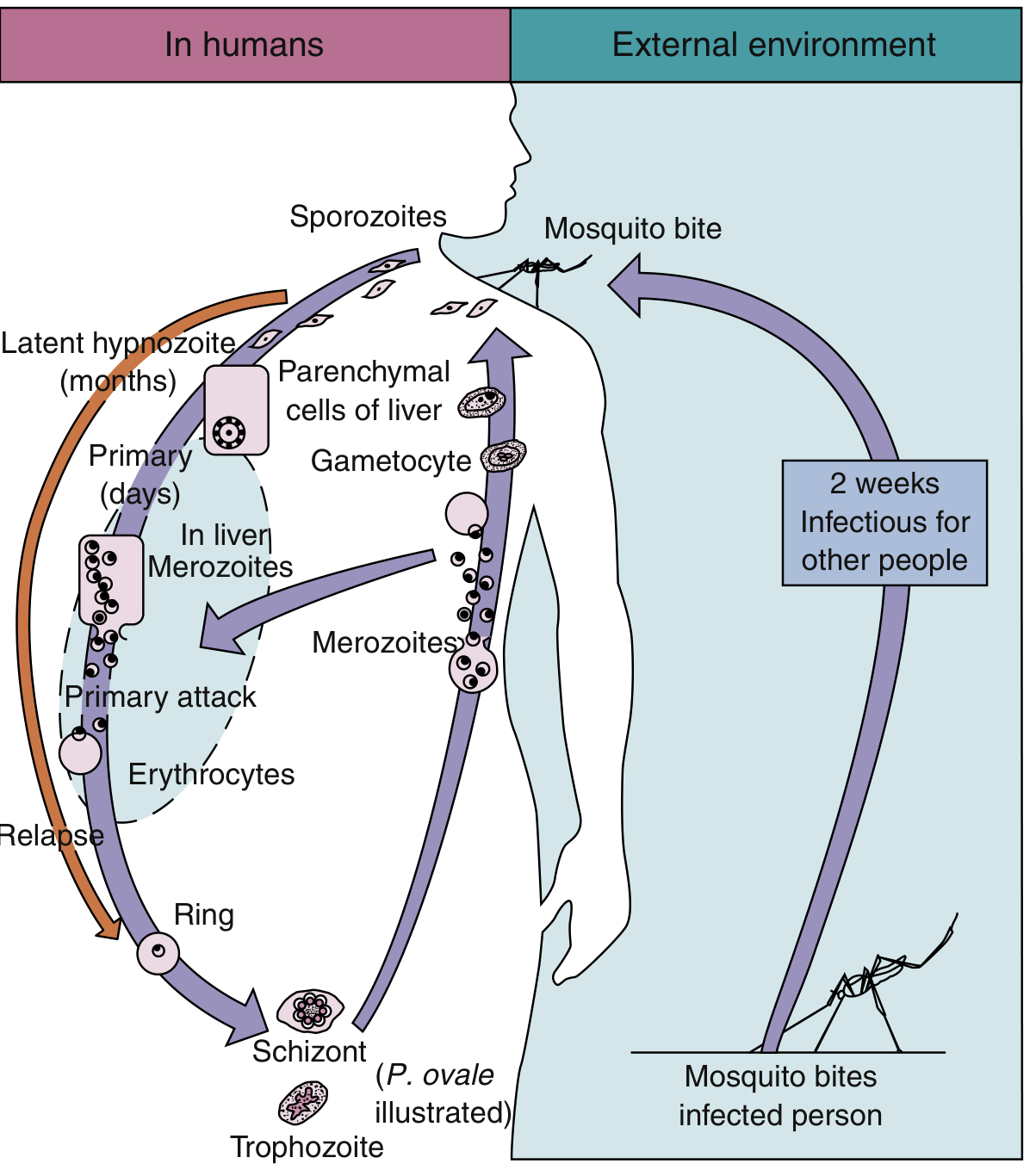
Sporogonic cycle within the mosquito (extrinsic incubation):
When an Anopheles female takes a blood meal from an infected human:
- Ingests gametocytes (sexual stage) with the blood meal
- In the mosquito midgut: male/female gametocytes undergo sexual reproduction - microgametes fertilize macrogametes → zygote → ookinete
- Ookinete penetrates the midgut wall → forms oocyst on the outer midgut surface
- Oocyst divides repeatedly → ruptures → releases sporozoites
- Sporozoites migrate to the salivary glands → injected into next human host during biting
- Extrinsic incubation period (EIP): approximately 10-14 days at 25-28°C; temperature-dependent
When an Anopheles mosquito bites an infected person, male and female gametocytes undergo sexual reproduction within the vector's gut and migrate as infective sporozoites to her salivary glands, ready to infect the next host. - Tintinalli's Emergency Medicine
6. Breeding Habitats
Anopheles mosquitoes are far more varied in habitat preference than Aedes, and species differ considerably:
| Habitat type | Representative species |
|---|---|
| Swamps, marshes, rice fields | An. gambiae, An. culicifacies |
| Slow, sunlit streams/seepages | An. fluviatilis |
| Brackish water (mangrove, coastal) | An. sundaicus, An. melas |
| Clean hill streams | An. minimus, An. dirus |
| Tree holes, leaf axils | Some forest species |
| Wells, cisterns (urban) | An. stephensi |
| Animal hoof prints, tire ruts | An. arabiensis |
General characteristics of Anopheles breeding sites:
- Prefer clean, still or slow-moving water
- Often associated with aquatic vegetation (provides shade, organic material)
- In the tropics, breed year-round in relation to rainfall
- Do not tolerate heavily polluted water (unlike Culex)
7. Behavioral Ecology
| Behavior | Anopheles | Notes |
|---|---|---|
| Feeding time | Nocturnal (dusk to dawn) | Key epidemiological point |
| Host preference | Variable by species; many zoophilic or anthropozoophilic | An. gambiae highly anthropophilic |
| Resting (endophily) | Many species rest indoors after feeding (endophilic) | Basis for indoor residual spraying (IRS) |
| Flight range | Typically 0.5-3 km; up to 10 km recorded | Larger than Aedes |
| Swarm behavior | Males swarm at dusk near landmarks | |
| Gonotrophic concordance | 1 blood meal per egg batch | Some species take multiple partial meals |
8. Comparison: Anopheles vs. Culex vs. Aedes
| Feature | Anopheles | Culex | Aedes |
|---|---|---|---|
| Palps (female) | Long (= proboscis) | Short | Short |
| Wing spots | Present | Absent | Absent |
| Resting angle | 45° (body raised) | Parallel | Parallel |
| Egg arrangement | Singly, with floats | In rafts | Singly, no floats |
| Egg desiccation resistance | None | None | Yes |
| Larval position | Horizontal (parallel to surface) | Hanging at angle | Hanging at angle |
| Larval siphon | None (short spiracular plate) | Long, narrow | Short, stout |
| Biting time | Nocturnal (dusk to dawn) | Nocturnal/crepuscular | Diurnal (dawn/dusk) |
| Breeding habitat | Clean, natural water bodies | Stagnant, polluted water | Containers (artificial/natural) |
| Diseases transmitted | Malaria, filariasis | Filariasis, West Nile, JE | Dengue, Zika, Chikungunya, YF |
9. Diseases Transmitted
| Disease | Pathogen | Vector species |
|---|---|---|
| Malaria | Plasmodium falciparum, vivax, malariae, ovale, knowlesi | ~30-40 Anopheles spp. |
| Lymphatic filariasis | Wuchereria bancrofti | An. gambiae, An. funestus (parts of Africa) |
| O'nyong-nyong fever | ONNV (Alphavirus) | An. gambiae, An. funestus |
Malaria transmission is uniquely dependent on Anopheles: natural infection occurs only through the bite of an infected female Anopheles mosquito (other routes - transfusion, congenital, shared needles - are rare). - Jawetz Melnick & Adelberg's Medical Microbiology 28e
10. Vector Control
Control of Anopheles targets the nocturnal, endophilic behavior of most vector species:
Indoor/personal measures:
- Long-lasting insecticidal nets (LLINs) - most impactful intervention globally; kills or repels mosquitoes biting at night
- Indoor residual spraying (IRS) - DDT (historically), pyrethroids, organophosphates, carbamates applied to walls where mosquitoes rest after feeding
- Protective clothing; DEET repellents
Environmental / larval control:
- Drainage of stagnant water, marshes
- Larviciding with temephos, Bti, Bacillus sphaericus
- Biological control: larvivorous fish (Gambusia affinis)
- Rice field management (intermittent irrigation)
Chemical / adult control:
- Space spraying during outbreaks
- Insecticide-treated cattle (for zoophilic species like An. arabiensis)
Novel approaches:
- Wolbachia endosymbiont delivery
- Gene drive (e.g., CRISPR-based population suppression targeting An. gambiae)
- Sterile insect technique (SIT)
- Chemoprophylaxis for travelers and high-risk groups
Controlling Anopheles vectors through larval source management, indoor residual spraying, and long-lasting insecticidal nets renders malaria transmission vulnerable to sustained suppression. - Goodman & Gilman's Pharmacological Basis of Therapeutics
Sources:
- Medical Microbiology 9e (Murray)
- Goodman & Gilman's Pharmacological Basis of Therapeutics
- Jawetz Melnick & Adelberg's Medical Microbiology 28e
- Tintinalli's Emergency Medicine
- CDC: Life Cycle of Anopheles Mosquitoes
- Wikipedia: Anopheles
- UF/IFAS: African Malaria Mosquito An. gambiae
- Global Vector Hub: Anopheles
Aedes biting time
Aedes mosquitoes are daytime biters - this is one of their most clinically important characteristics, distinguishing them sharply from Anopheles (nocturnal) and Culex (nocturnal/crepuscular).
Searching sources...
Finding Sources
Searching the Web
Aedes aegypti albopictus biting time activity hours daytime crepuscular
Finding Sources
Finding Sources
Finding Sources
I have all the key information. Here is the focused answer:
Aedes Biting Time
Core Answer
Aedes mosquitoes are diurnal (daytime) biters - this is their defining behavioral characteristic and the most important point for disease prevention and public health.
Biting Pattern: Bimodal Crepuscular Activity
Aedes does not bite uniformly throughout the day. It shows a classic bimodal activity pattern with two daily peaks:
| Peak | Time window | Intensity |
|---|---|---|
| Morning peak | 07:00 - 09:00 (early morning) | Primary, higher bite rate |
| Afternoon/Evening peak | 16:00 - 18:00 (late afternoon to early evening) | Secondary |
Research data confirms this precisely:
- Outdoors, Ae. aegypti peaks between 07:00-08:00 at 4.5 bites/person/hour, with a second peak at 17:00-18:00 at 3.75 bites/person/hour
- Ae. albopictus shows crepuscular peaks at 06:30-09:30 (dawn) and 18:30-20:30 (dusk) - PLoS ONE study
The word "crepuscular" precisely describes this - activity concentrated around the twilight hours of dawn and dusk.
Why Do They Avoid Midday?
During peak midday heat (11:00-15:00), Aedes mosquitoes:
- Rest in shaded, cool, humid areas - under furniture, in closets, behind curtains, in vegetation
- High temperatures cause dehydration and reduce flight activity
- Resume biting once temperatures drop in the late afternoon
Ae. aegypti vs Ae. albopictus - Biting Behavior
| Feature | Ae. aegypti | Ae. albopictus |
|---|---|---|
| Timing | Diurnal, peak dawn/dusk | Diurnal, peak dawn/dusk; occasionally nocturnal |
| Aggressiveness | Highly aggressive, multiple bites per meal | Very aggressive (earned "tiger mosquito" name) |
| Location | Prefers indoor biting (endophagic) | Primarily outdoor biter (exophagic) |
| Host preference | Highly anthropophilic | More opportunistic (humans + animals) |
| Activity range | Activity in all daylight hours if host present | Similar, but also feeds at night in some studies |
Clinical and Public Health Significance of Daytime Biting
This single behavioral trait has profound implications:
-
Bed nets are largely ineffective - "The use of insecticide-treated bed nets is limited by the fact that the Aedes mosquito bites during daytime." - Park's Textbook of Preventive and Social Medicine. This distinguishes dengue/Zika prevention strategies entirely from malaria (where LLINs are the cornerstone of control).
-
Biting coincides with peak human activity - morning (07:00-09:00) corresponds to when people are getting ready, commuting, and working outdoors - maximizing human-vector contact and disease transmission risk.
-
Prevention requires daytime precautions: repellents (DEET, picaridin), long-sleeved clothing during morning and evening hours, window/door screens.
-
Indoors is not safe - Ae. aegypti is endophagic (bites indoors) and endophilic (rests indoors), so staying at home does not protect against its bite.
Comparison with Other Mosquito Genera
| Genus | Primary biting time | Key diseases |
|---|---|---|
| Aedes | Daytime (dawn + dusk peaks) | Dengue, Zika, Chikungunya, Yellow fever |
| Anopheles | Nocturnal (dusk to dawn) | Malaria, filariasis |
| Culex | Nocturnal/crepuscular (after sunset) | West Nile virus, Japanese encephalitis, filariasis |
Bottom line: When it comes to dengue, Zika, and chikungunya prevention, protection must be maintained throughout the daylight hours, with extra vigilance at the two peak windows - early morning (7-9 AM) and late afternoon (4-6 PM).
Baro meter psm importance
The barometer is a meteorological instrument used to measure atmospheric pressure. In Preventive and Social Medicine (PSM/Community Medicine), it is studied under meteorology and climate as one of the key instruments for measuring weather parameters that influence human health and disease.
Searching sources...
Finding Sources
Finding Sources
Finding Sources
Finding Sources
Finding Sources
Finding Sources
Finding Sources
Searching the Web
barometer importance PSM preventive social medicine atmospheric pressure health significance
Finding Sources
Finding Sources
Finding Sources
The library doesn't have a dedicated barometer/meteorology section, but I have solid knowledge and web sources to give a thorough PSM-focused answer.
Barometer - Importance in PSM (Preventive & Social Medicine)
Definition
A barometer is a scientific instrument used to measure atmospheric (barometric) pressure - the force exerted by the weight of the overlying column of air on a unit surface area. It is studied in PSM under the topic of meteorology and its influence on health.
Standard sea-level atmospheric pressure = 760 mm of mercury (mmHg) = 29.92 inches Hg = 1013.25 millibars (hPa).
Types of Barometers
1. Mercury (Fortin's) Barometer
- Gold standard instrument
- A glass tube (~90 cm long) filled with mercury, inverted into a mercury trough
- The column of mercury rises or falls with changes in atmospheric pressure
- Reading expressed in mm of mercury (mmHg)
- Accurate but fragile, bulky, not portable; contains toxic mercury
2. Aneroid Barometer
- Contains a sealed, evacuated metallic capsule (bellows) that expands and contracts with pressure changes
- Movement transmitted via levers to a pointer on a calibrated dial
- Portable, durable, no mercury - preferred for field use
- Slightly less accurate than mercury barometer; requires periodic calibration against a mercury barometer
3. Barograph
- A recording aneroid barometer - automatically traces a continuous pressure record on a paper chart (kymograph drum)
- Produces a barogram - a graphical record of pressure over time
- Particularly useful for studying weather patterns and trends
4. Digital/Electronic Barometer
- Uses piezoelectric transducers or MEMS sensors
- Displays pressure digitally; can log data electronically
- Used in modern weather stations and smartphones
Importance of the Barometer in PSM
1. Weather Forecasting and Disease Prediction
Atmospheric pressure is a primary driver of weather patterns, which directly influence disease incidence:
| Pressure type | Weather | Health implications |
|---|---|---|
| High pressure (>760 mmHg) | Clear, calm, dry weather | Reduced infectious disease transmission; increased air pollution (temperature inversions trap pollutants) |
| Low pressure (<760 mmHg) | Clouds, rain, storms | Increased vector breeding (mosquitoes, snails); higher respiratory infections; flood-related diseases |
| Rapidly falling pressure | Approaching storms | Triggers physiological responses in susceptible individuals |
- Epidemics of cholera, malaria, diarrheal diseases often follow periods of heavy rainfall preceded by low pressure
- Barometric readings help predict flood events → contamination of water supplies → cholera, typhoid outbreaks
2. Effects of Atmospheric Pressure on Human Health
A. Physiological effects of pressure changes:
- Falling pressure → reduced partial pressure of oxygen → headache, fatigue, dizziness, difficulty breathing (especially in respiratory patients - asthma, COPD)
- Changes in pressure affect tissue fluid dynamics → trigger joint pain and swelling (arthritis, fibromyalgia exacerbations)
- Inner ear pressure equilibration → vertigo, Meniere's disease aggravation
- Cardiovascular effects: pressure drops linked to blood pressure changes, increased risk of myocardial infarction, stroke
- Migraine headaches classically triggered by barometric pressure drops
- Epileptic seizure frequency may increase with significant pressure fluctuations (PubMed, PMID: 40531343)
B. Altitude-related pressure disorders (studied in occupational/environmental health):
| Condition | Mechanism |
|---|---|
| Acute mountain sickness (AMS) | Low barometric pressure → hypoxia |
| High-altitude pulmonary edema (HAPE) | Severe hypoxic vasoconstriction |
| High-altitude cerebral edema (HACE) | Cerebral vasodilation + fluid shift |
| Decompression sickness ("the bends") | Rapid pressure decrease → nitrogen bubble formation |
| Barotrauma (ear, sinus) | Pressure gradient across body cavities |
C. High-pressure environments (occupational health - divers, tunnel workers, caisson workers):
- Caisson disease / decompression sickness - nitrogen dissolved under high pressure forms bubbles on rapid ascent
- Oxygen toxicity in hyperbaric environments
3. Vector Biology and Epidemic Forecasting
Atmospheric pressure, through its effect on weather, indirectly governs vector mosquito populations:
- Low pressure + rainfall → increased Anopheles, Aedes, Culex breeding sites
- Integrated with temperature and humidity readings from weather stations (barometer + thermometer + hygrometer) to predict malaria, dengue, and encephalitis outbreaks
4. Occupational Health
The barometer is essential for:
- Monitoring working conditions in underground mines, tunnels, underwater environments
- Establishing safe pressure limits for divers and compressed air workers
- Calculating ventilation requirements in occupational settings (air exchange depends on pressure)
5. Air Quality and Pollution Monitoring
- Temperature inversions (common under high pressure, calm conditions) trap pollutants near ground level
- Rising barometric pressure with no wind = risk of smog, industrial air pollution episodes
- PSM relevance: increased hospital admissions for asthma, bronchitis, cardiovascular events during temperature inversions
6. Part of the Meteorological Instruments Set in PSM
In PSM, meteorological instruments studied together include:
| Instrument | Measures |
|---|---|
| Barometer | Atmospheric pressure |
| Thermometer (Six's max-min) | Temperature |
| Hygrometer / Psychrometer | Relative humidity |
| Rain gauge | Rainfall/precipitation |
| Anemometer | Wind speed |
| Wind vane | Wind direction |
| Sunshine recorder | Duration of sunshine |
The barometer is central to this set because pressure ties all other weather parameters together.
Summary: Key PSM Points about the Barometer
| Point | Detail |
|---|---|
| What it measures | Atmospheric pressure |
| Standard value | 760 mmHg at sea level |
| Types | Mercury (Fortin's), Aneroid, Barograph, Digital |
| Weather significance | High pressure = fair weather; Low pressure = rain/storms |
| Disease link | Low pressure → vector breeding, floods, diarrheal diseases, respiratory symptoms |
| Altitude diseases | AMS, HAPE, HACE from low barometric pressure |
| Occupational link | Decompression sickness from pressure extremes |
| Cardiovascular | Pressure drops → MI, stroke, migraine, arthritis flares |
| Air pollution | High pressure inversions trap pollutants |
The barometer is not just a weather instrument - in PSM it represents the link between the physical environment and human disease, reinforcing the core concept that the environment is a fundamental determinant of health.
This is a shared conversation. Sign in to Orris to start your own chat.