
Anatomy of lung
Reading File
Now let me search the medical library for lung anatomy content and images in parallel.
Finding Sources
Finding Sources
Searching Images
lung anatomy lobes bronchi diagram
Finding Sources
Loading Image
Loading Image
Reading File
Finding Sources
Searching Images
lung hilum pulmonary vessels pleura anatomy
Reading File
Finding Sources
Reading File
Reading File
Reading File
Loading Image
Loading Image
Reading File
I now have excellent content and images from Murray & Nadel's Respiratory Medicine and Gray's Anatomy for Students. Let me compile a comprehensive answer.
Anatomy of the Lung
Overview
The lungs are paired respiratory organs that occupy the thoracic cavity on either side of the mediastinum. In life, the human lungs weigh 900–1000 g (nearly 40–50% of which is blood). At end-expiration, gas volume is ~2.5 L; at maximal inspiration it may reach 6 L. The lung has two essential interdependent functions: ventilation-perfusion matching (O₂ delivery and CO₂ removal) and host defense against inhaled pathogens, chemicals, and particulates. — Murray & Nadel's Textbook of Respiratory Medicine
Gross Anatomy
External Features
Each lung has:
- An apex projecting into the root of the neck (~2.5 cm above the medial third of the clavicle)
- A base resting on the diaphragm (concave)
- Costal surface (convex, related to ribs)
- Mediastinal (medial) surface containing the hilum
- Anterior, posterior, and inferior borders
The cardiac notch is a prominent concavity on the left lung's anterior border, where the heart impresses the lung. The left lung also has the lingula — a tongue-like projection of the superior lobe that mirrors the right middle lobe.
Lobes and Fissures

| Feature | Right Lung | Left Lung |
|---|---|---|
| Lobes | 3 (superior, middle, inferior) | 2 (superior, inferior) |
| Fissures | Oblique (major) + Horizontal (minor) | Oblique (major) only |
| Special region | Middle lobe | Lingula (part of superior lobe) |
- The oblique (major) fissure is present in both lungs; it separates the inferior lobe from the superior (and middle on the right).
- The horizontal (minor) fissure (right lung only) separates the superior from the middle lobe.
The Bronchial Tree
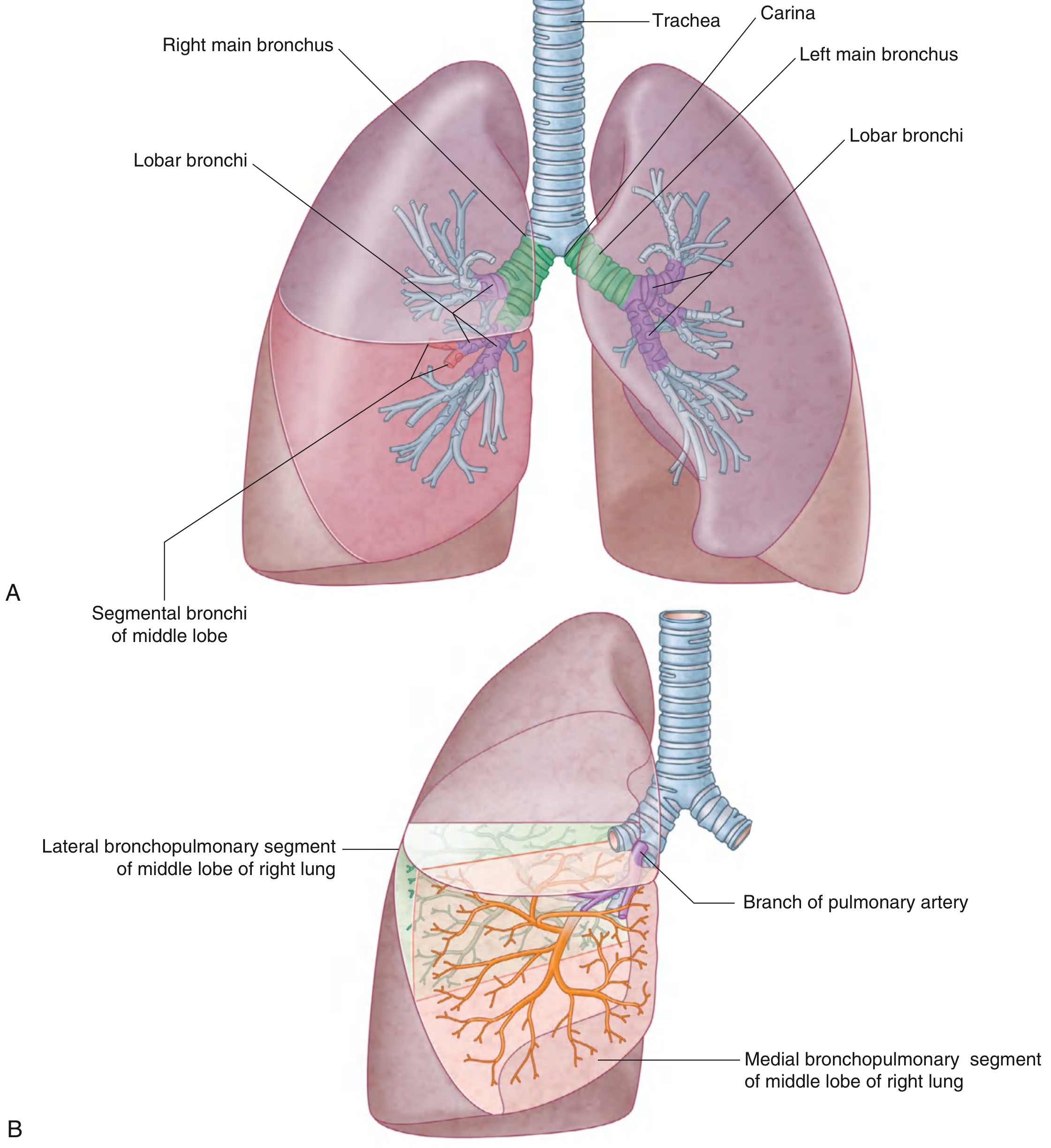
The trachea divides at the carina (vertebral level T4/T5) into the two main bronchi.
Main Bronchi
- Right main bronchus: wider, shorter (~2.5 cm), more vertical — foreign bodies preferentially enter here
- Left main bronchus: narrower, longer (~5 cm), more horizontal, passes inferior to the aortic arch
Lobar Bronchi
- Right: 3 lobar bronchi (superior, middle, inferior)
- Left: 2 lobar bronchi (superior, inferior)
- Right superior lobar bronchus arises 1–2.5 cm from the carina; middle and inferior arise ~5 cm from it
- On the left, division into superior and inferior lobar bronchi also occurs ~5 cm from the carina
Segmental Bronchi → Bronchopulmonary Segments
- Right lung: 10 segmental bronchi → 10 bronchopulmonary segments
- Left lung: 9 segmental bronchi (segments 1 & 2 fuse as the apicoposterior segment)
Each bronchopulmonary segment is:
- An irregular cone, apex toward the hilum, base at the lung surface
- Supplied by one segmental bronchus and an accompanying pulmonary artery branch (bronchoarterial unit)
- The smallest functionally independent unit of the lung — can be surgically resected without damaging adjacent segments
- Pulmonary veins run intersegmentally, demarcating segment boundaries
— Gray's Anatomy for Students; Color Atlas of Human Anatomy Vol. 2
Bronchopulmonary Segments — Detailed Map
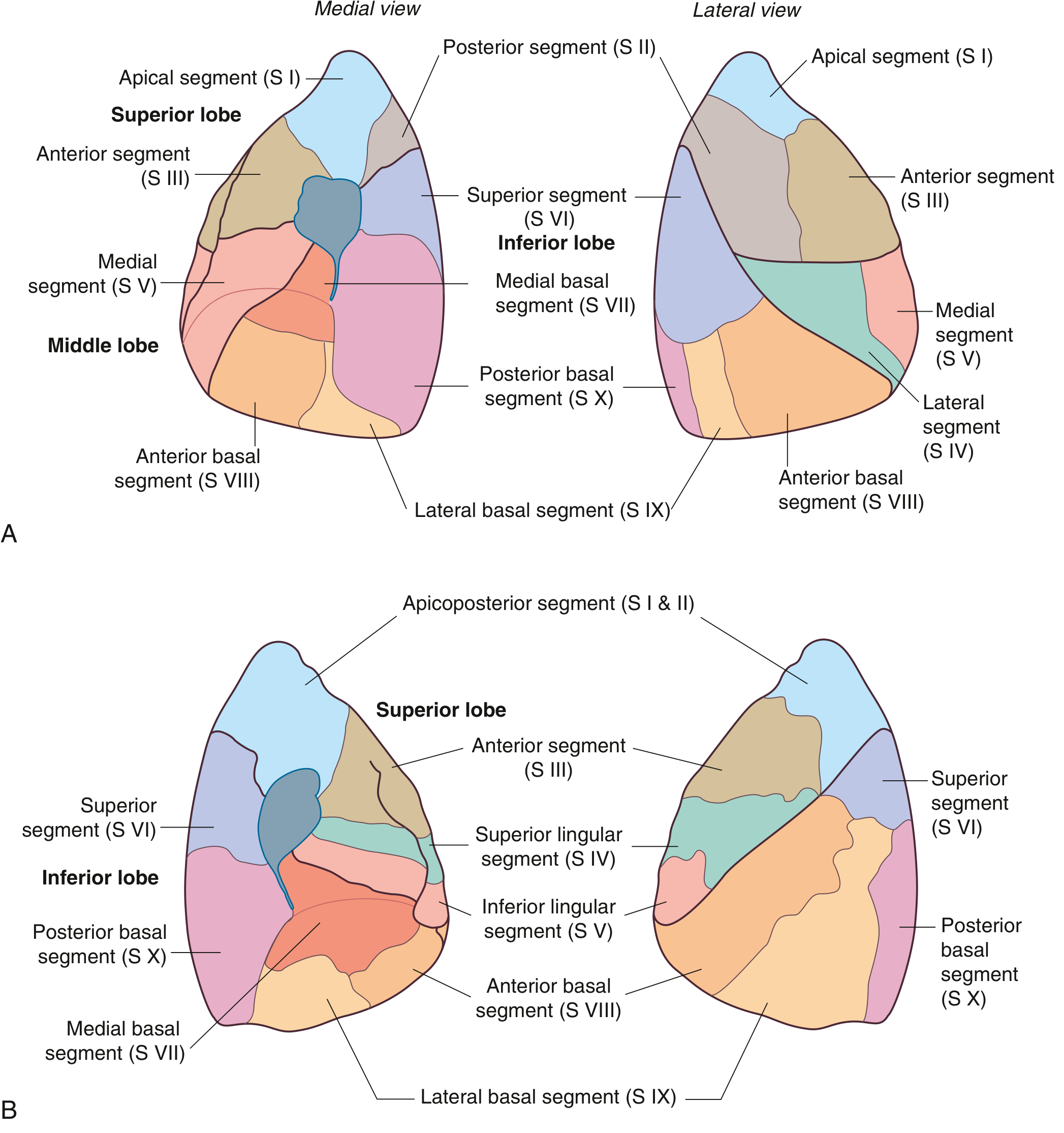
Right Lung (10 segments)
| Lobe | Segments |
|---|---|
| Superior | S I Apical, S II Posterior, S III Anterior |
| Middle | S IV Lateral, S V Medial |
| Inferior | S VI Superior, S VII Medial basal, S VIII Anterior basal, S IX Lateral basal, S X Posterior basal |
Left Lung (9 segments)
| Lobe | Segments |
|---|---|
| Superior | S I+II Apicoposterior, S III Anterior, S IV Superior lingular, S V Inferior lingular |
| Inferior | S VI Superior, S VII Medial basal, S VIII Anterior basal, S IX Lateral basal, S X Posterior basal |
Lung Lobules
Below segments, the bronchial tree subdivides into:
- Bronchioles (no cartilage) → supply pulmonary lobules
- Lobules are polygonal, 0.5–3 cm on each side, bounded by connective tissue septa (which appear blue-black from inhaled carbon)
- Each bronchiole divides 3–4 times → terminal bronchioles → respiratory bronchioles → alveolar ducts → alveoli
The Hilum
The hilum is the gateway on the mediastinal surface through which structures enter/leave the lung. Contents include:
- Main bronchus
- Pulmonary artery (1 per lung)
- Pulmonary veins (2 per lung — superior and inferior)
- Bronchial arteries and veins
- Lymphatics
- Autonomic nerve plexus
Arrangement at the Hilum (from anterior to posterior, right side):
Veins → Artery → Bronchus (VAB)
- Left: pulmonary artery is most superior; bronchus is posterior
Pulmonary Vasculature
Pulmonary Arteries (Low-pressure, deoxygenated blood)
- Arise from the pulmonary trunk, bifurcates at TIV/V
- Right pulmonary artery: longer, passes horizontally across mediastinum anterior to tracheal bifurcation, posterior to ascending aorta and SVC
- Left pulmonary artery: shorter, curves over the left main bronchus, connected to aortic arch by the ligamentum arteriosum
- Branches follow the bronchial tree (intrasegmental)
Pulmonary Veins (Oxygenated blood → left atrium)
- 4 pulmonary veins (2 right, 2 left) drain into the left atrium
- Run intersegmentally — do not follow bronchi
- Drain into superior and inferior pulmonary veins on each side
Bronchial Circulation
- Bronchial arteries (from the thoracic aorta): supply oxygenated blood to the bronchial tree walls, supporting tissue down to the respiratory bronchioles
- Bronchial veins: drain partly into the azygos/hemiazygos system and partly into the pulmonary veins
Lymphatics
- Superficial (subpleural) plexus: drains the periphery; flows toward the hilum
- Deep (peribronchial) plexus: follows the airways and vessels; drains toward hilar lymph nodes
- Right lung and left lower lobe → right bronchomediastinal trunk
- Left upper lobe → left bronchomediastinal trunk
Pleura
- Visceral pleura: intimately covers the lung surface (cannot be separated from lung parenchyma)
- Parietal pleura: lines the chest wall, diaphragm, and mediastinum
- Pleural cavity: potential space containing only a few micrometers of serous fluid; creates negative pressure that keeps the lung expanded
- Costophrenic recess: the lowest part of the pleural cavity, between the costal and diaphragmatic pleura — site of fluid accumulation
Innervation
- Parasympathetic: vagus nerve (CN X) → bronchoconstriction, increased mucus secretion, vasodilation
- Sympathetic: T2–T5 → bronchodilation, vasoconstriction
- Visceral afferents: carried with both sympathetic and vagal fibers; cough reflex via vagus
- Pulmonary plexus surrounds the hilum and sends branches along bronchi and vessels
Microstructure of the Airways
Bronchial Wall Layers (from lumen outward):
- Mucosa: pseudostratified columnar ciliated epithelium with goblet cells
- Lamina propria: loose CT with lymphoid tissue
- Smooth muscle (spiral bands)
- Submucosa: seromucous glands
- Cartilaginous plates (present in bronchi; absent in bronchioles)
- Adventitia
Key Epithelial Cells:
| Cell Type | Function |
|---|---|
| Ciliated cells | Mucociliary clearance (~200 cilia/cell, beating 8–15 Hz) |
| Goblet cells | Mucus secretion |
| Basal cells | Progenitor cells — regenerate all epithelial types |
| Club (Clara) cells | Secretion of surfactant-like proteins; detoxification |
| Neuroendocrine cells | Paracrine signaling |
| Ionocytes | Ion transport |
The Alveoli (Gas Exchange Unit)
- Total ~300–500 million alveoli per lung
- Total surface area for gas exchange: ~70–140 m²
- Alveolar wall (blood-air barrier) is extremely thin to facilitate O₂/CO₂ diffusion
- Type I pneumocytes (~95% of alveolar surface): thin, flat; gas exchange
- Type II pneumocytes (~5% of surface but 60% of cells): produce surfactant (reduces surface tension); serve as progenitors for Type I cells
- Alveolar macrophages: first-line defense; phagocytose inhaled particles
Connective Tissue Framework
Two systems of connective tissue:
- Peribronchial/periarterial CT: surrounds bronchial tree and pulmonary artery branches → allows movement against surrounding gas-exchanging tissue; forms the peribronchovascular connective tissue space (important in pulmonary edema)
- Subpleural CT: lines lobe surfaces; forms interlobular septa and intersegmental boundaries; acts as sliding layer and prevents overexpansion
The "elastic continuum" of the lung — interwoven collagen and elastin fibers — maintains the structural integrity of alveolar walls and determines lung recoil.
Sources:
- Murray & Nadel's Textbook of Respiratory Medicine (Chapter 1: Anatomy)
- Gray's Anatomy for Students (Chapter 3: Thorax)
- Color Atlas of Human Anatomy, Vol. 2: Internal Organs
This is a shared conversation. Sign in to Orris to start your own chat.